Image source: wikiart.org
Introduction to Rembrandt’s “Portrait of a Man” (1647)
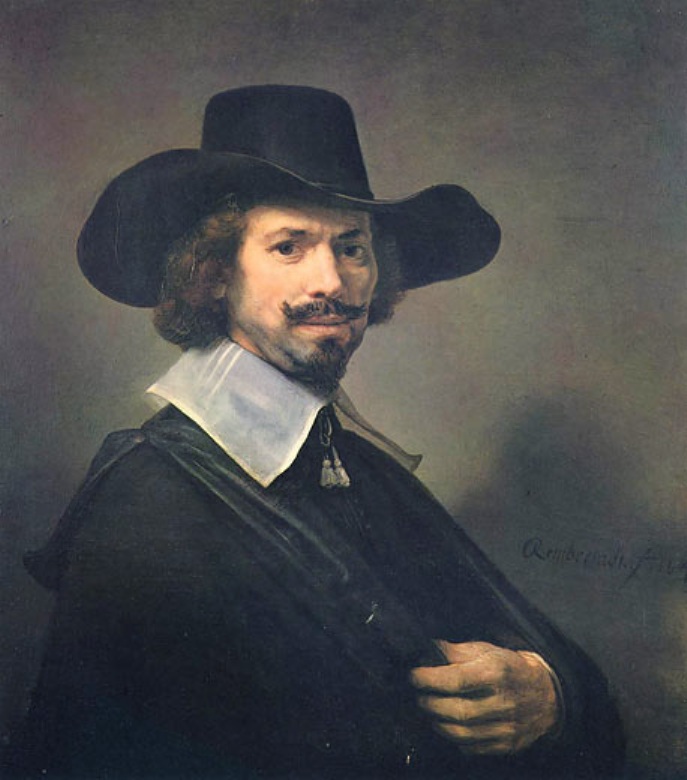
Rembrandt’s “Portrait of a Man” from 1647 is a concentrated demonstration of how presence can be built from light, fabric, and a single, decisive gesture. The sitter turns three-quarters toward us, head slightly cocked beneath a broad-brimmed hat, a crisp, double-pointed collar flashing against the depth of a dark mantle. His right hand rises to the breast in a motion caught between arranging the cloak and acknowledging the viewer. The background is a breath of gray-brown air, neither room nor landscape, a neutral climate that allows the face and hand to carry the drama. In this compact stage, Rembrandt composes an image of self-possession: a citizen of the Dutch Republic whose calm intelligence and cultivated poise read clearly before a word is spoken.
Composition That Harnesses Movement and Stillness
The design is governed by a triangle that begins at the hat’s crown, descends through the bright collar, and resolves at the illuminated hand. This triangular map stabilizes the turning torso and the forward glance. Countering it are supple curves: the sweeping brim, the slanting collar tips, the velvet strap that arcs across the chest. These lines keep the portrait from stiffness, allowing the sitter to feel ready to move or speak. Rembrandt situates the head slightly left of center and the hand slightly right, so eye and hand balance each other across the vertical axis. The effect is conversational; the viewer’s gaze travels between thought and action, the two coordinates by which the sitter defines himself.
Light As the Architecture of Character
Chiaroscuro is not spectacle here; it is a structure for meaning. A quiet light falls from the upper left, peeling the face from shadow, catching the beard and mustache, and riding the gleam along the collar’s edges. The hat’s underside darkens the forehead just enough to keep the gaze focused and to prevent theatrical glare. The cloak yields only a few highlights along folds and strap, maintaining its role as a dignified mass. This distribution of brightness makes an argument about priorities: clarity where recognition and expression live, modesty where status might be flaunted. The eye is thus trained to receive the sitter as person before costume.
The Face: Intelligence Tempered by Poise
Rembrandt renders the face with a blend of exactitude and restraint. The left eye—closer to the light—sparkles with a small, controlled highlight; the right, below the shadow of the brim, is quieter yet alert. The eyebrows arch with a confident symmetry; the mustache and small pointed beard are groomed without fussy finish, giving the mouth a tempered firmness. There is a hint of a smile only in the mobile corners of the lips and in the slight flex at the cheek, more hospitality than humor. The skin is modeled with buttery, palpable paint laid in planes that turn with anatomy, so that the sitter feels present rather than idealized. He looks not like a type but a specific mind in a specific body.
Hat, Collar, and Cloak: A Vocabulary of Status and Restraint
The hat is a theater in itself: broad enough to assert authority, simple enough to avoid ostentation. It casts a deliberate canopy over the face, organizing space and thought. The collar is a crisp, starched architecture of whiteness, its points cutting into the neutral air like quotation marks around the head. It announces cleanliness, self-command, and the economic means to maintain both without boasting. The cloak, a deep, absorbent black with a satiny strap diagonaling the chest, does the quiet work of framing the figure and providing the soft darkness from which light can be born. Together these elements compose a language of status that speaks softly.
The Gesture of the Hand and the Ethics of Address
The right hand, advancing gently into light, is one of those Rembrandt passages where gesture becomes biography. The fingers are gathered, the thumb tucked, the pressure minimal—neither oath-taking nor theatrical flourish. It is the action of a person momentarily adjusting clothing while turning to greet someone who has just entered. The gesture welcomes without conceding, opens without pleading. In many Rembrandt portraits, hands act as second faces; here the hand confirms the face’s message: self-aware, composed, ready to engage. The ring is subdued; it adds a glint of social weight without stealing attention from the anatomy of the pose.
The Background as Breathing Space
Rather than locate the sitter in a literal interior, Rembrandt offers an atmospheric field, a carefully modulated gray-brown that reads as air. Subtle temperature shifts—cooler at the top, warmer near the figure—create a sense of depth without describing walls. This choice lifts the portrait out of time and place, focusing the encounter on the individual and the present tense of looking. The background is not emptiness; it is a cushion of space that respects the sitter’s privacy and the viewer’s attention.
Brushwork and the Pleasure of Material Truth
The surface is alive with decisions. Skin is built from supple impasto that catches micro-highlights at the brow and cheek; the beard and mustache are abbreviated with flicks of darker paint and tiny touches of warm light; the collar is a fabric of swift, lifted strokes that preserve the starch and crispness of linen; the hat is a deep field of matt blacks on which only the slightest sheen along the crown is allowed. The cloak is painted with broader, more opaque sweeps that subdue incident and insist on mass. Each material receives its own touch, and this variety of handling does more than entertain the eye—it persuades the mind of the scene’s truth.
Psychology Without Theatre
Nothing in the portrait begs. The sitter does not project drama; he holds us with the steadiness of a person who knows himself and expects to be met honestly. The slight lift in the eyebrows and the forward set of the head read as attentiveness—an engagement begun rather than a performance concluded. Rembrandt refuses the temptation to dramatize by means of exaggerated expression; he trusts anatomy and light to state what is needed. This restraint produces an intimacy that feels contemporary: we are not told what to feel; we are given a credible human presence and the time to feel our way into it.
The Dutch Citizen Ideal and the Politics of Self-Presentation
Mid-seventeenth-century Amsterdam prized images of civic virtue: industry, sobriety, competence, and the elegant restraint that prosperity permits. “Portrait of a Man” embodies this ideal without turning into propaganda. The sober palette, the fine but unostentatious clothing, the composure of face and hand—these are the signs of a person comfortable in the social fabric of the Republic. Yet Rembrandt, allergic to cliché, adjusts the ideal with individuality: the slightly rakish tilt of the hat, the lively mustache, the quickness in the eyes, the gesture caught mid-action. The portrait records a type and a person at once.
The Signature and the Pact with the Viewer
Rembrandt’s signature sits to the right in the field of air, small and sure, an unobtrusive witness to the exchange between sitter and viewer. It functions like a notary’s mark: a guarantee that the encounter has been honestly recorded. The subdued placement keeps the focus where it belongs—on the human triad of face, collar, and hand—while acknowledging the artist’s role not as showman but as broker of presence.
Comparisons That Clarify: Kinship with Other Mid-1640s Portraits
Placed alongside the portraits of physicians and scholars Rembrandt painted and etched in the mid-1640s, this panel’s language becomes clearer. Where “Ephraim Bonus” or “Dr. Ephraim Bueno” emphasize listening and inwardness, “Portrait of a Man” leans slightly toward assertion. The sitter advances into our space with the hand’s motion and the hat’s boldly horizontal brim. Yet the overall ethic is shared: dignity without bluster, material truth without decorative noise, light used to articulate character rather than to stage spectacle.
The Palette’s Moral Temperature
Color here is as much moral temperature as optical choice. The near-monochrome of blacks, warm grays, umbers, and the clean whites of linen keeps the mood sober. Small sparks—the pinkish warmth at the inner lip, the flesh tones at the knuckles, the gentle sheen on the hatband—create interest without compromise. The harmony supports the sitter’s narrative: a person of order and measure who nonetheless carries energy and wit. Rembrandt’s limited palette becomes an ethical palette, insisting that clarity and restraint are compatible with vitality.
Light as Time: The Instant Between Motions
The portrait holds a moment between motions. The sitter has just turned; the hand has just risen; the mouth is about to speak. Light catches this transition and keeps it. You sense the before—a step forward, a slight adjustment of the cloak—and the after—a greeting, a sentence. Such timing gives the picture life. It also grants the viewer a role: we are the ones being greeted. The image is not a display for a crowd; it is an address to a person standing close.
The Human Scale of Grandeur
Though the painting is not large, it feels ample. Rembrandt achieves this amplitude by eliminating distraction, enlarging essentials, and giving the hat and collar the breadth of architectural elements. The sitter fills the space not by dominating it but by being perfectly at ease within it. Grandeur here is human scale: a well-made hat, a well-set collar, a hand that means what it does, a face that tells the truth about its owner.
Why the Portrait Still Feels New
The image remains fresh because it offers a way of looking that respects both subject and viewer. It is frank without being blunt, elegant without ornament, psychological without trickery. In a world saturated with performed identities, the portrait proposes a different mode: presence secured by attention to small facts—edge of brim, pressure in fingertips, angle of eye—and organized by light that understands what matters. It does not attempt to narrate the sitter’s life; it gives the conditions under which a life could be honestly met.
Conclusion: The Art of Being Present
“Portrait of a Man” shows Rembrandt at the height of his ability to make paint think. A wide hat and bright collar frame a face alive with poise; a hand lifts in a gesture that makes room for conversation; a neutral background breathes. Nothing is loud, yet everything is eloquent. The result is not a display of costume or a parade of technique, but a meeting: you and a thoughtful man, paused at the threshold of speech, set in a light that knows how to honor character.