Image source: wikiart.org
Introduction
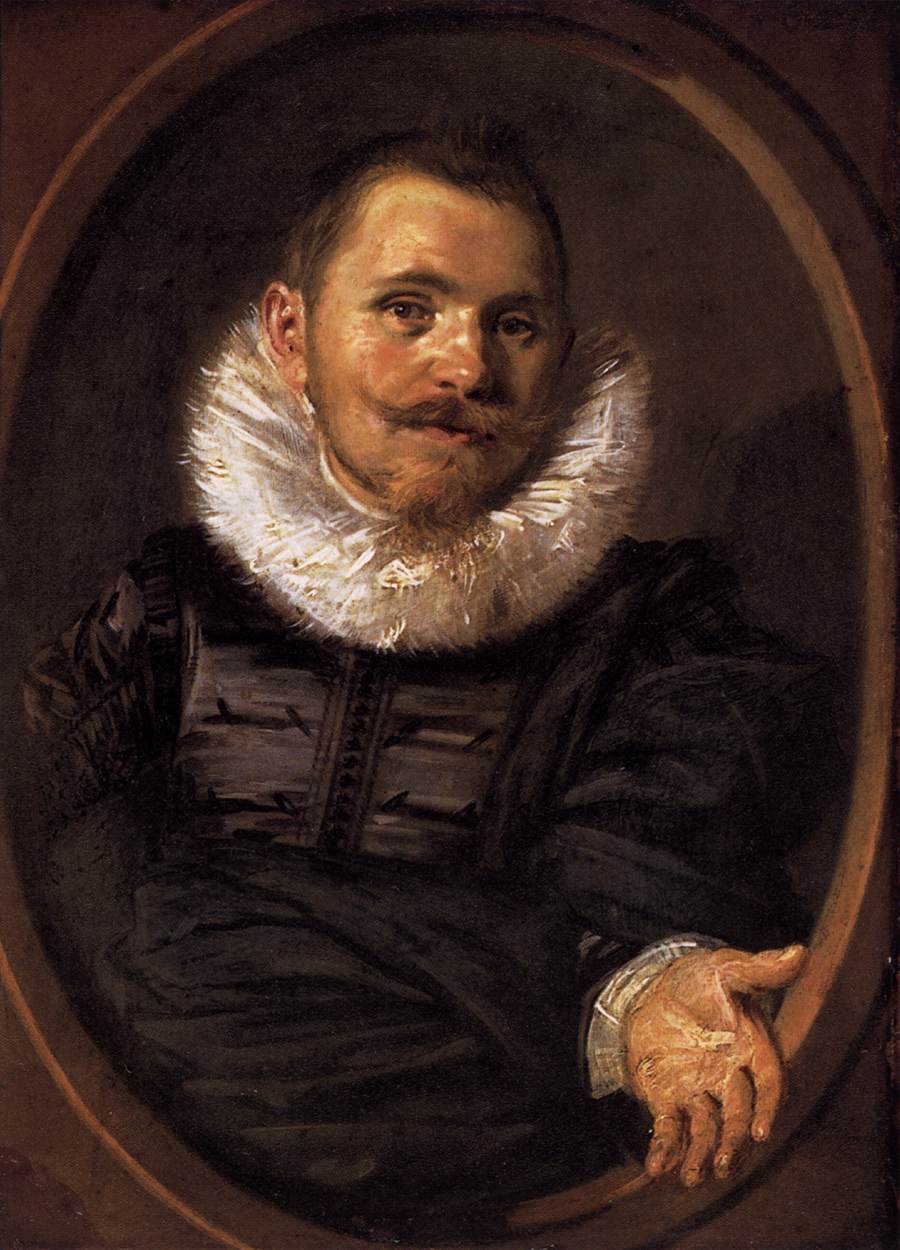
Frans Hals’s Portrait of a Man (1627) feels like a private joke shared across time. The sitter is framed within an oval, leaning forward with arms crossed and one hand extended beyond the implied boundary of the portrait, as if he is about to tap the frame or greet someone just outside it. His expression is open but not naive, friendly but not fully yielding. The small lift at the corner of his mouth and the directness of his gaze suggest a man who enjoys being seen and knows how to control what is revealed. Hals turns a conventional portrait into an event, a staged meeting that feels spontaneous, and that balance between artifice and immediacy is exactly why the painting remains so compelling.
The composition is built around a teasing contradiction. The oval format implies containment, a controlled image held within a boundary. Yet the sitter’s pose challenges that boundary. His hand seems to come forward into our space, and his gaze makes the encounter feel personal. This tension creates a sense of play. The painting is not only a record of likeness and status. It is an experiment in presence, a demonstration of how painted illusion can behave like social interaction.
Frans Hals in 1627: Portraiture as Performance
By 1627, Hals was at the height of his ability to capture personality with astonishing economy. He understood that portraiture in the Dutch Republic was not just about accurate features. It was about the construction of public identity. A sitter commissioned a portrait to project credibility, success, and character, and Hals excelled at making those projections feel vivid and believable. He did this by giving his sitters the impression of life in motion, as if the painting contains not a frozen pose but a moment of behavior.
This particular portrait shows Hals pushing that approach further through compositional invention. The oval frame and the sitter’s forward reach create a deliberate illusionistic effect that resembles a visual conversation. Rather than presenting the sitter as a distant figure to be admired, Hals makes him an active participant in the viewer’s space. The portrait becomes social theater, and the sitter appears perfectly at ease within that theater, which is itself a statement of status and confidence.
The Oval Format and the Illusion of Space
The most immediately striking feature is the oval boundary that surrounds the sitter. Ovals were often used to suggest elegance and refinement, but here the oval does something more dynamic. It functions like a window or opening, turning the portrait into a scene viewed through a shaped aperture. The sitter’s body is pressed close to this opening, reinforcing the sensation that he is right there, occupying the threshold.
This format heightens the painting’s intimacy. A rectangular frame can feel like a stable stage. An oval can feel like a lens, focusing attention and compressing space. Hals uses that compression to intensify presence. The sitter seems to lean into the oval as if leaning into conversation. The curved line also echoes the curve of the ruff around his neck, creating a visual rhythm that pulls the viewer inward.
At the same time, the oval sets up a boundary that the sitter then playfully tests. That boundary becomes meaningful only because Hals makes us aware of it. The painting invites the viewer to notice the frame and then notice how the sitter behaves against it.
Pose: Crossed Arms and the Extended Hand
The sitter’s arms are crossed, a gesture that can signal composure, self-confidence, or even guardedness. In many portraits, crossed arms close the body off. Here, Hals complicates that reading by extending one hand outward. The crossed arms create a stable, compact mass of dark fabric, while the hand introduces openness and contact. The sitter appears simultaneously self-contained and socially engaged.
The extended hand is a bold choice. It introduces foreshortening, bringing the viewer into close proximity with the sitter’s body. The palm faces upward in a relaxed, inviting way, as if offering a handshake, requesting something, or making a point mid-sentence. This gesture is ambiguous in exactly the right way. It does not lock the sitter into a single narrative. Instead, it suggests the sitter’s temperament: communicative, confident, perhaps lightly amused by the viewer’s attention.
The illusion that the hand breaks the portrait’s boundary also demonstrates Hals’s interest in tricking the eye. It is a sophisticated form of play, and it flatters both painter and sitter. The painter shows skill. The sitter shows charm and command of space.
Expression and Gaze: A Meeting Rather Than a Stare
The sitter looks directly out, and that directness is one of the portrait’s strongest psychological devices. Yet the gaze does not feel confrontational. The eyes are steady but soft, with a slight sparkle that suggests friendliness or wit. The mouth is relaxed, with a faint hint of a smile. Hals captures a face that feels responsive rather than fixed, as if the sitter might change expression depending on what is said next.
The moustache and small beard frame the mouth and reinforce the impression of cultivated style. These facial hair choices were fashionable and also helped structure the face, giving the sitter a refined masculinity that aligns with his controlled but sociable demeanor. Hals paints the facial hair with textured strokes that suggest softness and movement without becoming fussy.
The overall expression reads as confident ease. The sitter is not performing solemnity. He is performing presence. That is a subtle but important distinction. The portrait suggests that this man’s status is secure enough that he can afford warmth.
Costume: Black Cloth and the Brilliance of the Ruff
The sitter’s clothing is dark and restrained, and in the Dutch context that restraint often signaled seriousness, respectability, and wealth expressed without flamboyance. Hals renders the black garment with tonal variation that distinguishes folds, seams, and the slight sheen of fabric. The darkness forms a grounded base, allowing the face and ruff to become the brightest focal points.
The ruff is painted with lively strokes that make it feel crisp and tactile. It frames the sitter’s face like a ring of light, intensifying the sense of immediacy. Hals does not treat the ruff as a static accessory. He gives it a kind of movement, as if the fabric catches air and light in tiny fluctuations. This liveliness contributes to the sense that the sitter is alive in the moment.
The contrast between the ruff and the dark clothing also creates a moral and social metaphor. The bright collar suggests clarity and refinement, while the dark garment suggests restraint. Together, they create an image of a man who balances elegance with control.
Light and Color: Warm Flesh Against Deep Shadow
The portrait’s lighting is concentrated and warm, especially on the face, ruff, and extended hand. Hals uses light to build a hierarchy of attention. The viewer’s eye is drawn first to the face, then to the ruff, then to the hand. This sequence mirrors how a real encounter works. We look at someone’s face, notice their clothing and signals of status, then respond to their gesture.
The flesh tones are warm and natural, with subtle transitions that suggest living skin rather than polished idealization. The cheeks carry a faint flush, and the forehead catches a highlight that gives the face dimension. The hand is equally warm, painted with attention to knuckles, veins, and the slight tension of a relaxed gesture. Hals treats the hand as an expressive instrument, not merely an anatomical detail.
The background remains subdued, creating a sense of depth without narrative distraction. The darkness around the oval makes the sitter’s illuminated features feel even closer, as if he emerges from shadow into the viewer’s space.
The Painting as a Social Encounter
What makes this portrait unusually engaging is how it stages an encounter between sitter and viewer. The oval frame functions like a threshold, and the sitter’s posture suggests that he has leaned forward to address someone. The extended hand adds to this impression, as if he is inviting response. Hals transforms the viewing experience into something interactive.
This interactivity has social implications. A portrait is a public statement, and here the statement is not only about wealth or respectability. It is about sociability, charisma, and the ability to command attention without strain. The sitter appears like someone who knows how to navigate conversation, how to signal confidence, and how to keep things slightly playful. That kind of social intelligence was valuable in a world of trade, civic networks, and reputation.
The portrait also suggests an awareness of artifice. The sitter seems almost to collaborate with the illusion, playing along with the frame and the viewer. This makes the painting feel witty. It is not just a serious record of identity. It is a demonstration of how identity can be performed.
Brushwork: Liveliness With Structural Control
Hals’s brushwork is essential to the painting’s effect. The strokes are confident and varied, adapting to different textures. The ruff is built from quick, bright passages that suggest layered fabric. The face is handled with smoother blending that preserves subtle expression. The black clothing is painted with broader areas of darkness punctuated by highlights that imply fold and sheen.
This variety creates a convincing sensory world. The viewer can almost feel the crispness of the ruff and the softness of skin. Hals does not chase perfect smoothness. He allows the paint to remain visible as paint, and that visibility enhances the sense of immediacy. The portrait feels made quickly, but not carelessly. It feels like the product of practiced confidence.
The brushwork also contributes to psychological realism. Because the paint is lively, the sitter feels lively. The surface suggests motion and energy, aligning with the sitter’s engaged pose and direct gaze.
Character and Status: Confidence Without Stiffness
The sitter’s overall presentation suggests a man of standing, likely within the prosperous circles of Haarlem or the broader Dutch Republic. The ruff, the quality of clothing, and the assured manner all point toward social respectability. Yet Hals emphasizes a particular kind of status: status expressed through ease.
In many portraits, authority is communicated through sternness, rigid posture, or distance. Here, authority is communicated through comfort and direct engagement. The sitter is not anxious about how he appears. He seems to enjoy the act of being seen. That enjoyment is not frivolous. It reads as security. The portrait suggests that this man’s public image can include warmth because his position does not depend on intimidation.
The crossed arms add a hint of self-possession, preventing the openness of the hand from becoming too vulnerable. The result is a balanced character: approachable, but not easily penetrated. Hals captures the complexity of social confidence, the way someone can be friendly while maintaining control.
The Oval as a Metaphor for Containment and Overflow
Beyond its visual cleverness, the oval framing can be read metaphorically. A portrait frame is meant to contain identity, to fix it into a stable image. Hals’s sitter pushes against that containment by leaning forward and extending his hand. The portrait becomes a subtle argument about personality: real presence cannot be fully contained by an image.
This idea resonates with Hals’s broader project as a portraitist. He often paints people as if they are mid-gesture, mid-expression, mid-life. He suggests that identity is not a static thing. It is behavior, interaction, and energy. The oval frame in this painting makes that suggestion explicit. It shows a boundary and then shows how the sitter’s presence challenges it.
The viewer becomes part of that challenge. We are invited to feel the portrait as a living exchange rather than an object on a wall.
Enduring Appeal: Why This Portrait Still Feels Immediate
This portrait remains compelling because it captures a kind of human presence that crosses centuries easily. The sitter’s expression reads as intelligent, lightly amused, and socially attuned. The hand gesture reads as inviting and conversational. The oval illusion reads as playful. These qualities feel modern because they mirror how people still perform confidence and charm in public life.
The painting also endures because it rewards close looking. The ruff’s strokes, the subtle modeling of skin, the tonal variety in the dark clothing, and the foreshortened hand all reveal Hals’s mastery. Yet the technique never overshadows the sitter. Everything serves the illusion of encounter.
In the end, the portrait’s lasting power lies in its balance. It is formal enough to assert status and respectability, but informal enough to feel like a meeting. It is contained within an elegant oval, yet it reaches outward. It is a still image that feels like the beginning of a conversation.