Image source: wikiart.org
Introduction
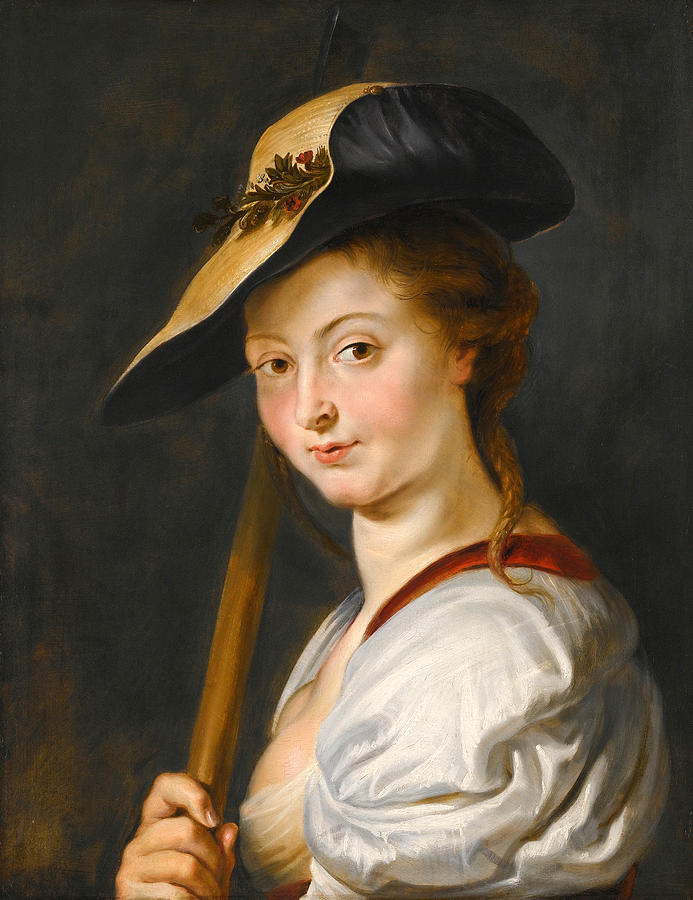
“Portrait of a Lady, Possibly Isabella Brant as a Shepherdess” presents an intimate, almost conspiratorial encounter between viewer and sitter. The woman turns toward us with a half-smile, her lips slightly parted, her gaze bright and knowing. She wears a broad-brimmed hat decorated with flowers and holds a shepherd’s staff, yet her delicate features, pale skin, and carefully arranged costume reveal her as anything but a simple country girl. Peter Paul Rubens uses the pastoral disguise to explore charm, sensuality, and playacting, turning a conventional portrait into a lively dialogue about love, identity, and theatrical self-presentation.
Although the sitter is not definitively identified, she is often thought to be Isabella Brant, Rubens’s first wife. Whether or not this attribution is correct, the painting radiates familiarity and affection. The woman’s relaxed pose, the softness of her expression, and the gentle modeling of her features suggest that Rubens regarded her not merely as a professional subject but as someone he knew well. The result is one of his most engaging female portraits, poised somewhere between genre painting and personal homage.
Historical Context and the Question of Identity
Rubens painted this work in the early decades of the seventeenth century, when pastoral themes were fashionable across European art and literature. Courtly society delighted in images of shepherds and shepherdesses, inspired by classical poetry and contemporary romances. These rustic figures were rarely realistic peasants; they were idealized, elegant stand-ins for aristocratic men and women who imagined themselves in an idyllic countryside, free from courtly constraints yet still refined.
The identification of the sitter as Isabella Brant rests on similarities with other portraits of Rubens’s wife and on the special care evident in the painting. Isabella appears in the famous double portrait “Rubens and Isabella Brant in the Honeysuckle Bower,” and in several other works, where her features—rounded face, pale luminous skin, gently arched brows—resemble those seen here. Even if the likeness is not exact, the tradition of associating this portrait with her adds an additional layer of meaning: we may be looking at the artist’s beloved in an invented pastoral role, a playful masquerade familiar in court entertainments and private imagery.
In any case, the painting reflects a culture in which identity could be fluid, shaped and reshaped through costume. By adopting the shepherdess guise, the sitter participates in a broader Baroque fascination with performance and transformation. Rubens captures that spirit with a light, affectionate touch.
Composition and Pose
The composition is simple yet carefully calculated. The woman is shown from the waist up, turned three-quarters toward the viewer. Her body curves gently, with the shoulder on the left slightly raised, giving energy and movement to the pose. She holds a long staff diagonally, its vertical weight balanced by the wide horizontal brim of her hat. These elements create a subtle X-shaped structure that stabilizes the image while keeping it dynamic.
The sitter’s head is slightly tilted, and her eyes meet ours from under the shadow of the hat. This tilt of the head and direct gaze create an impression of alertness and curiosity, as though we have just caught her attention. The composition feels intimate: she stands close to the picture plane, filling most of the frame, with only a dark, neutral background behind her. There is no landscape or architectural setting; all visual interest is concentrated on the woman herself.
Rubens crops the figure tightly, allowing the broad brim of the hat to nearly touch the upper edge of the canvas. This closeness reduces distance between subject and viewer, intensifying the sense of encounter. At the same time, the angled brim introduces an elegant asymmetry, guiding the eye in a gentle arc from the hat down to the face, then along the staff and back to the hand.
Costume, Hat, and the Shepherdess Motif
The shepherdess costume centers around the wide straw hat, adorned with a wreath of leaves and small flowers. The hat’s brim is lined with dark fabric, which curves upward and casts a soft shadow across the upper part of the face. This piece of headgear signals the pastoral theme instantly: in both painting and theater, such hats were conventional attributes of shepherds and shepherdesses.
Beneath the hat, the sitter wears a simple white blouse gathered at the shoulders and chest. The fabric is loose and voluminous, with soft folds that catch the light. The neckline dips in a modest yet revealing way, exposing part of the upper chest and hinting at the body beneath. A narrow red strap runs over the shoulder, adding a touch of vivid color that echoes the flowers on the hat.
The staff she holds is another pastoral prop, associated with tending flocks. It is rendered in warm brown tones, its texture plain and unadorned. Held near the bottom and resting diagonally across the figure, it acts as both an emblem and a compositional line.
While these elements evoke rustic life, Rubens’s handling of them reveals the artificiality of the disguise. The blouse may be simple in design, but the quality of the fabric and the careful way it is arranged suggest a costume chosen for charm rather than necessity. The hat, though straw, is ornamented with delicate foliage more appropriate to a court masquerade than to daily farm work. The painting acknowledges the shepherdess role as playful fantasy, a fashionably pastoral mask worn by an evidently refined woman.
Face, Expression, and Psychological Nuance
The true heart of the painting is the sitter’s face. Rubens devotes meticulous attention to its modeling and expression, letting us feel that we are in the presence of a living person. The complexion is velvety and luminous, with a gentle flush on the cheeks that suggests youth and health. Soft transitions of light and shadow describe the rounded cheeks, the small chin, and the delicate nose.
Her eyes are particularly expressive. Slightly narrowed, they glance out with a mixture of curiosity, intelligence, and mild amusement. The gaze is direct but not confrontational, inviting rather than challenging. Combined with the faint smile at the corners of her lips, it gives the face a subtle, inward liveliness. We sense that she is aware of being looked at and participates actively in the act of being portrayed.
The mouth is small and well formed, with softly defined lips that appear ready to move. Rubens avoids a fixed, rigid smile; instead he captures a fleeting expression, as if she has just heard a remark or is about to speak. This ambiguity adds psychological depth. Different viewers may interpret her look as shy, playful, or self-assured, and this openness to interpretation is part of the portrait’s charm.
The hair is gathered back and twisted into a simple style, with a loose curl falling in front of the shoulder. Warm chestnut tones interwoven with lighter strands catch the light, providing a rich frame for the face. The simplicity of the hairstyle contributes to the pastoral characterization, yet the meticulous grooming again betrays a world of refinement.
Light, Color, and Brushwork
Rubens’s mastery of light and color is on full display. A soft, warm light grazes the sitter from the left, illuminating her face, the curve of her neck, and the folds of her blouse. The hat casts a gentle shadow that shapes the forehead and emphasizes the brightness of the cheeks. This interplay of light and shadow gives the head a sculptural presence; it seems to project out of the dark background.
The color palette is restrained but subtly varied. The main tones are creamy whites, soft pinks, golden browns, and the darker, almost blue-black interior of the hat. Small accents of red in the shoulder strap and the floral decoration provide points of visual emphasis. These warm and cool colors are carefully balanced so that no single element overwhelms the composition.
Rubens’s brushwork varies across the painting. In the face, the strokes are fine and smoothly blended, creating a polished, lifelike skin surface. In the blouse and hat, his touch becomes broader and more suggestive. Folds of fabric are indicated with confident sweeps of the brush, allowing the viewer’s eye to complete the illusion. The background, painted with loose, unobtrusive strokes of dark brown and grey, retreats into depth and provides a neutral stage for the luminous figure.
This combination of carefully finished facial features with more painterly surroundings is typical of Rubens’s portrait style. It focuses attention on the psychological center of the work while letting the rest of the canvas vibrate with lively, tactile energy.
Sensuality, Innocence, and Rubensian Femininity
Rubens often painted women with a distinctive blend of sensuality and vitality, and this portrait is no exception. The sitter’s bare neck, hint of décolletage, and softly rounded shoulders subtly emphasize her physical presence. The loose blouse, with its billowing folds, both conceals and accentuates the curves beneath. Yet the overall impression is not overtly erotic; rather, it suggests youthful freshness and natural allure.
The shepherdess costume contributes to this mood. In seventeenth-century art, pastoral figures frequently served as vehicles for exploring flirtation and desire in a safely distant, fictional setting. The countryside, imagined as a place of innocence and freedom, allowed for playful encounters and gentle seductions. By portraying the lady as a shepherdess, Rubens taps into this tradition. The staff she holds might symbolize care and guidance, but in the context of courtly imagery it also hints at playful role-play and romantic fantasy.
At the same time, the sitter’s expression tempers this sensuality with intelligence and self-possession. She is not a passive object of the viewer’s gaze. Her half-smile and direct eyes suggest that she is aware of the charm she projects and participates in the performance. This balance between bodily presence and self-conscious agency reflects Rubens’s nuanced approach to female portraiture.
Nature, Pastoral Fantasy, and the Absent Landscape
Curiously, the painting includes no explicit landscape or natural setting, despite the shepherdess theme. Instead, the background remains a dark, almost abstract space. This absence of scenery sharpens our awareness that the pastoral role is a costume rather than a literal environment. The idea of the countryside is evoked through props and clothing rather than depicted directly.
This approach aligns with the portrait’s probable function as a decorative, intimate image rather than as a narrative scene. The rustic persona is more symbolic than descriptive. It suggests virtues associated with pastoral life—simplicity, sincerity, closeness to nature—without requiring a detailed backdrop.
For a contemporary viewer of Rubens’s time, these cues would have been sufficient. Audiences were familiar with pastoral plays, poems, and court masques in which nobles donned rustic attire on elaborately decorated stages. The imagination supplied the meadows, flocks, and trees. Rubens’s painting participates in that imaginative world, allowing the sitter to inhabit a dual identity: both sophisticated lady and charming shepherdess of fantasy.
Rubens, Portraiture, and Domestic Affection
When considered alongside Rubens’s other portraits, “Portrait of a Lady, Possibly Isabella Brant as a Shepherdess” stands out for its intimacy and informality. Many of his commissioned portraits of aristocrats emphasize official status with grand poses, dark backgrounds, and partial armor or luxurious gowns. In contrast, this work feels lighter, more playful, and personal.
If the sitter is indeed Isabella Brant, the painting may have been intended for private enjoyment, perhaps displayed in Rubens’s home rather than in a public hall. It would join other images of his wife and family that reveal his affection and pride. Even if the identification is uncertain, the warmth of the portrayal suggests a sitter he knew and liked.
Rubens balances the requirements of portrait likeness with his own artistic interests: expressive faces, elegant hands, and richly rendered fabrics. The result is both a record of an individual and a small masterpiece of color and form. Through this portrait, we glimpse Rubens not only as court painter and history painter, but as acute observer of everyday humanity.
Legacy and Interpretation
Today, “Portrait of a Lady, Possibly Isabella Brant as a Shepherdess” continues to fascinate viewers because it feels surprisingly modern in its psychological subtlety. The sitter’s direct gaze and half-smile seem to break the barrier of centuries, establishing a personal connection with those who stand before the canvas. The pastoral disguise now appears charmingly theatrical, but the human presence beneath it remains convincing and relatable.
Art historians value the painting for what it reveals about early Baroque portraiture, gender roles, and the culture of masquerade. It demonstrates how noble women could adopt playful personas in art, experimenting with representations of self that went beyond rigid social categories. At the same time, it highlights Rubens’s extraordinary ability to make such role-playing feel natural and spontaneous rather than contrived.
For general audiences, the portrait offers sheer visual pleasure: the soft glow of skin against dark background, the sheen of the hat, the lively twist of the blouse’s folds, and the sense that the sitter might at any moment shift her weight, speak, or laugh. Rubens’s brush breathes life into the image, ensuring its enduring appeal.
Conclusion
“Portrait of a Lady, Possibly Isabella Brant as a Shepherdess” is more than a charming picture of a woman in a costume. It is a sophisticated meditation on identity, performance, and affection. Through a restrained yet elegant composition, carefully controlled light, and subtle facial expression, Peter Paul Rubens creates a portrait that feels both intimate and theatrical.
Whether or not the sitter is Isabella Brant, the painting conveys the closeness between artist and model. The shepherdess disguise allows Rubens to explore pastoral fantasy while keeping the focus on the sitter’s individuality—her intelligence, her playful confidence, and her quiet sensuality. The result is a work that enchants modern viewers as it likely did its first audience, inviting them into a timeless exchange of glances and unspoken words.