Image source: wikiart.org
Introducing Bartolomé Esteban Murillo’s “Portrait of a Gentleman in a Ruff Collar”
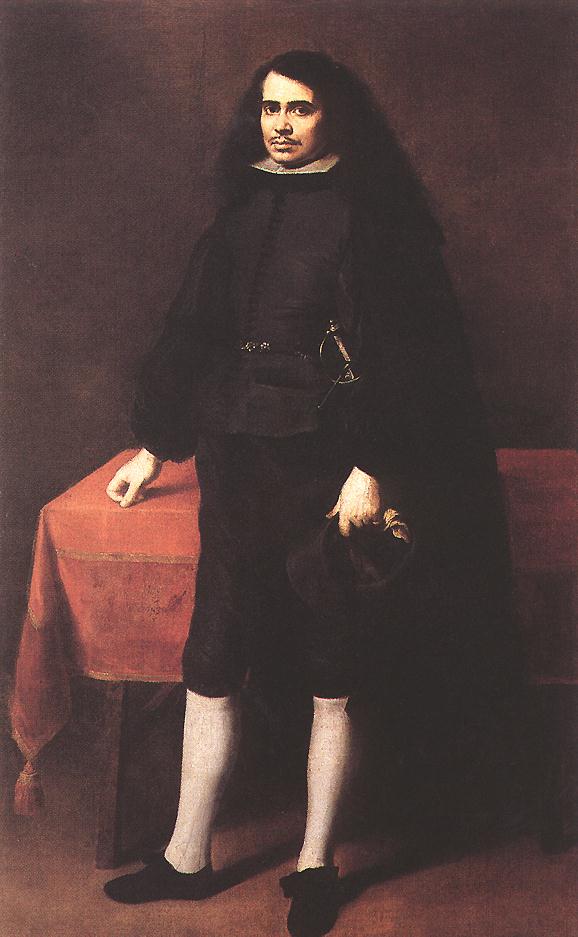
“Portrait of a Gentleman in a Ruff Collar” presents an elegant full length image of a Spanish nobleman, painted around 1670 by Bartolomé Esteban Murillo. At first glance the work seems straightforward, a well dressed man standing beside a table. Yet the more closely you look, the more subtle choices of pose, light, costume, and expression reveal layers of social status, character, and cultural identity in seventeenth century Spain.
Murillo is most famous for tender religious scenes and lively pictures of street children. Here he turns his attention to a different subject, the cultivated urban gentleman who would have commissioned an expensive portrait to proclaim his position. The painting becomes a carefully staged performance of dignity and restraint, but it is also a deeply human encounter between viewer and sitter.
The Spanish Golden Age and the Culture of Portraiture
The portrait belongs to the later phase of the Spanish Golden Age, a period in which painters like Velázquez, Zurbarán, and Murillo supplied images for court, church, and private devotion. Secular portraiture had grown increasingly important, especially among upwardly mobile elites in Seville, where trade with the New World created fortunes outside the traditional nobility.
This gentleman’s clothing already suggests that he moves within that prosperous world. His outfit is fashionable but not ostentatious, predominantly black with controlled accents of white and red. Black was the preferred color of Spanish courtly dress through much of the seventeenth century, associated with dignity, sobriety, and self control. A man who wore such clothing signaled seriousness and moral rectitude as much as wealth.
Murillo’s portrait therefore participates in a broader cultural conversation about virtue and status. It offers an image of a man who is at once worldly and respectable, comfortable with luxury yet committed to a restrained ideal of honor.
Composition and the Command of Space
The composition is built around a strong vertical axis formed by the gentleman’s standing figure. He occupies almost the entire height of the canvas, from his black shoes at the bottom to the dark sweep of his hair near the top. This vertical emphasis gives him an immediate authority. He does not lean or lounge, but stands solidly grounded with feet slightly apart, one foot advanced as if he has just taken a step.
To the left a red covered table interrupts the empty space and provides a counterweight. The tablecloth drops in straight folds that echo the verticality of the figure. Murillo uses the deep red of the cloth to lead our eye diagonally upward from the corner of the canvas to the sitter’s hand and then to his face. The right side remains relatively empty, filled with a dark, indistinct background that pushes the figure forward.
The gentleman is turned slightly toward the viewer, not in strict profile and not entirely front facing. This three quarter pose is ideal for portraiture because it creates a sense of movement and life. We feel that he has just turned toward us, perhaps interrupted in the act of removing his hat or preparing to speak. The table serves as an anchor for his left hand, which rests lightly on the edge. With his right hand he holds a dark hat with a pair of gloves. These diagonals, from one hand to the other, from hat to table, animate the otherwise still scene.
Despite the simplicity of the background Murillo suggests a shallow interior space through delicate gradations of tone. The floor is only hinted at, yet the placement of the man and the table convinces us of solid ground under their feet. This careful control of spatial cues keeps attention on the sitter while maintaining an impression of believable reality.
The Gentleman’s Costume and the Language of Status
Clothing is one of the main vehicles through which the painting communicates meaning. The gentleman wears a long black doublet and cloak over knee length breeches. White stockings and plain black shoes complete the lower half of his outfit, while at his neck sits a stiff, modest ruff collar. There are no jewels and no extravagant decorations. Everything is cut with precision, yet the total effect is restrained.
In seventeenth century Spain a ruff collar was not only a fashion accessory but a sign of refinement and rank. The tall starched collar frames the face, separates head from torso, and lends a sense of erect posture even when the sitter’s stance is relaxed. Murillo renders the ruff with delicate highlights along its curved folds, allowing the viewer to feel the crispness of the linen. The collar also acts as a bright ring of light against the dark clothing, drawing attention to the pale face above.
The black garments absorb light and visually slim the figure, but Murillo enlivens them with subtle nuances. The buttons of the doublet, the seams of the sleeves, and the soft fall of the cloak are indicated with just enough detail to suggest rich fabric without distracting from the whole. The wide belt with metal fittings at the waist hints at both wealth and readiness, since belts often carried small weapons or pouches.
The white stockings and cuffs introduce an important contrast. Their brightness breaks up the expanse of black and echoes the light of the collar. This repetition of white at head, wrists, and ankles creates a rhythmic pattern, guiding the viewer’s gaze around the figure. It also reinforces the idea of cleanliness and decorum, virtues highly prized in polite society.
The hat and gloves in his right hand carry their own meanings. Hat removal was and still is a gesture of respect. By showing the gentleman holding his hat rather than wearing it, Murillo implies that he is in a setting that demands courtesy and seriousness, perhaps a formal visit or an audience. Gloves were costly items associated with rank and sometimes represented a pledge of honor. Their presence suggests a man who values proper conduct and social codes.
Light, Color, and Atmosphere
Murillo orchestrates the lighting with the subtlety for which he is known. A gentle illumination falls from the left, washing over the gentleman’s face, collar, and front of the body, while leaving the far side in soft shadow. There is enough contrast to model the forms and give the figure volume, yet the transitions remain smooth and lyrical.
The background is a deep brown with hints of red that echo the tablecloth. It is neither entirely dark nor entirely featureless. Slight variations in tone give a sense of air behind the sitter rather than an oppressive wall. The warm color temperature of the background counterbalances the coolness of the black garments and creates a harmonious whole.
Murillo’s use of red is particularly striking. The tablecloth is a strong brick red, almost glowing in relation to the dark surroundings. This color not only enlivens the composition but also evokes associations with power and dignity. Red often appears in depictions of kings, cardinals, and high officials. Here it appears not as clothing but as a supporting element, suggesting that the sitter participates in that world of authority even if he does not flaunt it.
The skin tones are rendered with great sensitivity. The gentleman’s face is pale but not lifeless, with subtle blushes at the cheeks and lips. Murillo employs gradations of warm and cool tones to give the impression of living flesh beneath the surface. The hands receive similar attention, their delicate shading emphasizing the elegance of long fingers that rest lightly yet confidently.
Expression and Psychological Insight
One of the most compelling aspects of the portrait is the sitter’s expression. His eyes meet the viewer’s gaze directly, yet his mouth remains neutral, neither smiling nor stern. The overall effect is one of calm self possession. He appears confident in his status, aware of being observed, and ready to maintain his dignity.
Murillo avoids caricature or excessive idealization. The man’s slightly heavy eyelids, the narrow moustache, and the strong jawline all feel particular rather than generic. We sense the individuality of a real person, not just an archetype of a gentleman. At the same time Murillo smooths away any harshness, giving the face a gentle introspective quality that invites contemplation rather than awe.
The sitter’s posture supports this reading. Although he stands upright, there is a subtle softness in the bend of the elbows and the slight tilt of the shoulders. He is not rigid or militant, but composed and at ease. The hand on the table, with fingers extended but relaxed, feels like a gesture caught mid movement, as though he has just turned from his papers or a conversation to receive the painter and viewer.
This psychological depth is a hallmark of Murillo’s mature portraits. Rather than focusing solely on external trappings, he strives to capture the inner life of his sitters, their modest pride, their measured reserve, even their hint of vulnerability. The result is a painting that feels quietly intimate despite its formal structure.
Murillo’s Approach to Portraiture
Although Murillo produced fewer portraits than religious images, works like this show his skill in adapting his tender style to secular themes. He brings to the gentleman the same empathy he uses in pictures of the Virgin and Child or street urchins, treating every sitter as a unique soul.
His brushwork is relatively smooth here compared to the looser handling in some of his genre scenes. The surface appears carefully finished, especially in the face and collar, where fine strokes define details without calling attention to themselves. In the cloak and background the paint becomes broader and more suggestive, allowing texture and atmospheric depth to emerge.
Murillo’s portrait aligns with a broader Spanish tradition shaped by Velázquez, who had painted courtly figures in austere settings decades earlier. Yet Murillo’s temperament is slightly warmer. Where Velázquez can be coolly observational, Murillo typically softens edges and infuses his subjects with gentle humanity. The “Portrait of a Gentleman in a Ruff Collar” exemplifies this fusion of dignity and warmth.
The painting also reminds us of the social role of portraiture. Such works were often displayed in private homes or family chapels, preserving the likeness of ancestors and proclaiming lineage. By capturing the sitter at his best, dressed appropriately and posed with decorum, Murillo provides his patron with a visual legacy meant to endure beyond his lifetime.
Narrative Possibilities and Everyday Life
There is no explicit story in this painting, yet the details invite speculation about the man’s life. The plain interior and red covered table suggest an environment of study or administration. Perhaps he is a lawyer, a merchant, or an official connected to the municipal council of Seville. The slight bulge at his belt may hint at a purse or keys, symbols of responsibility.
His calm gaze hints at education and literacy. One can imagine documents spread on the table just out of sight, maybe legal contracts or letters from overseas trade. Murillo chooses not to clutter the scene with props, but the minimal setting leaves room for the viewer’s imagination to fill in the narrative of this man’s role in society.
This balance between specific characterization and open ended storytelling is another reason the portrait remains engaging. It feels grounded in everyday reality yet never collapses into mere documentary. Instead it invites the viewer to see the sitter as a representative of a broader class of early modern Spanish citizens, men who navigated the evolving world of commerce, faith, and politics.
Legacy and Continuing Appeal
Today “Portrait of a Gentleman in a Ruff Collar” stands as an important document of Murillo’s range as an artist. It shows that he could handle not only tender Madonnas and lively street boys, but also the quiet drama of an individual facing the viewer in a simple interior. The painting appeals to modern audiences partly because it feels so recognizably human. The sitter’s reserved yet attentive expression could belong to a person you might meet in any professional setting, despite the historical clothing.
The work also illustrates the timeless power of portraiture. Centuries after this gentleman posed for Murillo, viewers still feel a sense of connection. His clothing and manners may belong to seventeenth century Seville, but his desire to be seen and remembered is universal. Murillo grants him that wish with grace and sensitivity.
For those interested in the history of fashion, social hierarchies, or Spanish art, the painting offers rich material. For those drawn to psychological nuance and the quiet dialogue between viewer and subject, it offers an intimate encounter with a long gone individual whose presence remains vivid on the canvas.
Conclusion
“Portrait of a Gentleman in a Ruff Collar” is a masterful fusion of formality and humanity. Through composed structure, carefully chosen costume, controlled lighting, and subtle expression, Bartolomé Esteban Murillo creates an image that both celebrates social standing and reveals personal character. The sitter stands in a world of muted colors and quiet interior space, yet he commands attention through his upright posture and steady gaze.
Murillo’s handling of black fabrics, white accents, and red tablecloth demonstrates his sensitivity to color harmony and symbolic resonance. His focus on the face and hands underscores the importance of presence and gesture in communicating dignity and inner life. The portrait invites us into a moment of recognition, a silent meeting between past and present.
As with many of Murillo’s works, what lingers is not only the technical excellence but the sense of compassionate observation. This gentleman is no anonymous symbol of rank, he feels like a real human being, thoughtful, perhaps slightly reserved, yet fully alive within the painted surface. Through this painting Murillo reminds us that portraits are more than records, they are acts of remembrance that keep individual stories glowing within the larger sweep of history.