Image source: wikiart.org
Introduction
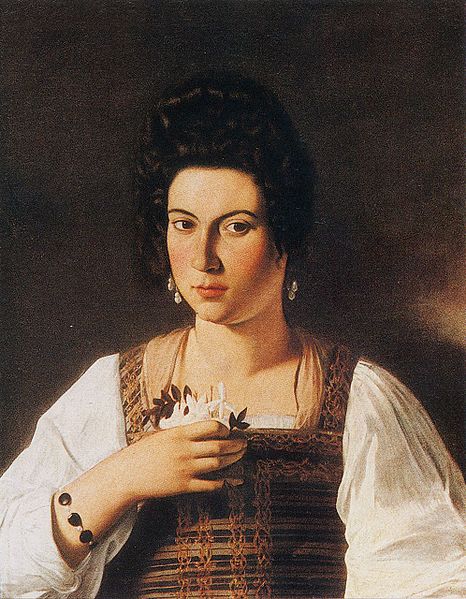
Caravaggio’s “Portrait of a Courtesan,” painted in 1597, captures a woman whose poise, intelligence, and guarded self-awareness command the room more forcefully than any ornate backdrop could. The sitter meets the viewer head-on, framed by a dark, unadorned ground that heightens the impact of her face, her hand, and the small cluster of flowers she holds close to her chest. In an age accustomed to allegory and idealization, Caravaggio offers a portrait that feels unmediated and modern, stripping away distracting emblems so that personality, gesture, and light become the narrative. The result is not an anecdote about vice or virtue, but a study in presence—one human being testing the space between self-presentation and truth.
Historical Context
In late sixteenth-century Rome, portraiture served social visibility, advertising lineage, office, or beauty. Caravaggio arrived in this world as an outsider with a new pictorial grammar. Rather than place his sitters amid architectural splendor, he preferred a shallow stage of darkness and light. In 1597 he was on the cusp of success, moving in circles where artists, dealers, patrons, and high-status courtesans crossed paths. Portraits of prominent courtesans were not unusual; they circulated among patrons and admirers, and they also functioned as self-fashioning tools for women whose public image was integral to their livelihood. Caravaggio’s canvas participates in that economy while quietly reshaping it. He refuses the easy stereotypes that turned courtesans into stock figures. Instead, he paints a person whose self-possession complicates any moralized reading.
The Sitter and the Roman Courtesan
The title announces the subject’s profession, but Caravaggio withholds the theatrical cues that earlier painters used to signal erotic commerce. There is no overt display, no stagey luxuries, no allegorical props. The woman’s costume is richly textured yet practical; her jewelry is restrained; her hair is dressed but not ostentatious. This deliberate moderation aligns with the cultivated public image of many elite Roman courtesans, who marketed wit, musical skill, and conversation as much as physical allure. Caravaggio’s sitter appears conscious of being looked at without surrendering the privacy of her thoughts. The frank gaze and closed mouth speak of practiced control, the poise of someone who understands how portraits travel through rooms and through hands.
Composition and the Architecture of Presence
Caravaggio engineers a quiet but commanding geometry. The portrait is half-length and frontally oriented, but the axis is subtly offset by the diagonal formed by the sitter’s forearm and the tucked hand that presses flowers to the bodice. A narrow triangle of pale chemise at the neckline, the glint along the bracelet, and the small bursts of light on the earrings create a constellation that pulls the eye in a slow circuit around the face and hand. The background is a near-featureless dusk, which has two effects: it makes the figure feel physically near, and it denies any narrative detour. The viewer is left to read character through posture, skin, fabric, and the interlock of looker and looked-at.
Light, Shadow, and the Charge of Chiaroscuro
Light enters as if from a high window, crisp but not cruel. It models the cheeks and brow, sharpens the nose’s ridge, and strikes the pearls with tight sparks before sinking into the folds of the sleeve and the darks of the hair. This chiaroscuro does more than describe volume; it distributes attention. The face absorbs the most sustained glow, establishing intellect and temperament as the portrait’s center of gravity. The hand, second in brightness, becomes a secondary locus of meaning, the place where decision and self-presentation crystallize. Caravaggio’s control of penumbra—the soft threshold where light yields to shadow—prevents theatrical extremes and sustains a persuasive human temperature.
Costume, Texture, and Social Signals
The bodice’s woven pattern, the laced front, and the sturdy linen chemise belong to the shared vocabulary of late sixteenth-century dress, but Caravaggio paints them with a tactile frankness that resists ornamental fetish. The fabric reads as fabric; the metal reads as metal. The bracelet’s black beads, likely jet or onyx, catch just enough light to register without dazzling. Everything suggests means without excess, elegance without proclamation. In this, the costume becomes a social argument. The sitter is neither the coy temptress of erotic prints nor the remote paragon of aristocratic state portraiture. She is a professional woman inhabiting the delicate boundary between public availability and personal sovereignty, and her clothes are instruments of that balance.
Gesture, Flowers, and the Rhetoric of the Hand
The hand that lifts the small spray of flowers is the portrait’s hinge. The gesture is economical, not theatrical; the fingers are strong, the grip secure but not tight. Flowers can carry an overabundance of meaning in Renaissance painting—chastity, transience, scent, allure—but Caravaggio reduces the symbolism to a near-literal act: a woman choosing what to show and how close to hold it. The bouquet’s placement at the breast may acknowledge a marketplace of desire, yet the angle of the wrist and the slight barrier it creates read as self-editing rather than surrender. In Caravaggio, hands often speak where mouths do not; here they articulate a contract between display and reserve.
Psychological Realism and the Exchange of Looks
One of Caravaggio’s most radical contributions to portraiture lies in the candor of his sitters’ gazes. This woman looks back. Her eyes are neither coquettish nor downcast; they measure. That reciprocity unsettles a passive model–active viewer hierarchy. The viewer feels seen and, by extension, judged—if only for a moment—by the person depicted. The slight asymmetry of the brows, the compressed lips, the almost imperceptible shift of weight across the shoulders produce a portrait that breathes. Caravaggio avoids smoothing the face into an ideal type; tiny irregularities in skin tone and contour protect the portrait’s humanity. Such fidelity to the particular anchors the image in lived time rather than in allegory.
The Ethics of Simplicity
Caravaggio’s refusal of background furnishings has ethical as well as aesthetic weight. By subtracting the props that might have narrated the woman’s story, he denies the viewer the comfort of cliché. The portrait does not instruct with overt moralizing; it insists on regard. Simplicity here is a discipline. It asks the painter to rely on light, edge, and proportion; it asks the viewer to attend without distraction. In that exchange, dignity becomes the picture’s governing value. The sitter’s profession may shape the portrait’s title, but the person takes precedence over any category.
Comparisons within Caravaggio’s Oeuvre
Seen alongside Caravaggio’s other works from the late 1590s, the portrait shares a family of solutions. The dark field recalls the settings of half-length saints and musicians. The illumination, angled and emphatic, anticipates later masterpieces where revelation arrives through light rather than symbol. If the same model appears elsewhere as a martyr or penitent, the recycling is not cynical; it is a deliberate reminder that sacred history and contemporary life can share the same human face. Caravaggio’s world is one where a courtesan can enact sanctity on one canvas and assert worldly intelligence on another, not because the roles are interchangeable, but because the human substrate is constant.
Technique and the Evidence of the Brush
The paint handling is brisk and assured. Caravaggio builds the head out of broad tonal planes, reserving crisp accents for lash lines, nostril, and lip corner. The sleeve is sketched with decisive strokes that catch the way linen breaks into small creases under the elbow’s bend. The bodice’s pattern is suggested rather than counted, a strategy that sacrifices weave-by-weave description for the greater truth of how patterned cloth registers at portrait distance. Highlights on the earrings and bracelet are placed with a single loaded touch, as if the painter knew exactly where the eye would need a spark to complete the form. Nothing feels labored; everything feels seen.
The Courtesan’s Agency and the Politics of Portraiture
Portraits were never neutral. They circulated within networks of patronage, affection, rivalry, and memory. For a courtesan, whose income depended on reputation, a portrait could be both calling card and shield. Caravaggio’s image grants the sitter a striking degree of agency. She faces front, occupies the center, and controls the terms of approach with that measured gaze and self-possessed gesture. Even the flowers, soft as they are, become instruments of self-definition. The portrait neither condemns nor romanticizes. It acknowledges a woman navigating a public life with precision and caution.
Time, Transience, and the Fragility of Image
The flowers introduce a temporal chord. However restrained their symbolism, they bear the inevitability of fading, and by extension they measure the gap between the sitter’s mortal time and the portrait’s longer endurance. Caravaggio’s honest light makes no promises of immortality by idealization. Instead, it preserves a particular afternoon’s arrangement of features, fabrics, and attention. That modesty of claim—this is what she looked like, here, now—paradoxically deepens the portrait’s pathos. The sitter becomes present rather than exemplary, finite rather than abstract, which is precisely why the image continues to feel alive.
Reception and the Challenge to Convention
Viewers habituated to sumptuous backdrops and ostentatious symbols may have found the portrait severe. Yet that severity was a wager on clarity. The plain ground recalibrates the relationship between viewer and sitter, making the encounter immediate, almost conversational. Over time, this directness would become one of Caravaggio’s most influential legacies. Painters across Europe learned from him that a single figure, honestly observed in controlled light, could carry the psychological and ethical weight of a grand narrative. In that lineage, the courtesan’s measured presence becomes a prototype of modern portrait honesty.
The Portrait as Dialogue with the Viewer
Stand before the canvas and the experience feels less like looking at an object than meeting a person. The sitter’s gaze holds long enough to prompt self-consciousness; the hand’s small movement invites the viewer to consider what is offered and what is withheld. The dark background, rather than isolating her, seems to push her forward into the viewer’s space. Caravaggio thus turns a two-dimensional surface into a site of negotiation. The painting asks for attention without seduction, respect without deference. It is a contract sealed by light.
Materiality and Illusion
Caravaggio’s devotion to material truth underwrites his larger illusionistic goals. The gleam on the earring is not a generic highlight but a precise record of a specific light source striking a curved pearl. The translucency at the edge of the chemise reads as woven air, not chalk. Such exactitude lets the viewer trust the fiction. When fabric behaves like fabric and skin like skin, the mind relaxes into belief, and the portrait can do the subtler work of character study. This is the alchemy of Caravaggio’s realism: not a catalogue of facts, but a staging of credibility that opens a path to empathy.
Silence, Speech, and the Unsaid
No inscription tells us what to think. The sitter’s mouth is closed; the flowers do not spell out an allegory; the dark field refuses scenic chatter. That silence is not emptiness; it is room for the viewer’s intelligence. Caravaggio recognizes that portraits are collaborative. The painter sets conditions; the sitter offers presence; the viewer completes the meaning. In this portrait the unsaid becomes the field in which moralizing stereotypes dissolve and singularity takes root. The courtesan is neither sermon nor scandal. She is a person with a face and a will.
Caravaggio’s Humanism
The portrait’s ultimate subject is human worth. By granting intensity, gravity, and painterly care to a figure whom society ranked ambiguously, Caravaggio extends the dignity he would later bestow on pilgrims, laborers, and saints. Light in his work does not discriminate by status; it falls where attention is due. That democratic impulse is one reason his images still feel contemporary. He painted what it means to be someone—embodied, alert, finite—and he trusted that such someones were worthy of the highest resources of art.
How to Look
Begin at the eyes and remain there until the face steadies into a voice you can almost hear. Then move to the hand and the flowers, noticing how the fingers balance firmness and care. Step back to register the triangular play between earring, bracelet, and bouquet, and feel how those points of light choreograph your attention. Attend to the linen’s broken creases and the bodice’s abbreviated pattern; admire the painter’s confidence in letting suggestion do the work of description. Finally, allow the dark to surround the figure until the room where you stand becomes the portrait’s background. In that moment you and the sitter share a single space of looking.
Conclusion
“Portrait of a Courtesan” stands at the intersection of social history and painterly innovation. It memorializes a woman whose livelihood depended on visibility, yet it refuses to exploit her for spectacle. It refines portraiture to its essential transactions—gaze, gesture, light—and trusts those elements to bear complex meanings without recourse to cliché. In 1597, Caravaggio was already dismantling the scenic machinery of mannerist decorum to build a theatre of the human face. The courtesan meets us across centuries not as an emblem but as a presence, and the portrait’s austere eloquence reminds us that dignity in paint arises not from trappings but from attention.