Image source: wikiart.org
Introduction: A Face Found in Warm Shadow
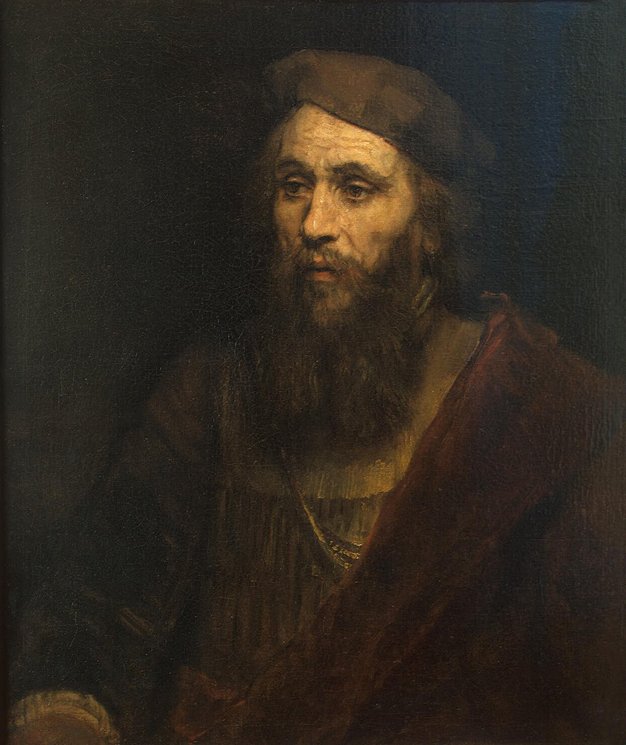
Rembrandt’s “Portrait of a Bearded Man” (1661) is a late, searching meditation on character rendered with minimal means: a head under a soft cap, a heavy beard lit from a high window, a dark cloak that dissolves into brown air. The sitter’s gaze is slightly off to the left, attentive yet withdrawn, as if listening to a thought more than to us. What might first appear a simple likeness quickly becomes a sustained performance of looking—Rembrandt’s and ours—where light tests every plane of the face, paint remembers the feel of cloth and hair, and silence turns into psychological presence.
Historical Context: Late Rembrandt’s Candor after Upheaval
By 1661 Rembrandt had weathered bankruptcy and the loss of fashionable patrons who preferred sleek finishes and decorous stories. His final decade is marked by a resolute independence: earth palettes, dense shadows that behave like air, surfaces that keep the record of touch, and a compassion that refuses flattery. Into that language this portrait fits perfectly. Nothing here is ornamental solution; everything is experiential truth. The sitter—unidentified, perhaps a friend, a scholar, or a dignified tradesman—arrives in front of us with the frank authority of someone who has not posed for glory but simply agreed to be seen honestly.
Composition: Triangle, Column, and the Arc of the Cap
The compositional architecture is spare and stable. The shoulders build a broad triangle that supports the weight of the head; the torso rises like a column, slightly turned, so that one shoulder recedes into dusk while the other catches a slow burn of light. The cap’s rounded edge forms an arc that frames the forehead and guides the eye back toward the gaze. The beard, dark and voluminous, is the vertical ballast linking head to chest; it thickens at the center and thins at the edges, allowing the shoulders to dissolve into atmosphere. Cropping is intimate, keeping attention near the face and preventing peripheral anecdote from distracting the encounter.
Chiaroscuro: Illumination as Judgment and Mercy
Rembrandt’s late chiaroscuro is more than a technical signature; it is a moral weather. Here the light seems to fall from a high left window, opening the forehead, ridge of the nose, and cheekbone before dissolving across the beard and collar. The right side of the head remains in breathable half-tone: not black, but an accumulation of warm olives and browns through which the skull still turns. Darkness is a kindness in late Rembrandt—it grants privacy to what does not need to be told, and concentrates our attention on what truly lives in the sitter. The result is a face that reads in time, as if emerging from thought rather than from paint.
Palette: Embered Earths and Quiet Reds
The color harmony keeps to Rembrandt’s late orchestra of earths. Umber and raw sienna make the room. The flesh is built from honeyed ochres and muted reds that cool toward gray in the shade. The cap carries a subdued brick red, echoed by the cloak’s browned crimson, knitting upper and lower halves of the portrait. Small lights—a pale touch on the eyelid, a faint glint on the chain peeking under the tunic, a warm lick along the cheek—are rationed carefully so that they carry maximum expressive weight. Because chroma is restrained, value and temperature perform the narrative, giving the image its lived warmth without theatricality.
Surface and Brushwork: Material That Speaks
The paint surface is the biography of making. Across the cap Rembrandt lays broader, absorbent strokes that suggest worn felt. In the beard the brush becomes springy and irregular, dragging loaded darks over mids so that real light can catch on the ridges like hair. The cloak and tunic are scumbled and then pulled with long, quiet strokes, more invested in weight than in detail. Within the face glazes and firmer touches alternate: a veil to sink a plane, a decisive ridge to secure a highlight, a softened scumble to temper the mouth. No passage is pedantic. The surface records decisions rather than formulae, which is why the portrait remains alive at multiple distances.
The Head and Gaze: Listening as Expression
The sitter’s expression is neither proud nor pleading. His eyes look slightly aside, as if measuring the room or letting a memory complete itself before speech. The lids carry weight, the brow is open but not arched, the mouth rests in a line more thoughtful than severe. Rembrandt’s refusal to dramatize earns the right to our attention: we lean closer because the portrait is not performing. The face communicates the rarest of emotions in portraiture—attentive calm—precisely because the painter trusts small modulations of value over graphic emphasis.
Beard, Age, and Identity: Particulars without Caricature
Beards tempt caricature; here they become structure. The thick mass anchors the head, but its edge is broken and breathing, allowing the skin beneath to glow where light penetrates the hair. This tact preserves age without spectacle. Wrinkles are not recorded as countable events; they appear as places where light slows down. The skin’s modeling avoids the theatrical notch at the mouth or exaggerated trough under the eye; character appears as a field of decisions rather than a checklist of signs. The sitter is thus individualized without being stereotyped, dignified without being idealized.
Costume and Meaning: Warmth, Weight, and Quiet Status
The garments are described with discreet precision. The cap and cloak suggest a person of learning or position, but the paint refuses heraldic crispness. A faint chain or cord glimmers near the tunic; the cloak’s inner lining mutters a richer red. These touches imply means without ostentation. More importantly, they serve composition and psychology: the warm cloth broadens the silhouette and cradles the head, turning worldly status into pictorial stability and bodily warmth. Rembrandt’s late portraits convert costume from social proof to human shelter.
Space and Background: A Chapel of Brown Air
Behind the sitter lies Rembrandt’s late, resonant dusk. There is no architectural stage—only a gentle gradient from near-black at left to brown-violet at right, with a breath of cooler blue tucked into the far darkness to keep the air alive. That atmosphere is not emptiness; it is hospitality. It welcomes the person forward without shouting. In such a room words would sound softly; in such a pictorial climate, the face can bear long attention without fatigue.
Gesture and Implied Hands: Anchoring the Body
Only a hint of the left hand appears at the lower edge—no more than a warm, rounded passage emerging from the cloak. Even so, it matters. The implied weight of the hand steadies the figure and prevents the head from floating as a bust. The absence of explicit gesture keeps the portrait inward. In late Rembrandt, hands are either eloquent speakers or graciously retired so the face can carry the conversation; here they choose retirement.
Process and Pentimenti: Edges That Think
Close looking reveals the history of revisions. The far contour of the cap has been softened, allowing dark to seep through and release pressure from the silhouette. The shadow under the nose appears re-glazed to integrate a previously sharper highlight; the mouth’s corners have been gentled with thin gray to avoid undue severity. At the collar the chain’s lights sit on top of deeper, cooler paint, a late addition when Rembrandt calibrated the balance between warmth at the torso and gravity at the head. These pentimenti are the painting’s conscience, showing how truth in likeness is reached by correction rather than bravura.
Kinships in the Oeuvre: Companions in Quiet Authority
The portrait converses with Rembrandt’s other late images of solitary men—apostles by a window, scholars with soft caps, anonymous sitters haloed by brown air. It shares with the “Apostle Paul” (1657–59) the inward gaze and humane light; with the late self-portraits it shares the tactile surface and refusal of courtly finish. Yet it keeps its own register: less theological than the apostles, less autobiographical than the self-portraits, it is a secular face made sacred by attention.
Psychology of Late Portraiture: Compassion over Flattery
Rembrandt’s late portraits replace social agreement with human regard. The sitter is not packed into contemporary ideals of virtue; he is allowed to be himself in a good light. This generosity is evident in the treatment of age, in the weight of the eyelids, in the way the beard does not obscure but softens. The painter gives the person the dignity of not being explained. We feel that dignity as psychological truth: the sitter looks capable, patient, and a little tired—qualities many viewers will recognize as their own.
The Role of Light as Narrative
Though the portrait avoids anecdote, its light still tells a story. It travels a diagonal path that begins at the cap’s crown, grazes the brow, pauses at the cheekbone, and descends into the beard before landing on the chest where the chain glints. The path reads like time across a life: mind, feeling, speech withheld, work done. Because the beam is mild, the story is humble. Yet the very restraint makes the narrative persuasive. We trust an image that refuses to shout.
Lessons for Painters and Viewers: Economy, Revision, and Care
For painters, the canvas is a masterclass in economy: how to suggest felt and hair with distinct kinds of drag; how to establish solidity with temperature shifts rather than outlines; how to make a face breathe via transitions rather than accents; how to leave revisions visible so that life remains in the surface. For viewers, it teaches a slower attention. The more softly you look, the more the portrait returns—minute warmings in the shadow, the way the gaze holds without pinning, the difference between respect and flattery.
Modern Resonance: Authenticity in an Age of Image
Contemporary audiences, used to photographic crispness and digital sheen, often find late Rembrandt startlingly modern. The work’s credibility comes from its refusal of polish as a substitute for truth. The sitter’s intelligence and fatigue, his composure and reserve, arrive through matter honestly handled. In an age dominated by curated personas, this painting models a counter-ethic: show up as you are, and let light do the rest.
Why the Portrait Endures
“Portrait of a Bearded Man” endures because it converts minimal narrative into maximum presence. There is no heraldry and almost no setting; there is only the companionship of a person and a painter who took him seriously. The warm shadows, the soft cap, the beard that breathes, the gaze that listens—these elements assemble into a likeness that feels less made than found. The painting keeps company with us because it kept company with its sitter, and that fidelity is the rarest virtue in portraiture.
Conclusion: A Small Chamber, a Large Humanity
In 1661, with a handful of earth pigments and the gentlest beam, Rembrandt created a room for one face to happen. The cap’s arc, the beard’s mass, the chain’s little lights, the cloak’s red-brown hush, the breathable dark—that is the architecture. Inside it, a man attends to his own thought while consenting to be seen. The portrait does not solve him; it honors him. That is late Rembrandt’s covenant: paint what is there, illuminate it with mercy, and trust that the human fact is large enough to carry meaning.