Image source: wikiart.org
First Encounter With a Face in Red
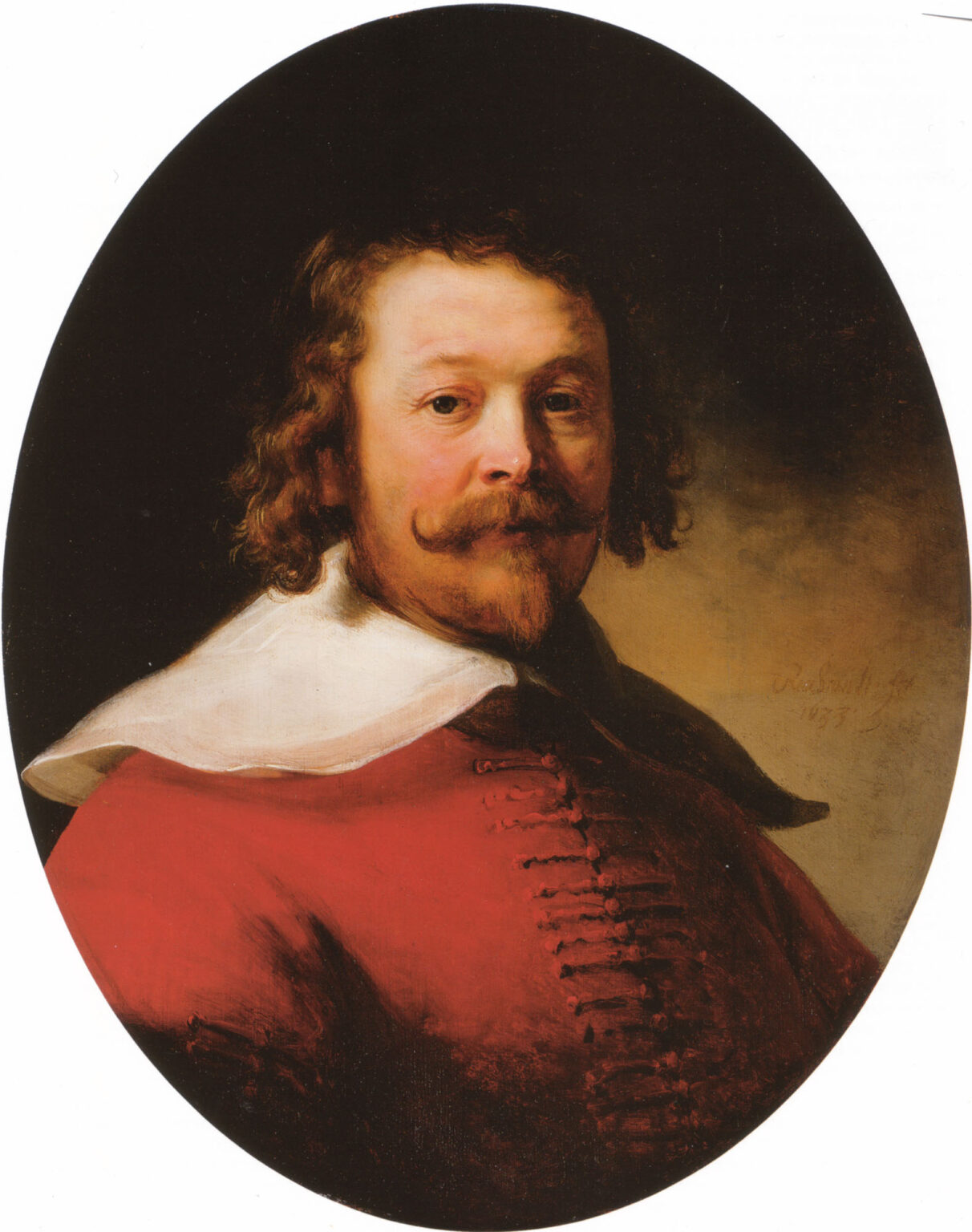
Rembrandt’s “Portrait of a Bearded Man, Bust Length, in a Red Doublet” announces itself with color before character. The sitter turns toward us from a dark oval field, his face calmly illuminated, his red doublet radiating a muted fire under the pale fold of a broad linen collar. The composition is simple and direct, yet the effect is complex: warmth without flamboyance, intimacy without intrusion, and a quietly persuasive sense that this person has stepped out of real air into our sight.
The Oval Format and Its Psychological Consequence
The portrait is set within an oval, a format that subtly concentrates attention. Unlike a rectangle, which can feel like a stage, the oval behaves like a lens or a locket—private, close, designed for contemplation. Rembrandt uses the shape to cup the head and shoulders, softening corners and trimming distractions. The curve seems to cradle the sitter’s gaze and to guide our own along a gentle circuit: from the flash of collar to the flush of cheek, along the mustache’s sweep, into the lucid eyes, and back to the red plane of the garment. The result is an unusually continuous looking experience, with no hard edge to break the flow of attention.
A Composition Balanced Between Warmth and Clarity
The sitter’s body turns slightly away as his head returns toward us, a classic three-quarter configuration that generates both depth and engagement. A narrow band of warm background intrudes at the right, giving the head a halo of earth tone rather than theatrical glow. The red doublet supplies mass and authority, but Rembrandt lets it fall into broad, economical modeling so that facial nuance can dominate. The big shapes are decisively arranged—dark field, bright collar, red garment, flesh oval—with transitions that feel as inevitable as they are refined.
The Drama of Red and the Discipline of White
Color here is character. The red is not a shout but a sustained note, rich with umbers and crimson lakes, deepened at the shadowed flank and aerated by soft halftones near the shoulder. Its warmth courts extroversion while the immaculate white collar disciplines the scene. That collar is painted with a sculptor’s intelligence: one wing lifts, catching light along a crisp ridge; the other curves downward toward shadow, its starch softened by use. Between them, the face glows with intermediary hues—peach, rose, tawny ocher—uniting the garment’s heat and the linen’s cool authority. Rembrandt composes color like an argument that arrives at harmony.
Light That Models Truth Without Spectacle
Rembrandt’s light is factual and kind. It strikes from upper left, catching the brow, the bridge of the nose, the upper lip, and the round of the cheek, then diminishes across the shadowed jaw and ear. Nothing blares; everything is calibrated to make the structure of the head persuasive. Tiny pearls of highlight animate the moist rim of the eye and the edge of the nostril. The skin is not polished porcelain; it is living tissue with slight subsurface bloom and the faint blotches that accompany real blood. Light dignifies the person by describing him truly rather than impressively.
The Grammar of Hair and Mustache
The sitter’s mustache, curled in controlled flourish at the ends, carries both style and temperament. Rembrandt paints each curve with a loaded, elastic stroke that records the brush’s pressure and the painter’s confidence. The beard along the chin is shorter and softer, indicated with feathered touches that allow the flesh tone to whisper through. Hair at the temples breaks into small waves that lose themselves at the dark background, edges dissolving like breath into air. This hair grammar—strong calligraphy at the mustache, soft texture at the beard, evaporating rim at the crown—animates the head without upstaging the eyes.
Eyes That Think Rather Than Pose
The eyes meet ours with composure. They are set slightly deep, sheltered by a gentle brow, and their gaze is steady rather than piercing. A trace of moisture, a micro-glint, and a damply reddened waterline make them convincing. More important is their psychological tone: expectant, not suspicious; alert, not defensive. The sitter appears to have been addressed and to be answering with attention. Rembrandt avoids the flattery of over-definition and the chill of indifference; he aims for the middle register where a person’s mind can be felt at work.
Flesh, Breath, and the Microclimate of the Face
Rembrandt’s handling of flesh suggests breath moving under skin. On the cheek, feathered halftones blend into a warmer blush; at the nose, delicate cooler notes keep the structure from swelling; around the mouth, subtle greys anchor the mustache and prevent sweetness. The painter alternates thin, lucid passages with thicker, buttery ones so that light appears to travel through the paint, not merely across it. The presence is physical enough to feel within reach and yet pictorial enough to remain a made thing, an artifact of judgment and touch.
Cloth as Social Signal and Painterly Playground
The red doublet is laced down the front, its closures registered by quick, confident impastos that read as loops or toggles. These notations are spare and musical—repeated marks that imply craft without enumerating every stitch. The garment declares status through color and cut, but Rembrandt resists fetishizing textile; he gives the doublet just enough finish to carry social meaning and then frees it to become an abstract plane against which the head resonates. It is both wardrobe and field, biography and design.
The Collar as Architectural Device
The broad collar is a small feat of engineering. One point flicks outward into space like a wing; the other lies back toward the shoulder as if recently adjusted. Its whiteness gathers and redistributes light, acting as a reflector that lifts the shadows under the chin while offering a bright counterform to the red. The edge is drawn with a firm but breathable contour, and the inner fold carries a faint pink where reflected skin warms the linen. This attention to optical truth makes the collar a participant in the portrait, not a mere border.
The Background and the Ethics of Omission
The dark surround is not an empty hole; it is a chamber that keeps the sitter’s presence undiluted. A warm plume to the right provides atmospheric depth and hints at the space outside the oval without narrating it. Rembrandt omits props, books, balustrades, or draperies that might distract, trusting the face to carry the narrative. This ethic of omission insists that character can be delivered through paint alone, without rhetorical devices.
The Turn of the Body and the Quiet Assertion of Agency
The sitter’s body rotates leftward, but the head arrests that motion by returning just enough to acknowledge the viewer. The posture communicates agency without aggression, a controlled hospitality. Shoulders broaden the base of the triangle that holds the composition steady, while the lifted collar point introduces a buoyant counter-note. The balance tells us something about the man: a temperament open to engagement, anchored by self-possession.
The Signature of 1633 and the Young Master’s Ambition
Painted in 1633, the work belongs to Rembrandt’s early Amsterdam years, when he had recently moved from Leiden and was pursuing portrait commissions with a mixture of bravura and discipline. The finesse of the skin, the relish for costume, the lucid lighting, and the modest oval format all belong to his public-facing maturity-in-bloom. While some portraits of the period push toward decorative splendor, this one favors psychological quietude, indicating a young master already confident enough to let restraint signal authority.
Technique as Evidence of Looking
The surface records choices. In the red doublet, broader brushes lay out planes with sweeping unity; around the eyes and nose, smaller, precise touches articulate form; in the hair, flexible strokes ride over underlayers to catch highlight. Glazes enrich shadows at the jaw and collarbone, while scumbled passages soften the transition at the temple. This variety of handling is not decorative virtuosity; it is evidence of looking—different tools for different truths, all in the service of a coherent presence.
The Social World Behind the Face
The sitter’s dress suggests a man of means, likely a member of the burgeoning Amsterdam middle class or professional elite who sought portraits that combined sober dignity with fashionable flair. The red doublet indicates confidence and prosperity, the white collar conveys cleanliness and order, and the moustache—a cultivated flourish—signals awareness of style. Rembrandt captures these social signals while refusing to reduce the man to them. The portrait does not advertise a brand; it shows a person who happens to wear one.
Psychological Register: Candor, Humor, and Reserve
There is a trace of humor at the mouth’s corners, a softening that resists severity. The eyes hold candor more than challenge. Yet reserve remains; the subject is not undressed emotionally. Rembrandt threads these strands—openness, warmth, self-command—into a unified tone that keeps the face readable but not exhausted by explanation. We feel we could speak with him and that he would answer thoughtfully, perhaps wryly, from a settled center.
The Poetics of Edges
Edges in the painting are modulated like breath. The collar’s outer rim sharpens where it cuts against the dark; the hairline softens as curls lose themselves at the background; the cheek’s contour is neither crisp nor mushy but negotiates delicately with the surrounding air. These edge decisions control the portrait’s pulse, advancing and receding attention, admitting space, and preventing the head from behaving like a cutout. The sitter seems to occupy the same air we do.
A Portrait of Time Held Gently
Time is visible but not insistent. A slight flush suggests recent movement or conversation. The mustache’s careful turn implies minutes of grooming that morning. Light falls as if from a real window at a particular hour. These cues anchor the picture in the quotidian while the oval and the dark ground lift it toward the timeless. The painting holds time gently, keeping a living moment while allowing it to stand for more than itself.
Why the Portrait Still Feels Contemporary
Modern viewers find the combination of minimal staging, direct gaze, and confident color strikingly fresh. The portrait reads like an honest profile image turned masterpiece: no props, just light, cloth, and a face. Its restraint amid abundance, its warmth without gloss, and its trust in human presence over allegorical flourish align with contemporary tastes for authenticity. The painting models how to be seen without spectacle.
A Closing Reflection on Presence and Paint
“Portrait of a Bearded Man, Bust Length, in a Red Doublet” distills Rembrandt’s early gift for making paint behave like presence. Color and light collaborate to unveil structure; brushwork records thought; omissions clear a path for character. The red garment brings the world’s energy; the white collar brings order; the face gathers both into a poised humanity that meets our gaze across centuries. The painting does not insist on a story; it offers a person. In that offering lies its lasting authority.