Image source: wikiart.org
Introduction
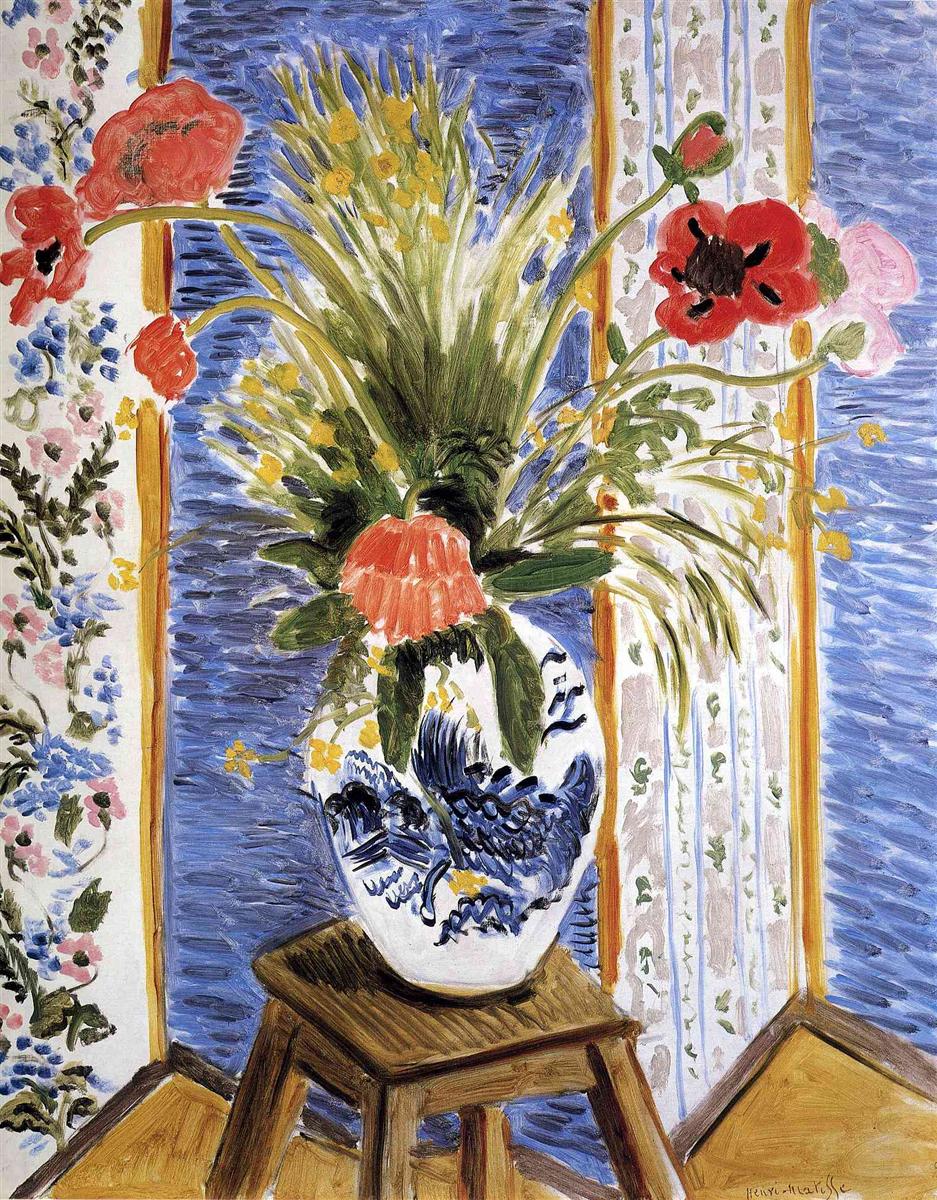
Henri Matisse’s “Poppies” (1919) stages a floral arrangement as a radiant performance of color, pattern, and movement. A white porcelain vase painted in luminous cobalt sits on a wooden stool. From that vessel springs a dramatic bouquet: red poppies with deep centers, feathery grasses that flare like fireworks, and small yellow blossoms that sparkle between green blades. Behind the bouquet a decorative screen or wall—organized in vertical panels—alternates floral bands with dense fields of rippled blue. The floor tilts up in warm ochres, turning the corner of the room into a shallow stage. Everything is orchestrated to keep the eye circulating, to let color do the architectural work, and to transform a domestic still life into a complete environment.
Historical Moment and the Nice Period
Painted in 1919, “Poppies” belongs to Matisse’s early Nice period, the years immediately following the First World War when he turned repeatedly to interiors, screens, bouquets, open windows, and patterned textiles. The Mediterranean climate of Nice offered even, temperate light that suited his reformulated ambition: to rebuild harmony with lucid color relations rather than with the shock tactics of his Fauve youth. During these years, decoration ceases to be a surface accessory and becomes structural; shallow spaces are preferred so that painting remains a designed object; and the everyday—flowers on a stool, a chair by a window—becomes the site of an expansive visual music. “Poppies” epitomizes that program, uniting ornamental vigor with a calm, legible order.
First Look at the Motif
The motif is simple and abundant at once. A blue-and-white vase anchors the center, perched on an angular stool whose legs splay like a small easel. The bouquet is exuberant: two large red poppies dominate the right and left, a coral blossom gathers light at the center, and long grasses launch upward, fanning out to nearly touch the top edge. Sprigs of tiny yellow flowers stitch through the greens, catching the eye like notes in a melody. The backdrop is divided into panels bounded by warm yellow borders: some panels display floral tapestries in soft pinks and blues, while others are brushed into dense, horizontal waves of blue. Matisse places the stool near the room’s corner, where ochre floorboards meet and climb the wall as triangular planes, compressing space and concentrating attention around the vase.
Composition and Framing
Matisse builds the composition as a set of echoes and counters. The vase’s oval mass sits low, its white body surrounded by darker fields so that it glows. The stool forms a second, earthy anchor whose diagonals aim toward the bouquet’s vertical surge. Above, the fan of grasses arcs outward in three principal directions—left, center, right—creating a crown that contains the red poppies and carries the gaze to the painting’s edges. The background panels run vertically, countering the bouquet’s splay and giving the image a calm spine. The borders between panels act like pilasters, architecture for a floral theater. Cropping is tight enough that the bouquet seems to press into the space of the viewer, yet there is no crowding; the screen’s bands provide breathing intervals and clarify the bouquet’s silhouette.
Color Architecture
Color is the true scaffolding. The background’s deep blues form a cool field against which warm accents can flare. Those cools are tempered by the vertical borders painted in honeyed yellow, so blue never becomes cold. The poppies are hot cadmium reds with near-black hearts; they deliver the painting’s loudest notes and establish its emotional temperature. The coral blossom at the bouquet’s center is a softer orange-red that bridges to the yellow sprigs. Greens vary from dark bottle tones to olive and sap; each green registers as a plane rather than a blended haze. Most decisive of all is the white of the vase, intensified by cobalt decorations. That white repeats in the floral panels at left and right and in small flecks among the bouquet, binding the high-intensity colors into a single chord. Because each color family appears in more than one location, the eye senses coherence: blue in the panel and in the vase’s design; red in poppies and coral head; yellow in borders and blossoms; green in leaves and in the hints painted atop the stool’s shadow.
Light and Atmosphere
The light is Mediterranean and even, arriving as a broad wash rather than as spotlit drama. Surfaces are turned not by heavy chiaroscuro but by temperature shifts and the direction of the brush. On the stool, cooler strokes describe shaded planes while warmer ones catch the top where light rests. The vase is modeled with the minimum means: a few gray-violet notes under its belly, a lifted highlight along the left rim, and reflected blues from its painted design. The grasses receive thin, swift strokes that leave the canvas breathing between them, letting light feel like air moving through the bouquet. The screen’s blue panels are scumbled with horizontal strokes that recall light glancing off silk or painted paper. This moderated climate keeps the painting hospitable; it lets color speak in full voice without glare.
Pattern and Ornament as Structure
Ornament in “Poppies” is not added flourish; it is the architecture of the picture. The screen’s floral bands, with their pink and blue sprays on white, echo the bouquet’s forms at another scale. The blue panels, dense and horizontal, act as tonal counterweight and as a continuous plane that holds the bouquet near the surface. The golden borders act like columns, joining floor and wall, unifying the room’s geometry, and giving the composition a grid within which the explosive bouquet can remain legible. Even the stool participates in this decorative logic: its legs create simple calligraphic lines that repeat the arabesques of leaves and stems. The result is an interior built out of pattern—modern flatness harnessed to a classical sense of order.
The Vase as Actor
The vase merits particular attention. Its white body is animated by cobalt designs that suggest a bird or dragon in motion, a nod to the blue-and-white porcelain traditions Matisse admired. That painted creature contributes a secondary narrative—motion within stillness—and a crucial formal device: concentrated darks within light that stabilize the entire lower half. The vase’s whiteness also reflects nearby color. You can sense faint greens and pinks scumbled across it, binding vessel and bouquet. Placed on the stool, the vase’s roundness pushes against the rectangular furniture and the vertical screen, heightening the sense that living forms press outward from a designed frame.
The Bouquet: Gesture and Species
Although the title calls out poppies, the bouquet includes companions: airy grasses whose seed heads flicker yellow, a central coral flower that warms the heart of the ensemble, and several leafy sprays that provide depth. Matisse paints species as character rather than inventory. Poppies are the extroverts—large, flat blooms with dark centers that read instantly at a distance. Grasses are kinetic and feathery, vectors that carry the eye upward and outward. The small yellow flowers scatter like percussion, keeping rhythm among the larger leaves. He renders them with strokes that remain legible as paint; petals and seeds are single gestures, not laborious constructions. This economy sustains freshness and preserves speed in the image, as though the bouquet still remembers the moment it was arranged.
Brushwork and Material Presence
Across the surface, the variety of touch creates a tactile syntax. The blue panels are streaked with repeated, slightly dry horizontal strokes, a weave that becomes a modern equivalent of a tapestry ground. The grasses are pulled in long, loaded arcs that taper to a filament. Poppies are spread with opaque, buttery passes, their centers punched in with thick, dark discs. The stool and floor are laid down with broader, directional strokes that articulate plane by orientation rather than by blend. Nowhere does Matisse pretend that the paint is something other than pigment on canvas; yet everywhere the strokes do double duty, giving both material truth and the sensation of objects under light.
Space: Shallow, Breathable, Designed
The picture’s space is shallow by intention. The stool’s angles and the floor’s twin wedges create a small, habitable corner; the screen rises immediately behind the bouquet, preventing deep recession. This shallow construction preserves the picture plane where decoration thrives while granting enough depth for the bouquet to occupy real air. It is the spatial compromise characteristic of the Nice period—a painting that remains a designed object even as it hosts a believable interior.
Rhythm and the Eye’s Path
“Poppies” trains the viewer’s gaze like a conductor. Most eyes begin at the bright red bloom on the right, leap to the coral center, and then to the left poppy before riding the arcs of grass to the top edge. From there the eye slides down a golden border, touches the blue panel, and finds its way to the vase’s cobalt figure, which spins the gaze into the stool and floor planes. The loop closes as one returns to the bouquet through the opposite border. Each turn of the circuit reinforces correspondences: red against blue, white vessel against dark field, vertical border against splaying grass. The image becomes an optical promenade, not a static display.
Dialogue with Tradition
The painting converses with a long tradition of still life and decorative art. The blue-and-white vase recalls centuries of Asian porcelain prized in Europe—a cross-cultural object Matisse collected and sketched often. The screen’s bands echo Japanese and Islamic textiles that informed his sense of pattern. At the same time, the work is resiliently modern: flatness is affirmed, cast shadows are minimal, and illusion gives way to surface relations. Where an academic still life might labor to represent roses with botanical precision, Matisse shows how a few decisive strokes can carry character more vividly and how surrounding pattern can elevate a bouquet into architecture.
Psychological Tone and Seasonal Suggestion
Poppies often carry associations of summer fields and, in European memory after the war, of remembrance. Matisse does not press symbolism, yet the choice of poppies in 1919 reads as a quietly hopeful gesture: life vivid and brief, beauty candid rather than solemn. The painting’s mood is extroverted but not strident. The blue ground cools the temperature; the golden borders and ochre floor warm it again; the bouquet bursts but remains held within pattern. The room feels well tuned, alive to air and color, a place where attention heals.
Relations to Other Works of 1919
When set beside other Nice still lifes—“Daisies,” “Flowers,” “Pansies on a Table,” and “Still Life with Lemons”—this canvas is the most theatrical. The stool lifts the vase like a pedestal; the screen furnishes a decorative proscenium; the bouquet performs. Yet the underlying grammar is the same: large planes, structural pattern, and a small family of saturated accents. Where “Daisies” uses a single rectangle of sky as a luminous wall, “Poppies” multiplies planes into a tri-fold screen; where “Pansies on a Table” cultivates chamber intimacy, this painting expands into orchestral color without sacrificing clarity.
A Closer Look at the Palette
The color set appears concentrated and deliberate. Cobalt and ultramarine shape the deep blues of panel and porcelain; lead white suffuses the vessel, floral bands, and highlights; cadmium reds and vermilion energize the poppies; yellow ochre and a touch of Naples yellow build borders and floor; sap green and emerald provide leaves; earth umbers construct the stool; ivory black intensifies flower centers and cobalt outlines. The paint is mixed to relative opacity so that colors stand as planes rather than veils. That solidity of hue is a principal reason the composition reads as architecture.
How to Look
The painting rewards viewing at two distances. From across a room, allow the big chord—red poppies, blue panels, white vase—to sound first. Notice how the golden borders lock the rhythm and how the floor wedges push you inward. Then approach to reading distance. Watch how a single stroke becomes a grass blade, how tiny yellow dots float like pollen, how the cobalt creature on the vase animates the lower register. Step back again; the strokes fuse, the bouquet breathes, the screen steadies it. This oscillation between near and far is the experience Matisse designs: seeing paint and seeing flowers at once.
Legacy and Significance
“Poppies” synthesizes much of what would carry Matisse forward. The belief that pattern can be structural culminates in the paper cut-outs decades later; the anchoring use of bold planes informs his late chapel work; the trust in color’s capacity to build order remains a touchstone for painters after him. As a single canvas, it stands as a persuasive statement that domestic subjects can bear large artistic arguments. A stool, a vase, a screen, and a handful of flowers are sufficient to express a civilization of color.
Conclusion
In “Poppies,” Matisse turns a bouquet into a complete environment. The white porcelain vase glows as a central lantern; red poppies strike the high notes; grasses and yellows shimmer like accompaniment; blue panels provide depthless air; golden borders erect the theatre; the stool and floor steady the stage. Brushwork remains visible, space remains shallow but habitable, and color carries structure. The painting offers a vision of order that is joyous and disciplined at once—an emblem of the Nice period’s promise that clarity, decoration, and everyday life can harmonize.