Image source: wikiart.org
Introduction
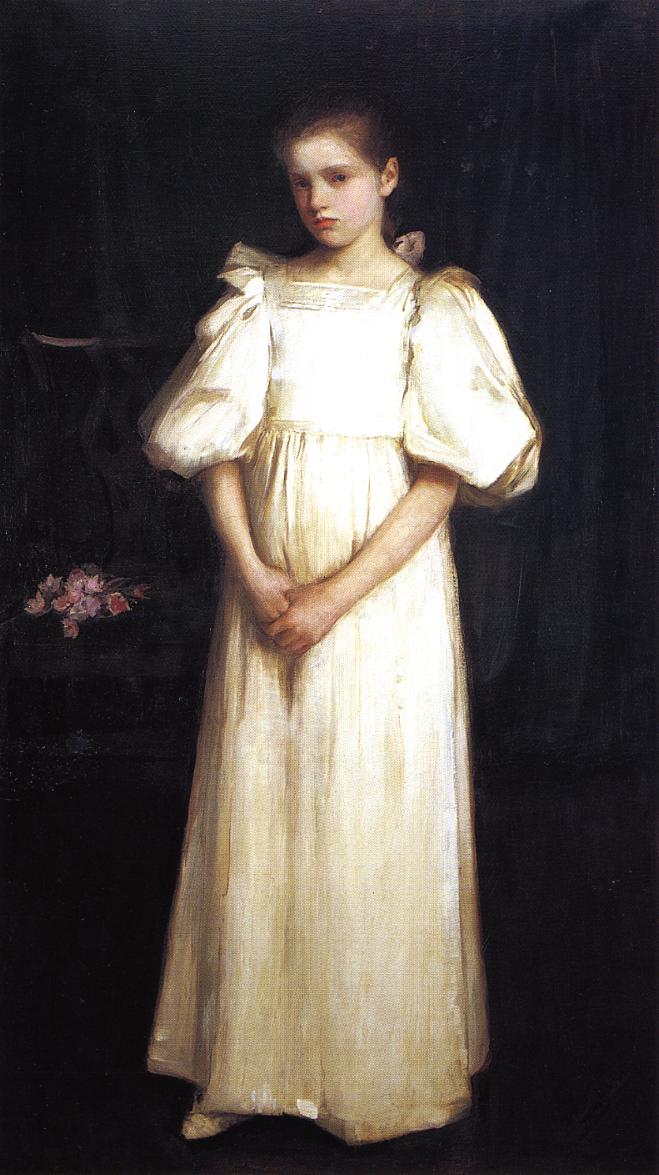
Painted in 1895, “Phyllis Waterlow” is one of those portraits that feels quiet at first, then steadily grows more intense the longer you stay with it. John William Waterhouse places a young sitter full length against a dim interior, letting her white dress act like a lantern in a shadowed room. The result is both simple and psychologically alert: a child presented with formal restraint, yet rendered with enough sensitivity that you sense a whole inner life just behind the face.
What makes this portrait memorable is not an elaborate story or theatrical setting, but the careful balance between presence and distance. The girl’s body is solidly there, hands folded, feet planted, dress weighty and real. At the same time, the background recedes into near darkness, as if the world around her has been lowered in volume so we can hear the quieter register of her mood. The painting becomes an encounter with a person, not a costume display, not a sentimental vignette.
First Impressions and Setting
The first thing most viewers notice is the contrast: a pale figure in a light dress set against a deep, muted ground. The background is not empty, but it is deliberately subdued, with soft indications of furniture and a dark curtain or wall surface. This restraint makes the interior feel private, almost hushed, like a sitting room with the lamps turned low. The portrait does not advertise wealth through glittering objects or bright décor. Instead, it suggests a domestic space where attention is directed toward character, posture, and the small signs that imply upbringing.
A cluster of pink flowers sits off to the left, low and quiet. It is not a loud bouquet staged for spectacle. It reads more like an incidental presence in the room, a note of color that gently answers the sitter’s youth. The setting feels real, but also edited, as though anything that might distract from the girl’s stillness has been softened into shadow.
Composition and Pose
The composition is built around a steady vertical, the figure rising from the darker lower edge to the lighter center where the dress catches the most illumination. Waterhouse keeps the pose restrained: shoulders relaxed, arms lowered, hands clasped in front. The gesture is both polite and protective. Clasped hands can signal training in manners, but they can also signal self-comfort, a way of gathering oneself when asked to stand still and be observed.
Her head tilts slightly, creating a subtle diagonal that prevents the portrait from becoming stiff. That tilt, combined with her direct but reserved gaze, generates the painting’s emotional tension. She is not smiling, not performing cheerfulness. Yet she is not withdrawn into blankness either. She meets the viewer with a seriousness that feels practiced and genuine at the same time, like a child learning the adult language of composure.
The space around her is carefully rationed. There is enough room to breathe, but not so much that she feels lost. The dark field behind her acts like a stage backing, compressing depth so that her presence feels close. Waterhouse uses this closeness to make the portrait feel intimate without being invasive.
Light, Tonal Structure, and the Drama of White
The painting’s emotional force is carried by light, especially the way light behaves on white fabric. White is difficult: it can look chalky, flat, or harsh if handled carelessly. Here, it becomes nuanced. The dress is not a single white, but a spectrum of warm creams, pale golds, and cool highlights. The brightest area sits across the upper bodice, pulling the eye to the center of her torso, then up to her face.
This is a clever tonal strategy. By making the dress the brightest element, Waterhouse turns the sitter into the painting’s light source. The surrounding darkness is not only background, it is a foil that makes her seem more vivid, more fragile, more immediate. At the same time, the shadows within the folds keep the dress grounded in material reality. You sense the thickness of cloth, the way it hangs, the way it gathers at the waist, the way weight pulls it downward.
Notice also how the light does not create sharp edges. The transitions are soft, giving the portrait a gentle atmosphere. This softness is not laziness, it is control. The painter wants the scene to feel like it is seen in quiet indoor light, not in harsh daylight. That choice matches the sitter’s mood: introspective, contained, and slightly solemn.
Color and the Quiet Accent of Pink
Although the palette is mostly restrained, it is not colorless. The skin carries delicate warmth, especially in the cheeks and lips. The hair, dark and softly handled, sits between the extremes of white dress and black background, acting as a middle tone that helps the face feel anchored.
The small patch of pink flowers on the left matters more than its size suggests. It introduces a tender color that echoes the sitter’s youth, but it also keeps the painting from becoming a purely monochrome exercise. Pink against dark is a classic move for softness, but Waterhouse avoids the overly sweet effect by keeping the flowers low, partially in shadow, and visually secondary to the figure.
This creates a quiet rhythm: white, flesh, dark, then a small return of gentle color. It feels like a controlled chord progression rather than a decorative flourish. The overall mood stays serious, but the pink keeps it human, reminding you that this is a young person in a lived room, not an abstract study.
Brushwork, Texture, and Waterhouse Technique
Waterhouse is often praised for lyrical surfaces, and here he adapts that sensibility to portraiture. The paint handling is smoother in the face, where small shifts in value and tone shape the cheeks and jaw. The eyes and mouth are defined with restraint, avoiding harsh outlines. This approach makes the expression feel natural, not pinned in place.
In the dress, the brushwork becomes more visible. The sleeves, especially, show broader handling, with light catching the rounded volume of fabric. Those puffed sleeves are painted in a way that emphasizes air and structure, as if you can feel the cloth’s stiffness and the trapped space inside. The lower skirt is more softly generalized, suggesting the long fall of fabric without turning every fold into a crisp diagram.
The background is the most economical, with dark paint laid in with minimal description. This economy is not a lack of skill, it is a deliberate hierarchy. Waterhouse spends detail where psychology lives, and he simplifies where distraction might creep in. The painting reads as confident because it knows what to state clearly and what to leave implied.
Clothing as Narrative: Childhood, Formality, and Transition
The dress is central to the portrait’s story. It is formal enough to signal a posed sitting, yet it retains a simplicity associated with childhood clothing rather than adult fashion drama. The long skirt and structured sleeves create a silhouette that feels ceremonial, almost like a special occasion garment. At the same time, the unadorned whiteness avoids the impression of vanity or display.
White in portraiture often carries layered meanings: innocence, cleanliness, social respectability, and the idea of being presented. In a child’s portrait, these meanings intensify. The sitter becomes a symbol of family hopes, good upbringing, and the promise of the future. But Waterhouse does not let the symbol swallow the person. The dress may speak of ideals, yet the girl’s expression speaks of lived feeling, which is more complicated than any ideal.
There is also a sense of transition. The sitter is not a tiny child, but not an adult. The posture feels trained, the gaze composed, the mouth serious. The painting registers that in-between state where a person is old enough to understand being looked at, and young enough to still feel the weight of that attention.
Expression and Psychology
The face is where the portrait becomes genuinely affecting. The sitter’s gaze is direct, but not inviting. It holds the viewer at a respectful distance. There is no obvious narrative clue that tells you what she is thinking, and that ambiguity is part of the portrait’s realism. Many children, when asked to pose, fall into a quiet seriousness that is not sadness exactly, but concentration, patience, and a mild discomfort at being required to perform stillness.
The slight downward set of the mouth and the calm steadiness of the eyes create an emotional key that feels truthful. The painting does not manufacture charm. Instead, it suggests a personality: thoughtful, reserved, perhaps a little wary. The portrait becomes less about prettiness and more about temperament.
Her clasped hands reinforce this psychological reading. Hands in portraits often reveal what faces hide. Here, they show restraint and self-control. The gesture can be read as etiquette, but it can also be read as a subtle self-hold, an instinctive way of staying composed during a long sitting.
Space, Furniture, and the Interior Stage
The dark furnishings behind her are barely described, yet they matter. Their presence anchors the figure in a real domestic interior. Without them, the darkness could become purely abstract. With them, it becomes a room, a place, a social environment.
The furniture and shadowy backdrop also create a sense of enclosure. The sitter is framed by darkness that feels protective rather than threatening. It is as if the room wraps around her, holding the moment still. This contributes to the portrait’s mood of quiet observation. You are not seeing a public presentation in a grand hall. You are seeing a controlled, private moment where the subject is asked to stand, to be recorded, and to endure the gaze.
The small floral note at the left also helps structure the space. It pulls the eye outward briefly, then returns you to the figure. This prevents the composition from becoming a single vertical column and adds a gentle asymmetry that keeps the painting alive.
Waterhouse in 1895 and the Portrait Tradition
By 1895, Waterhouse was known for images that often drew on literary and mythic themes, yet he was also capable of portraiture that carries a similar poetic restraint. This painting feels connected to a broader late Victorian taste for tonal harmony, psychological seriousness, and carefully managed light. It is not a flashy society portrait aimed at spectacle. It is closer to a thoughtful study, where character is suggested through understatement.
The portrait also echoes certain Pre-Raphaelite values without copying early Pre-Raphaelite sharpness. Pre-Raphaelite Brotherhood ideals often involved attentiveness to presence and an intensity of looking, even when the subject is quiet. Here, Waterhouse channels that intensity into tone and mood rather than jewel-like detail. The darkness behind the figure, the luminous dress, and the meditative stillness create a modern kind of gravity.
In the context of Victorian portraiture, the painting stands out for its refusal to over-explain. Many portraits of children lean into sentimentality. Waterhouse gives dignity instead. The child is not turned into a cherub or a decorative accessory. She is treated as a person with interiority, which is a subtler and more respectful approach.
Themes: Innocence, Self-Possession, and Social Identity
“Innocence” is the obvious theme viewers might reach for, because of the white dress and the youth of the sitter. Yet the painting complicates innocence by adding seriousness. The girl is not depicted as carefree. She is depicted as aware. This awareness is crucial. It suggests that childhood is not merely playfulness, it is also learning, observation, and the early formation of selfhood.
Self-possession is another key theme. The sitter’s body language is controlled, not passive. Even in stillness, there is a sense of firmness. She is presented, but she does not dissolve into the presentation. Her gaze marks a boundary. She seems to be saying, quietly, that she will be seen, but she will not be easily owned by the viewer’s imagination.
Social identity is present, too, though understated. The formal clothing, the interior setting, and the calm discipline of the pose all imply a certain class environment where manners and presentation matter. The portrait becomes a record of how a family wished to see their child, and also a record of how the child actually appeared in that moment, with her own temperament intact.
Why the Painting Still Works Today
This portrait remains compelling because it does not rely on a fashionable gimmick or a loud narrative hook. It relies on human presence. Many modern viewers respond to images that feel authentic, and this painting feels authentic in its refusal to oversell emotion. The sitter’s seriousness reads as real rather than staged. The lighting reads as observed rather than theatrical. The background reads as a lived space rather than a decorative set.
The painting also offers a lesson in restraint. It shows how a limited palette can still feel rich, how a simple pose can still carry psychology, and how quietness can be more haunting than drama. In a visual culture that often rewards spectacle, Waterhouse’s calm control feels refreshing.
Finally, the portrait invites repeated looking. The longer you look, the more you notice small decisions: the subtle modeling of the sleeves, the gentle warmth in the face, the way the dark background sets off the figure without swallowing her. It is a portrait that rewards patience, which is perhaps fitting for a subject who had to practice patience herself during the sitting.
Closing Reflection
“Phyllis Waterlow” captures a moment balanced between childhood and the expectations that begin to gather around it. Waterhouse paints the sitter with tenderness, but also with seriousness, allowing her to appear as more than an emblem. The white dress glows, but it does not turn her into a symbol without weight. The darkness surrounds her, but it does not erase her. Instead, it gives her a stage where the smallest signs of expression matter.
The portrait’s power lies in that balance: light and shadow, formality and feeling, presentation and personhood. It is a quiet painting, but it is not a slight one. It stays with you because it respects the complexity of a young subject, and because it trusts that the simplest means, tone, posture, and gaze, can carry the deepest sense of life.