
Image source: wikiart.org
Introduction to “Phyllis and Demophoön”
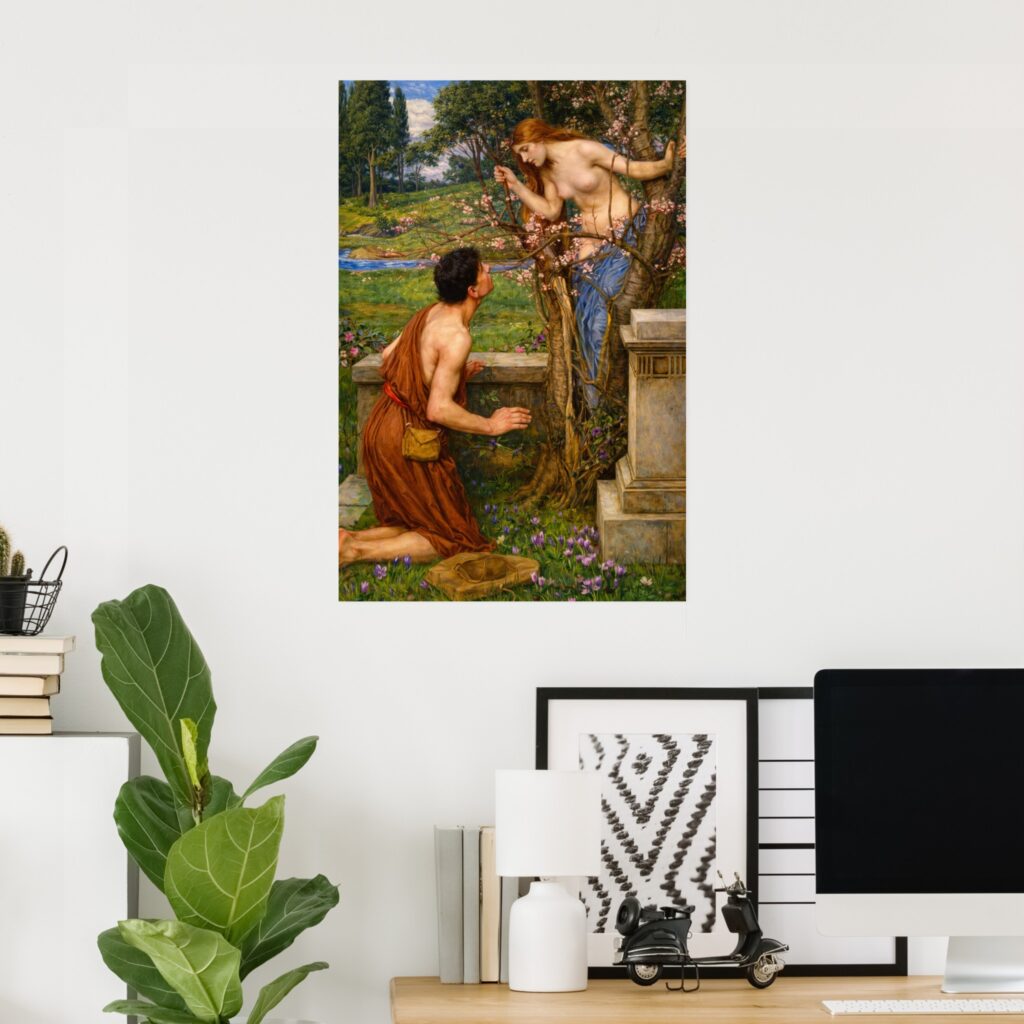
John William Waterhouse’s “Phyllis and Demophoön” (1905) stages a myth of longing and retaliation with the quiet intensity of a garden scene. At first glance, the painting looks like a tender encounter framed by blossom and stone. The longer you stay with it, the more it feels like a moment caught mid turn, when devotion curdles into consequence. Waterhouse chooses not to show the myth’s loudest outcomes. Instead, he paints the instant when emotional pressure becomes visible in posture, distance, and touch.
The work belongs to Waterhouse’s late, mature handling of mythological subjects, where ancient stories become intimate dramas. Rather than presenting myth as spectacle, he brings it close, like a whispered confession overheard beside a wall. The figures are nearly life sized, and the setting feels navigable, not theatrical. That sense of proximity is crucial. It makes the viewer a witness, placed just behind the kneeling man, looking up toward the woman who is both near and unreachable.
The Myth Behind the Moment
The story of Phyllis and Demophoön is a tale about promises and time. Demophoön leaves Phyllis with vows of return, then delays or fails to come back when expected. In versions of the myth, Phyllis’s hope collapses into grief, and grief hardens into action. The narrative has always been concerned with waiting, and the psychological violence of being left in uncertainty. Waterhouse selects a scene that speaks to that suspended agony: the returning lover and the beloved who has already crossed the boundary from yearning to judgment.
Even without knowing the myth, the painting communicates a power imbalance in motion. Demophoön is lower, pleading or explaining. Phyllis stands above, half concealed by flowering branches, her body angled away even as her face turns down. Waterhouse lets the myth function as emotional architecture rather than literal illustration. The story becomes a set of forces: desire, betrayal, regret, and a choice that cannot be unchosen.
Setting as Emotional Stage
The garden is not simply a backdrop. It performs the scene’s emotional logic. Stone architecture suggests permanence and social order, while the blossoming tree suggests cyclical time, fertility, and the natural world’s indifferent return. The wall separating the two figures reads as a boundary between states of being: inside and outside, accepted and excluded, forgiven and condemned. Demophoön kneels on the viewer’s side of the wall, as if barred from entry. Phyllis occupies the elevated garden space, positioned like a guardian of a threshold.
Waterhouse uses the tree as a second barrier. Branches lace across the space between them, softening the divide while also tangling it. Blossoms look gentle, but they crowd the air like a web. In a love story, flowers can signal romance. Here they also suggest the trap of timing. Nature is in bloom, yet the relationship is already ruptured. That contrast sharpens the tragedy: the world is ready for union, but the human promise arrives too late.
Composition and the Geometry of Power
The composition is built on a steep diagonal that runs from Demophoön’s kneeling body up toward Phyllis’s torso and face. This diagonal carries the eye like a plea rising upward. Demophoön’s posture is open and exposed. His bent knee, extended hand, and lifted gaze create a visual grammar of supplication. He is caught in the act of reaching, not touching. That near contact intensifies the tension. Waterhouse often understands drama as the distance between a hand and its desire.
Phyllis, by contrast, is composed with a mixture of invitation and refusal. Her body is turned partly away, her arm extended back as if steadying herself against the trunk or pulling the branches aside. The pose suggests she has agency over what happens next. She does not fall toward him. She holds her height. Even the line of her neck and the tilt of her head convey deliberation rather than surrender. She looks down, but the gaze does not soften into welcome.
The wall and the pedestal at the right anchor the scene in firm verticals. These forms counter the diagonal of Demophoön’s ascent, creating a visual conflict between aspiration and obstruction. Waterhouse uses architecture as an argument. Love may urge upward and forward, but consequence is built of stone.
Color, Light, and the Mood of Late Realization
The palette is characteristic of Waterhouse’s restrained richness. Earthy browns and muted reds in Demophoön’s garment meet the cool greens and lilacs of the garden. Phyllis’s pale skin becomes a luminous focal point, not as spectacle but as emotional exposure. Her brightness draws attention while also suggesting vulnerability, as if she stands unarmored yet unyielding.
Light is soft and diffuse, avoiding sharp contrasts. This creates an atmosphere of inevitability rather than shock. The scene does not feel like a sudden confrontation in harsh daylight. It feels like something that has been forming for a long time and has finally come to a head. The blossoms and the distant landscape are painted with a gentle haze that implies memory. The viewer senses that the decisive events may already have happened emotionally, even if the characters are only now speaking them aloud.
Waterhouse’s control of temperature also matters. The garden’s greens are cool, the stone is grey, and Demophoön’s clothing introduces warmth that reads like human blood and urgency. He brings heat into a place that has already cooled toward verdict.
Gesture and the Psychology of the Two Figures
Demophoön’s face is turned up with a searching intensity. He looks like someone trying to re enter a life he left behind. His mouth is slightly parted, his expression caught between explanation and astonishment. The kneeling pose suggests both apology and dependence. Yet Waterhouse avoids caricature. Demophoön is not painted as villainous. He is painted as human, which makes the moral tension sharper. The viewer is left to weigh intention against impact.
Phyllis’s expression is more difficult to read, and that ambiguity is deliberate. Her eyes are downcast, but her mouth and posture resist easy classification as pity or anger. The ambiguity resembles the internal conflict of someone who once loved deeply and now has to decide what that love can become after betrayal. The painting’s emotional center lives in her restraint. She does not strike, she does not collapse, she does not embrace. She pauses, and the pause carries the full weight of choice.
The branches near her hands and torso also echo her psychological state. They are delicate, flowering, and yet they can scratch and snag. Love in this painting is not smooth. It is alive, tangled, and capable of hurt.
Symbolism in Blossoms, Stone, and Thresholds
The blossoms are the most immediately symbolic element. They evoke spring and renewal, but placed between estranged lovers they become bittersweet. Bloom is a sign that time has passed. The tree has moved forward whether Demophoön did or not. In a story about waiting, a flowering branch can be a calendar you cannot argue with. It marks the season Phyllis endured alone.
Stone architecture, on the other hand, represents what does not change. The pedestal and wall suggest social structures and personal boundaries that survive passion. Waterhouse often uses classical or garden architecture to imply a moral frame. Here, stone reads like consequence: impersonal, durable, and indifferent to excuses.
The threshold itself becomes a symbol of trust. Demophoön is outside, Phyllis is inside. To cross back over, he would need permission. The painting captures the precise psychological truth of a broken promise: the return is not a restoration. It is a request, and the person asked now holds power.
Waterhouse’s Pre Raphaelite Inheritance and Late Style
Waterhouse is often linked with the Pre Raphaelite tradition, especially in his attention to natural detail, mythic narrative, and the centrality of the female figure. In “Phyllis and Demophoön,” those traits persist, but they are tempered by a late style that favors mood over minute botanical inventory. The flowers and grasses are present and persuasive, yet they serve the drama more than they demand cataloging.
The painting also demonstrates Waterhouse’s continuing fascination with women at the edge of decision. Many of his mythological and literary heroines are shown in moments of transformation: a thought becoming an action, an emotion hardening into fate. Phyllis stands in that familiar Waterhouse space between inward feeling and outward consequence. He does not paint her as merely victim or avenger. He paints her as a person whose inner world has become decisive.
At the same time, the male figure is not absent or incidental. Waterhouse gives Demophoön physical presence and emotional specificity. This balance makes the narrative feel like a collision of two real experiences rather than a simple moral lesson.
The Tension Between Sensuality and Judgment
One of the painting’s most provocative qualities is its mix of sensual intimacy and moral distance. Phyllis’s nudity could easily turn the scene into a conventional mythological display. Waterhouse complicates that expectation by positioning her body as part of a psychological argument rather than an invitation. Her exposed skin is luminous, but her posture is guarded. The sensual is present, but it is not comforting.
Demophoön’s gaze could be read as desire, regret, or desperation. The painting allows these readings to overlap. That overlap mirrors how betrayal often works. The returning person may feel genuine longing, but longing does not erase harm. Waterhouse lets the viewer feel the pull of reconciliation while also sensing that reconciliation might be impossible. The erotic charge in the scene becomes another form of tension, the memory of what was and the impossibility of returning to it unchanged.
Nature as Witness and Participant
The garden feels inhabited by more than the two figures. The distant trees and soft landscape suggest an outside world that continues. Yet the immediate foreground, with its small purple flowers near Demophoön’s knees, pulls attention to the ground where he is humbled. Nature does not console him. It frames him.
The tree is especially important because it operates like a character. It stands between them, it blooms, it reaches across, it touches both spaces. In myths, transformations into trees are common, and even if the viewer does not recall the story precisely, the presence of the tree feels charged with that possibility. Waterhouse paints the trunk and branches with enough solidity to hint at inevitability. It is as if the natural world is ready to record the emotional truth of the moment in a form that will outlast speech.
What the Painting Suggests About Love and Time
“Phyllis and Demophoön” is ultimately a painting about time’s cruelty and love’s accountability. Demophoön returns, but the return is not a reset. The painting does not show the past promise, only the present consequence. That choice places the emphasis on Phyllis’s lived experience of waiting. In many love stories, the beloved is expected to forgive because the lover is back. Waterhouse refuses that easy ending. He paints the psychological reality that trust is not elastic. It stretches, and then it tears.
The scene also suggests that love can persist even when it no longer functions as reunion. Phyllis’s downward gaze could hold lingering feeling. Demophoön’s upward gaze certainly does. Yet the barriers remain. The painting’s tragedy is not that love never existed, but that love is now entangled with something that cannot be undone.
Waterhouse makes that tragedy feel quiet rather than operatic. The softness of the light, the calm garden, and the delicate flowers contrast with the intensity of the emotional stakes. That contrast is what makes the image stay in the mind. It looks peaceful. It is not.