Image source: wikiart.org
Introduction
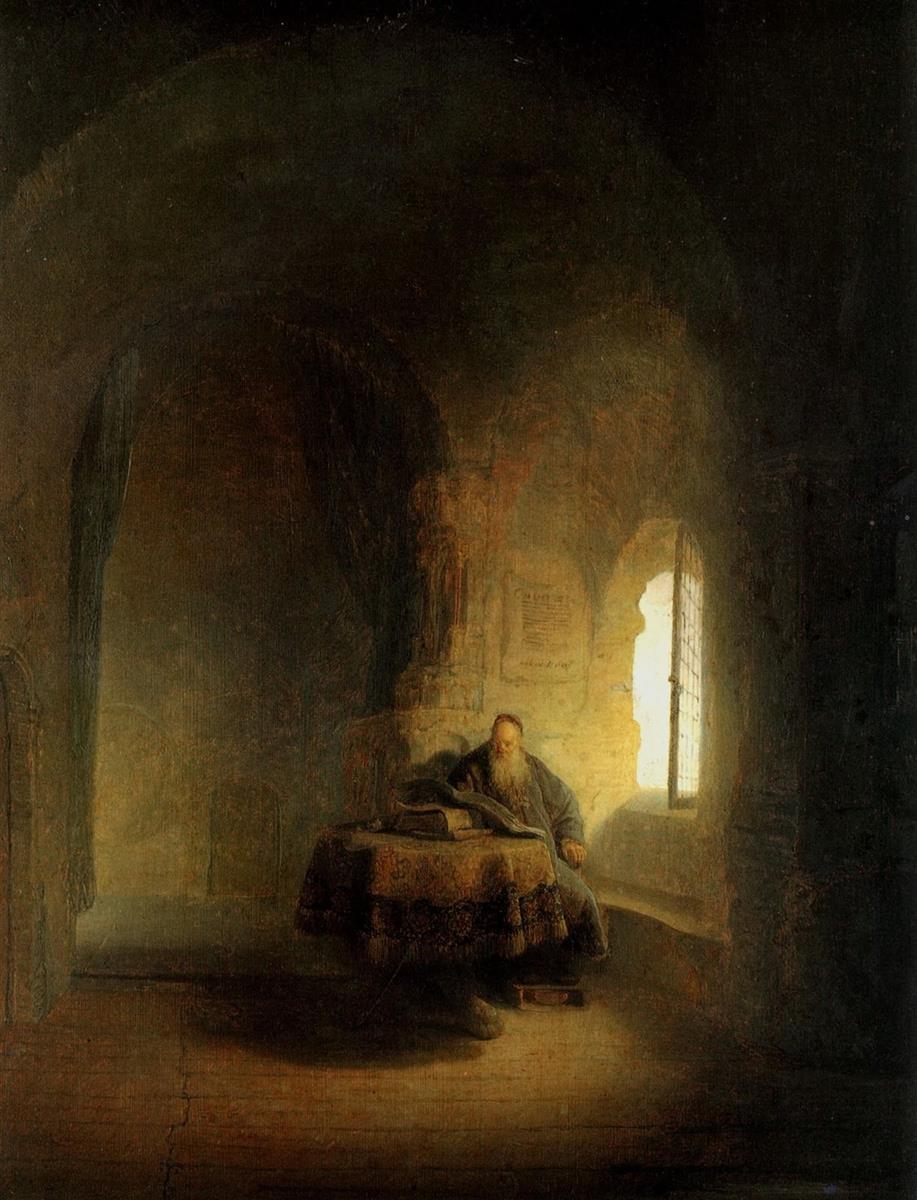
“Philosopher Reading” (1631) is one of Rembrandt’s most compelling early meditations on the union of light and thought. A solitary scholar sits at a round table draped in patterned cloth, his body half cradled by a deep window embrasure. A single casement admits a calm, honeyed light that spreads outward like revelation, briefly clothing the reader, the table, and the nearby wall before thinning into dusk across the cavernous room. The composition is at once intimate and monumental: a small figure, nearly swallowed by architecture, holds the visual center not by scale but by illumination. What begins as a description of someone reading becomes a reflection on attention itself—how a mind concentrates, how space shapes contemplation, and how light confers meaning.
The Work In Rembrandt’s Early Trajectory
The year 1631 marks Rembrandt’s move from Leiden’s tight network of studios to Amsterdam’s broader market. He was twenty-five, celebrated for his expressive heads and small-scale narratives, and increasingly ambitious about orchestrating atmosphere. This painting demonstrates the synthesis he achieved at that threshold: the human presence is rendered with the tactile specificity that had won him admirers, while the surrounding architecture reveals a newly confident command of large, fused tonal masses. The work belongs to a short cluster of early interiors where reading, study, or prayer becomes the pretext for exploring how light inscribes meaning into space. Already the seeds of the late Rembrandt are visible in the way shadow is allowed to bear emotional weight rather than merely conceal detail.
Composition And The Geography Of Thought
The composition is governed by a dialogue between a concentrated pool of activity and a vast, quiet surround. The reader sits at the lower right, positioned near the brightest value in the painting—the window’s rectangle of day. The room rises above him in a broad, vaulted darkness that curves like an apse. This asymmetry creates a psychological geography. The illuminated corner feels like the lucid zone of attention, and the dark upper expanse becomes the mind’s hinterland, a reservoir of unarticulated possibilities. The eye circles the dome of shadow and returns, again and again, to the circle of the table and the rectangle of the window, two stable shapes that frame the act of reading.
The Table As Stage And Anchor
Rembrandt makes the table do an extraordinary amount of work. Draped with an ornamental cloth whose scalloped border is crisply picked out, it acts as a stage on which books and papers assume the gravity of actors. The circular top stabilizes the composition and echoes the repetitive rhythms of study—page turning, annotation, rumination. The table’s heavy cloth also anchors the figure to the floor, so that the surrounding darkness feels like space rather than void. Subtle highlights along the cloth’s woven motifs provide a low register of visual music that never competes with the main melody of the reader’s face and hands.
Light As The Real Protagonist
The painting’s drama lies in the way light behaves. It enters laterally through the window and lands first on the sill, then on the scholar’s shoulder and cheek, then on the tabletop and open pages, before fading into a soft penumbra on the floorboards. The path of light narrates the act of reading: from source to mind to text and back again, a cycle of illumination. Rembrandt refuses theatrical spotlighting; instead he sustains a glow that feels learned rather than sudden, a kind of daylight wisdom. Because the brightest area stops short of blowing out to pure white, the whole scene retains a mellow unity, and the eye moves without glare.
The Window As Measure Of Reality
The window is more than a device for lighting; it is a measure of the world beyond. Its leaded panes state, plainly, that there is a structured reality outside the room. The broken stucco around the embrasure, with irregular edges catching light, confers history: this is an old interior that has weathered seasons and repairs. The scholar does not look outward. His attention is tethered to the book, yet the window remains his silent interlocutor, reminding viewers that study is a conversation between interior reflection and exterior order.
The Scholar’s Body And The Posture Of Attention
The figure’s posture renders attention as a tangible, architectural act. He leans into the table while his right arm trails down toward the window bench, balancing the body between activity and rest. The beard flows like a stream from face to chest, visually connecting mind and heart. His robe is painted in broad, cool notes that belong to the room’s shadowy tonality, so that the head and hands emerge as the warm pivots of consciousness. The mouth is relaxed; the brow is gently set; nothing strains. This is the anatomy of well-practiced concentration.
Silence, Time, And The Acoustics Of Space
Rembrandt makes silence visible. The vaulted ceiling that curves into rich darkness behaves like an acoustic shell, absorbing noise and slowing time. The floorboards carry the light forward in long, soft bands that feel like quiet footfalls. A closed door and a curtain drawn back to a secondary recess suggest other rooms, other lives, temporarily muted. The slow gradations from shadow to light teach the viewer to breathe a little more slowly. The painting orchestrates not just looking but tempo.
Texture As Vocabulary
Every surface carries a specific vocabulary of touch. The rough plaster around the window is articulated with small, broken highlights that mimic crystalline dust. The tablecloth receives short, velvet strokes that catch the light like woven nap. The scholar’s robe is handled with broader, quieter sweeps, letting form emerge from temperature shifts rather than from decorative pattern. Books are given small, emphatic accents along edges and spines, granting them substance without fussy description. The floor is a field of worn translucency, in which delicate linear cracks act as memory traces. Together these textures construct a tactile world that answers to the mind’s focus: where attention lands, description sharpens; where attention loosens, paint opens into atmosphere.
Color And The Moral Temperature Of Warmth
The palette is restricted but eloquent. Warm ochres and ambers concentrate near the window and table, while cooler greens and brown-blacks saturate the recesses. This distribution reads as a moral temperature map. Warmth accompanies the life of mind and the companionship of books; coolness reigns in the untraveled reaches of the room. The coordination of value and temperature allows Rembrandt to shift emphasis with extraordinary subtlety. A minor increase of warmth along the scholar’s cheek can summon presence more effectively than any contour could.
The Books As Actors And Mirrors
Rembrandt paints the books not merely as props but as actors in a quiet drama. The open folio forms a small landscape of light, its pages cresting like low hills. A thinner volume lies crosswise, introducing a contrapuntal rhythm. The book placed closed on the floor reads as a moment of past labor or a promise of future inquiry. In their varied orientations—open, half-closed, shut—these objects mirror the stages of thought: discovery, review, and rest. Their physicality insists that thinking is a craft conducted with materials that age, stain, and gather weight.
Scale And The Paradox Of Intimacy
One of the painting’s most striking paradoxes is the sense of intimacy produced within a grand interior. The vaulted ceiling and deep recesses would dwarf any person; yet the scholar does not seem lost. The concentration of light and detail around him creates a small republic of clarity within the larger monarchy of shadow. This double scale—the cosmic room and the human enclave—encodes a philosophy: meaningful thought requires both shelter and horizon, closeness and vastness.
Architecture As Metaphor
Architecture in the painting works metaphorically as a model of the mind. The thick walls declare stability and insulation; the deep window well suggests how ideas are incubated before they meet the light; the curtain in the left bay hints at thresholds the reader has not yet crossed. Even the minor ruin at the window edge—chips, cracks, irregularities—becomes a reminder that no mind is pristine. Learning accrues in imperfect rooms, and experience leaves marks that do not diminish function but deepen character.
The Discipline Of Reserve
A powerful lesson here is Rembrandt’s restraint. He withholds descriptive saturation from most of the interior, allowing vast swaths to remain indeterminate. This reserve does two things. It leaves the painting open to air, preventing the scene from feeling cramped, and it cedes control to the viewer’s imagination. The darkness contains possibilities we complete in the act of looking. By not “finishing” the room, Rembrandt finishes the experience of contemplation.
The Presence Of The Sacred Without Iconography
Though the painting is not overtly religious, it harbors a devotional atmosphere. The arc of the ceiling resembles a chapel vault; the scholar’s posture echoes prayer; the glow of the window has the softness of a sanctuary lamp. Rembrandt suggests that study itself can be a form of reverence—an ordered, patient attendance upon truth. This spiritual register is achieved without attributes, and that very lack grants the scene a broad human resonance.
Movement Without Motion
Nothing moves, yet everything flows. Light pours, dust circulates, pages ripple softly where they have been handled many times. The slow diagonals that lead from the door through the curtain toward the window create a barely perceptible current, guiding the eye to the reader and then outward again. Even the beard participates in this movement, an unbroken stream from face to breast. The painting demonstrates how to build vitality without narrative action—a signature of Rembrandt’s mature storytelling.
The Reader As Everyperson
Is the figure a specific philosopher? The painting refuses to say. He is a type, not a portrait, which allows viewers to recognize in him students, monks, jurists, or scientists—anyone whose task is to listen longer than the world demands. By sidestepping individual biography, Rembrandt frees the image to speak about the common labor of understanding. It is precisely because the scholar lacks an identifying attribute that his reading feels universal.
Close Looking And The Path Of Vision
A rewarding way to read the painting is to follow the itinerary the light proposes. Begin at the window’s paling, where the brightest notes gather. Let your eye slide along the sill into the scholar’s sleeve, and then up the slope of the robe to the face, which is warmer than any surrounding note. Drop down to the open book and trace the alternation of light and shadow across its leaves. From there, travel to the table’s fringe and the quiet glints along the woven pattern. Lastly, allow your gaze to expand into the arch’s darkness, finding the faintest outlines of the left-hand alcove and the curtain’s heavy fall before returning, by visual gravity, to the illuminated circle. This path models the rhythm of study itself: absorb, test, wander, return.
Relation To Rembrandt’s Prints And Small Paintings
The room’s tonal unity and the luminous staging of a reader recall Rembrandt’s contemporary etchings of hermits and scholars. In those prints, as here, he discovers how the simplest narrative—one person, one book, one source of light—can accommodate immense psychological complexity. Compared to many early oil panels bustling with anecdote, this image feels distilled. It announces a new confidence in the power of atmosphere to carry meaning and in the large surface of shadow to act not as absence but as presence.
Emotional Weather And The Ethics Of Attention
The painting’s emotional weather is temperate and steady. No storm of revelation disrupts the room; no crisis contorts the reader’s face. Instead, the mood is one of sustained generosity: the world offers light; the page offers sense; the mind offers time. That ethics of attention—ordered, patient, grateful—animates the scene more profoundly than any explicit moralizing could. In an age of spectacle, the painting remains radical precisely because it treats attention as a heroic act.
Why The Image Still Feels Modern
Contemporary viewers, accustomed to photographs that exalt natural light and interiors that celebrate texture, find this painting surprisingly current. Its open shadows, unforced highlights, and respect for unremarkable materials anticipate modern sensibilities. At the same time, the work carries an antidote to modern distraction: it models a happiness found in sustained focus, in an environment shaped to protect it. The image therefore speaks across centuries to anyone who has loved a quiet table and a good book.
Conclusion
“Philosopher Reading” distills Rembrandt’s early mastery into a single, resonant image. Architecture becomes a metaphor for the mind; light becomes a partner to thought; objects, from tablecloth to folio, become participants rather than scenery. The scholar’s submitted posture and the room’s capacious dark together create a sanctuary of attention. Without spectacle or emblem, the painting makes a case for the dignity of study and for the power of light to confer meaning on humble things. It is a vision of the interior life not as retreat from the world but as a way to encounter it more truly.