Image source: wikiart.org
Introduction to Peter Paul Rubens’s “Philip IV of Spain”
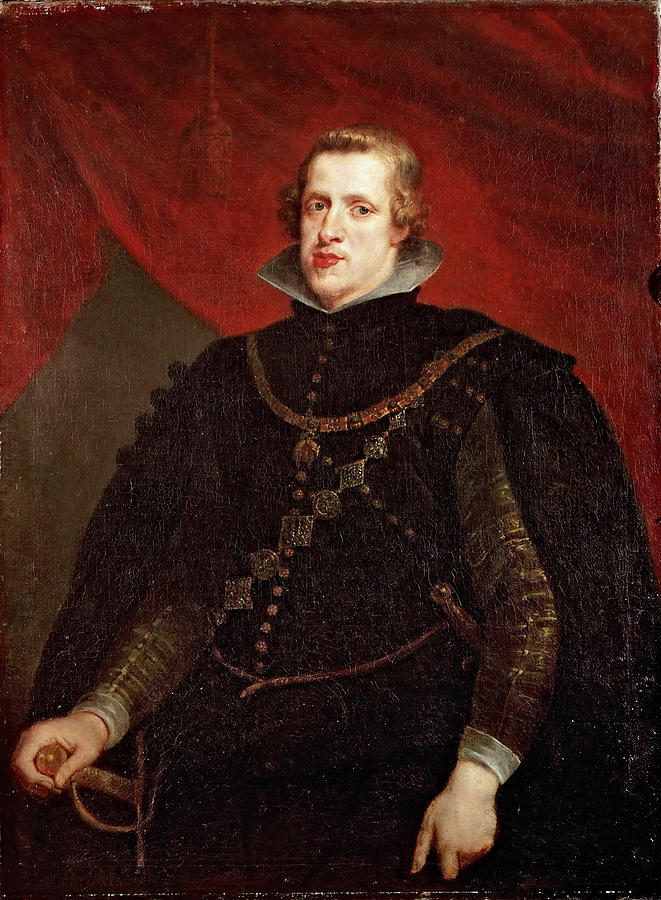
Peter Paul Rubens’s “Philip IV of Spain” presents the young monarch as a commanding yet somewhat introspective ruler, standing against a sumptuous backdrop of red drapery. Clad in dark courtly dress enriched with gold embroidery, the king holds the hilt of his sword in one hand while the other hangs relaxed at his side. His pale face, framed by blond hair, emerges vividly from the deep tones of his clothing and the background, creating a striking focal point.
This portrait belongs to the long European tradition of dynastic imagery in which painters crafted carefully controlled images of kings and princes. Rubens, who traveled widely as a diplomat as well as an artist, understood the political weight of such portraits. In “Philip IV of Spain,” he merges the theatrical splendor of the Baroque with a subtle reading of the king’s character, crafting an image that proclaims authority and royal dignity while hinting at fragility beneath the ceremonious exterior.
Historical and Political Context
Philip IV ascended the Spanish throne in the early seventeenth century, inheriting a vast empire stretching across Europe and the Americas. Spain was still a major global power, yet its resources were strained by wars and economic challenges. Portraits of the young king served not only as personal likenesses but as diplomatic tools, sent to courts across Europe to assert Spain’s prestige and the legitimacy of its ruler.
Rubens, a Flemish subject of the Spanish Habsburgs, had strong ties to the Spanish court. He worked for Archduke Albert and Archduchess Isabella in Brussels, produced commissions for Spanish patrons, and later traveled to Madrid. Whether this particular version of Philip IV was painted directly from life or based on earlier images, Rubens clearly aims to embed the monarch within the broader iconography of Habsburg power. The painting speaks the visual language of monarchy: sword, rich textiles, dark grandeur, and controlled posture.
Composition and Posing of the King
Rubens places Philip IV slightly off center, standing in three-quarter view. The king’s body faces forward but turns gently to his left, while his head is directed toward the viewer. This arrangement gives the figure a sense of volume and movement, avoiding stiffness while maintaining dignified formality.
The composition is vertically oriented, emphasizing the king’s stature. The lower edge of the canvas cuts just below the hips, allowing Rubens to show both hands, the sword hilt, and enough of the torso to display the embroidered costume and chain. Behind Philip, a rich red curtain descends diagonally, creating a powerful backdrop that frames his head and shoulders like a stage canopy. To the left, a darker triangular shape—perhaps the shadowed side of a tent or a hanging tapestry—introduces another diagonal that counterbalances the curtain and pushes the figure forward.
Philip’s left hand grasps the sword hilt in a relaxed but unmistakably firm manner, while his right arm hangs naturally. The combination of the upright torso, squared shoulders, and steady feet communicates readiness and authority. Yet the slight tilt of the head and the softness around the mouth hint at a more reflective, youthful personality, preventing the image from becoming a mere symbol of rigid power.
Costume, Armor, and Royal Insignia
The clothing Philip IV wears in Rubens’s portrait is a carefully constructed statement of rank. The king is dressed predominantly in black, a color that in Spanish court culture signified austerity, gravitas, and aristocratic refinement. This dark ensemble consists of a richly tailored doublet and breeches, with subtle surface patterns suggesting fine fabric and perhaps light armor elements beneath.
Across his chest runs a magnificent chain of the Order of the Golden Fleece, the chivalric order closely associated with Habsburg sovereignty. Rubens renders the chain as a series of intricate gold links and badges that catch the light and break the expanse of black garment. This glittering diagonal accent not only signals Philip’s status as a knightly monarch but also enlivens the composition, leading the viewer’s eye from shoulder to waist.
The king’s sleeves, either of armor or elaborately embroidered cloth, show metallic reflections and horizontal bands. These details allude to his role as a warrior king, even if he is depicted in a court setting rather than on the battlefield. Around his waist a belt supports the sword, whose hilt emerges prominently at his left hand. The weapon is more symbolic than functional in this context, representing royal justice and the defense of the faith and the realm.
A high, starched white collar frames Philip’s face like a delicate architectural element. Its angular points contrast with the softer oval of his head, drawing attention to his features and underscoring the formality of court fashion. The gleam of white against black also echoes the play of pallid skin against dark costume, reinforcing the portrait’s powerful tonal structure.
Color, Light, and Baroque Atmosphere
Rubens orchestrates color and light to create a compelling Baroque atmosphere. The dominant tones are deep blacks, glowing reds, and warm flesh tones. The background curtain is a rich crimson, its folds suggesting expensive velvet. This bold color conveys royal splendor and forms a visual halo around the king, making him appear as the central figure in a theatrical tableau.
Light falls from the left, illuminating Philip’s face, collar, hands, and parts of the chain and sleeve. The play of light against the black doublet produces subtle reflections and textures, testifying to Rubens’s skill in rendering dark materials without losing form. The right side of the figure recedes into softer shadow, adding depth and emphasizing the three-dimensionality of the body.
The flesh is modeled using delicate variations of pinks and creams. The king’s face, relatively pale, stands out vividly against both his clothing and the red curtain. This light-dark contrast—a hallmark of Baroque chiaroscuro—focuses attention on Philip’s expression. The overall effect is one of solemn grandeur: the dramatic lighting suggests a ruler emerging from darkness into the symbolic light of duty and divine favor.
Psychological Characterization of Philip IV
Although the portrait adheres to conventions of royal representation, Rubens also strives for psychological insight. Philip IV appears young, perhaps in his late teens or early twenties. His lips are slightly pursed, his chin small, and his eyes look out with a mixture of reserve and curiosity. There is a hint of shyness or vulnerability beneath the rigid posture and formal attire.
The Habsburg facial traits—long upper lip, slightly protruding lower jaw—are present but not exaggerated. Rubens treats them with a degree of kindness, avoiding caricature while preserving recognizable likeness. The king’s fair hair is styled in loose curls that rest above his collar, softening the severity of his black costume.
This balance between authority and youthfulness is vital to the portrait’s impact. Philip is presented as a legitimate and powerful monarch, yet the viewer also senses that he is still forming as a person, perhaps weighed down by the expectations of empire. Rubens thus humanizes the king while still fulfilling the demands of dynastic propaganda. The viewer does not see an impersonal symbol but an individual bearing the heavy mantle of rulership.
Relationship to Other Royal Portraits
Rubens’s depiction of Philip IV echoes and interacts with other royal portraits of the time, particularly those produced by court painters in Spain. The Spanish monarchy favored a relatively restrained, hieratic mode of portraiture: dark costumes, frontal poses, and minimal external distractions. Rubens respects these conventions but infuses them with his own Baroque energy.
Compared with some Spanish portraits in which kings appear almost motionless, Rubens’s Philip has more sense of volume and latent movement. The diagonals of the curtain and chain, the subtle twist of the body, and the active handling of the paint lend the image a dynamic quality that anticipates or parallels the work of Velázquez, who later became Philip IV’s most celebrated portraitist.
At the same time, Rubens’s approach aligns with his other portraits of rulers and nobles, such as his images of Charles I of England or the Archdukes of the Spanish Netherlands. In all these works he combines ceremonial pose with psychological nuance, presenting his sitters as both symbols of power and complex individuals. “Philip IV of Spain” fits seamlessly into this broader oeuvre, illustrating Rubens’s ability to adapt his style to different courts while maintaining his artistic identity.
Rubens’s Painterly Technique and Workshop Practice
The surface of “Philip IV of Spain” reveals Rubens’s characteristic painterly technique. The red drapery is painted with broad, energetic strokes that suggest movement and depth rather than precise delineation of every fold. The black costume, difficult to render convincingly, is built up with layered glazes and touches of lighter pigment to capture the play of light on fabric and possible armor.
In the face and hands, Rubens’s brushwork becomes more meticulous but never stiff. Thin glazes allow underlayers to glow through, giving the skin a sense of translucency and life. Small, deft strokes define the eyes, nostrils, and lips, while soft transitions of tone shape the contours of the cheeks and chin.
It is possible that assistants in Rubens’s workshop helped execute parts of the painting, especially repetitive elements such as the curtain or sections of the costume. Nevertheless, the key elements that convey likeness and character—the head, hands, and main structuring of the figure—bear the mark of Rubens’s own hand. The portrait thus demonstrates the collaborative yet master-driven nature of large Baroque studios, where important commissions combined efficiency with a recognizable artistic signature.
Symbols of Power and Monarchical Ideology
Every element in the painting serves to reinforce Philip IV’s royal identity. The sword, though only partially visible, symbolizes his command of military power and his role as defender of the realm. The Order of the Golden Fleece chain aligns him with a long lineage of Habsburg rulers and the ideals of chivalric honor. The sumptuous red curtain behind him functions almost as a throne canopy or stage drapery, transforming a neutral interior into a symbolic space of sovereignty.
The predominance of black in the king’s attire resonates with Spanish ideals of sobriety and Catholic piety. It suggests that Philip’s authority is not based only on wealth and pageantry but on moral self-control and seriousness. Yet the gold ornaments, rich textiles, and dramatic lighting remind the viewer that monarchy also thrives on spectacle.
Together, these visual cues create a carefully balanced monarchical ideology. Philip IV appears as a ruler who unites strength and restraint, martial readiness and courtly refinement, earthly power and divine sanction. Even his relative youth, rather than being downplayed, is integrated into this image: he is the young hope of a powerful dynasty, poised to lead his empire into the future.
Legacy and Contemporary Appreciation
Today, viewers encounter Rubens’s “Philip IV of Spain” not as a tool of dynastic propaganda but as a work of art that reveals the complexities of early modern kingship. The portrait offers a window into Spanish court culture, the politics of image-making, and Rubens’s international career. Its rich color, dramatic composition, and psychological subtlety continue to captivate audiences.
Modern viewers may respond especially to the tension between the king’s imposing costume and his human face. In an age that still grapples with the nature of leadership and the construction of public image, Rubens’s painting feels remarkably relevant. It reminds us that behind every grand display of power stands an individual with personal hopes, fears, and vulnerabilities.
“Philip IV of Spain” thus occupies an important place not only in Rubens’s oeuvre but also in the broader tradition of European portraiture. It exemplifies how art can both serve and transcend politics, forging images that outlive their immediate purposes to become enduring reflections on authority and humanity.