Image source: wikiart.org
Historical Context of “Perseus and Andromeda”
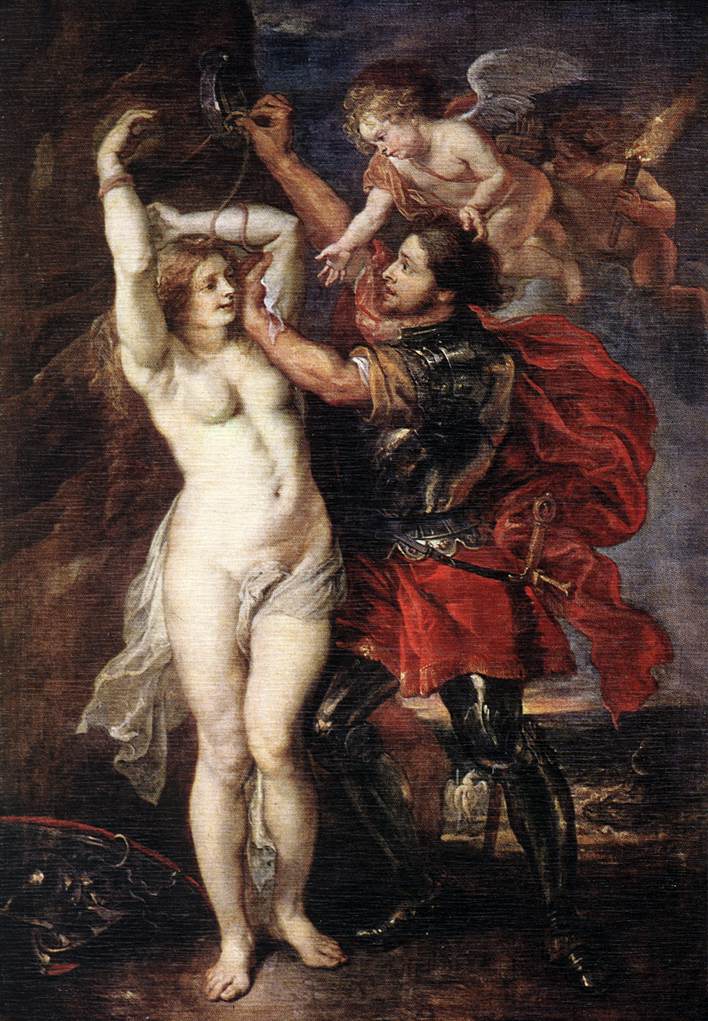
Peter Paul Rubens painted “Perseus and Andromeda” around 1640, during the final year of his life. By then he was a celebrated Baroque master, renowned for his dynamic compositions, heroic narratives, and sensuous treatment of the human body. The myth of Perseus and Andromeda, taken from Ovid’s Metamorphoses, offered Rubens an ideal subject: a heroic rescue, a beautiful nude, and the chance to blend drama, tenderness, and spectacle.
The painting shows the moment just after Perseus has slain the sea monster that threatened Andromeda. Instead of focusing on the battle itself, Rubens chooses the intimate aftermath, when the hero frees the princess from her chains. This choice reflects the artist’s late preference for emotional and psychological depth over purely martial display. The myth, long popular in Renaissance and Baroque art, becomes in Rubens’ hands a celebration of deliverance, erotic awakening, and divine favor.
The Mythological Story Behind the Scene
In Greek mythology, Andromeda is the daughter of King Cepheus and Queen Cassiopeia of Ethiopia. Cassiopeia boasts that her daughter is more beautiful than the Nereids, provoking the wrath of Poseidon, who sends a sea monster to ravage the coast. An oracle decrees that the only way to placate the gods is to sacrifice Andromeda, so she is chained naked to a rock by the shore.
Perseus, returning from his quest to slay Medusa, flies over the scene, falls in love with Andromeda at first sight, and agrees to fight the monster in exchange for her hand in marriage. After a ferocious battle, he kills the beast and frees the princess. The gods later place Andromeda in the heavens as a constellation.
Rubens’ painting captures the emotionally charged moment when Perseus unfastens the shackles, guided by winged cupids who embody divine love. It is the transition between captivity and freedom, fear and safety, death sentence and bridal promise.
Composition and Focus on the Lovers
The composition centers on two standing figures, Andromeda on the left and Perseus on the right, forming a powerful vertical axis. Andromeda’s body is almost fully frontal, arms raised, wrists tied to an iron ring in the rock. Perseus leans toward her from the right, one arm reaching up to the chains, the other gently supporting her. Their bodies create a subtle S-curve, connecting them physically and visually.
Rubens arranges the scene so that the viewer’s eye moves in a loop: from Andromeda’s illuminated face and raised arms, along Perseus’ red cloak and gleaming armor, up to the hovering cupid who helps unlock the shackles, and back down again. The background is relatively dark and indistinct, making the central group stand out like figures on a stage. By compressing the action into a close-up, half-length format rather than a wide landscape, Rubens intensifies the sense of physical and emotional proximity.
At the bottom left, Perseus’ discarded helmet and shield lie on the ground, reminders of the battle just completed. The monster itself is absent, its threat implied rather than shown. Rubens is not interested in the spectacle of violence here; he wants to highlight the union of rescuer and rescued.
The Figure of Andromeda: Vulnerability and Awakening
Andromeda is depicted as the quintessential Rubensian nude: soft-bodied, full-figured, and radiant. Her pale skin glows against the darker background and the deeper tones of Perseus’ armor and cloak. Only a thin, translucent cloth wraps loosely around her hips, emphasizing rather than concealing her nudity. This minimal drapery underscores her forced exposure during the ordeal, yet in Rubens’ treatment it also suggests the dawning of erotic awareness.
Her pose expresses both vulnerability and trust. With her arms stretched high and wrists bound, she is physically helpless, but her body leans subtly toward Perseus. She tilts her head slightly, looking either at him or beyond him, her lips parted in a mixture of relief, exhaustion, and perhaps shy curiosity. The tension in her upraised arms contrasts with the softness of her torso and legs, conveying the shift from painful bondage toward relaxation and release.
Tears or dampness do not mark her face; instead, Rubens gives her a calm, almost dreamlike expression. She has been rescued from death, and the immediate terror has passed. The focus is now on the tender contact between her and Perseus, on the first moments of connection that will lead to marriage.
Perseus as Hero and Lover
Perseus appears as an ideal Baroque hero: youthful, strong, and energetic. He wears a gleaming cuirass and leg armor, their dark metallic surfaces reflecting highlights that catch the viewer’s eye. Over this he sports a vivid red cloak, its billowing folds swirling behind him and injecting dynamic movement into the composition.
His face, turned upward toward the chains, communicates concentration and care rather than brute force. One hand supports Andromeda’s arm or shoulder; the other reaches to free her, while a cupid assists in unfastening the metal. This dual action—supporting and liberating—embodies his role as gentle rescuer. Rubens avoids a triumphant, boastful demeanor; Perseus is fully absorbed in the task of ensuring Andromeda’s safety.
The red cloak also carries symbolic weight. Red in Baroque painting often signifies passion, courage, and life-force. Draped around Perseus, it marks him as the fiery agent who transforms Andromeda’s situation from death to new life. Its color echoes the warm hues of her skin, visually linking them as destined partners.
The Role of the Cupids
Two cupids hover in the upper right portion of the painting. The nearer cupid, positioned just above Perseus and Andromeda, uses both hands to manipulate the chain or lock, assisting in Andromeda’s liberation. The second cupid, farther back, carries a flaming torch. Together they represent the presence of love and divine sanction within the scene.
The cupid handling the chains functions almost like a celestial locksmith, suggesting that love itself helps break the bonds of fear and punishment. The flaming torch, a traditional attribute of Cupid in love allegories, signals inflamed passion and the light of desire. In the context of the myth, these symbols also affirm that the union of Perseus and Andromeda is ordained by higher powers rather than being a mere worldly romance.
Rubens paints the cupids with the plump, lively bodies typical of his workshop: rosy limbs, small wings, and curly hair. Their childlike playfulness offsets the more solemn drama below and lightens the mood, emphasizing that joy and celebration follow the brutal episode of sacrifice.
Light, Color, and Baroque Drama
Light plays a crucial role in shaping the emotional atmosphere of “Perseus and Andromeda.” A strong, warm light falls from the upper left, illuminating Andromeda’s body and Perseus’ face and chest. The rock to which she is chained remains mostly in shadow, as does the distant sea and sky. This contrast visually separates the realm of danger and death—the dark rock, the unseen monster—from the zone of salvation defined by light and flesh.
The color palette centers on the interplay of flesh tones, reds, blacks, and neutral browns. Andromeda’s skin is painted in creamy whites and pinks, with subtle shading that emphasizes her curves and the softness of her form. Perseus’ armor, rendered in deep blacks and silvery highlights, gives a strong counterpoint to her delicacy. The red of his cloak adds warmth and energy, while the golden glints on the cupids and chain unify the different elements.
Rubens’ brushwork is characteristically vigorous. Draperies and background are painted with broad, fluid strokes; details like curls of hair and metallic reflections are added with more precise touches. The overall effect is lively and immediate. Viewers sense that the scene is happening in a single, charged moment rather than being a static tableau.
Sensuality, Decorum, and Baroque Ideals
The painting undeniably has an erotic dimension: a nude woman, shackled, being touched and liberated by a armored hero, under the auspices of cupids. In Rubens’ time, such sensuality was acceptable within mythological contexts, where naked bodies could be justified as classical subjects. The story of Andromeda’s rescue offered an opportunity to celebrate beauty and desire within a moral narrative of heroism and divine providence.
Rubens navigates the balance between sensuality and decorum through Andromeda’s expression and posture. She is not depicted as lascivious or shameful; rather, her nudity is presented as a condition imposed by the cruel sacrifice and redeemed by love. Her face shows gratitude and quiet openness, not overt seduction. Perseus, for his part, appears respectful and focused, not predatory.
This approach aligns with Baroque ideals that linked physical beauty with spiritual themes. The body, in Rubens’ view, could be a vehicle of joy and grace, reflecting the generosity of creation. “Perseus and Andromeda” celebrates the union of strength and tenderness, of male courage and female beauty, under the guiding light of divine love.
Comparison with Rubens’ Other Treatments of the Theme
Rubens painted the Andromeda story more than once. A related work, “Andromeda” (c. 1638), focuses solely on the chained heroine, showing her alone before Perseus arrives. That painting emphasizes her isolation, fear, and the dramatic sea setting. In contrast, the 1640 “Perseus and Andromeda” centers on the couple together, transforming the narrative into a scene of reunion and rescue.
Comparing the two, one sees Rubens’ evolving interest. The earlier Andromeda stands as a solitary figure of vulnerability; the later painting shifts attention toward the interaction of two protagonists and the mediating role of cupids. The narrative has moved from impending disaster to fulfilled promise. This change may reflect the artist’s own late-life desire to emphasize harmony, reconciliation, and happy endings.
The 1640 version also shows Rubens’ mature handling of intimate, vertical compositions. Instead of a wide landscape, he compresses the scene into a close framing that intensifies emotional exchanges and allows the viewer to study every gesture and glance.
Symbolic Meanings and Interpretive Layers
Beyond the literal myth, “Perseus and Andromeda” can be read allegorically. Perseus may represent virtuous courage or Christian heroism; Andromeda may symbolize the soul or the Church liberated from bondage. The monster he has slain could stand for sin, heresy, or tyranny. The cupids, then, become signs of divine grace, guiding the soul toward salvation and union.
The chains and rock evoke more than physical captivity; they can be seen as metaphors for psychological or spiritual imprisonment. By showing them being removed, Rubens suggests the possibility of transformation and rebirth. The painting thus speaks not only about romantic love but also about deliverance from fear and the opening of new life paths.
At the same time, the work might reflect courtly values of the seventeenth century. Patrons often commissioned mythological scenes that paralleled their own ideals of chivalric love and noble conduct. Perseus’ behavior—brave in battle, gentle in victory—offered an exemplary model for aristocratic viewers, who aspired to unite martial prowess with gallant respect for women.
Rubens’ Late Style and Personal Context
Painted in 1640, the year of Rubens’ death, “Perseus and Andromeda” exemplifies his late style: freer, more atmospheric, and deeply focused on the human figure. His experience as both artist and diplomat had given him a nuanced understanding of human emotion and relationships, which he channeled into his mythological works.
The painting also mirrors his personal circumstances. In his later years, Rubens enjoyed a fulfilled domestic life with his second wife, Helena Fourment, and their children. Many scholars see Helena’s features in his female figures from this period, including Andromeda: the rounded cheeks, soft mouth, and fair hair. If so, the painting may carry an additional layer of private affection, reflecting the artist’s own sense of having been blessed by love and family.
Despite chronic gout and advancing age, Rubens painted with undiminished energy. The swift, confident strokes in “Perseus and Andromeda” attest to his continued vigor and mastery. The work stands as a final flourish in his long career of bringing classical myths to pulsating life.
Lasting Impact and Modern Reception
“Perseus and Andromeda” remains a compelling work for modern audiences. Its combination of narrative clarity, emotional intimacy, and visual richness offers multiple points of engagement. Viewers can appreciate the delicate modeling of flesh, the dramatic sweep of red cloak, and the interplay of human and divine figures.
The painting also invites contemporary reflection on themes of rescue, consent, and representation. While rooted in seventeenth-century conventions, it can be discussed in light of modern questions about how myths portray female vulnerability and male heroism. Rubens’ relatively gentle treatment of the relationship, emphasizing support and gratitude rather than domination, provides fruitful material for nuanced interpretation.
In the history of art, the work stands as one of the most poignant visualizations of the Perseus-and-Andromeda myth, influencing later depictions by artists across Europe. Its focus on the liberating moment rather than the battle itself helped shift the iconography toward more intimate, human-centered readings of heroic stories.
Conclusion
“Perseus and Andromeda” by Peter Paul Rubens is a late Baroque masterpiece that transforms a classical myth into a deeply felt drama of rescue, love, and liberation. Through a tightly focused composition, luminous flesh tones, and expressive gestures, Rubens captures the moment when chains fall away and a doomed victim becomes a beloved bride. The hero Perseus, clad in shining armor and swirling red cloak, acts with both strength and tenderness; Andromeda, radiant and vulnerable, leans toward the new life opening before her; cupids hover overhead, symbolizing divine approval and the burning light of passion.
Painted in 1640, the work showcases Rubens’ mature style and his ability to blend sensual beauty with moral and allegorical depth. It stands as a testament to his enduring fascination with the human body, heroic narrative, and the powerful interplay between earthly desire and higher destiny. Centuries later, “Perseus and Andromeda” continues to enchant viewers, offering a vivid image of love strong enough to break chains and transform fate.