Image source: wikiart.org
Introduction
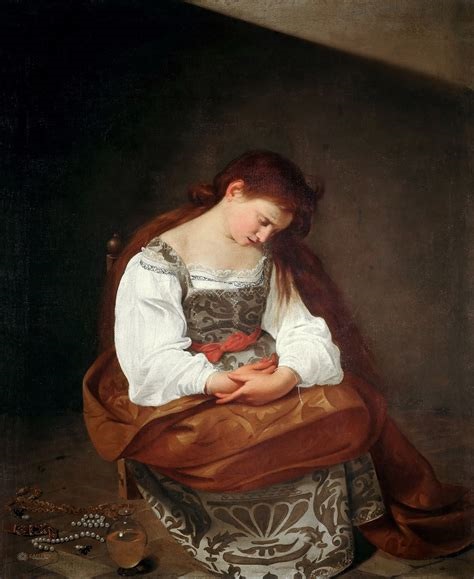
Caravaggio’s “Penitent Magdalene” presents a moment of private reckoning rendered with the piercing naturalism that made the painter both controversial and indispensable at the end of the sixteenth century. Seated low on a chair in a bare interior, Mary Magdalene tilts her head downward, hands folded in her lap, her rich hair falling across a white chemise and brocaded skirt. Scattered beside her are jewels, a string of pearls, and a vessel of perfumed oil—tokens of her former life suddenly stripped of glamour. Caravaggio transforms a familiar subject into an intimate drama of conscience, choosing silence over spectacle and human truth over formulaic sanctity. Painted in 1597, the work shows an artist refining his signature language of light, texture, and gesture to recast sacred narrative as lived experience.
Historical Context
When Caravaggio painted this Magdalene he was a young artist in Rome, newly aware of the city’s hunger for devotional pictures that spoke directly to the senses. The Counter-Reformation called for clarity and emotional accessibility in religious art, and Caravaggio supplied both without surrendering his stubborn realism. Rather than stage the saint in an ideal landscape with clouds and angels, he sets her in a dim, ordinary room. The austerity of the setting aligns with the era’s insistence on penitence and inner reform, yet his realism makes that penitence tangible and psychologically legible. The Magdalene here is neither an alabaster statue of virtue nor a melodramatic sinner; she is a young woman caught in the stillness after a decisive renunciation, a figure whose spiritual turning is legible through the body itself.
Subject and Iconography
Mary Magdalene’s iconography had long included the ointment jar used to anoint Christ, loosened hair signaling penitence, and discarded ornaments signifying the rejection of vanity. Caravaggio keeps these attributes but strips them to essentials. The glass vessel on the floor, the necklace and pearls fallen slack, and the ribboned bodice whose costly textures remain yet no longer seduce all serve as narrative anchors. The saint’s bowed head and closed eyes replace overt tears or theatrical gestures; penitence is suggested not by heavy symbolism but by a pause, a breath held between past and future. The simplicity of props sharpens the scene’s moral clarity: nothing distracts from the interior movement of conversion.
Composition and the Geometry of Stillness
The composition is built from stable diagonals and contained curves that produce an architecture of quiet. The most insistent line is the diagonal shadow that cuts across the upper background, echoing the downward tilt of Magdalene’s head and the slope of her long hair. Her torso forms an opposing diagonal, while the rounded sweep of the gold-brown cloak pools at her knees and ankles, anchoring her in a low center of gravity. Caravaggio places the hands at the compositional core, fingers intertwined and gently pressed together, a small chapel of flesh enclosing prayer. The eye moves from the bowed head to the clasped hands to the discarded jewels, then circles back to the face, completing a visual rosary whose beads are glances rather than stones. The chair’s verticals and the wall’s muted plane keep the stage spare and frontal, inviting the viewer to occupy a respectful distance as if entering a quiet cell.
Chiaroscuro and the Ethics of Light
Caravaggio’s light does not simply reveal forms; it assigns moral weight. A soft but directional illumination descends from above and to the left, igniting the white sleeve, glazing the cheek and neck, and touching the pearls with a cooler glimmer. Darkness thickens in the upper right and along the wall behind her, pressing forward like a background of past temptations, while the light collects where grace is at work—the face, the hands, the white linen emblematic of spiritual cleansing. This chiaroscuro avoids harsh contrasts in favor of a contemplative half-light, a tonal atmosphere as hushed as a whispered vow. By dimming the setting and brightening the figure, Caravaggio makes interiority visible without resorting to mystic glow; the light feels earthly and immediate, yet morally purposeful.
Color, Fabric, and the Tactility of Renunciation
Color in the painting is restrained to earth browns, muted golds, and dull greens, punctuated by the white chemise and a faint red sash. The palette suggests the world’s material warmth now turned sober, like a festival hall after the candles have guttered out. Caravaggio’s observation of textile is astonishing: the brocade of the skirt with its foliate motif, the heavy velvet of the mantle that pools in weighted folds, the crisp gathered linen of the sleeve. These tactile surfaces stage a drama of touch. The viewer senses the luster of wealth even as the saint withdraws from it. Renunciation here is not the absence of luxury but the felt relinquishment of it. The fabrics remain gorgeous, but desire has slipped off them like light off satin at dusk.
Gesture and Psychological Realism
The painting’s psychological power resides in the economy of its gestures. Magdalene’s head droops to the side, exposing the vulnerability of the neck, an anatomical confession more eloquent than verbal admission. Her hands, loosely folded, express a learned humility rather than frantic remorse. There is no self-flagellation, no extroverted grief. This quiet bodily rhetoric allows the viewer to believe in her transformation because it resembles the way real people process sudden moral insight: they fall silent, their muscles settle, the gaze turns inward. Caravaggio’s young model—recognizably human in her flushed skin and imperfect, un-idealized features—anchors the sacred story in the observable world, a hallmark of his method and a decisive break from polished mannerist convention.
The Magdalene as a Figure of Time
Caravaggio captures a liminal instant, a hinge in time. The jewels on the floor belong to the past; the folded hands belong to the future; the bowed head marks the present, suspended and decisive. Even the painting’s textures participate in this temporal structure: the brocade speaks of prior revels, the clean chemise promises a new life, the pearls, once strung on a continuous thread, now lie broken into discrete moments like a life newly counted. Penitence is not portrayed as an abstract state but as a temporal crossing, and the room becomes a threshold space where one identity is shed and another quietly assumed.
Theological Resonances Without Didacticism
The painting resonates with theological themes central to late sixteenth-century piety—contrition, confession, and amendment of life—yet it does so without overt didactic signs. There is no crucifix, no open scripture, no angelic mediator. Instead, grace appears as a change in posture. Caravaggio trusts that the drama of redemption can be legible in the human body itself, a conviction that aligns with the Counter-Reformation’s emphasis on images that ordinary believers can read with the heart as much as the intellect. The ointment jar’s transparent clarity hints at purification; the white linen suggests baptismal renewal; the lowered head echoes traditional attitudes of prayer. But none of these symbols shouts. They breathe.
Innovation within a Traditional Theme
Images of the penitent Magdalene were widespread, but Caravaggio renews the theme by reducing it to essentials and by refusing idealized sanctity. Earlier treatments often amplified sensual beauty before staging its renunciation, creating a paradoxical spectacle of piety soaked in allure. Caravaggio, by contrast, robes the saint modestly and situates her on a humble chair close to the ground, a choice that protects the sincerity of her conversion. His refusal to beautify the figure into marble perfection was radical. He insists that holiness binds itself to ordinary flesh, that grace does not erase the human but transfigures it.
Spatial Minimalism and the Theatre of Conscience
The emptiness of the room functions like the plain stage of a morality play in which the protagonist is conscience itself. The walls offer no narrative distractions, no architectural vistas. The corner shadow cutting across the top could be read as the beam of a low ceiling or simply as an abstract zone of darkness, but in either case it lowers the space, bringing the scene into a human scale and intensifying the feeling of enclosure. Within this chamber of introspection, small objects assume outsized meaning. The strand of pearls curls like a question mark. The glass vessel keeps its fragile purity. The silence of the setting allows these inanimate witnesses to speak.
Technique and the Evidence of the Brush
Caravaggio’s handling of paint is efficient and economical. He builds forms through large tonal masses, then sharpens key edges where light meets darkness. The skin is modeled with warm underlayers and thin translucent glazes that preserve the vitality of flesh. Highlights on the pearls and the glass are placed with a decisiveness that suggests observation from life rather than studio formula. The fabrics, though convincing, are not fussy; the painter suggests pattern and weight through confident strokes, letting the eye finish what the brush only implies. This combination of accuracy and abbreviation gives the picture its immediacy, as if the viewer has stepped into the room before the paint has entirely dried.
Emotion, Not Sensationalism
Though Caravaggio is renowned for violent martyrdoms and dramatic callings, here he selects a quiet register. The emotion is inward, sustained, and durable rather than eruptive. The painting invites contemplation over shock, recognition over amazement. Yet the restraint intensifies the feeling. The viewer senses the cost of the decision lying on the floor with the jewels. The face’s downward angle, the softened mouth, the closed lid over the near eye all carry the weight of a story without narrating it explicitly. The effect is empathy rather than spectacle, a sacred intimacy that feels earned rather than advertised.
The Magdalene and the Viewer
Caravaggio positions the figure slightly below the viewer’s eye level, encouraging a stance of gentle regard rather than dominance. We are witnesses, not judges. The open foreground, with the pearls and jar placed close to the picture plane, draws the viewer into the moral inventory: we stand where these objects lie, as if asked whether we too might set something down. The picture thus becomes participatory. It does not merely show repentance; it asks for it, though with courtesy rather than coercion.
Relationship to Caravaggio’s Broader Oeuvre
“Penitent Magdalene” anticipates the painter’s later masterpieces in which ordinary rooms become theaters of revelation. The low illumination, the directional light from an unseen window or aperture, the use of contemporary models in sacred roles, and the concentration on a single, decisive human gesture all appear here in a seed form. Compared with his more crowded compositions, this work’s solitude reveals the root of Caravaggio’s vision: the belief that one person’s awakened conscience can be as momentous—and as visually compelling—as any public miracle.
The Role of Hair and the Redemption of the Body
In Magdalene imagery, hair is both ornament and instrument of devotion. Caravaggio lets the saint’s hair fall naturally across the shoulder, neither meticulously coiffed nor deliberately disheveled. It reads as a natural extension of the body newly claimed for grace. Where other painters turned hair into a sensual display, Caravaggio allows it to be simply human. The body is not the enemy in this conversion; it is the site of it. Folded hands, resting limbs, lowered head—every element confirms that holiness can inhabit the body without spectacle.
Narrative Without Movement
Nothing moves in the picture, and that stillness tells the story. The jewels do not roll; the mantle’s folds have settled; even the light seems to pause on the face and sleeve. Caravaggio’s narrative strategy is to capture the moment after the choice, when motion has ceased and meaning has intensified. This is the hush that follows the closing of a door, the interval in which a new life gathers its first breath. The viewer is held inside that suspension, learning to appreciate the drama contained in stillness.
Materiality and Spiritual Meaning
Caravaggio never despises matter; he sanctifies it by truthful depiction. Glass is rendered with the exact refractions of its thickness, metal with its cool gleam, fabric with weight and weave. Such material specificity is not opposed to spirituality; it grounds it. The saint’s turn from adornment is credible precisely because adornment was once enchanting. By painting worldly goods so well, Caravaggio shows the dignity of choosing something more enduring without denying the created beauty of what is left behind.
Reception and Afterlife
From its first viewers to contemporary audiences, “Penitent Magdalene” has been praised for its sincerity and criticized by some for its earthiness. That tension is the measure of its power. The picture continues to speak across centuries because it refuses to flatter either the pious or the skeptical. To believers, it offers a recognizable anatomy of contrition. To secular viewers, it presents a psychologically convincing portrait of change. Its influence can be traced in later Baroque treatments of solitary saints and in modern depictions of introspective figures bathed in a single directional light. Painters learned from Caravaggio that a room, a person, and a handful of objects could sustain a drama as profound as any historical pageant.
Where and How to Look
The painting rewards slow viewing from a middle distance and then from close range. At first, receive the overall architecture: the diagonal of the head, the pool of the cloak, the anchored hands. Then approach to notice the highlights tipping each pearl, the feathery transitions across the cheek, the faint edge where sleeve meets shadow. Step back again to feel how these details cohere into a mood of quiet resolve. The longer one stands with the Magdalene, the more audible the silence becomes, and the more persuasive her turning.
Conclusion
“Penitent Magdalene” distills Caravaggio’s vision into a luminous simplicity: a single figure, a brief instant, a redeemed future. Nothing is redundant, everything is eloquent, and the ordinary becomes the vessel of the sacred. In the bowed head and resting hands, one recognizes not only a saint but the human capacity for change. Caravaggio’s genius lies in granting that recognition the dignity of paint, light, and time. The result is a work that feels both ancient in its theme and modern in its psychological candor, a painting that asks the viewer, with extraordinary gentleness, to consider what lies at one’s own feet and what might, with grace, be set aside.