Image source: wikiart.org
Penelope, Waterhouse, and a Scene Built on Waiting
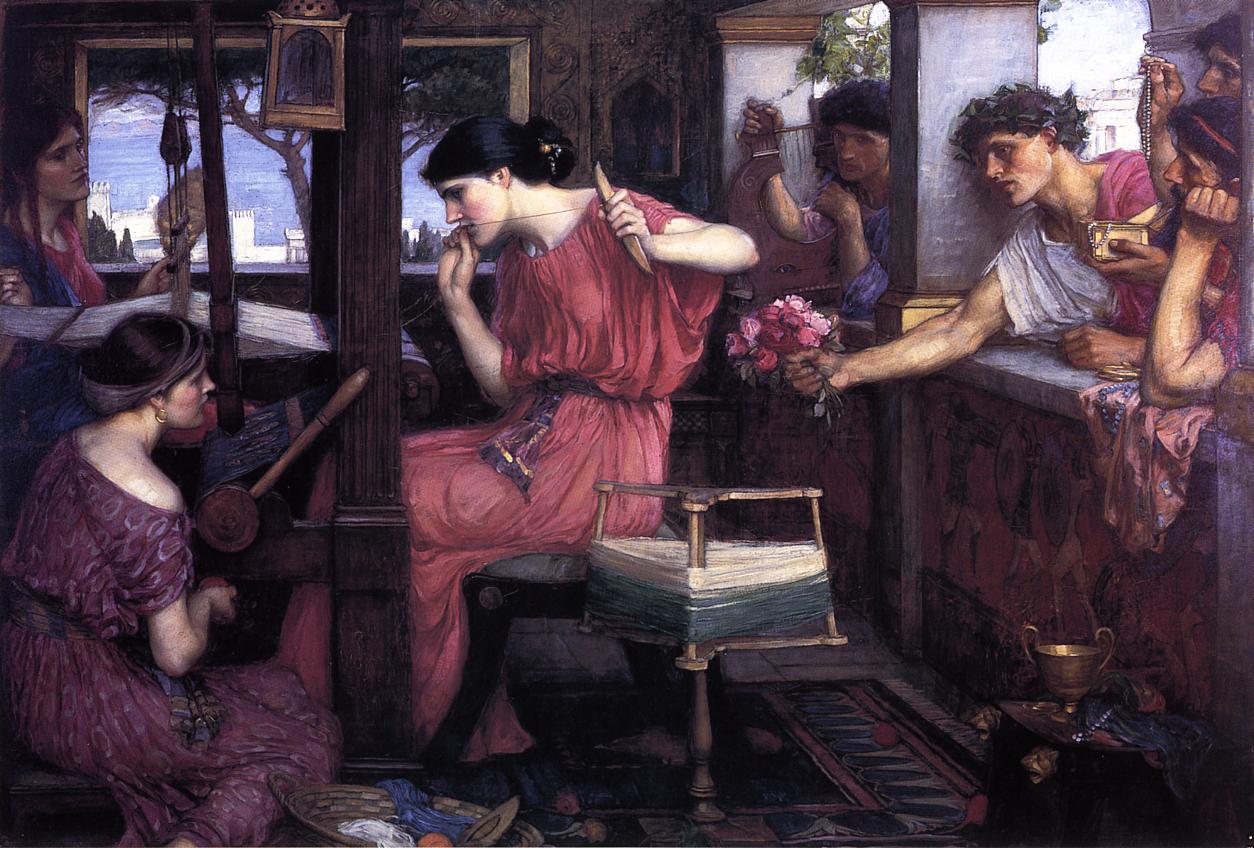
John William Waterhouse’s Penelope and the Suitors (1912) takes a story that most viewers think they already know and slows it down until it becomes almost unbearable. Instead of staging a dramatic confrontation, Waterhouse chooses a quieter and far more psychological moment from Homer’s Odyssey: the long, grinding middle of the myth, when Odysseus is still absent and Penelope is surrounded by men who treat her home like a banquet hall and her marriage like an inconvenience. The painting is not about the hero’s return. It is about the cost of his delay, measured in hours, in glances, in the small defensive movements a person makes when she is trying to remain herself while being pressured to surrender.
Waterhouse was a late practitioner of the Pre-Raphaelite and related classical revival traditions, and by 1912 his art often balances lush beauty with emotional unease. Here, the setting feels richly historical, yet the mood is modern in its attention to social tension and interior stress. The myth supplies the names, but the painting’s real subject is power: who has it, who pretends not to, and who must negotiate it every day in the most intimate space imaginable, the home.
The Myth Behind the Image
In the Odyssey, Penelope’s predicament is cruelly simple. She is the wife of Odysseus, presumed dead by many after years of war and wandering. Suitors crowd her house, demanding that she choose a new husband. They consume her household’s resources, pressure her emotionally, and attempt to force a decision that would erase Odysseus and seize his estate. Penelope famously delays them through strategy, promising she will decide after she finishes weaving a burial shroud, then undoing the work at night. Her weaving becomes a weapon of time, a moral stance, and a daily performance of resistance.
Waterhouse compresses that entire situation into a single room, and the choices he makes are revealing. He does not paint Penelope as a triumphant trickster, nor as a passive victim. Instead, he shows her mid-calculation, mid-discomfort, mid-survival. This is Penelope as a person managing pressure in real time, using craft, posture, and silence as her tools.
Composition and the Drama of the Interior
The painting is structured like a stage set with two opposing zones. On the left, Penelope and her attendants occupy the space of work, fabric, and interior order. On the right, the suitors crowd a threshold that feels like a public intrusion into private life. The architecture and furniture create a strong sense of partition, with vertical wooden posts and the loom acting like barriers that both protect Penelope and confine her.
Waterhouse intensifies the tension by staging the key exchange across a divide. A suitor leans forward offering flowers, a gesture that should read as courtly, even tender. Penelope turns away, physically and psychologically. The composition makes that refusal visible: her body angles left, her gaze drops, and her hand rises toward her mouth as if she is biting back words or bracing herself against the demand embedded in the gift. The room becomes a diagram of pressure, with the suitors’ reach crossing into Penelope’s space, and Penelope responding by retreating into the discipline of her work.
Penelope’s Pose and the Language of Refusal
Penelope is the painting’s emotional center, and Waterhouse gives her a posture that speaks in fragments rather than declarations. She sits on a bench near the loom, holding a weaving tool in one hand while the other touches her face. That gesture can suggest thought, anxiety, hesitation, or disgust, and it is powerful precisely because it refuses to settle into a single readable emotion. Penelope is not performing for the men. She is performing for herself, trying to maintain composure, trying to keep her plan intact, trying not to be pulled into a scene of persuasion where words can be used against her.
Her head tilts downward, her neck exposed, her hair gathered back, emphasizing vulnerability. Yet her torso twists away, asserting control. Waterhouse makes her refusal physical before it becomes verbal, which matters because the suitors’ primary weapon is social pressure. In such a setting, a direct confrontation might be dangerous. Turning away can be safer, and it can also be more humiliating for the aggressor. Penelope’s refusal denies the suitor the satisfaction of engagement.
The Suitors as a Collective Force
Waterhouse paints the suitors not as individual romantic rivals, but as a cluster, a crowd, a chorus of entitlement. Their faces press toward Penelope’s space from the right, and their bodies stack behind one another so that desire becomes something almost architectural, like a wall leaning inward. One suitor holds out flowers, another raises a chain or necklace, another looks on with a heavy, appraising stare. These are not offerings freely given. They are attempts to purchase consent, or at least to exhaust resistance.
The men’s laurel crowns and classical drapery place them in an ancient world, but their behavior reads as timeless. The painting captures the way unwanted attention can multiply, how a single person becomes an arena where other people play status games. The suitors watch one another as much as they watch Penelope, as if her choice is also a contest between them. Their presence turns the home into a public stage where Penelope is expected to decide her future under surveillance.
The Loom as Shield, Trap, and Clock
The loom dominates the left side, and it is not just a prop. It is the engine of Penelope’s strategy and the painting’s central symbol. Weaving is both creation and delay. It produces something visible and legitimate, which gives Penelope a socially acceptable reason to postpone the suitors. Yet it also binds her to an endless cycle of labor, a loop of making and unmaking. Waterhouse suggests this double meaning by showing the loom as a dense structure of wood, thread, and fabric, something that can protect Penelope by occupying her hands and attention, while also keeping her pinned to the same spot day after day.
The weaving itself, layered and pale, looks substantial, almost like accumulated time. The textiles in the scene, from the loom to the garments, echo the theme that identity and fate are made by threads. In Greek myth, weaving often connects to women’s agency and to the larger idea of destiny. Waterhouse uses that tradition but grounds it in the lived reality of patience as work.
Servants, Companions, and the Quiet Network of Support
Penelope is not alone in the left half of the painting. Women around her attend to the loom and the materials of weaving. Their presence changes the scene from a private romantic dilemma into a social situation with witnesses and allies. One woman kneels close to the loom, hands near the threads, focused on the craft. Another figure appears near the left edge, partially framed by the interior architecture, as if moving between spaces. These attendants bring a sense of continuity, routine, and protection. They also remind the viewer that Penelope’s resistance is not only personal but domestic. The household, with its labor and its order, is what the suitors are consuming.
There is a subtle tension here too. Servants can be loyal, but they can also be conduits of information. The Odyssey itself is full of questions about loyalty in the household during Odysseus’s absence. Waterhouse does not turn this into a melodrama, but he keeps the atmosphere watchful. Even the women’s quiet concentration can feel like vigilance.
Color, Light, and the Mood of Late Waterhouse
The palette is muted and rich, heavy on deep violets, rose reds, smoky browns, and cool blues seen through the openings to the outside. Penelope’s garment, a warm red, makes her the focal point, but it is not a celebratory red. It reads as weighty, like responsibility. The suitors’ lighter drapery on the right catches the eye, but the brightness there feels intrusive rather than hopeful, as if their presence brings glare into a room that wants shade.
Light enters through the architectural openings, revealing glimpses of sky and landscape. Those windows function like reminders of a wider world, and perhaps of escape, but they also emphasize Penelope’s confinement. The outside is visible, yet unreachable. The interior lighting stays gentle and subdued, which supports the painting’s psychological realism. This is not a theatrical spotlight. It is the light of a day that repeats itself.
Space, Thresholds, and Invasion
Waterhouse is meticulous about boundaries. The suitors cluster at what feels like a threshold, leaning into Penelope’s domain without fully entering it. That ambiguity is crucial. They are inside her home, yet they behave like guests who have turned into occupiers. Their bodies press forward, but the architecture holds them back, as if the house itself resists their claims.
Penelope is positioned near the center, but she is pulled toward the left, toward the loom, toward the inner sanctum of labor. The composition makes her feel both central and cornered. She cannot flee the scene without abandoning her strategy and perhaps her dignity. So she remains, working, turning away, enduring. The room becomes a metaphor for a siege conducted through manners rather than weapons.
Gesture, Eye Lines, and Psychological Pressure
Much of the painting’s drama is carried by eye lines and hands. The suitors’ hands extend gifts, touch jewelry, rest on the ledge, and hover in states of expectation. Penelope’s hands are different. One holds a tool, tied to work and control. The other touches her mouth, tied to thought and restraint. The contrast suggests two kinds of power: the suitors’ power to demand attention, and Penelope’s power to deny it without openly declaring war.
The suitor offering flowers looks intent, almost pleading, but the crowd behind him undermines any claim to sincerity. The men’s proximity makes every gesture feel like a coordinated push. Penelope’s turned head blocks the exchange at the level of gaze. She refuses to meet the suitor’s eyes, refusing the social contract that would obligate her to respond. Waterhouse shows how refusal can be enacted in small ways when larger refusals are punished.
Beauty as a Tool and a Threat
Waterhouse is famous for painting women with lyrical beauty, and Penelope is no exception. Yet in this scene, beauty does not operate as a simple invitation. It becomes part of the trap. The suitors’ attention is fueled by desire, but also by the prestige of possessing such a figure. Penelope’s beauty, then, is not merely her own. It is something others attempt to claim, interpret, and trade.
At the same time, Waterhouse allows beauty to communicate strength. Penelope’s profile, her composed features, and the controlled line of her posture suggest discipline. She is not disheveled by the pressure, even if she is strained. The painting implies that her self-command is a form of sovereignty. She rules her response, even if she cannot rule the situation.
Waterhouse and the Late Classical Imagination
Painted in 1912, Penelope and the Suitors belongs to Waterhouse’s later period, when his mythological subjects often feel more intimate and psychologically charged than purely decorative. The Pre-Raphaelite inheritance is visible in the attention to textiles, patterns, and narrative clarity, but the mood is less about medieval romance and more about endurance. The painting also reflects a broader late Victorian and Edwardian fascination with classical antiquity, not as distant grandeur but as a mirror for modern emotional life.
Waterhouse’s Penelope is not a marble ideal. She is human, tired, alert, and strategic. The myth becomes a lens for examining social coercion, the vulnerability of women in patriarchal structures, and the way domestic labor can become both a refuge and a burden. The year 1912 sits on the edge of enormous historical change, and while the painting does not reference contemporary politics directly, it carries an atmosphere of strain, as if old stories are being used to think through enduring social conflicts.
Time, Patience, and the Ethics of Delay
The most haunting element of the painting may be its sense of suspended time. Nothing here resolves. The suitors wait, Penelope waits, the household continues its rituals. The loom stands as a machine for making time visible. Weaving becomes an ethical act because it refuses the suitors’ demand for immediate compliance. Penelope’s delay is not indecision. It is a moral stance, a refusal to betray a bond without certainty, and a refusal to allow pressure to define truth.
Waterhouse emphasizes the cost of that stance. Delay requires constant performance. It requires energy, craft, and the ability to withstand boredom, irritation, and fear. Penelope’s posture suggests that endurance is not serene. It is active. It is a series of choices made every day.
Interpreting the Gifts, Flowers, and Domestic Objects
The suitor’s bouquet is a familiar symbol of courtship, but in this context it becomes almost ironic. Flowers are temporary, and Penelope’s entire strategy is built on outlasting the temporary. Jewelry, too, appears as an offered chain, a promise of wealth and status. Yet Penelope already occupies the status of queen within her household. The gifts are not upgrades. They are bribes meant to rewrite her identity.
Meanwhile, Waterhouse fills the scene with domestic objects that speak of continuity: thread, fabric, baskets, carved wood, patterned surfaces. These are things that belong to the rhythms of a home rather than the spectacle of conquest. The objects on Penelope’s side of the room feel lived in, useful, quietly dignified. The objects on the suitors’ side, gifts and adornments, feel performative. The contrast reinforces the painting’s moral structure, where genuine value resides in labor and loyalty rather than in display.
Why This Penelope Still Feels Modern
Even without knowing the Odyssey, many viewers recognize the emotional truth of the scene. It captures what it feels like to be watched, pressured, and expected to respond politely to a situation that is fundamentally disrespectful. Penelope’s refusal is careful because her environment is hostile, yet it is unmistakable. Waterhouse turns myth into a study of boundaries, consent, and resilience.
The painting also complicates the idea of heroism. Odysseus is absent, and his epic adventures are elsewhere. Here, heroism is domestic, repetitive, and largely invisible. Penelope’s courage is the courage to continue, to keep faith, to invent strategies that preserve her autonomy when brute force is not an option. Waterhouse gives that courage a face, a gesture, and a room full of tension.