Image source: wikiart.org
Introduction to Rubens’ “Pastoral Scene”
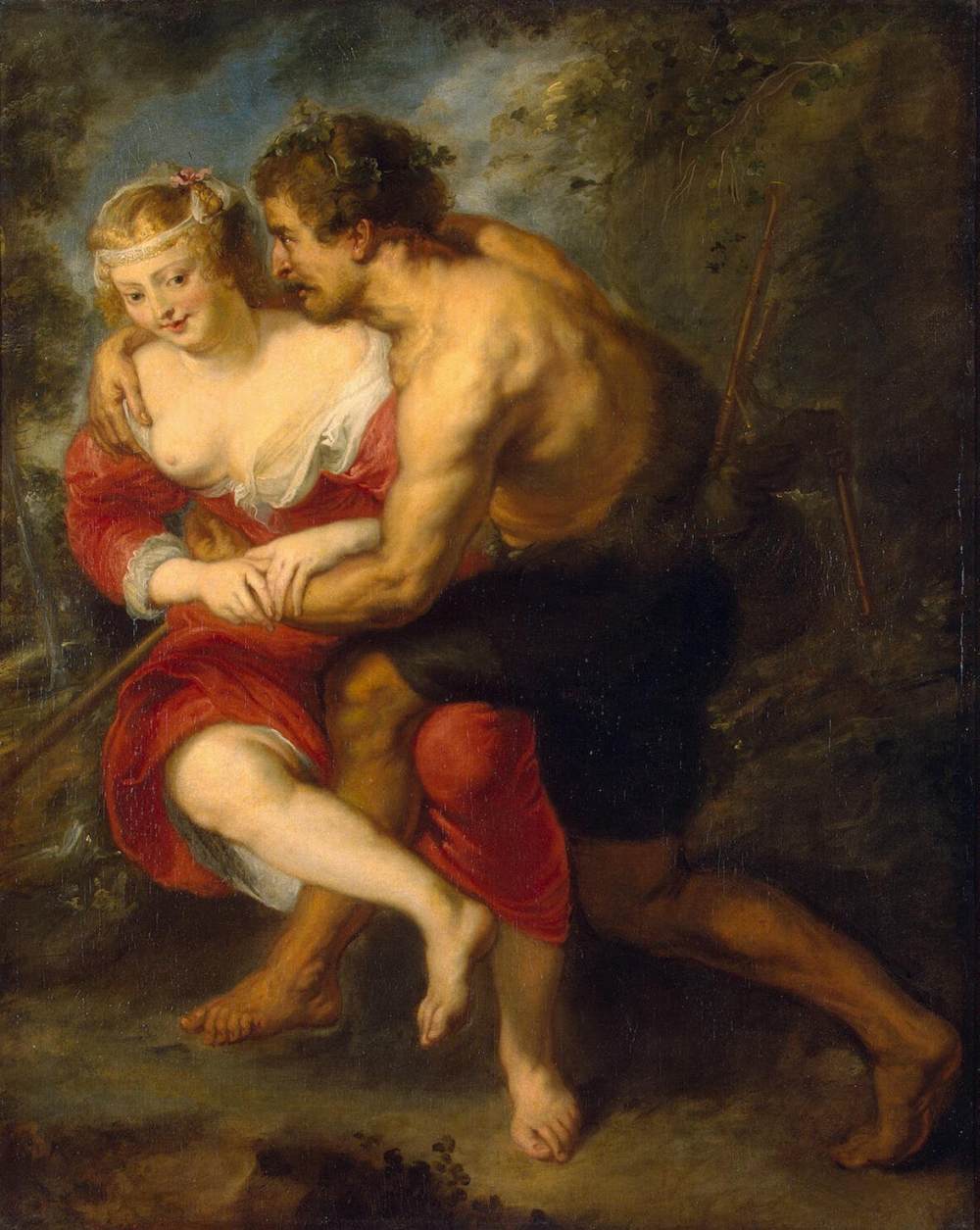
Peter Paul Rubens’ “Pastoral Scene,” painted around 1638, is a vivid vision of rustic intimacy that blends myth, sensuality, and everyday life. The work shows a strong, bare-chested man and a voluptuous young woman locked in a close embrace in a landscape setting. She wears a red dress that has slipped from her shoulders, exposing her breast, while he leans in, one arm wrapped around her, the other gripping her hands. Their bare feet tread the same patch of earth, anchoring the scene in a tangible, physical world rather than an abstract allegory.
This painting belongs to Rubens’ late period, when he had retired to his country estate at Het Steen and often depicted pastoral subjects filled with sensual figures, warm light, and fertile landscapes. “Pastoral Scene” is not a literal genre scene; it is a carefully constructed fantasy of rural love, a celebration of physical presence and human desire cast in the idiom of classical Arcadia.
The Characters and Their Relationship
At first glance, the painting appears to show a shepherd and a country girl, but closer inspection reveals a more ambiguous pairing. The man’s robust musculature, garland of leaves in his hair, and almost animal energy suggest a mythological herdsman or satyr rather than a simple peasant. His tanned skin and dark, tousled hair contrast with the woman’s pale complexion and carefully styled locks, emphasizing their difference while also stressing their complementarity.
The woman, with her fair hair, jewelry, and refined features, hardly looks like a poor shepherdess. Her dress, despite being loosened and rustic in cut, is of a rich, glowing red, and she wears a delicate headband and small floral accent. Many scholars see in her type the features of Rubens’ second wife, Helene Fourment, whose soft, rounded beauty epitomized his ideal of feminine allure.
Their relationship in the painting is charged with tension. The man presses close, his arm slung around her shoulders in a possessive gesture, his face near her ear as if whispering or coaxing. His muscular hand encircles her clasped wrists. The woman’s pose is more complex: she leans slightly back into him, allowing the closeness, yet her hands are turned inward, fingers folding as if in modest resistance or playful restraint. Her expression is not fearful; she gazes outward with a half-smile, cheeks flushed, suggesting she is aware of being observed and not altogether displeased.
Rubens thus creates a nuanced interplay between seduction and consent, play and control. It is the visual equivalent of a flirtatious tug-of-war, a rural courting scene where strength and softness meet.
Composition and Movement
The composition is tightly focused on the intertwined bodies of the couple. Rubens crops the figures closely so that they dominate the canvas, with only a modest glimpse of landscape behind them. This near-frontal arrangement makes the viewer feel almost physically present in the scene, as though standing only a few steps away.
The lines of the figures form an energetic spiral. Starting from the woman’s bare foot at the lower left, the eye follows her extended leg up along the red curve of her dress, across her torso to the exposed breast and rounded shoulder, then along the man’s long arm looped around her. From there the gaze travels up to his head and back down his bare torso and legs. This looping rhythm reinforces the sense of entanglement and movement.
Their legs are crossed and interwoven, an important detail. The man’s darker legs frame the woman’s pale ones and anchor the composition diagonally from lower right to center. Bare feet on bare earth underscore the pastoral theme and the painting’s emphasis on physical contact with nature.
The background is kept deliberately soft and indistinct: a darkened bank, a few hints of foliage, a staff or shepherd’s crook leaning at an angle. These elements provide context and depth but never compete with the figures. Rubens uses them to create a shallow stage of earth and trees against which the human drama unfolds.
Light, Color, and Atmosphere
Light in “Pastoral Scene” falls from the left, bathing the woman’s face, breast, and legs in a gentle glow. Her skin is the brightest area of the painting, drawing the viewer’s eye immediately. The man, in contrast, is half in shadow; his back and arms catch some light, but his face is more muted, blending into the darker background. This contrast emphasizes her as the central focus and object of desire while also making his presence slightly more mysterious and predatory.
The color palette is dominated by warm tones. The rich red of the woman’s dress is the most striking hue, symbolizing passion, vitality, and sensual warmth. Rubens modulates this red with subtle pinks and oranges in the folds and highlights, giving the fabric texture and weight. Her pale skin is modeled with creamy whites, peaches, and delicate rose tones, typical of Rubens’ approach to flesh.
The man’s body is painted in warmer, bronzed tones, reflecting sun exposure and vigorous outdoor life. The dark, earthy background—browns, deep greens, and cool grays—creates a natural frame for the warmer figures, reinforcing the impression that they are the living, breathing heart of the environment.
Atmospherically, the painting feels dense and slightly humid, like a sheltered corner of woodland on a summer day. Rubens’ handling of the brush is soft and fluid, particularly in the foliage and sky, where strokes merge and dissolve. Around the couple the air seems to vibrate gently, enhancing the sense of closeness and intimacy.
Sensuality and the Rubensian Ideal of Beauty
Rubens is famous for his celebration of full, sensuous bodies, and “Pastoral Scene” is a quintessential example. The woman’s figure is not slender or idealized according to later classical norms; she is rounded, soft, and weighty. Her exposed breast and curving thigh are painted with evident delight in texture and volume. The man’s body, too, is robust rather than lean, with strong arms, thick torso, and powerful legs.
This mutual corporeality is central to the painting’s meaning. In Rubens’ world, beauty is inseparable from physical presence and fertility. The pastoral setting reinforces this connection: the natural world is fecund, and so are the lovers. The embrace suggests that human passion is an extension of the earth’s generative forces.
At the same time, Rubens avoids vulgarity. While the scene is undeniably erotic, it is also suffused with warmth and playfulness. The woman’s half-smile, the wreath in the man’s hair, and the presence of rustic props like the staff hint at a festive, Bacchic atmosphere rather than a sinister encounter. The painting taps into the classical tradition of pastoral poetry, where shepherds and nymphs engage in amorous games amid groves and springs.
Mythological Echoes and the Pastoral Tradition
Though titled simply “Pastoral Scene,” the painting resonates with mythological undertones. The male figure’s leafy garland, bare chest, and earthy vigor recall satyrs or followers of Bacchus from classical art. He may be a human herdsman, but Rubens imbues him with a hint of the wild, irrational side of nature. The woman, with her bright attire and soft flesh, recalls nymphs or maenads, mortal yet touched by divine sensuality.
This blending of rustic genre and myth aligns with the long tradition of pastoral literature dating back to Theocritus and Virgil, and extended by Renaissance poets. In this tradition, shepherds, nymphs, and rustic lovers are vehicles for exploring themes of love, desire, and the relationship between nature and civilization. Rubens translates this poetic convention into visual form. The couple is not simply a random peasant pair; they are idealized representatives of an imagined rural paradise where passion is more direct and less constrained than in polite urban society.
Rubens’ own life in the countryside at Het Steen contributed to this vision. In his later years he enjoyed the role of country gentleman, walking fields and woods, observing peasants at work, and integrating his classical learning with direct experience of rural life. “Pastoral Scene” reflects this fusion of intellectual and lived experience.
Gender Dynamics and Power
A modern viewer may notice that the man’s embrace is forceful. His arm encircles the woman’s body tightly; his hand grips her wrists; his face and chest press forward into her space. The unequal distribution of physical power is clear: he is larger, stronger, and more active. She, while not passive, is more contained, her arms and legs crossing defensively as she leans back.
Rubens renders this asymmetry without overt judgment, but contemporary interpretation must grapple with its implications. The painting belongs to a time when male desire and pursuit were commonly idealized in art, and female resistance was often framed as playful or coy. Within that cultural context, the scene likely read as consensual flirtation, a rustic game of chase and capture.
Yet Rubens also gives the woman a distinct agency. Her facial expression is calm, even slightly amused; her body does not twist away in fear but curves in a way that keeps her center balanced. Her gaze, directed outward, acknowledges the viewer rather than being wholly absorbed by her companion. These elements suggest that she is not merely a victim but an active participant in a complicated, mutual exchange of attraction, teasing, and negotiation.
The ambiguity is part of the painting’s power. It opens questions about desire, control, and the interplay between strength and softness—questions that remain relevant in discussions of relationships and representation today.
Rubens’ Late Style and Personal Context
By 1638, Rubens was in the final years of his life. He suffered from gout and often retreated from courtly duties to the quiet of his estate. His second marriage to the much younger Helene Fourment had brought renewed domestic happiness and several children. Many of his late works radiate a sense of fulfilled sensual and familial life, along with a deeper awareness of mortality.
“Pastoral Scene” fits this late style. The brushwork is freer than in his earlier, more tightly finished paintings. Edges soften; transitions between light and shadow are more atmospheric. The palette is rich and warm, with a golden undertone that suggests late afternoon or early evening light. The figures feel less like meticulously constructed academic studies and more like living forms emerging out of paint.
The painting may also carry a personal dimension. If the woman indeed echoes Helene’s features, then the male figure, vigorous yet slightly grizzled, may reflect Rubens’ own self-image as an aging but still passionate man. In this reading, the work becomes a playful, idealized representation of marital affection set in a mythic countryside, a celebration of love that persists beyond youth.
The Landscape as Emotional Setting
While the figures dominate, the landscape plays a subtle but important role. Behind the couple, dark foliage and rocky ground create a sort of natural alcove, an intimate nook in the wilderness. The trees arch overhead, enclosing the space and giving it a secretive, sheltered quality. Patches of sky peek through with patches of blue and soft clouds, hinting at openness beyond.
The staff or crook leaning against the bank, barely visible, indicates that this is a pastoral environment and that the man may be a herdsman. Its presence also adds vertical emphasis to the right side, balancing the diagonal of the intertwined legs.
The ground beneath their feet is earthy and uneven, with small stones and shadows. Rubens renders it broadly, without meticulous detail, but enough to suggest the feel of cool soil under bare toes. The landscape is not a detailed topographical description; it is an emotional setting, a natural stage for human affection.
Reception and Legacy
“Pastoral Scene” may not be as famous as Rubens’ large altarpieces or royal commissions, but it has long attracted viewers for its intimate scale and vivid portrayal of rustic passion. Collectors of the seventeenth and eighteenth centuries valued such works as embodiments of the pleasures of the countryside, especially when framed against the sophistication of court life.
For modern audiences, the painting offers insight into Baroque ideals of beauty and the intertwining of myth and everyday life. It also invites reflection on how art presents romantic relationships, especially in terms of power and consent. The painting’s sensual warmth and painterly richness ensure that it continues to captivate, even as its underlying assumptions about gender roles prompt critical discussion.
Art historically, “Pastoral Scene” stands as a bridge between grand mythological narratives and the more intimate, genre-like scenes that would flourish in later centuries. Its focus on a single couple in a natural setting anticipates the Rococo’s interest in amorous fêtes champêtres, while its robust bodies and earthy atmosphere remain distinctly Rubensian.
Conclusion
Peter Paul Rubens’ “Pastoral Scene” is a richly layered work that encapsulates his late artistic vision: sensuous, earthy, and deeply rooted in both classical tradition and lived experience. The painting presents a moment of rustic intimacy between a powerful herdsman and a voluptuous young woman, set within a softly painted landscape. Through dynamic composition, warm color, and expressive anatomy, Rubens explores themes of desire, play, power, and the unity of human bodies with the natural world.
The work can be read as a celebration of physical love, an homage to the pastoral ideal, a reflection on the artist’s own mature marriage, and a reminder of the enduring tension between strength and tenderness. More than three centuries later, “Pastoral Scene” still invites viewers into its secluded woodland corner, asking them to consider the complexities of affection and the timeless allure of the countryside as a setting for human connection.