Image source: wikiart.org
Introduction
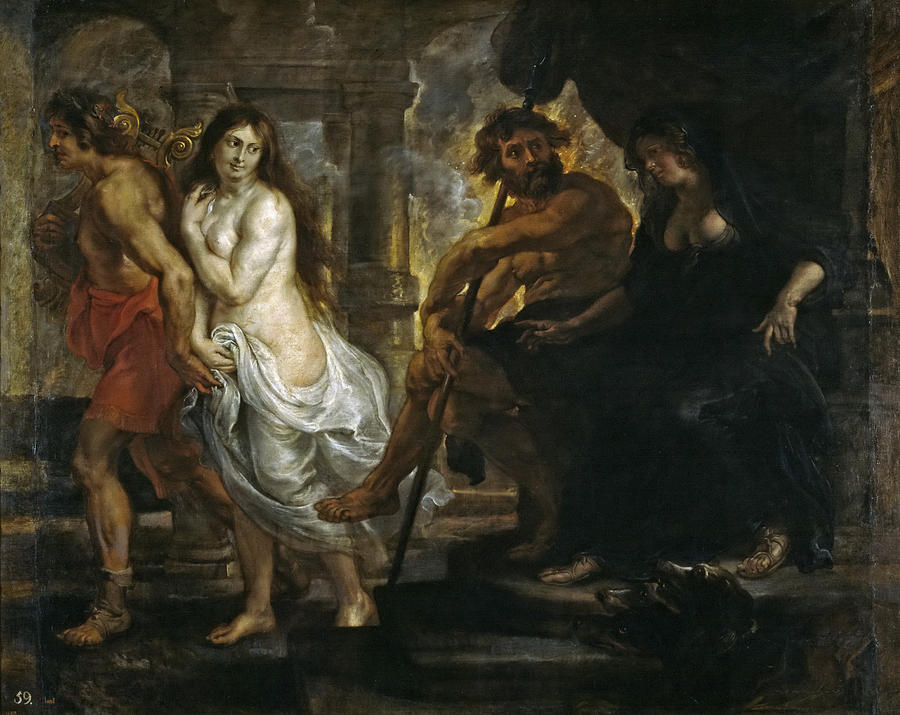
“Orpheus and Eurydice” by Peter Paul Rubens is a compact tragedy staged with operatic force. In a single sweep from left to right, the painter compresses the arc of love, loss, persuasion, and fatal doubt. Orpheus, lyre slung on his shoulder, leads Eurydice upward from the underworld. Hades broods on his stone seat with a monarch’s gravity, while Persephone—queen and advocate—leans toward him with a hand still suspended between permission and regret. A patch of pallid light opens in the corridor ahead; behind, darkness pools around Cerberus and the throne. One step, one glance, separates rescue from ruin. Rubens makes that fraction of time visible and makes the viewer feel its cost.
The Chosen Instant in the Mythic Narrative
The painter selects the decisive heartbeat after Orpheus has secured permission to lead Eurydice back to the world, provided he never looks back. He sets the scene in the liminal zone between palace and passage, where columns dissolve into smoke and earth, and where an edict must be obeyed not once but continuously—at every stride until daylight. Orpheus moves, chin lifted, eyes set forward in practiced self-command. Eurydice turns, reflexively drawn by the weight of the gaze she cannot receive. Hades’ trident rests, but his eyes do not. Persephone’s body leans toward mercy even as the law she shares with her husband remains in force. The entire composition, and the fate of two lovers, pivots on a rule about seeing.
Composition as Tragic Machinery
Rubens builds the canvas like a stage set. A dark, right-hand apse encloses Hades and Persephone within a cave of authority; a brighter, receding left flank opens a ramp toward escape. The figures are arranged along a diagonal that begins with Cerberus in the lower right, rises through Hades’ seated mass and Persephone’s bent profile, then leaps across Eurydice’s luminous torso to Orpheus’ shoulder and the lyre that crowns his silhouette. That diagonal directs the eye from doom to hope, but the painter complicates it with a counter-rhythm: every head turns backward except Orpheus’. The line of bodies flows left; the current of glances flows right. From this collision of vectors Rubens extracts the shiver of tragedy.
Light, Shadow, and the Meteorology of Fate
Light in the painting does not describe so much as judge. A pale, almost mineral illumination washes Eurydice and bleaches the drapery gathered at her hip; it is the light of the world above, prematurely touching her as if to claim her. Orpheus receives a cooler, directional glint that picks out the polish on his lyre and the tension in his neck. Hades and Persephone sit in a sculptural dusk, the governor’s shadow that belongs to stone halls and irrevocable decisions. Small tongues of fire smolder behind the throne and feather up the columns, a subterranean weather that never quite flares into open flame. Darkness lays an inky paw on Cerberus, who glows only at the wet edge of his muzzle. The heavens are elsewhere; here light is a narrow promise that must be carried like a thread.
Orpheus: Musician, Diplomat, and Strategist of Vision
Rubens refuses the stereotype of the soft, distracted minstrel. His Orpheus is athletic, calves knotted, stride long, shoulders compact beneath the lyre’s gilded curl. The head is tilted with intention rather than accident, a pose learned through rehearsal: do not look back. The left hand gathers Eurydice’s fingers without clutching; the right, near the instrument, reads as both guide and guardian. Flesh is modeled with cool, even tones, and the red wrap ricochets a small but decisive flare of color into the hallway’s grays. We sense the calculation of a man who has already sung past monsters and negotiated with monarchs. The test now is not persuasion but endurance.
Eurydice: The Body on the Edge of Return
Eurydice’s body is the painting’s luminous hinge. Her torso and thigh receive the strongest light, a whiteness made tender by thin roseate glazes at knees, elbow, breast, and cheek. She is still of the underworld—the shadow stains her hair, and the coolness of stone clings to her—but the light discovers her as if already memorializing. The turn of her head is not coyness; it is a reflex born of love and fear, a tug of recognition that erodes rules. The gathered cloth at her hip serves as both veil and sail, catching light and motion, suggesting that if she takes two more steps the breeze of the living world will lift it. Rubens grants her agency in that half-turn. She is not dragged; she hazards a glance that will decide everything.
Hades and Persephone: Law and Compassion in Counterpoise
Hades appears as Rubens often imagines force: a massive torso under coarse drapery, forearms furred and strong, a face that carries authority without hysteria. He leans on a staff rather than brandishing a weapon, an executive whose strength is the strength of decree. Persephone sits adjacent, her body turned toward Eurydice, her hand rising in a gesture that mingles injunction and blessing. The dialogue between these two bodies articulates a philosophy. Kingship sets limits; queenship interprets. Rubens keeps the balance unsentimental. It was Persephone who softened the law; it will be the law that exacts the price of a broken condition.
Cerberus and the Ecology of the Underworld
At the foot of the throne sprawls a dark dog shape—the underworld’s sentinel reduced to a low, watchful energy. Rubens avoids folkloric excess; the beast reads not as three-headed spectacle but as a compression of menace. Near it, a smudge of fire and smoke stains the floor. The architecture behind the throne is part ruin, part temple, with heavy lintels and columns swallowed by vapors. These details do not declare geology; they declare jurisdiction. The underworld is a system of thresholds. Its animals, fires, and stones are administrators of passage, and Orpheus and Eurydice are just now passing through their narrowest corridor.
Color as Emotional Thermometer
The canvas is governed by subdued earths—brown, bone, ash, and iron—against which a few saturated accents strike with meaning. Orpheus’ red cloak pulses with life and warning; Eurydice’s milky drapery catches sky that is not yet visible; Persephone’s black-blue robe blends with the canopy of shadow, asserting sovereignty without spectacle. Warm flesh tones pull toward the left; cool, matted blacks consolidate on the right. The color story parallels the moral one: desire and hope migrate out of darkness toward a still-receding exit.
Gesture, Hands, and the Rhetoric of Touch
In Rubens, hands speak like actors. Orpheus’ fingers close over Eurydice’s with care, the pressure sufficient to lead but not to hurt. Eurydice’s left hand tugs her wrap instinctively forward, protecting modesty and perhaps warmth as she rises from the chill. Persephone’s hand, palm down, traces a plane in the air—a last, gentle line across which the edict will be enforced. Hades’ weighty grip gathers the staff into a vertical grammar mark, an exclamation the law will not retract. Every gesture builds the sentence that ends the story: do not look back.
Movement, Time, and the Baroque Instant
Baroque painting specializes in the instant that teeters between states. Here Rubens suspends action at the zenith of its moral arc. Orpheus advances; Eurydice turns; Hades waits; Persephone pleads. In half a heartbeat either a rescue completes itself or a second death begins. Rubens writes that half-heartbeat with drapery that flutters, hair that slides, smoke that curls, and a foot that rises just enough to promise the next step. We stand where time slows, knowing it will snap forward in the direction of loss.
Sound and Silence as Invisible Actors
The canvas is noiseless, but sound is everywhere implied. The lyre is silent now—that is the condition of the bargain—but its gilded arms still tremble with remembered vibration. The marble hall absorbs breath and returns it as a whisper. A cinder pops in a brazier. Far off, water mutters in the caverns. The most terrible sound is the one we know will come after the glance: Eurydice’s cry dissolving into air as she fades, and the sudden, hollow weight of Orpheus’ silence when persuasion is no longer possible. Rubens makes those sounds imaginable through the density of his black and the brittleness of his light.
Texture and the Craft of Reality
Rubens persuades the eye with tactile facts: the grainy bite of stone, the damp glisten on the dog’s muzzle, the soft nap of Persephone’s mantle, the warm bloom on living skin, and the thin, metallic glare along the lyre’s edge. These textures are not an end in themselves; they are instruments of belief. Tragedy needs credible matter. The more we can feel the substances in the room, the more weight the myth acquires when it says a woman can vanish from them.
Architecture of the Underworld as Moral Topography
The setting is not a neutral palace but a map of ethics. Valleys of dark transport the gaze to the right, where judgment seats itself. Columns rise and stop short, truncated like lives. A split in the roof admits no sky but channels a cooler light that seems to come from remembered day rather than present dawn. The staircase under Orpheus’ bare feet is worn by other bargains kept or broken. Rubens does not design fantasy; he designs bureaucracy. The underworld is a place of forms, thresholds, and rules that cannot be argued with twice.
Sources, Echoes, and Rubens’ Humanist Eye
Rubens’ image converses with antique reliefs of Orpheus leading Eurydice and with Renaissance inventions by Virgilian-minded painters. Yet his figures breathe with a Flemish immediacy: flesh that flushes, hair that tangles, eyes that moisten. The artist’s Roman education appears in Hades’ sculptural contour and in the architectural grammar of the set; his Venetian sympathies glow in the tonal warmth that binds bodies to air. The synthesis is not erudition for its own sake; it is a humanist wager that stories this old can still be felt as news.
Workshop Practice and the Master’s Touch
The canvas shows the economy of a studio piece supervised closely by Rubens. Assistants could underpaint architecture and lay large passages of shadow; the master would have returned to finish faces, hands, and the kinetic edge where drapery meets thigh. In particular, Eurydice’s flesh bears the glazes and loaded edges characteristic of Rubens’ own brush. Whatever the distribution of hands, the choreography is unmistakably his: a tight, three-act stage set, conducted by diagonals and bound by light.
The Philosophy of a Condition
Every retelling of Orpheus turns on the clause “on condition that he not look back.” Rubens paints the ontology of such a clause. A condition is a law spread across time; it requires continuous attention; it turns love’s instincts into potential offenses. The painting invites us to measure the cruelty of the rule against the mercy that granted it. Was the edict designed to fail? Is human love, which includes the desire to see and to be seen, compatible with legal absolutes? Rubens does not sermonize. He shows a man doing all he can, a woman doing what humans do, a law holding steady, a queen softening what she can, and a king who will not flinch.
The Poetics of the Backward Look
The backward look is one of art’s oldest gestures. It can mean longing, suspicion, caution, or love. Here it means all of them at once, sharpened by prohibition. Rubens makes the backward look heartbreaking by setting it within a forward-moving body. Eurydice is literally walking out of death even as she symbolically peers back into it. The painter understands that tragedy happens not when villains triumph but when virtues collide: fidelity asks for sight; obedience denies it. The glance is not failure of love; it is love’s excess.
Aftermath Written in Advance
Rubens plants clues to what follows. The shadow at Eurydice’s calf thickens as if to catch her; the air around Persephone seems ready to reabsorb a shape; Cerberus lifts, already sensing that the corridor will soon be empty again. Orpheus’ lyre, by contrast, will travel upward with its player, an instrument that will know new songs of absence. By reading the painting’s atmospherics, we feel the narrative’s next page turning even as this one holds still.
Conclusion
“Orpheus and Eurydice” distills the myth to its bare, most urgent terms: a condition, a corridor, a couple, and the silent weight of sovereign law. Rubens stages the scene as a dialogue of vectors—forward motion and backward sight—under a regime of judging light and administering dark. Each figure is morally legible without caricature: Orpheus as disciplined lover, Eurydice as fully human partner, Persephone as advocate within constraints, Hades as cold necessity, Cerberus as the world’s non-negotiable fact. The painting’s power lies in how physically it makes these abstractions felt: in the warmth of hands, the grit of stone, the hush of smoke, and the ache of a neck turning where it must not. We leave the canvas with the sense that tragedy, like light in this underworld, is a narrow path that can be broken by the smallest movement—and that love, even at its bravest, must walk that path with eyes fixed ahead.