Image source: wikiart.org
First Impressions and the Emotional Temperature
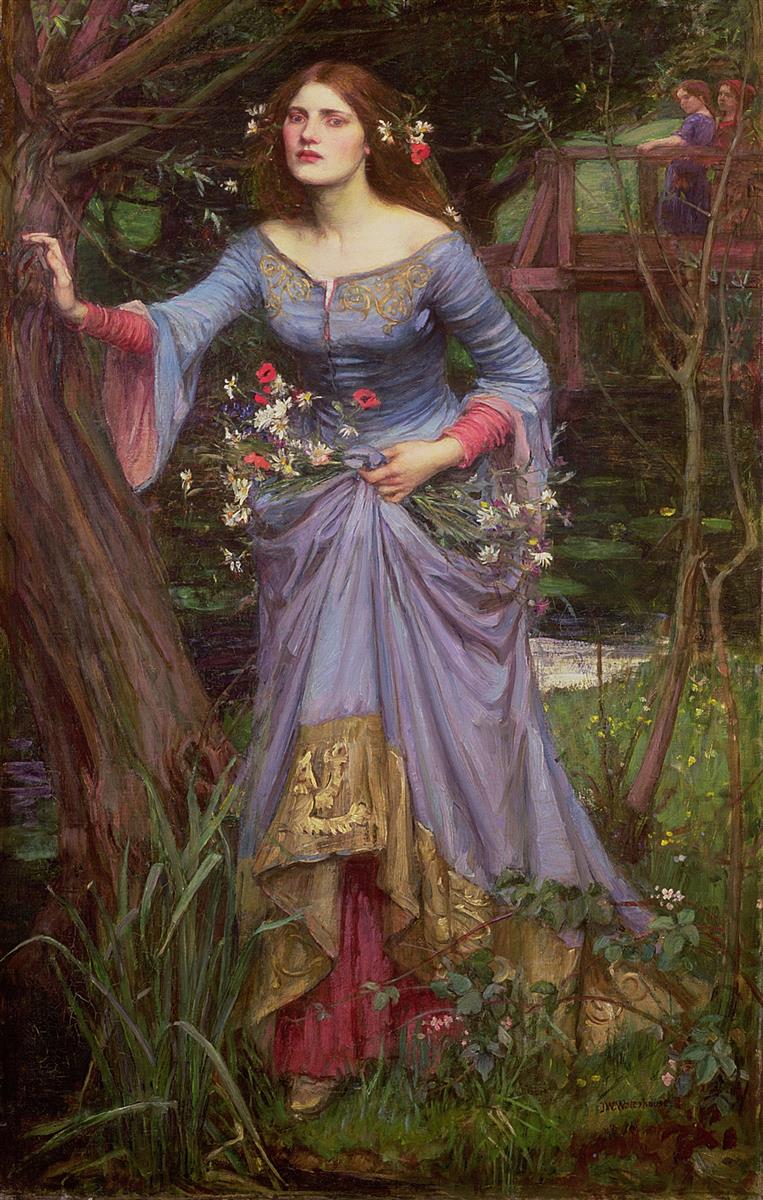
John William Waterhouse’s Ophelia (1910) greets you with a sensation that is both hushed and alert, like stepping into a shaded garden where something important has just happened or is about to happen. The figure stands close to the picture plane, nearly life-sized in feeling, yet she seems separated from us by the thickness of leaves, branches, and damp air. Waterhouse positions Ophelia as a presence rather than a story illustration: she is not merely a character you recognize, but a young woman caught in a precise emotional weather. Her gaze is steady and forward, not dreamy, not fully elsewhere. It has the stillness of someone holding themselves together.
This painting feels like a pause made visible. Ophelia is mid-step, mid-thought, mid-choice. One hand braces against a tree, the other gathers up her skirt. The bouquet at her waist looks freshly picked, imperfectly arranged, like the result of wandering and collecting rather than a planned adornment. Even without a single dramatic gesture, the canvas suggests tension, the kind that lives in the body: the lifted fabric, the slight forward lean, the anchored hand. Waterhouse makes that tension readable through posture and through environment, as if the world itself is pressing close.
Ophelia Reimagined: Character, Not Spectacle
Ophelia is one of literature’s most painted figures, often shown floating, sinking, or surrounded by watery symbols. Waterhouse chooses something different here: he offers Ophelia upright, clothed, and attentive. This alone changes the meaning. Instead of tragedy presented as an outcome, we see tragedy as a condition that has not yet settled into a single image. She is still moving, still acting, still capable of decision, yet she looks as if she carries a heavy inwardness.
Her face is the key to this reinterpretation. Waterhouse paints it with a soft firmness: pale skin, lightly flushed lips, and eyes that meet the viewer. There is no theatrical grief. The expression reads as restrained sorrow, or perhaps a complicated mix of sadness, disbelief, and resolve. The calmness is not comfort. It is the calm that can appear when emotion has reached a point where it becomes quiet rather than loud.
By refusing sensational drama, Waterhouse makes Ophelia more intimate. She becomes less a symbol and more a person. The painting invites you to wonder what has happened just before this moment, and what might happen next. That uncertainty is part of the work’s power.
Composition and the Sense of Being Enclosed
The composition is built around enclosure and interruption. Ophelia is framed by foliage that leans inward, creating a natural arch and a darker canopy above her head. The tree trunk at left acts as a structural pillar, grounding the scene and giving her bracing hand a clear purpose. The background is not an open landscape; it is layered, screened, and partially blocked. This creates the feeling that Ophelia is moving through a narrow corridor of nature, where the path is not fully visible.
Waterhouse also places a secondary vignette in the distance: two figures on a raised wooden bridge or walkway. Their presence is small but meaningful. They introduce social space into Ophelia’s private moment. Whether they are watching her, ignoring her, or simply part of the world continuing on, they add a quiet pressure. Ophelia’s isolation is not total. It is the isolation of being emotionally alone while life remains populated.
The vertical format reinforces the figure’s tall, slender stance, while the surrounding greens compress the space. Ophelia appears both prominent and hemmed in. This is a clever visual metaphor for her situation: she is central, yet trapped inside circumstances, expectations, and her own mind.
Color, Light, and the Pre-Raphaelite Glow
Waterhouse uses color to create a mood that feels like late afternoon under trees: filtered light, cool shadows, and occasional bright notes. The dominant greens are deep and varied, ranging from mossy darkness to softer olive tones. Against this, Ophelia’s dress becomes a beacon. Its cool blue-violet hue reads as delicate and slightly unreal, like a remembered color rather than a purely natural one. It sets her apart from the surrounding foliage without making her look artificial.
The red accents are strategic and emotionally charged. The undersleeves and hints of red fabric at the lower skirt provide warmth that seems almost like a pulse under the cool surface of the painting. Red appears again in small flowers in her hair and bouquet, giving the impression that life and fragility are knotted together. The gold embroidery and trim add an antique richness, suggesting status and ceremony, but also weight, as if her clothing carries tradition like armor.
Light is handled softly, not as a harsh spotlight but as a gentle reveal. Her face and upper torso are the brightest areas, making her expression the visual anchor. The surrounding shadows create a cradle of darkness around her, intensifying the sense that she is stepping out from an inner world.
Gesture and Body Language: The Drama in Small Movements
Waterhouse builds the emotional narrative through subtle physical cues. Ophelia’s left hand rests against the tree, fingers lightly spread, as if testing stability. This is not the grip of fear, but the touch of someone orienting themselves. Her right hand gathers the skirt, lifting it just enough to move through undergrowth and avoid the damp ground. The gesture suggests both practicality and vulnerability: she must navigate carefully, and the act of lifting the fabric exposes the red beneath, like an unintentional confession.
Her shoulders are slightly forward, her neck extended, giving her posture a searching quality. She looks as if she has heard something or is trying to locate meaning in the distance. The stillness of her face contrasts with the implication of motion in her stance. This creates emotional dissonance, a hallmark of Waterhouse’s best figure paintings: outward composure paired with inner turbulence.
The bouquet matters here too. It is not a neat cluster held proudly in front of her. It is gathered at her waist, partly pressed into the folds of her dress, as if picked without fully knowing why. Flowers become less decorative and more compulsive, like something she does to occupy her hands while her mind unravels.
Setting as Psychological Landscape
The natural setting is not simply pretty scenery. It feels like a psychological extension of Ophelia’s state. The dense greenery presses in, suggesting confusion, emotional saturation, and the loss of clear direction. The dark canopy above her resembles a low ceiling, turning the outdoor scene into something almost interior, like a room made of leaves.
At the bottom of the painting, grasses and plants rise sharply, forming a tangle near her feet. This foreground vegetation heightens the sensation of difficulty, as if movement is obstructed. The small light patch at right, where the ground seems to open toward water or a brighter clearing, reads like a fragile exit, but it is not where she stands. She remains in the darker corridor.
The distant bridge introduces a more structured world, with straight lines and human-made order. Ophelia is separated from it by layers of branches, as though she exists at the edge of society. The painting turns the environment into a map of thresholds: wilderness versus structure, private grief versus public life, shadow versus light.
The Language of Flowers and Symbolic Detail
Even without naming specific blossoms, the floral elements clearly function as symbols of fragility, passing time, and emotional excess. Waterhouse paints the bouquet with lively color and careful variation, letting tiny whites, reds, and purples flicker against the blue folds of fabric. This makes the flowers feel freshly alive, which intensifies the sadness. Living flowers are temporary by nature. Their beauty contains its own countdown.
The flower crown in her hair adds another layer. It suggests innocence, romance, and a ceremonial softness, but it also hints at a mind drifting toward ritual and dream. A crown of flowers is both celebratory and funereal, depending on context. Waterhouse uses that ambiguity to keep Ophelia suspended between worlds.
Her embroidered dress carries symbolic weight too. The gold patterning feels medieval and storybook-like, connecting her to an older, idealized past. But the dress is also heavy with folds and trim, and she must physically manage it. That contrast between idealization and bodily reality mirrors the larger theme: the difference between what a life is supposed to be and what it feels like from inside.
Waterhouse’s Technique: Soft Edges, Dense Surfaces
Waterhouse’s brushwork here balances clarity with softness. The figure is rendered with smooth transitions in the face and skin, emphasizing youth and vulnerability. In contrast, the foliage is layered and textured, with strokes that suggest leaves, vines, and shadows without turning every inch into botanical illustration. This selective clarity guides attention. We are meant to read Ophelia’s expression first, then feel the environment as atmosphere.
The fabric is a showcase of controlled painting. The dress folds are complex, yet they remain believable and weighty. The blue-violet cloth catches light in gentle gradients, while the gold trim is handled with enough definition to feel ornamental, not merely painted on. The result is tactile: you can almost sense the coolness of the fabric and the dampness of the garden air.
Importantly, the painting does not feel glossy or overly polished. It feels lived-in, like a moment caught rather than staged. That effect comes from the way Waterhouse lets darker pigments mingle in the greenery and allows edges to dissolve into shadow. The world is not crisp because Ophelia’s experience is not crisp.
Themes: Innocence Under Pressure, Nature as Witness
At its heart, this Ophelia is about innocence under pressure. Not innocence as naivety, but innocence as openness, as a tender receptivity to the world. Ophelia seems porous, absorbing grief and confusion the way a garden absorbs rain. The painting suggests a mind overwhelmed not by a single event but by accumulation.
Nature becomes the witness to that overwhelm. The plants do not comfort her. They surround her. They are indifferent in their beauty. This indifference is part of the tragedy: the world continues to be lush and alive even when a person feels they cannot keep pace with it.
The distant figures intensify another theme: the gap between inner reality and social reality. There is a world of people, paths, and normalcy just behind her, yet she stands in a separate emotional climate. Waterhouse paints this separation without exaggeration, which makes it more haunting. Many people recognize that feeling: being physically near others while mentally isolated.
Why This Painting Stays With You
This work lingers because it refuses to finalize Ophelia into a single emblem. It offers her as a living question. Her gaze is direct enough to implicate the viewer. You are not only watching her; you are being addressed by her presence. She is not lost in a romantic haze. She is painfully present.
Waterhouse also understands the power of restraint. The painting is full of beauty, yet it does not let beauty erase discomfort. The colors are rich, but the shadows are real. The flowers are bright, but their fragility is unmistakable. The environment is lush, but it feels like a narrowing space.
In that balance, Ophelia becomes a portrait of a psychological threshold: the moment when inner strain begins to reshape how the world looks, when ordinary surroundings start to feel charged, crowded, and symbolic. Waterhouse captures not only a character from literature, but a universal human experience: the sensation of standing in the world while feeling the ground shift inside you.