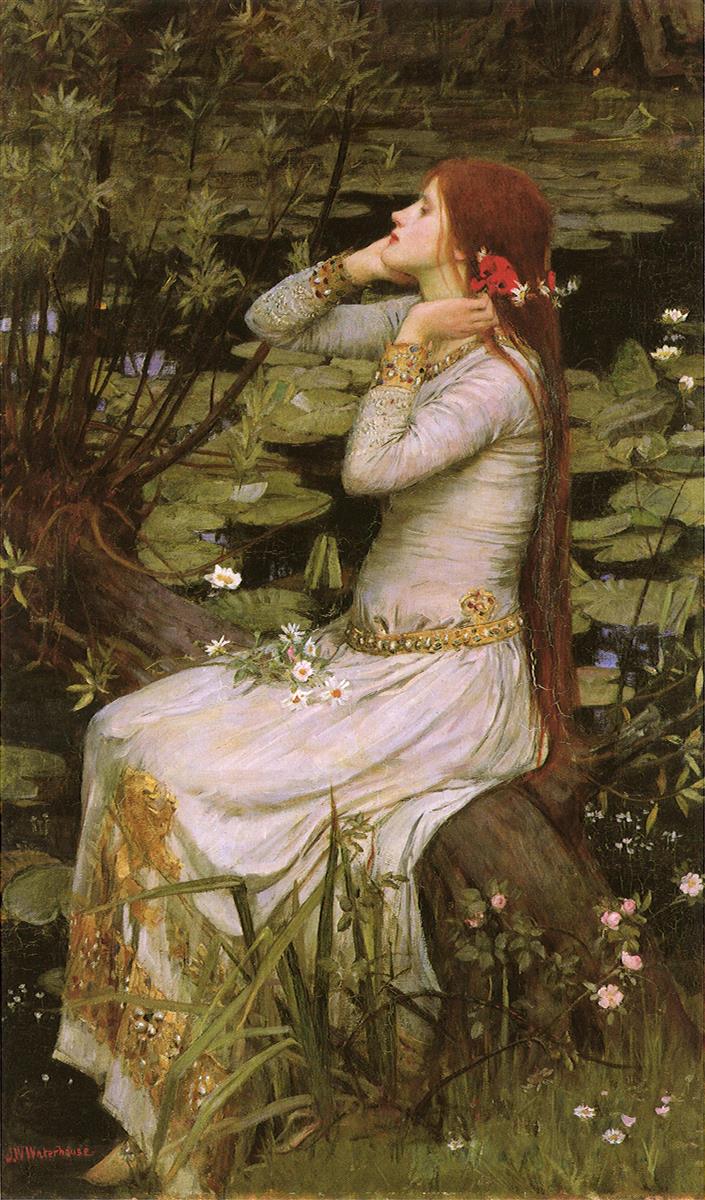
Image source: wikiart.org
First Impressions and the Emotional Temperature
In Ophelia (1894), John William Waterhouse gives you a moment that feels both hushed and dangerously close to tipping over into tragedy. The scene is calm on the surface: a young woman sits beside a pond dense with lily pads, her pale dress catching soft light, her long red hair trailing down her back. Yet the calm is the kind that makes you listen harder. Waterhouse stages Ophelia’s story not as a loud climax but as a suspended breath, a pause where beauty and unease coexist.
What makes the painting so gripping is how it refuses to be purely illustrative. You do not need to know the plot to sense that something is wrong in a gentle way. Ophelia’s posture reads as inward, almost self-contained, as if she is withdrawing from the world around her. The setting is not a neutral background but an active atmosphere, a wet, enveloping space where the natural world feels close enough to touch. Waterhouse’s Ophelia is not presented as a distant emblem. She is presented as a living presence, and that presence is poised on the edge between reverie and unraveling.
Waterhouse and the Late Pre-Raphaelite Imagination
Waterhouse is often linked with the afterlife of the Pre-Raphaelite Brotherhood, even though he belongs to a slightly later generation. By the 1890s, Pre-Raphaelite ideals had already shaped public taste: vivid natural detail, literary subjects, jewel-like color, and a fascination with women as symbolic figures. Waterhouse inherits these traits, but he softens them into something more psychological and cinematic.
Instead of turning Ophelia into a purely moral symbol, he treats her as a person caught in a story that is larger than her ability to control. The late Victorian audience loved narratives pulled from poetry and drama, especially when they could be filtered through lavish surface beauty. Waterhouse understood that attraction. He gives the viewer the pleasure of texture, color, and atmosphere, then uses that pleasure to lure you into a darker emotional register.
His approach also reflects the era’s hunger for mood. The 1890s leaned toward ambiguity, toward feelings that could not be easily categorized as virtue or vice, sanity or madness, innocence or desire. This Ophelia feels built for that world: a painting that is beautiful enough to display proudly, yet unsettled enough to haunt the mind after you look away.
Ophelia as a Literary Figure
Ophelia arrives from Hamlet by William Shakespeare with a heavy cultural echo already attached to her name. She is one of those characters who became larger than the play itself, a shorthand for fragile innocence, grief, and the terrifying way a life can be swept aside by forces it did not choose. Victorian art repeatedly returned to her because she offered a ready-made fusion of poetry, pathos, and visual opportunity: flowers, water, pale fabric, and a female figure whose emotional life could be depicted as both tender and perilous.
Waterhouse’s choice of moment matters. Rather than showing the most explicit point of disaster, he gives you something that feels like the threshold. Ophelia here appears absorbed in her own gesture, adjusting something near her ear, touching her hair, or fixing a flower. It reads like a small act of self-arrangement, a quiet ritual that suggests she is trying to hold herself together. That ordinariness is heartbreaking, because we sense it cannot last.
The painting becomes a meditation on how tragedy does not always arrive with spectacle. Sometimes it arrives while someone is still performing simple, human actions. Waterhouse allows Ophelia that dignity, and the dignity makes the looming loss sharper.
Composition and the Power of the Profile
The composition is built around a profile view that is both classical and intensely vulnerable. Ophelia’s face is turned away from us, which limits direct confrontation but heightens intimacy. A profile can feel like a private view, as if we are witnessing her without being invited. Waterhouse uses this to create a gentle tension between closeness and distance. We are near enough to read her skin and hair, yet we cannot fully access her gaze.
Her seated position anchors the painting low, close to the earth and the waterline. The bank, the thick vegetation, and the lily pads surround her, framing her body as though the landscape is enclosing her. That enclosure is not aggressive, but it is inescapable. Nature is not simply decorating her story; it is gradually absorbing it.
Waterhouse also choreographs the flow of attention. Your eye moves from the pale dress to the warm red hair, then outward to the greens and browns that dominate the pond. The palette is restrained, but it is not dull. It feels like late summer turning toward autumn, a time when richness persists even as decay begins. That seasonal suggestion becomes a visual metaphor for Ophelia’s own state: still radiant, already fading.
Color, Light, and Surface Realism
One of the strongest features of this painting is the balance between sensual surface and emotional meaning. The white dress is not a flat white. It is a spectrum of warm and cool notes, catching subtle light and reflecting the surrounding greens. Waterhouse paints fabric as something with weight and pliability, so you can imagine how it drapes against her body and gathers in folds around her knees. That realism makes her feel physically present.
Against the dress, the red hair becomes a focal flare. It is not just a color accent but a psychological signal. Red hair in Victorian imagery could suggest vitality, sensuality, or otherness, and Waterhouse often uses it to make his heroines feel unforgettable. Here the hair is extraordinarily long, which amplifies the sense of time and fate. It looks like something that belongs to myth, not to everyday life. The length also echoes the vertical pull of the reeds and stems, binding Ophelia visually to the plant life around her.
The greens of the pond are complex and layered. Lily pads overlap like shields, creating a patterned surface that feels both decorative and claustrophobic. Waterhouse’s handling of light across the water suggests a world that is alive but not comforting. The pond does not sparkle; it broods. The light is filtered, absorbed, and returned in muted tones, as if the environment is holding its own secrets.
The Language of Flowers and the Natural Setting
In images of Ophelia, flowers are never merely pretty. They are part of a cultural language, a visual poetry that Victorians understood instinctively. Waterhouse includes blossoms and vegetation in ways that feel both carefully observed and symbolically charged. The pond lilies, the scattered small flowers, and the abundant greenery all speak to the traditional association between Ophelia and a world of fragile beauty.
But Waterhouse does something more interesting than simply “decorate” her with flowers. He lets the environment compete with her. The lily pads are large and numerous, dominating much of the picture plane. They are not delicate accents; they are a mass, a living carpet that suggests how the natural world can overwhelm the human figure. Ophelia’s pale body becomes a luminous interruption in a sea of green.
This transforms the setting into a narrative force. The pond feels like a boundary, a threshold space between solid ground and surrender. Water, in art, is often linked to memory, subconscious feeling, cleansing, or danger. Here it feels like all of those at once. The viewer senses that the pond is not only where the story takes place but where the story ends.
Gesture, Hair, and the Psychology of Stillness
The gesture at Ophelia’s head is crucial. It can be read as adjusting a flower, smoothing hair, or performing a small self-soothing action. Whatever the literal explanation, it communicates inwardness. She is not reaching out to the world; she is tending to herself in a way that suggests she is trying to remain intact.
Her expression, seen in profile, is delicate and remote. The lips are slightly parted, the face softly angled upward. It does not look like a grimace of suffering, and that is precisely what makes it unsettling. Waterhouse depicts a mind turned away from ordinary social reality. This is not melodrama; it is drifting.
The hair contributes to this psychology. It flows down with a heaviness that reads like a burden. In many Waterhouse paintings, hair is both beauty and fate, something sensuous that also signals entanglement. Here it is like a thread linking Ophelia to the earth, to the water, to the story that is pulling her under. The painting suggests that her identity, her femininity, and her vulnerability are all bound together in the same visual material.
Beauty and Tragedy in Victorian Visual Culture
Victorian and late Victorian art often presented women as the carriers of heightened emotion, morality, or spiritual meaning. Ophelia, in particular, became a kind of cultural mirror: artists could project ideas about purity, fragility, desire, and social pressure onto her figure. Waterhouse participates in this tradition, but he does not make Ophelia purely passive. She is quiet, yes, but she is also intensely centered within the painting. The world is arranged around her, not the other way around.
At the same time, the painting cannot be separated from the era’s aesthetic of “beautiful sorrow.” There is a long tradition in Western art of turning female suffering into a visually pleasing image, and late Victorian audiences often consumed these images as a refined form of emotion. Waterhouse’s Ophelia sits within that tradition, yet it complicates it by giving us a moment that feels private rather than performative. She does not look like she is being displayed for pity. She looks like she is being lost to herself.
The result is a painting that makes the viewer complicit. You are invited to admire the dress, the hair, the flowers, the painterly skill, and then you realize that the admiration is tied to a narrative of collapse. Waterhouse’s achievement is that he makes this realization feel like part of the emotional experience rather than a moral lecture.
Conversation with Other Ophelias
It is impossible to look at Waterhouse’s Ophelia without sensing the shadow of John Everett Millais and his famous Ophelia image, which shaped the public imagination of the subject. Millais famously emphasized the figure floating in water, surrounded by botanical detail, creating an iconic fusion of realism and tragedy. Waterhouse, by contrast, chooses a different psychological angle. He brings Ophelia to the bank, to the edge, to a place where the body is not yet surrendered to the water.
This shift changes everything. It turns the painting into a study of anticipation rather than aftermath. The viewer is not confronted with a completed tragedy but with the conditions that make tragedy feel inevitable. The pond in Waterhouse’s version feels less like a stage for spectacle and more like an agent waiting patiently.
By making Ophelia seated and self-absorbed, Waterhouse also nudges the subject toward introspection. We witness not only what happens to her, but what it feels like to be her in the quiet before the fall. That psychological focus is one reason Waterhouse’s Ophelia continues to resonate. It is not merely a scene from a play; it is an image of a mind slipping beyond reach.
Why This Painting Still Works Today
Even for viewers who are not steeped in Victorian literature or symbolism, Waterhouse’s Ophelia remains powerful because it captures a universal emotional experience: the moment when the world is present, detailed, and beautiful, yet you feel yourself separating from it. The painting is about isolation that does not announce itself loudly. It is about the soft gravity of sadness, the way it can pull someone inward while everything outside remains lush and indifferent.
The craft supports that theme. The careful realism of plants and fabric makes the scene believable, while the controlled palette and enclosed composition make it feel inevitable. There is no visual escape route. The pond fills the space; the vegetation presses in; the figure, though luminous, is surrounded.
For an art history viewer, the painting is also a clear example of how narrative painting can survive modern skepticism. Even in an era that often prizes abstraction or conceptual strategies, this work demonstrates the enduring strength of storytelling through image. Waterhouse tells a story without showing “action.” He tells it through atmosphere, through posture, through the relationship between a human figure and the world that is slowly swallowing her.
In the end, Waterhouse’s Ophelia is not only about Ophelia. It is about how beauty can be inseparable from danger, how nature can be both exquisite and indifferent, and how the most devastating turning points can look, from the outside, like a quiet moment beside the water.