Image source: wikiart.org
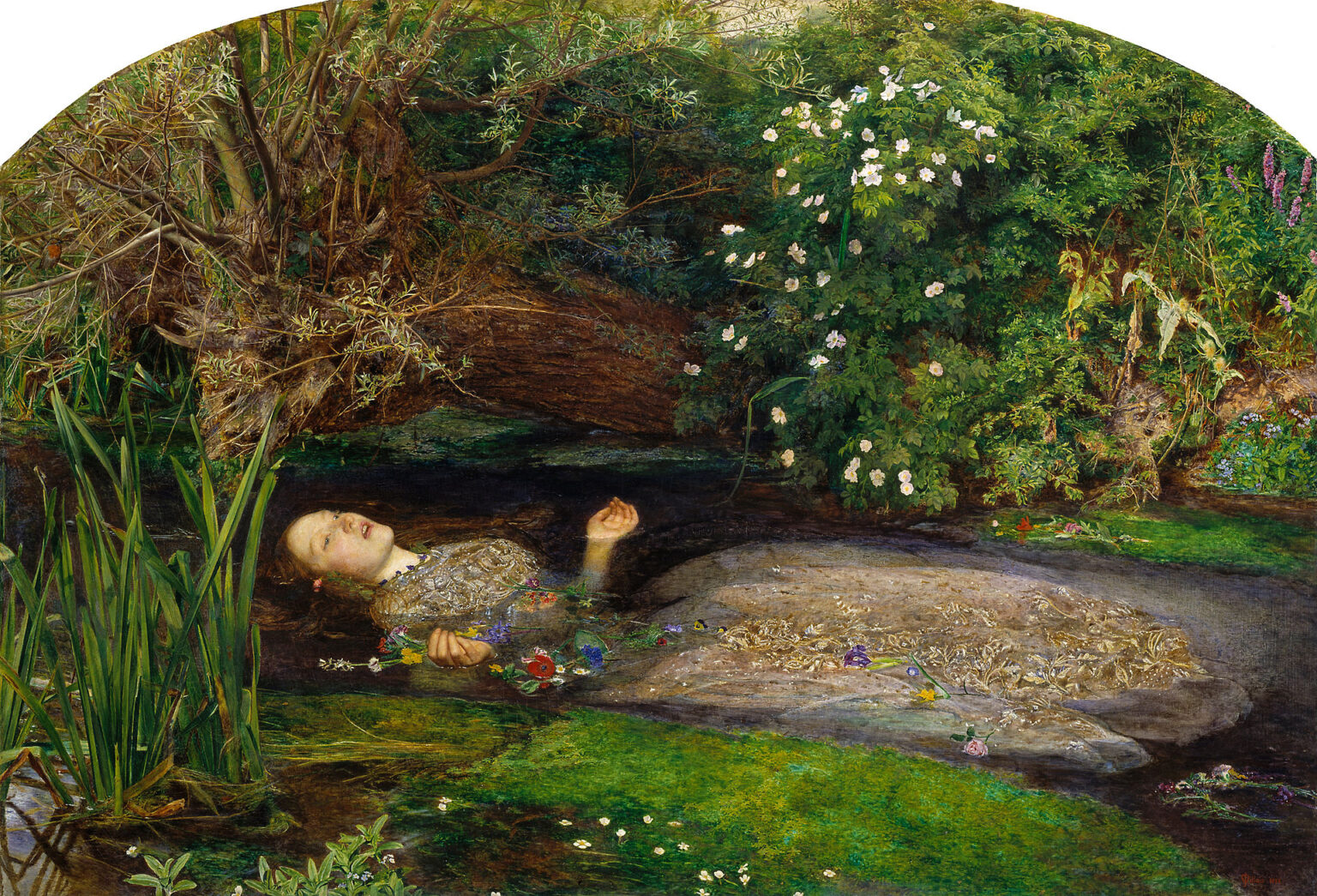
Ophelia by John Everett Millais
John Everett Millais’s Ophelia is one of the defining images of nineteenth century British painting and one of the most memorable visual interpretations of Shakespeare ever made. Painted in 1852, the work transforms a tragic literary death into a scene of astonishing beauty, stillness, and unease. At first glance, the picture appears lush, immersive, and almost dreamlike. The river is dense with reeds, grasses, blossoms, and tangled branches. In the middle of this natural richness floats the pale figure of Ophelia, her body suspended between life and death, between surrender and resistance, between the visible world and the symbolic one.
What makes the painting so powerful is the tension Millais creates between subject and surface. The scene is undeniably tragic, yet it is rendered with such precision and sensual beauty that the viewer is pulled into a complicated emotional response. We do not simply witness death. We witness death absorbed into nature, framed by color, texture, and light so exquisite that it becomes impossible to separate sorrow from visual pleasure. That tension is the heart of the painting’s enduring force.
Millais was one of the founders of the Pre-Raphaelite Brotherhood, and Ophelia stands as one of the clearest expressions of that movement’s ideals. It rejects loose convention and generalized scenery in favor of sharp observation, intense color, symbolic detail, and emotional immediacy. At the same time, it rises above program or manifesto. It is not memorable merely because it is technically accomplished or historically significant. It is memorable because it creates an unforgettable mood. The viewer feels the quiet of the stream, the weight of the water, the chill of the scene, and the eerie calm of a human body drifting into legend.
The Shakespearean Source Behind the Painting
The painting draws from Hamlet, where Ophelia’s death is described rather than staged directly. In Shakespeare’s play, Queen Gertrude recounts how Ophelia fell into a brook while gathering flowers. For a brief moment her garments spread upon the water and kept her afloat, “mermaid-like,” before they grew heavy and pulled her down. This passage is one of the most poetic accounts of death in Shakespeare, and Millais responds to it not by simplifying it into melodrama, but by preserving its strange suspension between grace and horror.
That choice matters. Rather than depict Ophelia before the fall or after death has fully claimed her, Millais chooses the moment of transition. She is still visible, still luminous, still almost singing, but already claimed by the river. This in-between moment is what gives the painting its haunting quality. We do not see violence. We see the last fragile interval in which life remains visible even as it disappears.
The Shakespearean context also deepens the emotional meaning of the work. Ophelia is not merely a drowned woman in a stream. She is a character destroyed by grief, political manipulation, paternal control, and emotional abandonment. By the time she reaches this river, she has been broken by forces larger than herself. Millais does not narrate all of that directly, but the painting gains power from that invisible history. The stillness of the body carries the weight of psychological collapse.
The Immediate Visual Experience
The first thing many viewers notice is the extraordinary density of the natural setting. The riverbank is not a backdrop. It is an environment that seems almost to press inward from every side. Branches arch over the water, reeds thrust upward at the left, flowers cluster across the scene, and the dark stream moves quietly through the center like a hidden current of fate. Nature is not empty or neutral here. It is abundant, specific, and almost overwhelmingly alive.
Against this richness, Ophelia’s face and hands emerge with startling clarity. Her skin is pale and luminous, seeming to catch the little light that filters through the scene. Her dress spreads out beneath the water in a heavy, elaborate mass of silver and cream, turning her body into something both physical and ghostly. The open mouth and upturned gaze are especially affecting. They suggest song, prayer, shock, or surrender. Millais leaves the expression open enough that the painting resists a single easy interpretation.
The composition guides the eye gently but inexorably toward her. The diagonal drift of the body, the surrounding vegetation, and the dark water all work together to center the figure without isolating her. She is not placed on nature. She is enveloped by it. This is one of the painting’s greatest achievements. Ophelia feels both distinct from the landscape and already absorbed into it.
Millais and the Pre-Raphaelite Vision
To understand why Ophelia looks the way it does, it helps to place it within the Pre-Raphaelite movement. Millais and his fellow artists sought a return to sincerity, detail, and intense visual truth. They admired early Renaissance art for its clarity and spiritual seriousness, and they rejected the formulaic habits they associated with academic painting. In practice, this often meant bright color, sharp focus, literary subjects, and painstaking attention to the natural world.
In Ophelia, these ideals are visible everywhere. Nothing feels casually painted. Every leaf, branch, flower, and reflection seems studied. The painting has a jewel-like precision that refuses vagueness. The surface is rich with information, but it never collapses into mere display. Instead, the detail becomes emotional. The abundance of observed reality heightens the tragedy because it insists that this death is happening in a world of vivid, tangible life.
The Pre-Raphaelites also believed that beauty should not be separated from seriousness. Millais does not choose between visual delight and emotional gravity. He binds them together. The result is a work in which technical brilliance intensifies feeling rather than distracting from it. The painting is beautiful in a way that makes the tragedy more painful, not less.
Nature as More Than a Setting
In many narrative paintings, landscape serves mainly to frame the action. In Ophelia, landscape becomes a central actor in the drama. The river receives the body. The plants surround it. The branches lean over like witnesses. The flowers float beside her like fragments of ritual or memory. Nature here is not sentimental refuge. It is beautiful, indifferent, cyclical, and all-encompassing.
This is part of what makes the work feel so modern in emotional terms. Millais does not force nature into a neat moral message. The environment is not obviously condemning, comforting, or explaining Ophelia’s death. It simply continues in all its richness. The flowers bloom, the water moves, the greenery thickens, and the human figure becomes one more element within that larger order. That idea can feel both consoling and devastating. It suggests that death returns the individual to the natural world, but it also suggests how little the world pauses for personal suffering.
The river itself is crucial. Water in art often symbolizes transition, purification, time, or oblivion. Here it does all of those things at once. It carries Ophelia gently, but it also erases her. The current seems calm rather than violent, which only heightens the dread. This is not catastrophe as spectacle. It is disappearance as inevitability.
The Figure of Ophelia
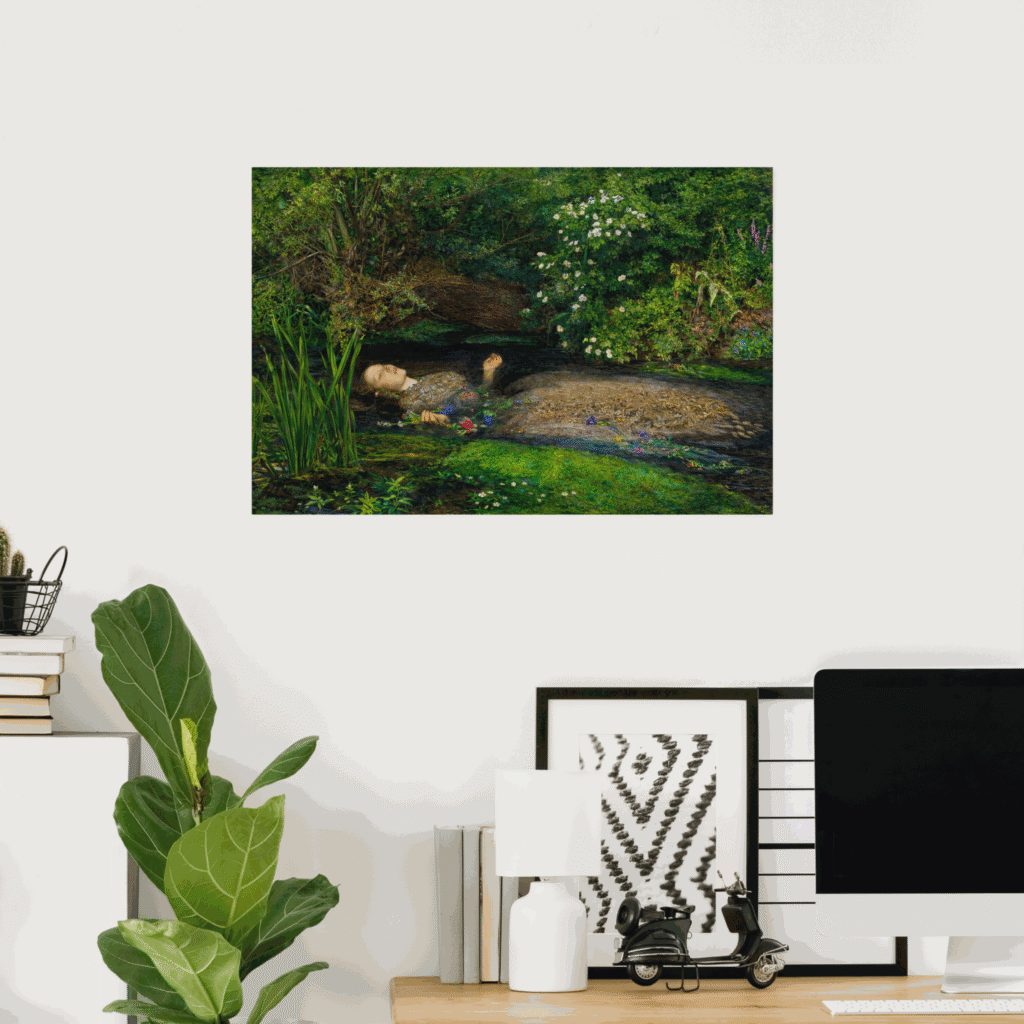
Ophelia’s body is one of the most delicately balanced elements in the painting. Her arms are open, her palms partially turned upward, and her head tilts back into the current. These gestures can be read in multiple ways. They may suggest surrender, helplessness, or a kind of ritual offering. They also carry an unmistakable echo of religious imagery. There is something almost saint-like in the way her body is displayed, luminous and still within the water.
That suggestion is important because it complicates the viewer’s response. Ophelia is a tragic literary heroine, but under Millais’s brush she also becomes an icon. Her suffering is individualized by the face and costume, yet universalized by the pose. She becomes an image of beauty under threat, innocence undone, and consciousness fading into silence.
At the same time, there is nothing purely abstract about her. The face remains sensuously human. The parted lips, flushed features, and wet hair keep her grounded in physical reality. Millais does not allow her to become a cold symbol. She is symbolic and bodily at once. That duality is one reason the painting has remained so compelling. It preserves the emotional charge of an individual life even while turning that life into a mythic image.
Color, Light, and Texture
The color structure of Ophelia is essential to its effect. Much of the painting is built from deep greens, earthy browns, dark blues, and shadowed blacks, creating a setting that feels rich, humid, and enclosed. Against these darker tones, the pale body and shimmering dress stand out dramatically. Millais uses contrast not only to direct attention but to produce mood. The dark water makes the exposed skin seem fragile. The surrounding greens make the flesh appear almost spectral.
The handling of texture is equally remarkable. The tangled wood at the left feels dry, twisted, and rough. The water appears smooth but murky, reflective yet opaque. The dress seems heavy, embroidered, and waterlogged, its luxurious fabric now turned into a burden. The flowers offer brief points of soft brightness across the scene. This variety of textures makes the painting almost tactile. The viewer can imagine the cold water, the drag of wet cloth, the softness of petals, and the density of overgrown vegetation.
Light is used with great subtlety. This is not a radiant landscape flooded with sunlight. Instead, illumination seems filtered and intermittent. It touches selected surfaces, especially Ophelia’s face and costume, creating a quiet glow rather than a theatrical spotlight. That restraint helps preserve the atmosphere of suspended time. The painting feels neither fully day nor fully dusk, but poised in a still, hushed interval.
The Symbolic Language of Flowers
One of the most discussed aspects of Ophelia is its floral symbolism. Millais includes a wide array of plants and blossoms, many of which carry meanings associated with Shakespeare’s text and with Victorian traditions of symbolic botany. Even without identifying every species, the viewer senses that the flowers are doing more than decorating the riverbank. They function like visual echoes of Ophelia’s emotional and moral condition.
Flowers in the painting suggest innocence, love, grief, fragility, and mortality. They are beautiful but transient. They bloom at the very moment the human figure is vanishing. This creates a poignant contrast between natural renewal and individual extinction. The flowers do not rescue Ophelia. They accompany her. Their presence turns the scene into something almost ceremonial, as though the landscape itself has strewn offerings around her.
This symbolism also reinforces the connection between Ophelia and nature. In Hamlet, she distributes flowers and speaks in fragments that link emotional states with plants. Millais develops that literary association visually, making the riverbank into an extension of her inner world. The result is not merely illustrative. It is poetic. The environment becomes a language through which grief, purity, and dissolution are expressed without needing words.
Beauty and Death in Delicate Balance
Perhaps the greatest reason Ophelia continues to fascinate viewers is the way it balances beauty and death without allowing either to cancel the other. If the painting were only beautiful, it would feel decorative. If it were only tragic, it might feel heavy-handed. Millais achieves something far more disturbing and memorable by merging the two so completely.
The viewer is drawn in by the beauty of the surface, the luminosity of the color, and the richness of detail. But the longer one looks, the more that beauty begins to feel unstable. The flowers become funeral-like. The water becomes suffocating. The graceful floating body becomes a body that is sinking. Even the dress, magnificent in texture and design, becomes a sign of fatal weight. Beauty here is not comforting. It is bound to mortality.
This delicate balance gives the painting its psychological depth. We are made to confront a difficult truth: tragedy can appear serene from a distance. Suffering can be aesthetically framed without ceasing to be suffering. Millais does not solve that tension. He makes us feel it. The painting’s emotional sophistication lies precisely in that refusal to simplify.
Ophelia as a Victorian Image
Although rooted in Shakespeare, Ophelia is also deeply connected to Victorian culture. The nineteenth century was fascinated by female beauty, emotional intensity, symbolic nature, and tragic femininity. Ophelia became one of the period’s most powerful archetypes, representing innocence undone, sensibility pushed to the edge, and womanhood associated with vulnerability and pathos.
Millais’s painting helped define that image for generations. His Ophelia is delicate but not empty, passive but still emotionally charged, beautiful but doomed. The painting reflects Victorian ideas about femininity, yet it also exceeds them. There is something unsettlingly independent about her final isolation in nature. She is no longer under the gaze of court, father, brother, or lover. She belongs only to the river and the viewer’s contemplation. That makes the work more than a conventional moral image. It becomes a meditation on how society fails certain kinds of sensitivity and how beauty itself can be caught within structures of loss.
The work also speaks to Victorian interest in the relationship between art and literature. Rather than simply illustrate Shakespeare, Millais reimagines him through painting’s unique powers: color, stillness, texture, and spatial immersion. The result is both literary and distinctly visual.
Technique and the Illusion of Reality
A major part of the painting’s enduring reputation comes from its astonishing technique. Millais’s rendering of the landscape is so precise that viewers often feel they are looking into an actual place rather than a constructed image. Every area seems carefully observed. Yet the painting never loses compositional control. It feels natural without becoming chaotic.
This balance between realism and design is central to Millais’s achievement. The scene appears spontaneous, as though nature simply arranged itself around Ophelia, but in fact it is carefully orchestrated. Dark and light, detail and focus, figure and environment are all placed with great intelligence. The viewer experiences the image as immersive because Millais has mastered both observation and composition.
The dress is especially notable from a technical standpoint. Its embroidered surface, softened by water and shadow, is painted with extraordinary sensitivity. It gives physical substance to the figure while also suggesting the way material wealth, social identity, and earthly beauty become strangely irrelevant in death. Technique here is never merely technical. It is always expressive.
Why Ophelia Still Feels Contemporary
Despite its nineteenth century origin, Ophelia still feels emotionally immediate. Part of that comes from its refusal to be loud. In an age saturated with dramatic images, this painting remains powerful because of its quietness. It does not scream. It lingers. Its tragedy is slow, suspended, and inward. That quality makes it easy for modern viewers to project their own thoughts about grief, fragility, depression, beauty, and dissolution onto the image.
The painting also remains relevant because it captures a feeling many people recognize: the sense of being overwhelmed by forces that are both external and internal. Ophelia’s body seems at once passive and expressive, defeated yet strangely luminous. That combination resonates beyond its literary source. The work speaks to psychological states that remain familiar, even when interpreted through modern language rather than Victorian sensibility.
Its visual influence has also been immense. Countless later images of women in water, floral melancholy, and romanticized tragedy owe something to Millais’s vision. Even people who do not know the painting’s title often recognize its mood. It has entered the wider visual imagination as an emblem of haunting beauty.
The Lasting Power of Millais’s Masterpiece
Ophelia endures because it achieves an almost perfect union of literary meaning, emotional complexity, and painterly control. Millais takes a well-known tragic figure and gives her a visual form so persuasive that it has shaped how generations imagine her. Yet the painting is more than an illustration of Shakespeare. It is a profound meditation on transience, beauty, and the unsettling calm with which death can enter the natural world.
Its greatness lies in the fact that it never becomes simple. Ophelia is victim and icon, individual and symbol, alive and dying. Nature is beautiful and indifferent. The painting is ravishing and deeply sad. Nothing is reduced to a single note. Instead, Millais sustains a state of emotional and visual tension that continues to fascinate viewers long after the first look.
In the end, Ophelia is unforgettable because it turns stillness into drama. There is no violent gesture, no theatrical collapse, no overt spectacle. There is only a body in water, flowers drifting nearby, and a world of astonishing beauty continuing around her. From those elements, Millais creates one of the most haunting images in Western art, a painting that invites admiration and grief in the same breath.