Image source: wikiart.org
Introduction
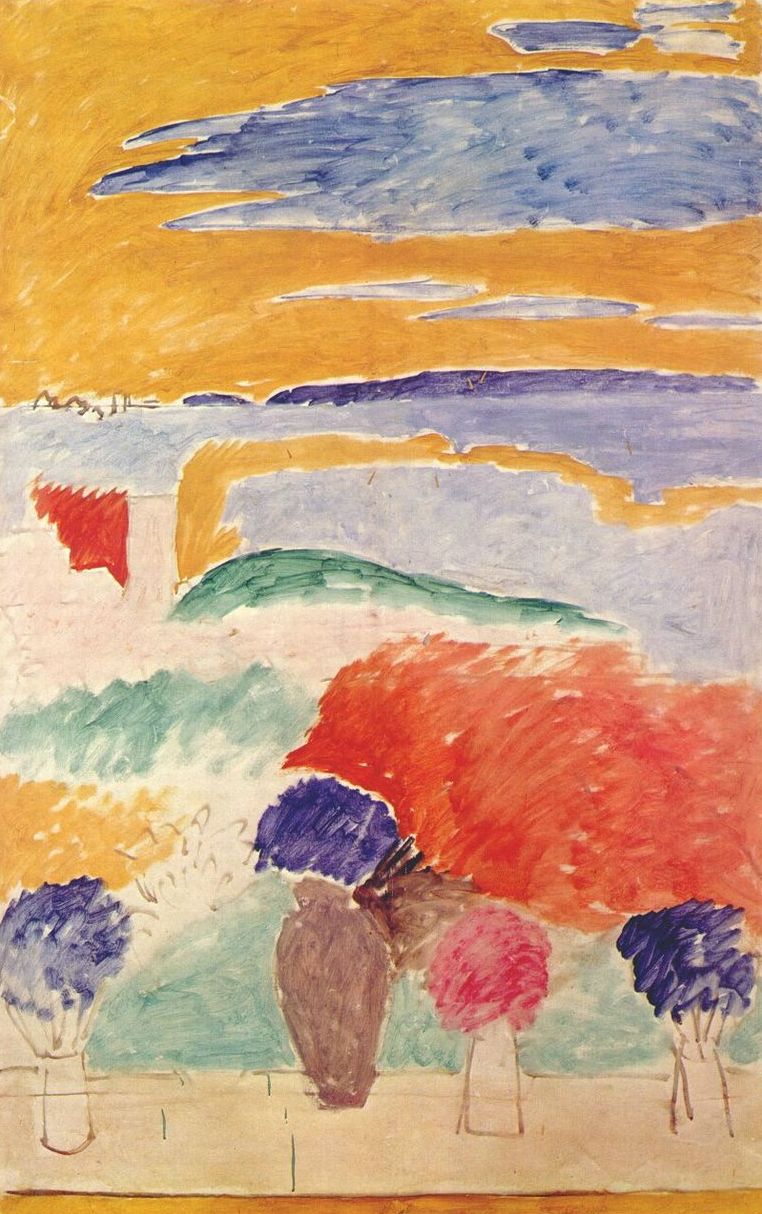
Henri Matisse’s “Open Window at Tangier” (1913) converts a simple Mediterranean view into a luminous architecture of color. The painting describes an interior balcony ledge strewn with vases and flowering shrubs; beyond it, the harbor of Tangier steps back in broad, horizontal bands to a sky the color of burnt honey, streaked with cool lavender clouds. Instead of naturalistic detail, Matisse offers essentials: a few emphatic shapes, quick strokes that breathe, and color intervals tuned like music. The window becomes a hinge between cultivated interior and expansive exterior, between the hand-arranged bouquet and the windswept sea. What might have been a casual look outward becomes a manifesto for modern painting’s ability to turn sensation into structure.
Historical Moment
The year 1913 falls within Matisse’s Moroccan period, a time when the intensity of North African light sharpened his pursuit of clarity. He had already learned, through Fauvism, that color could shoulder the weight of form; in Tangier he discovered a climate that simplified appearances into planes. White walls blazed; shadows pooled into single tones; the sea gathered into wide stripes of turquoise and slate. “Open Window at Tangier” absorbs those lessons while extending a long personal theme. Ever since “Open Window, Collioure” (1905), Matisse had used the motif of a window to dramatize how painting transforms space. Here the device matures: the window is not only a frame but a stage on which color negotiates inside and outside.
The Window as Idea
Matisse’s open windows never behave like purely optical devices. They are metaphors for painting itself: a flat surface that proposes depth. In Tangier the sash is mostly absent; only the stone parapet at the bottom reminds us of the room. The open field beyond is stacked rather than receding—sea, shore, distant headland, sky—each laid down as a broad, unified band. The result is a paradoxical space that is both shallow and vast. We stand indoors, yet the world presses right up against us as fields of color. The window unites two modes of seeing: the tactile nearness of objects we can touch and the expansive rhythm of a landscape that nearly becomes a wall hanging.
Composition and Scale
The composition keys itself to a few anchoring shapes. The lower edge carries a pale stone ledge upon which stand five containers: two slim vases at the flanks, a larger brown jar at center, and two ghosted plinths whose lines are barely notated. From these vessels rise compact bouquets—violet, pink, and indigo—compressed mounds that read as cultivated counterparts to the exuberant masses beyond. Just behind them spreads an enormous orange-red tree or bush that eats much of the middle ground, counterbalanced by a smaller green swell at left. Farther back, chalky blues and lavenders step toward the horizon. Above, the sky is an ocher sheet punctuated by layered, slate-blue clouds that drift from right to left. Matisse allows scale to go elastic: foreground shrubs are not dwarfed by distance; they converse as equals with the coastal forms, a choice that knits the entire scene into a single decorative unity.
Color Architecture
Color does the structural work. The painting is built from two great families—warm ochers and reds, cool blues and greens—held in a taut, glowing balance. The sky’s orange ground, brushed thinly so that light seems to leak through, warms the entire canvas. Across it lie long, cool plates of cloud that anchor the upper register and echo the terraced blues of water below. The red-orange mass at center right is the painting’s heat source; it pushes forward against the milky blues behind and makes the nearby pink bouquet sing. Green, a relatively small presence, is placed with care: a swell of emerald to the left of the red, plus muted sea greens beneath the horizon. These measured greens bridge warm and cool, preventing a split between sky and sea. Nothing is blended for atmospheric softness; instead, intervals are tuned—warm next to cool, dense next to thin—so the eye experiences depth as a sequence of chords.
Brushwork and the Breath of Paint
A remarkable lightness governs the surface. Matisse often lets the bristles skid, leaving streaks that animate the clouds and sea as if stirred by breeze. In places the undercolor or even raw ground peeks out between strokes, creating halos that sharpen edges while keeping them airy. The vases and bouquets are laid in with a few quick marks that reveal the speed of the hand; yet the marks are decisive, never fussy. This economy makes the painting feel freshly seen rather than laboriously built, as though the wind and sunlight have been given a direct transcription in paint.
The Foreground Bouquets
The potted shrubs along the sill are not incidental decoration. They are the interior’s reply to the exterior’s wild forms. Their violets and pinks pick up the cooler notes of sea and cloud, pulling those distant colors into the room, while their clustered shapes rhyme with the red-orange canopy beyond. The central brown jar weighs the composition just enough to keep the view from floating away. This is Matisse’s characteristic diplomacy: domestic objects are not props but structural actors that allow the landscape to harmonize with the room.
Space Without Conventional Perspective
Linear perspective is replaced by stacking and overlap. The sea is a horizontal ladder of tones rather than a funnel toward a vanishing point. The terrace parapet sits like a pale threshold, firmly flat; above it the world advances in slabs. Overlap clarifies position—the bouquets in front of the red tree, the red tree before the pale shore, the shore below the sky—but nothing slips into deep, diminishing space. The sensation is of a landscape that has come forward to greet us, flattening into pattern without losing its identity as sea and sky. This strategy lets Matisse reconcile two ambitions: the decorative coherence of a textile and the lived sense of a place.
Light of Tangier
The peculiar glow of North African daylight is everywhere in the painting. Instead of modeling with shadow, Matisse shows how light erases half-tones and turns volumes into planes. The ocher sky breathes warmth into even the coolest hues; the pale blues of the water have a chalky clarity, as if seen through sunlit air. Where shadow occurs, it is more a shift of hue than of value. This is not a meteorological sky; it is a climate made visible. The viewer senses heat in the ochers, salt in the chalky blue, and the dry brightness that makes edges crisp and colors clean.
Drawing as Edge
Matisse draws largely by adjacency. Where ocher meets lavender, a line appears without being drawn; where red abuts pale blue, a thin seam of ground peeks through and acts as a luminous boundary. Actual outlines are scarce and sparingly used—slender uprights for vase stems, a few notations for plinths, a jagged scarlet block that may suggest a rooftop or awning. This reliance on edge rather than contour keeps the painting unified; every boundary is also a color decision, and drawing and painting remain one operation.
Rhythm and Movement
Although the image is still—a view taken from a fixed point—it hums with movement. Clouds slide horizontally like long boats. The sea marches in bands, each stripe tilting slightly so the rhythm feels hand-played rather than mechanical. The red mass billows; the bouquets quiver; the entire lower register breathes in short strokes. The eye follows a looping path: up from the left vase, across the red canopy, out to the blue bands, and back along the clouds’ underside. This sustained motion is one reason the painting feels larger than its subject; it is a landscape that moves at the tempo of looking.
Ornament and Nature
Matisse loved the decorative arts—tiles, textiles, papercuts—and in Morocco he encountered ornament embedded in daily life. “Open Window at Tangier” shows how easily nature itself can become ornament when seen through a clarifying eye. The clouds behave like long appliqués stitched onto the ocher sky. The sea’s bands are as patterned as a striped fabric. The shrubs on the sill are little rosettes. Yet the picture avoids mere design because color relationships remain rooted in sensation: the ocher sky convinces as light; the blue sea refreshes as water; the red bush radiates heat. Ornament and nature support rather than cancel each other.
The Poetics of Incompletion
Areas of the canvas retain an exploratory look: thinly brushed zones at the edges; softly indicated containers in the foreground; the red patch at left left purposely unresolved. Far from suggesting tentativeness, these passages register as honesty about process. They let us see how the painting came into being—broad shapes blocked in, relationships tuned, accents added. The partialness also keeps the surface open and breathing; it invites the viewer to finish the scene in the mind, an act that deepens engagement.
Dialogues with Earlier and Later Windows
Matisse’s windows create a lineage across his career. In Collioure the 1905 window is an explosion of Mediterranean color bursting through a sash; by 1913 in Tangier, the sash falls away and the world arrives as simplified fields. Later, in Nice, open windows return with draped fabrics and palm trees; the indoor-outdoor boundary remains essential, but the atmosphere softens. “Open Window at Tangier” stands at the center of that evolution: the motif is at its most abstract yet still entirely linked to a place. It demonstrates the confidence to let very little do a great deal.
Psychological Atmosphere
The mood is one of quiet exhilaration. The ocher sky glows like late afternoon heat; the blues calm; the red tree and pink bouquet provide bursts of warmth akin to laughter. Despite the lack of figures, the painting feels companionable, as if the viewer is welcomed to the terrace for a moment of looking. There is no anxiety, no drama—only abundance pared to essentials. That combination of intensity and rest is Matisse’s hallmark, a visual equivalent of deep breathing.
Why the Painting Matters
“Open Window at Tangier” matters because it demonstrates how modern painting can honor place without imitating it. With a handful of colors and simplified shapes, Matisse delivers the sensation of standing at a window in a bright climate, feeling the sea’s breadth and the garden’s closeness at once. The work also refines a broader argument: that a painting can be both decorative and profound. Its unity of surface does not flatten experience; it concentrates it. The window device becomes a philosophy of looking—outward to the world, inward to the picture’s own order—and the harmony between those directions is the painting’s true subject.
Conclusion
A pale sill, five quick bouquets, a red canopy, stepped blues of water, and an ocher sky with lavender sails of cloud: from these minimal means Matisse builds a place that feels endless. The window does not separate interior from exterior so much as marry them; the pots and the horizon, the brush and the breeze, share one rhythm. In Tangier, under a sun that turns nuance into clear decisions, Matisse found a way to let color speak plainly and completely. “Open Window at Tangier” is that speech made visible—lucid, generous, and inexhaustibly fresh.