Image source: wikiart.org
Historical Context of “Old Woman with a Hen”
“Old Woman with a Hen” is a striking example of Bartolome Esteban Murillo’s interest in everyday life, painted at a time when Spanish Baroque art was dominated by religious commissions and aristocratic portraiture. Although the exact date is unknown, stylistic clues suggest the work belongs to Murillo’s mid career, when he was living in Seville and exploring genre subjects alongside his devotional paintings.
Seville in the seventeenth century was a city of sharp contrasts. Great wealth flowed through its port, yet poverty and hunger were widespread. Religious institutions, confraternities, and charitable hospitals commissioned paintings to move the faithful to compassion and piety. Within this environment, Murillo developed a unique visual language that dignified humble people while appealing to contemporary taste for realism and emotional immediacy.
“Old Woman with a Hen” participates in the Spanish tradition of bodegones, paintings that focus on ordinary foodstuffs, kitchen utensils, and anonymous figures. Artists such as Velázquez and Zurbarán had already elevated such scenes into serious art, using them to explore light, texture, and the quiet heroism of labor. Murillo continues this tradition but infuses it with a particular warmth. His old woman is not a caricature; she is a fully realized personality, presented with a mix of gravity and tenderness that reflects the artist’s empathy for the poor.
First Impression and Overall Composition
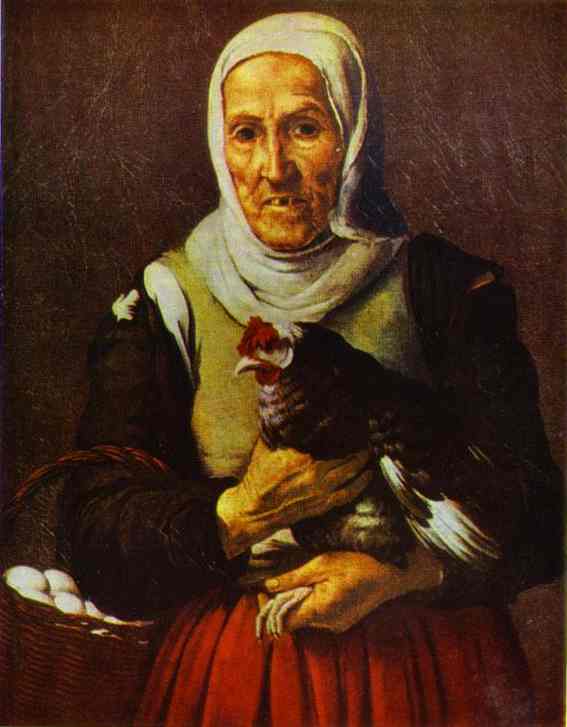
At first glance, the viewer encounters a single figure against a dark, plain background. An elderly woman faces us directly, her body turned slightly but her gaze fixed on the spectator. She wears a white headscarf and neckerchief, a simple vest, and a red skirt. In her arms she cradles a hen, holding it firmly yet gently. To her left, a wicker basket brimming with eggs peeks into the picture plane, further emphasizing her role as a keeper of poultry.
The composition is tightly framed, focusing almost exclusively on the upper half of the woman’s body and the hen. The cropping gives the portrait a monumental quality despite its humble subject. There is no distracting scenery, no narrative episode unfolding in the background. Murillo insists that we confront this woman, her age, her work, and her quiet strength.
The triangular arrangement formed by the woman’s head, the hen, and the basket of eggs guides the eye. The apex is her face, illuminated by a subdued light that brings out the fine wrinkles and bony structure. From there, the viewer’s gaze moves down to the hen’s red comb and speckled feathers, then across to the white eggs nestled in the basket. The dark background and the deep tones of her clothing allow these lighter elements—face, scarf, hen, eggs—to stand out, creating a harmonious balance between shadow and light.
The Old Woman as Central Figure
Murillo paints the old woman with unflinching honesty. Her face is lined, her mouth slightly pursed, her eyes tired but alert. There is no attempt to idealize her features or soften the marks of age. Yet this realism is not cruel. The artist’s brush records every crease with a kind of respectful attentiveness, turning the signs of a hard life into a badge of experience.
Her white headscarf frames the face like a halo of fabric, emphasizing its presence and echoing the traditional veils of female saints and widows in religious art. This subtle visual reference ennobles her without turning her into an allegorical figure. She remains unmistakably a peasant woman, yet we sense a moral dignity in her expression.
Her hands are equally revealing. The right hand grips the hen securely, fingers pressing gently into its feathers. The left hand supports the bird’s body, but also seems to rest protectively on its back. These are working hands, slightly rough and veined, shaped by years of labor. Murillo’s careful attention to their positioning suggests a relationship of familiarity and care between woman and animal. She knows how to hold a hen without hurting it, a sign of practical knowledge and everyday compassion.
Her clothing underscores her modest status. The vest and sleeves are dark and worn, lacking any adornment. The red skirt adds a vivid note of color, but it is a dense, earthy red rather than a luxurious crimson. Everything about her appearance speaks of simplicity and resilience.
The Hen and the Basket of Eggs
The hen and the basket of eggs are more than incidental props; they are integral to the painting’s meaning. The hen, held close to the woman’s chest, introduces movement and texture into the composition. Its feathers are rendered with quick, lively strokes, contrasting with the smoother surfaces of skin and fabric. The bird’s head, with its bright red comb and alert eye, adds a small but intense focal point.
Symbolically, the hen can be read in several ways. On a literal level, it identifies the woman as someone engaged in small scale farming or market trade. She might be a seller of eggs and poultry, a figure common in Seville’s bustling markets. On a more metaphorical level, the hen suggests domestic care, fertility, and the repetitive labor of sustaining life. The act of holding the bird close to her body evokes a maternal gesture, as if she were cradling a child rather than an animal. This connection hints at the nurturing role older women often played within extended families and village communities.
The basket of eggs reinforces these ideas. Eggs are symbols of potential life and fragile sustenance. In the painting they are carefully arranged, their smooth white shells catching the light. Their placement near the lower left corner anchors the composition and balances the visual weight of the hen. The viewer senses that these eggs represent not only the woman’s livelihood but also the precariousness of survival. A dropped basket, a bad season, or an illness could easily disrupt the delicate balance of her existence.
Together, hen and eggs create a microcosm of rural economy: care for animals, collection of produce, and the ongoing effort to trade or cook what is gathered. Murillo’s choice to center these simple objects alongside the woman highlights the dignity of such work.
Light, Color, and Baroque Realism
The lighting in “Old Woman with a Hen” is characteristically Baroque. A soft, concentrated light seems to fall from the left, illuminating the woman’s face, hands, and the hen while leaving the background in shadow. This use of chiaroscuro gives the composition depth and drama, making the figures emerge as if from darkness. Yet the contrasts are not as stark as in Caravaggio or Zurbarán; Murillo tempers the shadows with warm transitions, creating a more humane atmosphere.
The color palette is limited but carefully orchestrated. Neutral browns and grays dominate the clothing and background, providing a subdued stage for the highlights of white and red. The white of the headscarf, neckerchief, and eggs draws attention to key areas: the face, the gesture of holding, and the fragile produce. The red of the skirt and the hen’s comb introduces warmth and energy, preventing the painting from becoming too somber.
This combination of restrained color and controlled light allows Murillo to focus on textures. The coarse fabric of the woman’s clothing, the smooth eggs, the glossy feathers of the hen, and the woven wicker of the basket are all rendered with loving attention. Such textural richness invites close viewing and underscores the painter’s keen observation of the material world.
Psychological Depth and Human Presence
One of the most compelling aspects of the painting is its psychological depth. The old woman’s expression is not easily summarized. She does not smile, yet there is no overt bitterness in her gaze. Instead, we sense a mixture of fatigue, alertness, and guardedness. She looks outward as if assessing the viewer, perhaps imagining us as a potential customer or stranger on the street.
This ambiguity makes the portrait feel alive. We can imagine many possible stories: she might be on her way to market, paused for a moment of conversation; she might be standing in her doorway, hen in hand, discussing the price of eggs. The directness of her gaze invites us to consider her inner life, her experiences, and the burdens she carries.
Murillo avoids sentimentalizing her poverty. There is no exaggerated pathos, no theatrical pose designed to elicit immediate pity. Instead, he offers a calm, unsentimental presence. The viewer is encouraged to respect her strength rather than simply feel sorry for her. In this way, the painting becomes a quiet statement about human dignity, asserting that the lives of ordinary women are worthy of serious artistic attention.
Social and Cultural Significance
“Old Woman with a Hen” reflects broader social realities of seventeenth century Spain. Many elderly women, particularly widows, depended on small scale commerce or domestic work to survive. They might sell eggs, vegetables, or homemade goods in local markets. Their labor was essential to family economies yet often undervalued.
By choosing such a subject, Murillo aligns himself with a current of Spanish art that foregrounded the poor and marginalized. His numerous paintings of street children, beggars, and humble workers testify to his concern for social issues. Although these works were often commissioned by wealthy patrons, they encouraged viewers to acknowledge the humanity of those at the bottom of the social hierarchy.
In a religiously charged environment like Seville, such images also carried spiritual implications. They echoed Christian teachings about charity and the virtue of humility. Viewing an old poultry seller with the same seriousness as a saintly figure challenged the audience to see Christ in the poor and to recognize sanctity in everyday life. Even if “Old Woman with a Hen” is not explicitly religious, it participates in this moral and spiritual discourse.
Murillo’s Technique and Artistic Development
From a technical standpoint, the painting shows Murillo’s skill as a portraitist and his ability to integrate genre elements within a concentrated format. The brushwork is controlled yet lively. In the face and hands, he uses fine strokes to model volume and capture subtle expressions. In the hen’s feathers and basket, the strokes become more energetic, suggesting texture without overworking detail.
The composition’s clarity and the harmonious relationship between figure and objects indicate a mature artist confident in his craft. Murillo balances realism with painterly freedom, allowing the viewer to appreciate both the illusion of life and the presence of the painted surface.
Comparing this work to his religious paintings reveals an interesting continuity. The same sensitivity to facial expression and gentle handling of light appears in his depictions of the Virgin, saints, and biblical scenes. This suggests that he brought the same compassionate eye to both sacred and secular subjects, erasing the boundary between them at the level of human feeling.
Symbolic Readings and Interpretive Possibilities
While the painting can be enjoyed simply as a realistic portrayal of a rural woman, it also invites symbolic interpretations. The hen and eggs, as noted, relate to themes of fertility, sustenance, and the cycle of life. The woman’s age introduces a contrast between past childbearing years and continued nurturing through work. In her arms, the hen becomes a kind of substitute child, a creature still dependent on her care.
The contrast between white and red may carry additional resonance. White—seen in the scarf and eggs—can symbolize purity, honesty, and simplicity. Red—present in the skirt and the hen’s comb—suggests vitality, blood, and earthy energy. Together, these colors express the union of moral integrity and physical labor that characterizes the woman’s life.
Some viewers might even detect echoes of religious iconography. The way she cradles the hen recalls traditional depictions of the Madonna holding the Christ child, while the basket of eggs could faintly echo offerings brought to the temple. Murillo, steeped in religious imagery, may have subconsciously drawn on these archetypes, elevating his humble subject through subtle visual analogies.
Emotional Impact and Lasting Appeal
The enduring appeal of “Old Woman with a Hen” lies in its combination of realism, empathy, and painterly beauty. The painting does not rely on spectacular effects or dramatic narrative. Instead, it offers a quiet, concentrated moment that grows richer the more one looks.
For contemporary viewers, the image can resonate on multiple levels. It may evoke memories of grandparents, of rural relatives, or of markets where older women still sell eggs and produce. It may also prompt reflection on issues of aging, economic vulnerability, and the value society places on manual labor. In an age that often marginalizes the elderly, Murillo’s respectful treatment of his subject feels particularly poignant.
As a work of art, the painting demonstrates how a master can transform an ordinary scene into a compelling visual meditation. Through subtle light, carefully chosen colors, and an unflinching yet compassionate gaze, Murillo turns an anonymous poultry seller into a timeless symbol of resilience and quiet dignity.
Conclusion
“Old Woman with a Hen” by Bartolome Esteban Murillo is a powerful testament to the depth and humanity of Spanish Baroque painting. Set against a dark background, the elderly woman, her hen, and the basket of eggs become the focus of a moving exploration of age, labor, and everyday survival. Murillo’s realistic rendering of her face and hands, his sensitive use of light and color, and his careful arrangement of objects all contribute to an image that is at once simple and profound.
The painting celebrates the dignity of humble work and invites viewers to look closely at a life often overlooked. In giving this woman the full attention usually reserved for saints and nobles, Murillo affirms that every human being, regardless of social status, is worthy of artistic and moral consideration. Centuries after it was painted, “Old Woman with a Hen” continues to speak with quiet force, reminding us that beauty and meaning can be found in the most ordinary corners of the world.