Image source: wikiart.org
Introduction
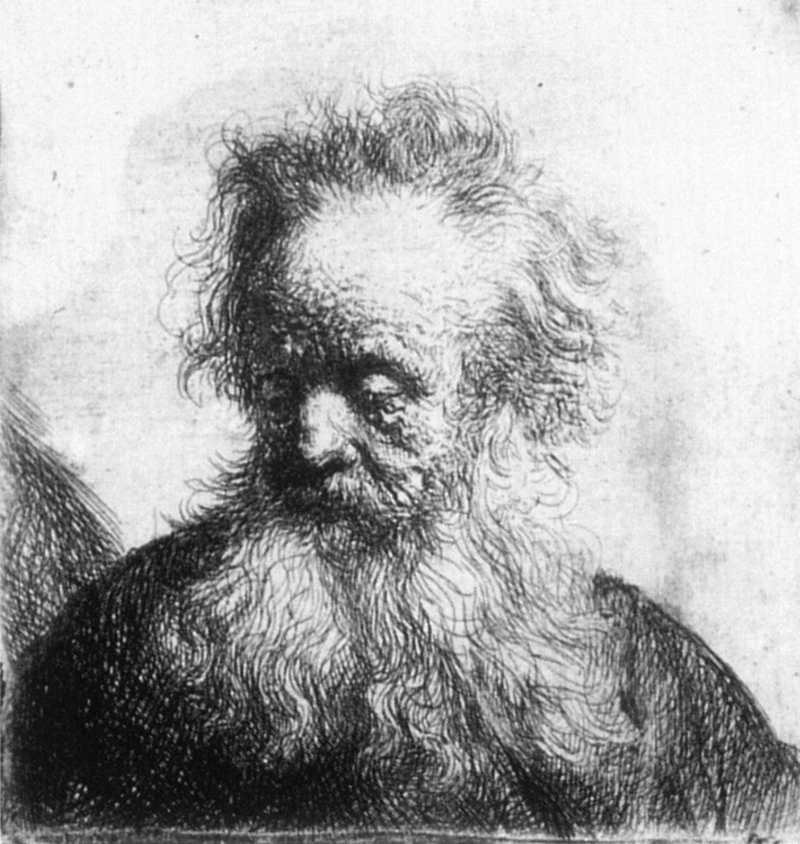
“Old Man with Flowing Beard, Looking down Left” (1631) is an intimate etching in which Rembrandt turns a few square inches of copper into a meditation on memory, gravity, and light. The head fills the small plate. Unruly hair rises like sea foam, the forehead is mapped by a thousand tiny marks, and the beard streams in arcs that seem to carry the air itself. The eyes drift downward, not in defeat but in inwardness. With line alone—pressed, lifted, doubled, and crossed—Rembrandt makes age luminous and contemplative.
A Hinge Year And A Laboratory Of Heads
The date 1631 marks Rembrandt’s decisive transition from Leiden to Amsterdam, a period thick with experiments in identity and expression. His studio became a laboratory of “tronies,” or character studies, in which costume and gesture served as tools for probing emotion. This small etching belongs to that laboratory. It is not a portrait of a named person but a study of how a human head carries time. The sheet is both calling card and manifesto, proving what the young master could do with nothing more than a needle, a ground, and acid.
Etching As A Sensor For Touch
Etching is unusually sensitive to pressure. A drawn line becomes a groove; acid fixes the gesture into metal; ink later fills those channels and prints them as palpable scratches of light and dark. Rembrandt exploits this tactile fidelity to differentiate tissues and weights. The forehead receives tiny, almost granular hatchings that pulse like pores. The hair blooms in spirals and zigzags that feel springy to the eye. The beard is a cascade of long, elastic strokes that thicken where lines cluster and thin where they separate, making strands appear to lift and fall. Because the etched mark records action, the face seems alive with micro-motions even though the sitter is still.
Composition And The Geometry Of Inwardness
The head tilts slightly and turns to the left, creating a gentle diagonal from the high right hairline to the low left beard tip. This diagonal draws the gaze downward with the eyes and prevents the square image from feeling static. The shoulders, barely sketched, form a dark base that supports the luminous dome of the forehead. A wedge of empty space opens along the upper right, where the pale plate tone becomes air. The entire composition funnels attention to the eyes while giving the beard room to flow.
Light That Thinks Before It Shines
Although printed in monochrome, the etching is a masterclass in light. Rembrandt uses density of line to simulate value. Where lines crowd and cross—under the eyes, along the cheek, at the base of the beard—shadow gathers. Where he spaces lines or allows the plate to rest, highlight appears. The brightest zone is the upper forehead, a smooth, slightly convex field that seems to receive a soft light from above. That glow reads as mental as much as physical, making the forehead a stage where thought becomes visible. The eyes and the corner of the mouth sit in moderated half-tones that keep expression alive without theatricality.
The Forehead As Landscape
Few artists have rendered a forehead with such authority. Rembrandt resists drawing it as a hard, gleaming plane. Instead he constructs it from innumerable, short hatchings and gently curved strokes that follow the skull’s topography. The result is not a mask but a living terrain. Small darker flecks near the temple suggest age spots without cruelty, and micro-ridges near the glabella hint at habitual concentration rather than grimace. This attention to the forehead matters because it is the canvas of memory; we feel years resting there like weather.
The Eyes And The Ethics Of Looking Down
The eyes turn down and to the left, their lashes and lids described by only a handful of decisive lines. In lesser hands such a downward gaze might signal caricatured melancholy. Rembrandt’s treatment communicates thoughtfulness. The eyes are not closed; they are working inward, surveying a landscape we cannot see. The direction of the gaze syncs with the beard’s flow, so that vision and time seem to travel together. We do not spy on a private sorrow; we witness a private inventory.
Hair And Beard As Weather Systems
The hair is a crown of turbulence. Fine curling lines erupt around the temples and lift away from the skull as if charged with static. Where the hair meets the forehead, Rembrandt breaks lines and leaves tiny reserves of blank paper, creating the sense of light filtering through wisps. The beard, by contrast, is a river. Its long curves and eddies are drawn with a freer, more elastic hand. Dark pockets where curls overlap create depth and shadow; lighter, parallel strands give sheen. The two systems—wind above, water below—frame the steady, reflective island of the face.
Nose, Mouth, And The Language Of Restraint
The nose is modeled with minimal means: a contour on the bridge, a shaded wedge for the nostril, a few crossings to indicate cast shadow. The mouth turns slightly downward but evades caricature; it is a resting mouth, not a signal. This restraint is crucial. Rembrandt refuses easy emotion cues. He trusts the whole mass of the head, its tilt, and the choreography of light to deliver psychology. The viewer is invited to infer rather than consume.
Background As Breath
The plate surrounding the head is left largely open, with faint plate tone in some impressions and clean paper in others. In both cases the background reads as breath, not emptiness. A few light diagonals near the left shoulder hint at environment—perhaps a cloak edge or a bench—but they never coalesce into setting. This breathy field prevents the etched lines from feeling cramped and grants the head a sense of suspension in air, which enhances the downward drift of thought.
Printing, Plate Tone, And The Image’s Weather
Rembrandt’s etchings often exist in impressions with differing atmospheres depending on inking and wiping. A cleanly wiped plate gives sparkling highlights across the forehead and beard. A retained plate tone enshrouds the head in a thin haze, warming shadows and slowing the transitions. The subject’s mood shifts subtly with these choices—from analytic clarity to meditative dusk—without a single line changing. This flexibility reveals the printmaker’s second stage of authorship at the press.
Conversation With Other Heads Of 1630–1631
The early 1630s bring a constellation of etched heads—young and old, laughing and grimacing, turned in hats and swathed in cloaks. Among them, this old man stands out for its quiet seriousness and its commitment to minute tonal transitions over bravura outline. Where the “long bushy hair” self-portrait flaunts calligraphic energy, this sheet pulls the tempo inward. It is closer in spirit to Rembrandt’s studies of prophets and hermits, where the face becomes a chamber for light rather than a theater of expression.
The Physics Of Scale
The plate is small—palmable—and the head nearly fills it. This scale creates intimacy. We are close enough to trace single lines with the eye, yet the head still reads as monumental because the beard and hair expand to the margins. The absence of a torso keeps us from reading social signals of clothing or rank. All identity resides in the face, turning the viewer’s attention to what time does to flesh and what attention does to time.
Technique As Biography
Look long and the etched marks begin to suggest the very processes they describe. The burr of deeper-bite lines at the beard’s base reads as roughness you could feel. Rapid, looping strokes at the hairline mimic unruly growth. Short, cautious hatchings across the cheek perform the tact of touching fragile skin. Technique becomes biography. The life of the man is recapitulated in the life of the line.
The Refusal Of Sentimentality
Images of aged people in the seventeenth century often veer toward moral lesson or comic type. Rembrandt avoids both. He does not convert the old man into an emblem of vanitas; there are no skulls, no hourglasses, no mocking details. Nor does he exaggerate the head into grotesque. Instead he accords the sitter a simple luxury: to be looked at carefully. The resulting dignity is quiet but indelible.
A Guide For Slow Looking
Begin at the forehead and watch how light blooms from sparsest hatch to dense weave. Move to the eyes and see how a single thicker stroke under the lower lid gives weight to the gaze. Let your vision slide down the nose into the shadow wedge above the mustache; feel how the mouth’s edge disappears into that half-tone. Drift into the beard and follow a single strand until it dissolves into a knot of crossings, then emerges again in a bright arc. Step back and notice the overall diagonal that sends the head and time to the left. The drawing reveals itself as a choreography, not a snapshot.
Why The Image Still Feels Modern
Contemporary viewers accustomed to photography and minimalist design recognize in this small etching principles they cherish: economy of means, trust in negative space, and attention as ethics. The head’s unadorned presentation—no narrative, no costume spectacle—anticipates modern portrait photography’s intimacy. Most of all, the image resists telling us what to feel. It offers the truth of surfaces and the invitation of inwardness, leaving interpretation to the viewer’s own store of experience.
Legacy And Afterlife
This etched head becomes a grammar book for Rembrandt’s later portraits. The calibration of light on forehead and cheek will return in scholars and rabbis; the cascading beard will reappear, differently inflected, in patriarchs and prophets; the downward, thinking gaze will haunt self-portraits in which the artist turns from mirror to thought. For printmakers across Europe the sheet demonstrated that a tiny plate could hold monumental presence if the lines were true and the air around them honest.
Conclusion
“Old Man with Flowing Beard, Looking down Left” is a small miracle of attention. With no costume, no emblem, and almost no background, Rembrandt makes a head that seems to breathe and remember. Each line has a purpose, each gap a function, and the whole mass tilts into a silence that the viewer completes. The etching is both a study and a finished world, a proof that the human face—especially a face shaped by years—needs very little to become inexhaustible in art.