Image source: wikiart.org
Introduction
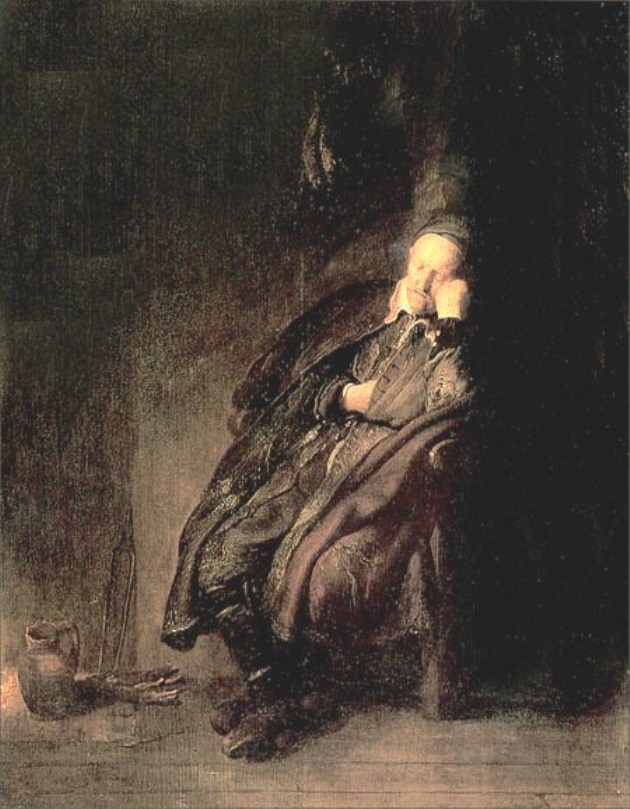
“Old Man Sleeping” (1629) stands among the intimate early interiors that established Rembrandt as a master of light and human feeling before he left Leiden for Amsterdam. Painted when he was about twenty-three, the work compresses drama into a private, almost soundless moment: an elderly figure dozes in a deep chair by a low fire, his cheek resting on his hand, his body slack with the irresistible weight of fatigue. Nothing sensational occurs, yet the scene holds the eye because Rembrandt builds a world out of darkness and a life out of a few planes of illumination. The painting is small, but it feels monumental, a quiet cathedral of shadow where a single flicker of warmth reveals character, time, and the texture of existence.
Context Within Rembrandt’s Leiden Years
The date places the picture within Rembrandt’s intensive Leiden period, when he explored tronies—character studies of anonymous heads—alongside compact histories and meditative interiors. In these years he absorbed and transformed lessons from the Utrecht Caravaggisti, whose tenebrist lighting and theatrical staging had swept through the northern Netherlands. But instead of adopting Caravaggio’s public stage, Rembrandt shifted the drama inward. The Leiden works dwell on the edges of consciousness: scholars caught between study and reverie, old men pausing mid-prayer, figures enclosed by shadow as if they were thinking inside a cave. “Old Man Sleeping” converts that introspective theater into a domestic key. The subject has no obvious narrative, yet the feeling of time passing—of an hour surrendered to sleep—becomes narrative enough.
Composition That Breathes Through Shadow
The composition is strikingly asymmetrical. The right side holds nearly all the mass: the cushioned armchair, a pooled cloak, the curved contour of the sitter’s shoulder, and the pale oval of his head tipping forward. The left side is almost bare, a shallow stage with a smudge of hearth-glow, a pot, and the faint verticals of tools. That imbalance is not clumsy but purposeful. By vacating the left half, Rembrandt allows space for light to travel. The glow crawls across the floorboards, climbs the chair leg, and rises like a tide to the sleeper’s face. Negative space becomes the channel through which warmth moves. The viewer’s gaze crosses that channel and lands on the sleeper at the precise place where light coagulates.
The diagonals also guide attention. The chair back forms a large, sloping arc that funnels the eye downward toward the folded forearms. A diagonal shadow plunges from upper left to lower right, setting the head like a lantern against darkness. Within this scaffold of diagonals, Rembrandt lets small perpendiculars—the line of the forearm, the edge of the cloak’s trim, the corner of the chair—act as rests where the eye slows. A painting about sleeping adopts a rhythm of deceleration.
Chiaroscuro As Emotional Architecture
Light does more than model form; it proposes a mood and a metaphysics. The brightest accents appear on the man’s temple, nose, and the knuckles that support his cheek. Those three pale islands describe a triangle of sensation: thought, breath, and touch. Around them, Rembrandt spreads warm brown halftones that melt into a blackness so full it feels substantial. This is not emptiness but a dark that functions like velvet, muffling sound and motion. The light is soft, lateral, and low, likely from the fire that smolders at the picture’s edge. Such firelight is fickle and humane. It caresses rather than interrogates, making the scene feel earned and natural rather than staged.
The chromatic economy is deliberate. Earth pigments—umbers, siennas, muted reds that bloom and sink—dominate the picture, creating a harmony of warmth that suits the subject’s lowered pulse. Rembrandt artisanship shows in the way he differentiates materials with value and edge more than hue. The robe’s nap absorbs light; the polished chair crest flashes it back; the skin refracts it through a delicate veil. In the interior world of 1629, color submits to tone, and tone submits to feeling.
The Poetics of Sleep in Seventeenth-Century Life
Sleep carried different habits and meanings in the seventeenth century than today. Segmented rest—first sleep, midnight waking, second sleep—was common, especially in winter when nights stretched long. Napping by the fire belonged to the ordinary grammar of domestic time. Rembrandt captures that culturally familiar interval yet steers away from caricature. There is no moralizing inscription about sloth, no comic snore. The man sleeps the way old people sometimes do: suddenly and publicly, without ceremony, as if the body stepped across a threshold before the mind finished deciding. The presence of the pot and the faint hearth suggests a household world of slow cooking, warmth managed carefully, hours punctuated by small tasks. The painting feels truthful because the details are not theatrical props but working facts.
At the same time, sleep can carry allegorical overtones. Early modern viewers recognized emblems of Time and Age in extinguished candles, hourglasses, and nodding heads. Rembrandt understates the emblematic language. The emblem here is fatigue itself—the body’s surrender as a sign that life has been long and used. If there is allegory, it is the gentlest kind: the awareness that rest is both necessity and mercy.
Materiality and Touch
The picture seems, even in reproduction, palpably handled. In passages of the cloak one senses loaded, sticky strokes laid and then lightly dragged so that they catch on the weave beneath. Highlights on the hand and cheek read as thicker touches, probably a small crest of lead-white flicked and settled, producing a minute relief that flashes when the light falls right. That sculptural surface allows Rembrandt to separate skin from cloth with barely any hue change. The eye reads texture because the paint itself behaves differently—dense for flesh, granular for fabric, satin-hard for polished wood. The viewer therefore experiences not only the sight of sleep but the tactile world that cradles it, and this transforms a genre scene into an encounter with the material presence of things.
The Psychology Of Anonymity
Rembrandt often preferred anonymous models for his early studies of age. Without the obligations of portrait likeness, he could push toward psychological truths that sit outside biography. The sitter here is no named citizen; he is an archetype of late life, rendered with tenderness. Lines around the eyes collapse as the lids droop. The mouth relaxes into a slack neutrality—neither smiling nor frowning, exactly the expression of someone who has momentarily laid down every mask. The hand that props the cheek is doing the minimum; you can feel the heaviness in the heel of the palm. It is a picture of trust. Only in a protected room can one sleep so openly. That implicit safety, offered by the home and multiplied by the enveloping dark, imbues the scene with quiet dignity.
Time Suspended And Time Accumulated
The painting holds two kinds of time at once. There is the instant: a body mid-doze, breath shallow, fire whispering. But there is also the sediment of a lifetime. The old man’s clothing suggests years of use; the chair’s arm bears the polish of countless rubs; the robe’s fringe releases small filamentary highlights like threads worn shiny by hands. Rembrandt makes the moment of sleep a visible summary of habituation. Everything here has been lived with for a long time, and because of that longevity the room can support oblivion. This fusion of the momentary and the enduring is characteristic of Rembrandt’s art. Whether painting prophets or beggars, he turns time into a palpable medium, something that can stain fabric, soften posture, and glow on skin.
Domestic Theater Without Spectators
Many early Rembrandt interiors stage a kind of one-person theater. In “Old Man Sleeping,” the spectator is the intruder, but the scene does not recoil. The man remains inside his own time. There is no acknowledgment, no lifted brow, no startled posture. That indifference to the viewer alters the picture’s ethical charge. Instead of being invited to judge, we are invited to keep company. The painting teaches a mode of looking that is respectful and slow, similar to waiting beside someone who naps rather than waking him. The ethical stance merges with the pictorial one; both are built from restraint.
The Edge Between Sacred And Ordinary
Although this is not a biblical subject, Rembrandt borrows sacred atmospherics. The light that pools on the sleeper’s forehead resembles the small, concentrated aureoles he often gives to saints and prophets. The depth of the surrounding dark has chapel gravity. Yet nothing here is miraculous. This edge condition—where ordinary life feels numinous because of how attentively it is seen—became a hallmark of Dutch Golden Age interiors. In Rembrandt’s hands, it becomes a philosophy of painting. Vision itself confers worth. The old man is important not because of office or narrative but because he exists with fullness and is granted the honor of our focused attention.
A Dialogue With the Artist’s Other Studies of Age
Seen alongside Rembrandt’s other studies of elderly figures from the late 1620s, this picture emphasizes gentleness over drama. Some related works show old men engaged in study, their brows knit as candles gutter, while others intensify chiaroscuro to near-mythic effect. Here the gesture is quieter. The interior is not crowded with books or attributes. By stripping away props, Rembrandt allows the face, hands, and posture to carry the narrative. The painting thus converses with the artist’s ongoing interest in states of mind—concentration, prayer, reverie—but replaces effort with release. Sleep is thought’s soft opposite, and painting it well is a test of sympathy.
The Craft Of Edges And The Breath Of Air
One of the most revealing features is Rembrandt’s management of edges. The illuminated cheek has a firm contour against the shadowed background, but the transition where the jaw meets the collar is softened, as if light dissolves into fabric. Along the sleeve he alternates sharp notches and lost edges, implying folds that advance and recede. These modulated boundaries create the sensation of air between things. The sitter does not paste onto the chair; he inhabits space, surrounded by a thin envelope of atmosphere warmed by the fire. That breath of air—impossible to draw but palpable in the best painting—helps the viewer feel present inside the room.
Narrative Possibilities Without Dogma
What does the old man do when he is not sleeping? His clothes suggest a modest prosperity: a substantial robe with patterned trim, sturdy shoes, a cap or night coif. He might be a household elder resting after a day of small labors, or a former scholar whose books are out of sight, or a shopkeeper who finally sat down. Rembrandt leaves such options open. The only firm claim the picture makes is about human commonality. Everyone sleeps; everyone finally leans on the hand; everyone knows the gentle shame and deep relief of nodding off in the chair. The painting’s generosity comes from that universality.
Light As Care
The manner in which light touches the sleeper reads almost like caretaking. Instead of blasting the figure, illumination arrives in increments, as if it were adjusting itself to the fragility of the subject. The warmth concentrates on skin and retreats from the ground. Even the fire at the left lurks at picture’s edge, not intruding. This circumspection gives the scene an ethos: to see someone kindly is to light them kindly. Rembrandt’s brush seems to understand that the old man’s dignity depends on not being overexposed.
The Quiet Modernity Of Intimacy
Although painted in 1629, the image feels modern in its refusal of spectacle. Many later painters—from Chardin to Whistler to the intimists of the nineteenth century—would cultivate similar domestic hush. The seed is here. The painting understands that small human states, when described with accuracy and feeling, can bear the full weight of art. That intuition helps explain why the work remains vivid to contemporary viewers. We recognize the room; we have sat in that chair; we have woken from such a doze with the same small start and the print of our fingers on our cheek.
Technique Serving Vision
Every technical choice serves the subject. The restricted palette compresses the visual chord so that tonal changes ring louder. The layered paint handling, alternately dense and scumbled, lets surfaces announce themselves without fussy detail. The composition stages an encounter between emptiness and presence, shadow and form. The result is a picture whose craft does not display itself but disappears into the scene’s life. That disappearance is not a refusal of virtuosity but its fulfillment. When technique becomes invisible, the viewer can meet the sleeper directly.
Humanity As Rembrandt’s True Subject
Whether depicting a biblical patriarch, a beggar, a scholar, or an anonymous elder, Rembrandt’s deepest subject is human interiority. “Old Man Sleeping” makes that commitment almost literal: the sitter’s interior life is temporarily closed, yet the painting invites us to imagine it with respect. The closed lids do not banish personality; they focus it. The curve of the spine, the weight of the head, the slackened mouth—all speak eloquently about a life that has worked, eaten, worried, loved, and is now resting. In the end, the picture’s power lies in its refusal to be cynical. Age is not mocked; fatigue is not condemned; poverty is not presumed; wealth is not flaunted. The old man is simply allowed to be.
Conclusion
“Old Man Sleeping” distills Rembrandt’s early mastery into a small, glowing chamber of time. The asymmetrical composition opens a pathway for light; the earth palette binds the scene into a single breath; the paint surface carries the tactility of fabric, wood, and skin; the psychology of anonymity frees the moment from biography and gives it to us as a shared human condition. In a culture that valued industry and moral instruction, Rembrandt paints rest without apology. The image honors the body’s need to pause and the home’s role in sheltering that pause. Nearly four centuries later, the room still feels warm, the air still quivers near the fire, and an old man still sleeps while the world, if only for a second, grows quiet around him.