Image source: wikiart.org
Introduction
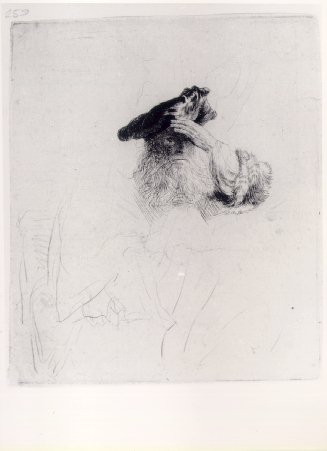
Rembrandt’s “Old Man Shading His Eyes with His Hand” (1639) is a small etching with a startlingly large presence. At first glance the sheet looks unfinished: a head turned upward, a raised hand, and a suggestion of torso emerge from a field of nearly untouched paper. The rest of the figure is ghosted in faint exploratory lines. Yet the fragment carries the authority of a complete image. In a few decisive strokes Rembrandt creates sunlight, age, gesture, and the psychology of looking. The figure squints beneath a beret-like cap, the palm lifted to block glare. We do not see what he sees; we feel the effort of seeing. That transfer—from representation to embodied sensation—is the true subject of this print.
A Study of Light and Sight
This etching examines the relationship between light and the human act of looking. The model lifts his hand not in greeting or prayer, but in the practical mechanics of vision. The hand becomes a visor, transforming raw brightness into intelligible sight. Rembrandt renders this with a minimal repertory of marks: the shadowed zone across the eyes; the abrupt highlights on cheek and beard; the dark, wedge-like cap that deepens the contrast. The gesture communicates a specific kind of illumination—low, strong, and frontal, as though the figure has stepped from a shaded interior into sunlight. The sheet therefore stages not only a person but a moment of transition, a crossing from dark to bright that the body must negotiate.
The Expressive Economy of Line
Etching allows for astonishing economy, and Rembrandt exploits it. The beard is a dense mesh of short strokes that thicken where the chin thrusts forward and loosen where hair thins along the cheek. The hand is built from just a handful of contours and a few diagonal hatch marks under the fingers to indicate shadow. The cuff is suggested by a small concentration of burr-rich lines that read as soft fabric. The cap, one of the darkest passages on the sheet, anchors the head and emphasizes the tilt of the face. Outside these decisive clusters the paper is almost blank, with faint, exploratory outlines suggesting a shoulder and the fall of a cloak. The deliberate incompletion keeps the focus on the moment of shading; the rest of the body recedes into possibility.
Gesture and the Body’s Intelligence
The raised hand is more than a visual device; it is an index of the body’s intelligence. Without seeing the sun, we infer its position from the angle of wrist and the spread of fingers. The subject’s neck stretches, the jaw juts slightly, and the mouth opens as if drawing a breath. In Rembrandt’s handling, these small movements create a richly physical experience. The pose is not staged, but caught, as if the artist asked his model to repeat an everyday motion. The authenticity of that movement gives the image its authority and abolishes the need for surrounding context.
The Old Man as a Figure of Experience
Rembrandt’s choice of an elderly sitter matters. Age gives the face more topography for light to discover—furrows, folds, and wiry hair that catch highlights like spark on dry grass. It also lends the gesture symbolic depth. An old man shading his eyes evokes the labor of attention late in life: the determination to keep looking into a world that can be too bright or too obscure. The portrait therefore reads as both specific study and quiet allegory of perception itself. Rembrandt often turned to elderly faces for such double meanings, finding in the textures of age a language for resilience and inquiry.
Unfinishedness as Intention
The apparent incompletion of the lower half is not accident; it is method. By withholding detail, Rembrandt ensures that all of the viewer’s attention aggregates around the head, hand, and the contested zone of sight. The blankness around the figure works like silence around a solo instrument; it intensifies what is heard. In technical terms, the untouched paper also functions as light, making the highlighted cheek and the illuminated edge of the hand feel believable without heavy modeling. The viewer mentally completes the body, which pulls us into collaboration with the artist.
The Role of Drypoint Burr
In many impressions of this plate, the burr—raised ridges of copper thrown up by the drypoint needle—softens edges and deepens shadows. Rembrandt uses this burr particularly in the darker notes of the beard, the cap’s rim, and parts of the sleeve. The resulting softness mimics the behavior of light on hair and cloth, offsetting the crisper etched lines that define the hand and cheek. This alternation of fuzzed and sharp passages is crucial to the sheet’s realism; our eyes recognize the difference between the matte absorption of hair and the slightly reflective plane of skin.
A Dialogue with Self-Portraits
The headwear, facial hair, and upward glance recall several of Rembrandt’s self-portraits from the late 1630s, where he experiments with expressive lighting and oblique angles. Whether or not the old man is the artist himself, the print belongs to that family of explorations in which a human face is used to test how far light can be bent to serve character. In painted self-portraits, Rembrandt often creates dramatic spotlight effects; here he relies on scarcely more than a dozen lines to generate comparable intensity. The print thus condenses lessons from the paintings into the most economical medium.
The Psychology of Looking Up
Upward glances in art are often associated with religious devotion or awe. Rembrandt hints at those associations while grounding the gesture in a practical act. The mouth’s slight parting and the furrowed brow read as effort as much as emotion. The viewer senses a mind trying to discern something barely visible in the glare. Because the target of the gaze remains offstage, the sheet invites projection: perhaps the man surveys a bright courtyard, seeks a figure on a balcony, or studies the shape of a cloud breaking open. This open-endedness keeps the print fresh; it refuses to lock the gesture into a single narrative.
Light Without Background
One of the sheet’s most striking decisions is the absence of a rendered background. With no walls, windows, or landscape cues, light must be inferred purely from its effects on the face and hand. This approach puts the emphasis where Rembrandt wants it: on the physiology of seeing rather than on the description of place. The white ground operates as both unpainted air and blinding glare. We are less in a room than in a field of brightness where the figure comes into being by subtracting light with a hand.
The Beret and the Arc of the Silhouette
The cap functions as both prop and compositional anchor. Its dark, rounded mass balances the wide white of the paper; its slanted lower edge sharpens the angle of the head’s tilt. Crucially, it throws the forehead and brow into shadow, making the act of shading necessary. The silhouette of cap and hand produces a strong, memorable contour—one of those simple arcs that stick in the mind long after detail has faded. Rembrandt often looked for such paramount lines as the backbone of an image.
Relationship to Everyday Observation
The etching draws on ordinary experience rather than staged drama. Anyone who has stepped from shade into sunlight recognizes the reflex captured here. That everydayness is central to the print’s appeal. Rembrandt elevates a common gesture into a subject worthy of concentrated art, the same way he elevates beggars, shopkeepers, and scholars in other small prints. The work promotes an ethic: the world’s minor motions deserve attention because they are the mechanics of being alive.
The Sheet as a Lesson in Drawing
For students of art, the print is a lesson in how to prioritize. Rembrandt selects the few forms that carry the story—the hand, the brow, the beard’s forward thrust—and renders them with maximum conviction. Secondary information is either whispered or omitted. The approach teaches that clarity comes not from adding everything seen, but from emphasizing what counts. The print’s authority stems from this discipline, from the willingness to stop as soon as the essential is achieved.
Texture and the Sense of Touch
Rembrandt’s lines do more than describe; they invite tactile imagination. The beard’s wiry mass feels prickly; the sleeve’s edge suggests wool; the cap reads as dense felt. Even the skin along the cheekbone, modeled with the lightest of hatching, implies a slight roughness of age. This tactile specificity enhances empathy. We don’t simply observe an old man; we feel the world as his hand would—blinding light softened by skin and bone.
Time Encoded in the Gesture
The graphic simplicity suggests an instant, yet the gesture encodes time. The hand must have risen, paused to find the right angle, and will soon lower as the eyes adapt. The sheet catches the midpoint of that brief sequence. In this sense the etching resembles Rembrandt’s landscape studies of weather in transition; both treasure thresholds—moments when the world changes and bodies recalibrate.
The Poise between Study and Artwork
Was this plate a preparatory study or a finished print intended for collectors? It lives in the fascinating middle ground. Its incompletion and focus on a single gesture suggest study; its exact, celebratory treatment of head and hand suggests a finished work on a small scale. Rembrandt routinely blurred such boundaries, allowing experiments to circulate as art and letting finished pieces reveal traces of process. That blurring adds to the print’s vitality. We feel present at the making rather than viewing a polished product from which all searching has been removed.
A Quiet Allegory of Perception
Beyond observation, the sheet reads as an allegory of perception’s labor. To know the world, we must sometimes shield ourselves from its excess. Truth comes not only by exposure but by measured attention—by shaping light to human scale. The old man’s visor-hand is thus a tool of intelligence. Rembrandt’s own art performs a parallel operation: he reduces the overwhelming complexity of the visible to a few chosen marks that make seeing possible. The print becomes a mirror of its maker’s method.
The Viewer’s Involvement
The large fields of blank paper around the figure have an unexpected effect: they implicate the viewer. Our eyes must cross that open space to reach the head; we mimic the subject’s effort by adjusting to the image’s own glare. The experience is collaborative. We complete the lower body, imagine the sunlight, and supply the world the man beholds. Few prints create such an intimate pact between maker, subject, and spectator with so little ink.
Enduring Power
“Old Man Shading His Eyes with His Hand” endures because it sums up Rembrandt’s gifts in miniature: empathy without sentimentality, technique without display, and a faith that human gestures contain inexhaustible drama. The etching is modest in size but monumental in implication. It invites us to practice the art it depicts—shielding glare, focusing attention, and continuing to look. In that practice, the old man’s ordinary action becomes a model for seeing art and life well.
Conclusion
Rembrandt transforms a tiny, familiar motion into a meditation on light, age, and the craft of perception. The raised hand converts brightness into vision; the etched lines convert paper into living flesh and felt. What looks unfinished has precisely the completeness the subject requires. Nothing extraneous competes with the turning head and the visor-hand. The sheet may have begun as an exercise, but it arrives as a statement: attentive seeing is heroic, and the simplest human gestures can carry the weight of experience. In the bright blank field of the paper, an old man leans into light—and teaches us how to do the same.