Image source: wikiart.org
Introduction
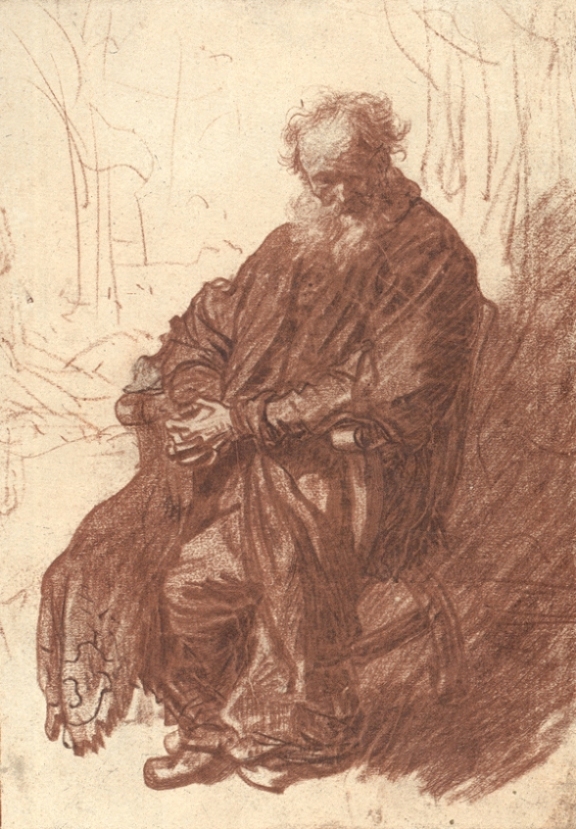
“Old Man Seated in an Armchair, Full Length” (1631) is one of Rembrandt’s most eloquent early figure studies, a drawing that turns the simplest of human actions—sitting, thinking, resting—into a complete drama of light, weight, and time. Executed with warm, reddish-brown chalk heightened by vigorous tonal rubbing and incisive line, the sheet shows a bearded elder sunk into a chair, head bowed, hands lightly locked, robe pooling in heavy folds to the floor. The background is barely notated; the air around him feels unforced and real. Without the crutch of anecdote or emblem, Rembrandt proves that line alone can carry presence and that the ordinary posture of a living body can reveal character more securely than any theatrical gesture.
A Pivotal Year And A Laboratory Of Looking
The date 1631 places the drawing at the hinge of Rembrandt’s move from Leiden to Amsterdam, when he had already mastered expressive heads in etching and was courting a broader market for portraits and histories. Drawings from this moment are laboratories. They test how surface, pressure, and speed might stand in for skin, cloth, and thought; they look for the fewest marks that can still persuade. In this sheet the laboratory yields a principle that will guide him for decades: if you record weight faithfully—where the body meets chair and floor—the rest of the likeness can be suggestive and still feel true.
Materials And The Warm Intelligence Of Sanguine
Rembrandt chooses red chalk (sanguine) for its ability to move between contour and mass without changing tools. Under light pressure it whispers pale scaffolding lines; with a firmer hand, it deepens into supple, velvety tones. The chalk’s iron-oxide warmth also carries an immediate association with skin and cloth. He exploits these properties with rare economy. The hair and beard are flicked with lively, granular strokes; the robe’s broad shadows are rubbed and reworked to produce a felt-like density; the hands and shoes receive denser, sharper accents so they hold their plane against the surrounding softness. A few passages of white paper, deliberately preserved, become blows of light that make the whole sheet breathe.
Composition: A Pyramid Of Quiet
The figure and chair form a stable pyramid that occupies the lower two-thirds of the sheet. The head inclines toward the apex; robe and chair arms spread into a broad base; the heavy hem crosses close to the lower edge, anchoring the mass to the ground. This triangular construction does two things. It stabilizes the eye—no adrenaline, no whirl—and it directs attention to the hands and face where the drawing’s psychology resides. The left margin retains ghost lines of an abandoned setting, lightly sketched trees or posts that amplify the isolation of the seated presence when left incomplete.
The Grammar Of Hands
Rembrandt gives the old man’s hands a near-liturgical clarity. You can feel the weight of fingers lightly clasping, knuckles modeling the light with small planes, a thumb resting as if marking a pause in thought. The hands are neither clenched nor limp; they are gathered, like attention. They act as the sentence’s verb, balancing the bowed head’s quiet subject. In later portraits Rembrandt will again use hands—resting on a chair arm, opening a book, cradling a cane—as crucial conveyors of thought. Here the discovery is already complete: gesture without display is the surest route to truth.
Head And Gaze: A Weather Of Thought
The head inclines in a curve that begins at the shoulder, continues through the neck, and slips into the crown of hair. A few insistently dark accents at brow, nostril, and moustache register physiognomy, but the anatomy is never pedantic. The face is less a map of features than a barometer of mood. The downward cast of the gaze does not read as grief; it registers deliberation, a mind folding inward. Rembrandt refuses the easy theatre of grimace or smile. Instead he writes the face with air—soft chiaroscuro that leaves room for the viewer’s inference.
Cloth, Weight, And The Physics Of Sitting
The robe is a masterclass in how to give cloth weight without counting folds. Using long, sloping strokes and areas of rubbed tone, Rembrandt suggests a heavy fabric pooling around knees and shins, thickening at the lap where the body’s mass compresses it, and thinning at the edges where light skims the weave. The chair records pressure points: the arm on the right receives a darker band where the forearm rests; the seat disappears under a plume of shadow that feels like compressed cushion. Because these physics are believable, the drawing’s atmosphere—the unruled background, the sketchy tree-like tracery—can remain unresolved without threatening the sitter’s reality.
Background As Breath
The empty upper field is not neglect; it is compositional mercy. By leaving the space airy and light, Rembrandt keeps the figure buoyant and gives the robe’s dense masses a place to exhale. A few exploratory chalk lines at the top left read like the first bars of a melody abandoned once the main theme emerged. Their survival on the sheet documents process and contributes a sense of time—the drawing remembers its own making.
The Chair As Silent Partner
Unlike showy chairs in patrician portraits, this armchair is stripped to essentials: a curving arm with a carved endpoint, a splayed leg, a seat just sturdy enough to hold age. Its descriptive modesty matches the sitter’s attitude. The chair’s arc repeats the bowed head’s curve, a rhyme that quietly unites body and support. Where the wood meets the robe, a few abrasive strokes of chalk indicate a worn edge—a small, humanizing detail that turns furniture into place.
From Line To Mass: A Controlled Improvisation
One of the sheet’s pleasures is watching Rembrandt toggle between outline and mass seamlessly. In the hand and shoe he lets the hard chalk edge bite, giving contour crisp authority. In the robe and hair he leans the stick to exploit its broad side, smudging and stroking to lay fields of tone. Across the figure faint diagonal “hatching shadows” unify the surface like a musician’s pedal, binding separate marks into a single atmosphere. The improvisation feels fearless because it is controlled by an inner sense of structure; every exploratory sweep lands where a real plane might turn.
Comparison To Contemporary Heads And Beggars
The early 1630s teemed with Rembrandt’s etchings and drawings of beggars, scholars, and elders. Many are bust-length; a few stride upright. This sheet is unusual for its full-length quiet, avoiding role, narrative, and prop. It stands closest to his “old man seated by the fire” studies, where posture carries psychology. Yet even among those, this drawing is spare: no hearth, no window, almost no room. The subtraction is the point. It insists that presence is enough and that a drawing can be complete without finishing the world around it.
The Ethics Of Attention
Rembrandt’s approach to age is neither sentimental nor clinical. He neither flatters nor parades decline. The skin of the hands is wrinkled but not caricatured; the beard is wiry and bright where light lifts it; the posture is restful without collapse. The effect is a kind of ethical attention—a willingness to see clearly while preserving dignity. This stance, first honed in drawings like this one, will shape his greatest late portraits, where frankness and mercy coexist in a single gaze.
Time In The Drawing: Marks As Minutes
Look closely and the chalk’s layers record changes of mind: a shifted edge of robe, a reweighted shoe, a second thought about the chair arm. These palimpsests do not clutter the picture; they endow it with duration. You can read not only the old man’s time—years in the bowed head—but the drawing’s time—minutes in the rethought line. That dual temporality is one secret of Rembrandt’s vitality. His images seem to keep happening while we look.
A Guide For Slow Looking
Begin at the clasped hands. Notice the way a single hard stroke along the index finger makes the knuckle’s light pop. Follow the line up to the sleeve opening, then let your eye slide down the robe’s diagonal to the hem where a ragged, almost broken edge catches. Pause at the shoe; its stout profile is built from two or three decisive marks that still manage to suggest leather’s resistance. Rise to the head and watch how the outline of the skull dissolves into beard and air. Step back and feel how the entire form sits within the pyramid of cloth and chair, held by gravity and by the white of the paper surrounding it.
The Role Of Scale And Paper Tone
The drawing’s scale is humane—large enough to admit full-length description, small enough to sit easily in the hands. The paper, now toned with age to a warm cream, collaborates with the chalk to create a middle value against which lights and darks can play. This middle registers as atmosphere; it prevents the white reserves from feeling naked and the darks from feeling abrupt. Rembrandt consistently exploits this middle in his chalk work, letting the sheet itself supply part of the light.
Anticipations Of The Mature Rembrandt
Even at twenty-five, Rembrandt’s instincts are visible: trust to posture over costume; enlist negative space as active air; make hands do narrative work; let the tool’s nature show. Later, oil paint will take over these responsibilities—its thick and thin will replace chalk’s drag and rub—but the underlying commitments remain. The old man here is the grandfather of the rabbi portraits, the scholar at his desk, the shipmaster taking stock; he is a rehearsal for Rembrandt’s lifelong conversation with time as it writes itself on the human body.
Why The Sheet Still Feels Modern
Strip away the seventeenth-century robe and chair, and the image is immediately legible to a contemporary eye. Its clarity of mass, economy of line, and generous negative space align with modern drawing sensibilities; its refusal of anecdote reads like a photographic portrait made in a thoughtful instant. Most of all, its empathy feels current. The drawing grants a stranger intensity without exploitation, an ethics of looking sorely needed in any era.
Reception And Uses In The Studio
Such studies did not necessarily aim at direct translation into finished paintings; they operating as memory banks. A clasp of hands, the droop of a head, the fall of a robe: these were phrases Rembrandt could later quote, recombine, and elaborate. Students and assistants would also have studied the sheet as a lesson in how to move from scaffolding to substance. It is a portable school: a demonstration of how to turn a blank field into a breathing person with limited means.
Conclusion
“Old Man Seated in an Armchair, Full Length” compresses Rembrandt’s early genius into a single figure drawn with a single stick. Weight is argued convincingly where body meets chair and floor; air is given room to circulate; the face and hands do just enough to invite our imagination to complete the rest. The drawing neither flatters nor scolds; it attends. In that attention Rembrandt discovers what will carry his art to greatness: the conviction that truth in representation begins with the physics of presence and ends with the viewer’s quiet recognition.