Image source: wikiart.org
Introduction
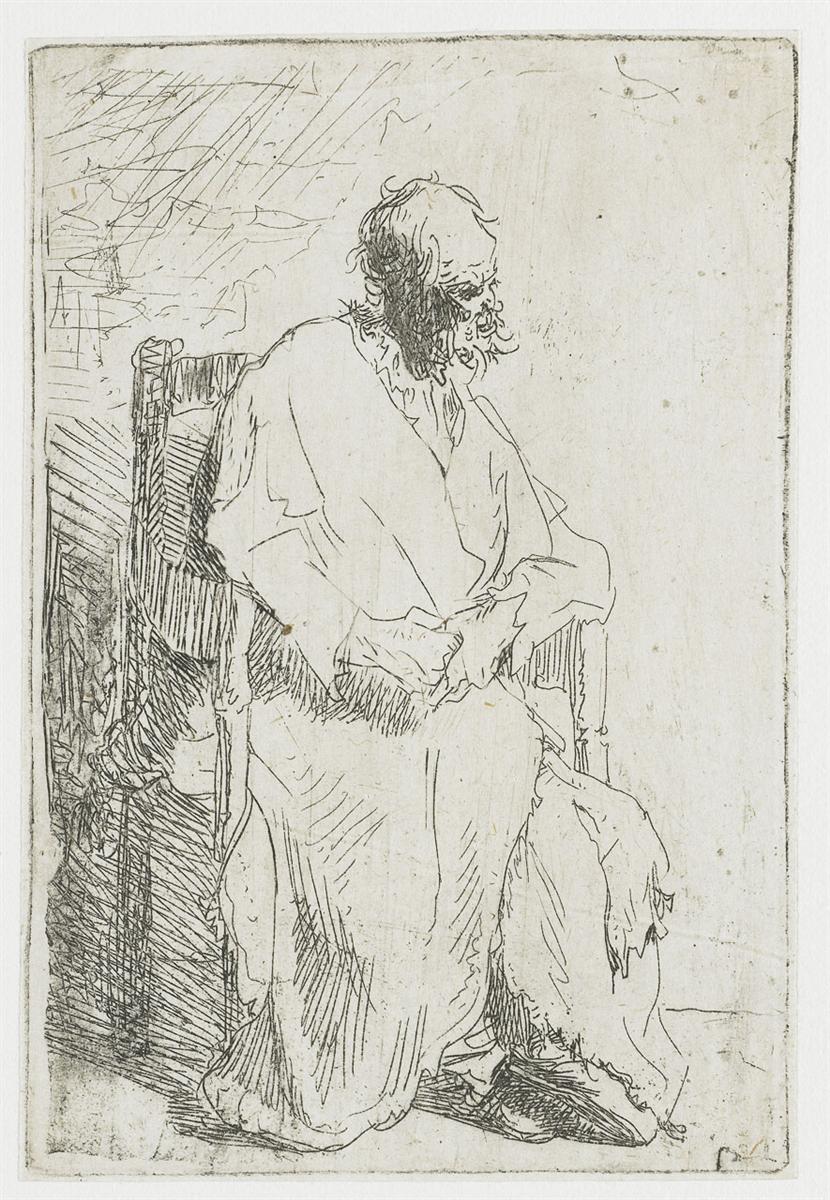
Rembrandt’s “Old Man in a Long Cloak Sitting in an Armchair” (1630) is a small etching that yields a vast interior world. The subject occupies nearly the entire plate, his robe falling in long, deliberate folds, his shoulders rounded, his hands clasped loosely in his lap. The chair is plain but sturdy, a woven back suggested by brisk strokes and a few emphatic darks. Around him, the etched field opens into breathable light; above him, the air is almost blank, as if silence itself were the room. With quick, exact marks and an unerring instinct for where to leave paper untouched, the young Rembrandt turns a simple seated pose into a meditation on time, dignity, and attention.
The Etching Medium and the Poetry of Line
Etching translates the velocity and pressure of the artist’s hand into copper. Rembrandt exploits that responsiveness by giving each material its own voice. The beard is a bristle of short strokes that buzz with life; the hair at the crown is scribbled in lighter loops that let the paper glint through; the robe descends in long, gravity-aligned lines that feel as heavy as cloth; the chair frame is defined by assertive verticals and crosshatching that reads as woven cane. The figure’s outline is not a hard contour so much as a gathering of directional marks; where Rembrandt wants softness, lines wander and thin; where he wants structure, they steepen and multiply. The surface becomes a score that the eye “plays,” hearing texture through rhythm.
Composition as Architecture of Stillness
The composition is deceptively straightforward: a three-quarter view of a seated elder, turned slightly to the right, set close to the picture plane. Yet the arrangement of masses and voids is intricate. The largest dark is the wedge of hatching behind the chair at left; it props the figure forward, preventing him from dissolving into the pale room. A few slanting marks in the upper left angle across the plate like quiet weather, balancing the downward sweep of the robe. The blank expanse to the right is not neglected space; it is the air into which the old man’s thought drifts. The open floor in front of his shoes, built from sparse, horizontal strokes, is a stage for small adjustments of weight. Every zone has a job, and every job serves calm.
The Chair as Character
Rembrandt’s armchair is no grand seat of office; it is a practical machine for rest. The uprights are indicated with a handful of lines, the woven back by swift diagonals and crossmarks, the near arm by a few dark accents that read as shadowed wood. This economy of description honors the chair’s usefulness rather than its appearance. It also aligns with the figure’s relationship to the world: ornament has drained away, function remains. By making the chair convincingly present without overworking it, Rembrandt sets the stage for the robe and the hands—the true centers of attention—to carry meaning.
The Robe and the Grammar of Gravity
The robe is the print’s most elaborate passage, a map of weight in motionless form. Long, parallel strokes cascade from the shoulder and gather at the ankles; breaks in the line register seams and tucks; sharp, narrow hatchings under the arm compress the fabric, convincing the eye of volume. The hem curls toward the viewer in loops that echo the shape of the old man’s bowed head, creating a subtle visual rhyme between top and bottom. These orchestrated strokes turn an inanimate garment into a story about posture: how the body beneath settles into the chair, how cloth accommodates bone, how time sits down with a person and stays.
Hands as a Second Face
Rembrandt often treats hands as a counterpart to the visage, and here they are essential. The old man’s fingers interlock lightly, not clenched, resting on the robe’s fold like a bookmark set between chapters. The knuckles are not carefully modeled; instead, a few small kinks in the line and a pocket of cross-hatching between fingers give structure without fuss. The absence of theatrical gesture is the point. These are hands that have worked and now attend, hands that know the chair as well as the chair knows them. Their quiet certitude contains emotion more credibly than a wringing pose would.
The Face and the Ethics of Reserve
Seen in profile and half-shadow, the head is built from minimal means: a sharp outline of brow and nose, a dark nest for the eye, a web of short strokes for beard and cheek. Rembrandt resists caricature. The nose is cragged but not exaggerated, the mouth relaxed, the eye socket heavy but not grim. Such restraint protects the figure from becoming a type. Instead of telling us what to feel about the old man, the artist lets posture and setting do the work. We sense weariness, alertness, and a pocket of inwardness that belongs to him alone.
Paper White as Air and Time
Because etching constructs darkness and leaves light as untouched paper, the white field around the figure becomes the very stuff of the room. It is also the image’s time signature. The open space above the head slows the eye; the margin to the right invites lingering; the pale floor lets the robe’s hem breathe. These reserves of white are not empty; they are the rests in the music, the pauses where experience accumulates. Rembrandt knows exactly when to stop, and that stopping is among the most eloquent things in the print.
Light Without a Source
There is no explicit lamp or window, yet the image is full of illumination. The brightest passages are simply where Rembrandt declines to cross-hatch: the cheek, the bridge of the nose, the edge of a sleeve, the swell of the robe near the knee. Darkness gathers under the arm, behind the chair, and in the folds pooling at the floor. This distribution of values suggests a diffuse, humane light—more like the ordinary day than the theatrical spotlight—consistent with the figure’s modest dignity.
The Psychology of Sitting
Sitting is not a neutral act; it is a negotiation with gravity. The old man’s pelvis tilts slightly forward, his shoulders bow, his head turns just enough toward the world to register its presence. The left foot tucks in, the right extends, the toes angled outward as if finding the most stable purchase. These nuances of pose sidestep drama and move straight to recognition. We read in the body the familiar arithmetic of rest: how far to lean, how hands help, how fabric shapes itself to the task. In making that arithmetic visible, the etching becomes a study in lived wisdom.
The Humanist Project of the Leiden Beggar Suite
This print belongs to a wider constellation of Rembrandt’s early etchings that dignify ordinary lives—beggars standing or warming their hands, elders bowed in thought, couples pausing in conversation. In each, he isolates an elemental human action and attends to it with the seriousness usually reserved for sacred history. The “Old Man in a Long Cloak Sitting in an Armchair” prioritizes rest. It declares that the world is not only heroic movement but also necessary pause, and that the pause has its own grandeur when seen with loving accuracy.
The Sound of the Plate
Spend time with the sheet and it acquires a kind of audibility. The short hatchings along the chair’s back rasp like woven straw; the robe’s long strokes murmur; the beard crackles; the open paper hums with quiet. This synesthetic effect arises from Rembrandt’s control of stroke length and density. He has written a tempo into each texture, guiding the viewer’s pace so the act of looking echoes the sitter’s unhurried stillness.
Printing Variants and Atmospheric Choice
Etching plates yield different moods depending on inking and wiping. A plate tone left on the copper can veil the open air with a faint gray, rendering the room duskier and the rest deeper; a cleanly wiped plate clarifies every reserve of paper white, brightening the cheek and sharpening the robe’s edge. Heavier inking deepens the chair’s shadows and grounds the figure; lighter inking lets the beard glimmer and the air expand. These options are not afterthoughts—they are different weathers for the same moment.
Space, Threshold, and the Unnamed Room
Nothing in the background identifies a specific location. The effect is deliberate and liberating. The chair could sit in a humble dwelling, a hospital, a study, or a shelter. The room is an ethical space rather than an architectural one. It keeps company with the sitter without prying into biography. By refusing anecdote, Rembrandt protects the image’s universality: anyone who has watched an elder at rest recognizes this room.
Lessons for Draftsmen
For artists, the print is a compact syllabus. Assign different stroke languages to different materials and keep them consistent across the form. Use a small wedge of dark to push a silhouette forward rather than drawing a full background. Trust open paper to stand for light and air. Build hands with minimal lines that indicate structure without over-modeling. Stage drapery so gravity, not outline, tells the story. Above all, finish the thought but not the paper; let silence do its work.
Emotion Without Spectacle
The etching’s feeling rises from exactness rather than from theater. No tears, halos, or props command sympathy. The viewer’s response springs from recognition: this is what bodies look like when time gathers on them and when rest is not a luxury but a rhythm. The print’s refusal to sentimentalize does not chill it; it warms it. The old man’s presence is honored because the artist’s attention is honest.
Kinship With Painted Contemplatives
Seen alongside Rembrandt’s paintings of the same era—“Old Woman in Prayer,” “Jeremiah Mourning over the Destruction of Jerusalem,” and intimate studies of scholars—the print shares a conviction that inwardness is visible. In paint he uses glow and color to stage that belief; in this etching he achieves it with the choreography of black and white. The continuity across media testifies to a young artist already certain of his subject: the drama of the human interior as it meets light.
The Old Man as Every Witness
Although the figure is particular—a certain nose, a certain beard, a certain slouch—he also reads as an emblem of witness. He sits at the threshold between activity and memory, present yet turned inward, body stilled while mind travels. The chair collects that witness as a vessel collects water. Rembrandt’s sympathy is with anyone who has entered this season of life, where the day’s victory is a comfortable seat and a mind allowed to range.
Why the Image Endures
The print endures because it makes a universal moment precise. It neither flatters nor indicts; it understands. Its beauty is the beauty of attention: the right number of lines, placed with care, leaving necessary space untouched. In an age awash with spectacle, its quiet remains radical. The old man sits, the chair holds, and the air around them glows with the light of being seen.