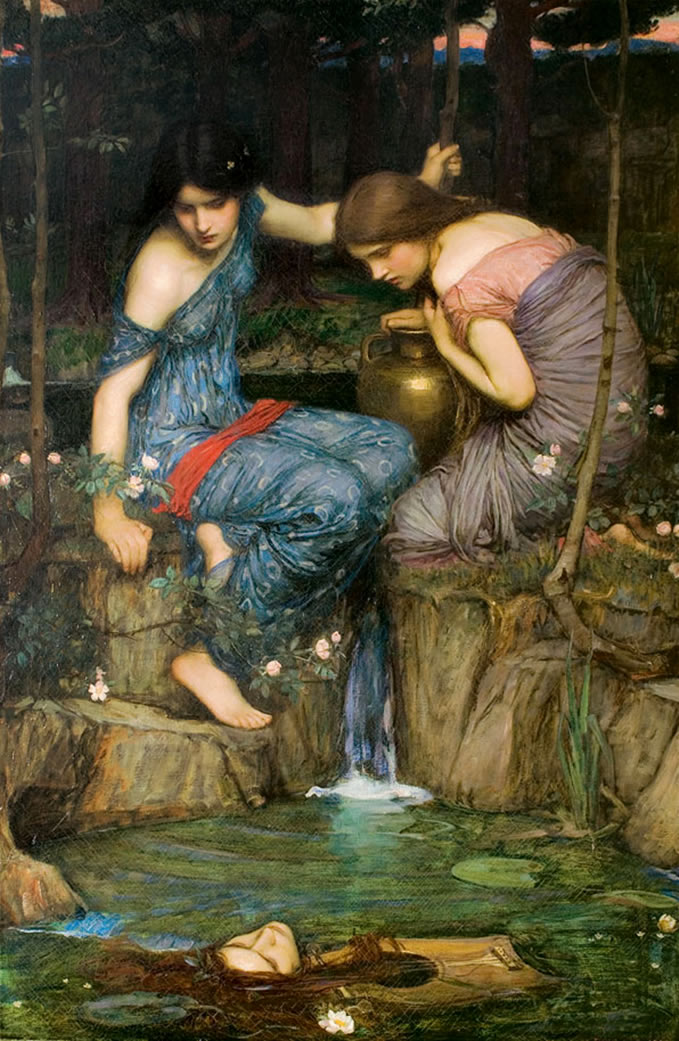
Image source: wikiart.org
Encounter at the Water’s Edge
In Nymphs Finding the Head of Orpheus (1900), John William Waterhouse chooses a moment that feels both intimate and impossible, a quiet discovery that carries the weight of a whole myth. Two nymphs pause at a woodland pool. One sits on a stone ledge, her bare foot near the water, her blue drapery gathered and cinched by a vivid red sash. The other leans forward, kneeling, her body angled toward the pool as if the surface might suddenly speak. Between them, a bronze vessel rests on the rock, catching faint light, while a thin ribbon of water slips down the stone into the pool below. At the bottom of the scene, the shock arrives: Orpheus’s severed head, still handsome, still strangely calm, floats alongside his lyre.
Waterhouse structures the painting like a suspended breath. Nothing is loud, yet everything is urgent. The nymphs do not recoil dramatically, and they do not touch what they have found. They hover in the space between recognition and response, the exact instant when beauty and horror coexist. That tension is where the painting lives. It is not simply a mythological illustration, but a meditation on what remains after song has been silenced, and on how nature receives the fragments of human tragedy.
The Myth of Orpheus as Waterhouse Uses It
The story behind Orpheus is one of the most enduring in classical mythology because it turns art into fate. Orpheus is the musician whose song can charm animals, calm storms, and move the underworld itself. After losing Eurydice, he descends to Hades and wins her return through music, only to lose her again when he looks back too soon. In many versions of the myth, Orpheus later rejects the love of other women, and he is killed by frenzied worshippers, often described as Maenads. His body is torn apart, and his head and lyre are cast into a river, drifting toward the sea.
Waterhouse does not paint the violence. He paints the aftermath, when the world has had a moment to cool. By choosing the discovery rather than the act, he reframes the myth as an elegy. Orpheus becomes less a tragic hero at the center of chaos and more a relic, a sacred object that carries the memory of music. The nymphs function like witnesses who belong to the landscape itself. They are not citizens, not mourners in a human sense, but presences of the wild, the kind of beings who might feel a disturbance in nature when a great voice is extinguished.
Composition and the Vertical Descent of the Eye
The painting is built as a vertical passage from the upper world to the lower, from shadowed forest to reflective water, from living bodies to a drifting remnant. Waterhouse guides the viewer downward in stages. First, we meet the nymphs framed by tree trunks and dark foliage. Then we notice the rock ledge and the thin cascade that marks the boundary between land and pool. Finally, the eye reaches the still water where the head and lyre float like an offering.
This downward movement is not just compositional. It echoes a mythic descent. Orpheus, the singer who once traveled to the underworld, now lies at the bottom of the image, as if the journey has reversed itself. Instead of going down to retrieve Eurydice, we look down to find him. The waterfall becomes a gentle, continuous line, a quiet conveyor between realms. It also acts like a visual thread that ties the nymphs to the discovery, preventing the lower portion from feeling separate or staged. The whole scene reads as one continuous environment, one continuous moment.
The ledge creates a natural stage, but it is a stage without performance. Where Orpheus once filled spaces with sound, this space is filled with listening, with leaning in, with the careful posture of attention.
The Nymphs as Witnesses, Not Actors
Waterhouse’s nymphs are not theatrical, and that restraint matters. The seated figure in blue turns her face slightly away, her gaze lowered and sidelong, as if she cannot bear to meet the sight directly. Her posture is heavy, not collapsed, but weighted, with one arm reaching down toward the stone as though grounding herself. The red sash around her waist introduces a note of living heat, a pulse of color that reads like vitality, but also like a wound if you allow the mind to connect it to what has been lost below.
The kneeling nymph in lilac and rose leans forward with a different kind of intensity. Her head dips close to the pool; her shoulder and back curve as if she is trying to confirm what she sees. One hand braces on the rock, the other rests near the bronze vessel, which suggests she was there for water. That ordinary action makes the discovery more piercing. The myth interrupts routine. A simple act at a spring becomes contact with tragedy.
Together, the two figures create a psychological balance. One embodies recoil and inwardness, the other embodies inquiry and closeness. Neither responds with panic. Their expressions feel hushed, almost reverent, as if they recognize Orpheus not only as a victim but as something rare, a presence whose artistry still clings to him even in death.
The Pool, the Waterfall, and the Language of Water
Water is not scenery here. It is the painting’s emotional medium. The thin waterfall suggests continuous time, the unbroken flow of the world even when a life ends. The pool, calmer and darker, suggests memory. Waterhouse paints the surface as a place that holds and carries, not a place that swallows. The head does not sink. The lyre does not vanish. They drift, supported, almost presented.
There is also a careful contrast between movement and stillness. The waterfall is the only obvious motion in the setting, a narrow, persistent stream. Everything else is held in quiet suspension. The nymphs lean and pause. The water rests. Even the floating objects seem almost arranged by fate, as if the current itself has chosen how to display them.
Water also connects to Orpheus’s power. Music is invisible, like a current, and it moves through bodies without being grasped. In this scene, the current becomes literal. It is what delivers the remnants of song to those who will find them. The pool becomes a mirror not just for light, but for meaning. We are invited to read the water’s surface the way one might read the last note of a melody, listening for what lingers after sound ends.
Flowers, Foliage, and the Tenderness of the Setting
One of the most striking choices in Nymphs Finding the Head of Orpheus is how tender the environment is. The rocks are softened by small blossoms, likely wild roses or rose like flowers, and delicate greenery. In the water, lily pads spread across the surface. Reeds rise at the margins. The setting does not look hostile or savage. It looks cared for, as if nature itself has prepared a quiet chamber for this discovery.
That softness complicates the subject. A severed head should bring ugliness, but Waterhouse counterbalances it with beauty so persistent that it becomes unsettling. The blossoms do not mock the tragedy. They frame it, turning the pool into a kind of natural shrine. The lily pads and flowers also relate to classical imagery of nymphs, springs, and sacred groves. These details anchor the myth in a recognizable poetic landscape, the kind of place where gods and spirits might pass unnoticed among trees.
The effect is that horror arrives gently. The viewer realizes what they are looking at almost the way the nymphs do, through closeness and attention rather than shock effects. Beauty becomes the vehicle through which grief is delivered.
Color, Light, and the Mood of Dusk
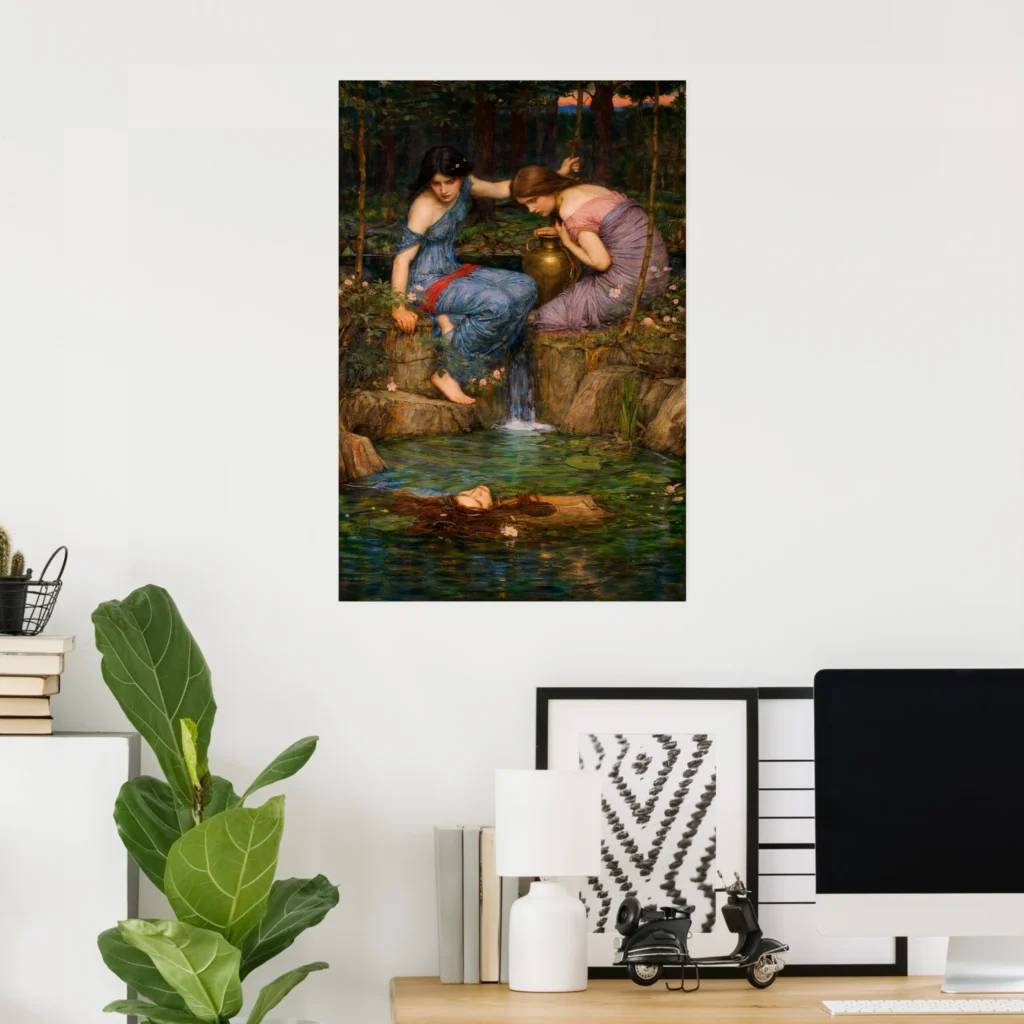
Waterhouse uses a restrained palette dominated by deep greens, shadowed browns, and muted stone tones, then punctuates that restraint with strong, memorable color notes. The seated nymph’s blue garment is the painting’s richest area of cool saturation, patterned and textured so that it feels heavy, draped, and real. Against it, the red sash reads like a concentrated flame. The kneeling nymph’s lilac dress and rose tinted sleeve soften the scene with warmth, but a quieter warmth than the sash, more like fading daylight than fire.
The background is dark, a woodland interior where trunks rise like columns. Beyond, there is a narrow band of sky with pink and orange tones, suggesting sunset or twilight. That sliver of distant light functions like a reminder that the world continues beyond this grove. It also adds a faint sense of the otherworldly, as if the scene takes place on the edge of day and night, or on the edge of life and death.
Light is handled with care rather than brilliance. The figures are illuminated enough to feel present, but the illumination is softened, almost velvety. The bronze vessel catches a dim highlight, an echo of the last light. The water reflects green and shadow, not sparkle. This is a painting of quiet seeing, and the lighting supports that hush.
Texture, Fabric, and the Pre Raphaelite Inheritance
Waterhouse is often linked with the Pre Raphaelite tradition, and this painting shows why, even as it also reveals his own later sensibility. The fabrics are described with loving attention. The blue dress falls in substantial folds, patterned so that it feels both decorative and weighty. The lilac dress gathers around the kneeling figure, creating a sense of body beneath cloth without emphasizing anatomy in a modern, clinical way. The hair is glossy and carefully shaped, the kind of hair that carries symbolic charge in Waterhouse’s work, as if it stores feeling.
The natural details are similarly deliberate. The blossoms are small but specific. The stones have layered color and weathering. The pool’s surface is painted with subtle variations, creating depth without turning the water into a mere reflective trick. These textures build credibility, and credibility matters because the subject is myth. Waterhouse asks the viewer to accept the impossible by making the environment tactile and coherent.
At the same time, the brushwork does not insist on hyper sharp edges everywhere. There is softness in the shadows, a gentle blending that supports mood. This balance between detail and atmosphere gives the painting its dreamlike realism, a world that feels believable while still suspended in legend.
Orpheus’s Head and Lyre as Symbols of Art After Death
The floating head is the painting’s emotional center, but Waterhouse treats it with restraint. The face is pale, the expression composed, the eyes closed or lowered, the features still beautiful. It is not grotesque. That choice shifts the focus from bodily violence to the idea of the artist as enduring image. Orpheus is not shown as mutilation, but as presence. The horror exists, but it is subdued, as if the painting is more interested in what Orpheus represents than in what happened to him.
Beside the head, the lyre appears like a companion object, a sign that song remains tied to him. In myth, the lyre often continues its journey, sometimes carried to a place where it will be honored. Here, it floats with him, a visual statement that art and identity remain linked even when the body is broken.
The pairing of head and instrument suggests that music persists in memory. The head, the seat of voice and song, and the lyre, the tool of music, drift together, held by the same water that holds the entire scene in silence. The painting becomes a paradox: an image about sound, made silent. It asks you to imagine music precisely because there is none.
The Psychology of Discovery and the Quiet Form of Grief
The painting’s drama is psychological. It is about recognition, the moment when the mind catches up to the eye. The nymphs’ expressions do not shout, so the viewer is invited to participate in their realization. The seated nymph looks away, as if grief makes her avert her gaze. The kneeling nymph looks closer, as if grief makes her need certainty. These two responses are both human, even though the figures are mythic.
Waterhouse also places the viewer in a gentle position of helplessness. We see what they see, but we cannot intervene. The water carries the head; the nymphs are poised between action and stillness. That pause becomes the emotional substance of the work. It is grief before ritual, grief before words, grief as a pure, raw awareness.
The environment reinforces that kind of grief. There is no crowd, no city, no social framework. There is only nature, which does not explain, and two beings who must decide how to respond. The painting suggests that some losses are too profound for immediate speech. They are first met with silence.
Waterhouse in 1900 and the Attraction of Mythic Tragedy
By 1900, Waterhouse had returned again and again to subjects where female figures encounter danger, enchantment, or loss. Myth and legend provided him with narratives that could carry intense emotion without becoming ordinary anecdote. In Nymphs Finding the Head of Orpheus, that preference produces something unusually restrained. The nymphs are not depicted as seductresses or as fatal temptresses. They are caretakers of a threshold moment. The scene is less about erotic myth and more about the sacredness of art and the fragility of beauty.
The painting also reflects an era fascinated by the idea of the doomed artist, the creator whose gift is inseparable from suffering. Orpheus is the archetype of that idea. He wins miracles through song and loses everything through the smallest human weakness. Waterhouse captures the myth at the point where the world holds the remains of genius, and asks what it means for nature, for spirits, and for us as viewers to encounter that remains.
In this sense, the painting reads as a statement about the afterlife of art. Orpheus’s voice is gone, but the image of him continues. The myth continues. The painting itself becomes the new vessel carrying Orpheus downstream into modern imagination.
Why the Painting Still Feels Modern
Despite its mythological subject and classical costumes, the painting can feel surprisingly modern because it avoids melodrama. It communicates through posture, distance, and mood rather than spectacle. The scene resembles a quiet moment one might stumble upon in a story, not a climactic tableau designed to overwhelm. That understatement invites repeated viewing. Each return reveals another subtle relationship: the red sash against blue cloth, the bronze vessel against stone, the thin waterfall against the heavy darkness of the trees, the pale face against green water.
The painting also anticipates modern questions about art and mortality. What does it mean for a voice to be extinguished while the work remains? What is left of a person when what they created outlives them? The floating head and lyre are literal answers to metaphorical questions, and that is why the image stays in the mind. Waterhouse turns myth into a visual poem about the residue of creativity.