Image source: wikiart.org
Introduction
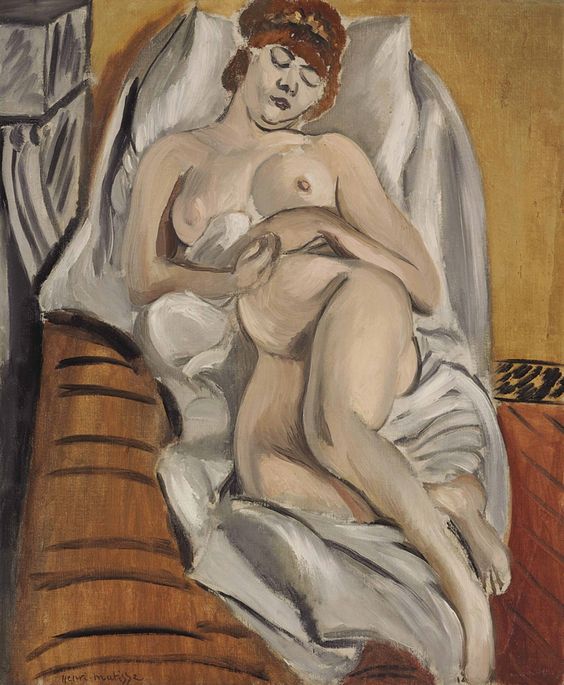
Henri Matisse’s “Nude Woman” (1915) captures the quiet drama of a body at rest and a painter at the height of his powers reducing form to its most eloquent essentials. A young woman reclines on a white heap of pillows and sheets, head tilted, eyes closed, one hand cupping her breast while the other rests on her stomach as her legs fold in a compact spiral. The palette is restrained—honeyed ochres, warm browns, creamy flesh, and decisive accents of slate gray and white—yet the painting glows as if suffused by interior light. What first reads as a simple studio scene soon reveals itself as a modern orchestration of planes, contours, and rhythms that balances tenderness with structural clarity.
Historical Context
Painted during the early phase of the First World War, “Nude Woman” belongs to a transitional moment in Matisse’s career. The explosive Fauvist color of 1905 had already given way to the severe, architectonic experiments of 1913–1914: windows transformed into grids, interiors reduced to a few tuned planes, portraits rendered in cool grisaille. In 1915 Matisse brought those lessons back to the figure. He did not return to academic modeling; rather, he applied the structural discipline of his prewar canvases to the most time-honored subject of European painting—the reclining nude. The result is neither a salon odalisque nor a Cubist deconstruction. It is a living equilibrium: classical repose filtered through modern reduction.
First Impressions
At a glance, the composition resolves into three large fields. A warm ochre panel at left suggests a bolster or upholstered couch. A wide area of crisp whites and cool grays maps the sheet and pillows, forming a bright cradle for the figure. A cinnamon-brown floor and a mustard wall close the right and upper margins, pushing the body toward the center. The diagonal of the woman’s torso runs from upper left to lower right; against it, a counter-diagonal of bent legs curls back toward the chest, creating a compact spiral that keeps the eye circling. The head’s gentle tilt and the closed eyes contribute an atmosphere of inwardness, as if the figure were resting between awareness and sleep.
A Modern Architecture of the Body
Matisse constructs the figure as a set of broad planes bound by clear, unbroken contours. The shoulder is a smooth arc; the breast is a luminous oval accented by a single shadow band; the stomach is a long, quiet plane interrupted by the mild ridge of the navel; the thigh is a firm, tapering mass. There is little fussing over surface detail. A few strokes along the rib cage, a decisive notch at the hip, a swift curve to define the knee: these do the work of volumes that traditional painting would have modeled with layers of half-tones. The effect is sculptural without being heavy, as if the body had been carved from cream and placed in the cool light of the studio.
The Pose and Its Psychology
The pose is intimate but not theatrical. One hand cups the breast not as display but as natural weight and warmth; the other rests on the lower abdomen in an instinctive gesture that gathers the spiral of the whole body. The legs fold in a protective curve, heel close to thigh, the toes neither pointed nor flexed but relaxed. The tilted head rests on the pillow like a closing parenthesis, echoing the curve of the torso. Because the eyes are closed, the viewer is allowed to look without confrontation; the picture’s intimacy is contemplative rather than provocative. The overall mood is of self-possession and ease, a body aware of itself rather than of the viewer.
Color and Temperature
The palette is economical and carefully tuned. Flesh tones are built from warm creams and pinkish beiges, cooled by thin bands of gray that turn planes without dulling them. The sheet and pillows contain the largest range of gray-blue whites, their variety creating a field of light that lifts the figure forward. Ochre and brown warm the flanking zones—the bolster at left and the floor at right—so that the cool whites have a foil. Black is absent as a flat area but present in thin, authority-giving lines at edges and folds. The restricted palette allows the smallest temperature shifts to register with significance: a faintly cooler gray under the breast, a warmer blush on the cheek, a honey note at the hip.
Light, Shadow, and Reserve
Matisse uses light as a clarifying geometry. Instead of casting hard shadows, he assigns each plane a value and trusts the viewer to feel roundness where two values meet. The sheet is not an inventory of creases; it is a set of confident strokes that propose folds the eye completes. In many places—especially around the arms and flanks—he allows the ground color to participate as light, a strategy of reserve that keeps the painting buoyant. By refusing dramatic chiaroscuro, he aligns the nude with the decorative ideal: a picture that sustains calm, breathable illumination rather than theatrical spotlight.
Brushwork and Surface
Up close, the surface is open and tactile. The brush moves with measured speed, leaving ridges in the whites of the bedding and thinner, creamier passages in the flesh. The ochre bolster at left is built with longer passes that show the direction of weave, a subtle echo of textile. Around edges—arm against sheet, thigh against pillow—small overlaps and halations remain, evidence of adjustments as Matisse tuned contours to the whole. These traces of process lend the picture life; final clarity feels achieved rather than imposed.
Space and the Decorative Field
The space is shallow and intentionally simplified. There is no deep room to wander into; the wall presses forward, the floor bites the right margin, the bed occupies nearly all the central field. This compression supports Matisse’s aim: the body should read first as a beautiful arrangement of shapes on a surface and only second as an inhabitant of measurable space. Yet the painting never collapses into flatness. Overlaps—the arm over pillow, the thigh pressed into sheet, the head nestled in bedding—supply sufficient depth to satisfy the eye while keeping the surface unified.
The Role of White
White is the unsung protagonist of the canvas. It is not a blank absence but a dynamic presence that bathes the figure and articulates the space. The pillows’ white is cooler and more varied, catching small reflections from the room; the flesh’s highlights are warmer, milk with a drop of honey. Where white brushes meet and cross—the sheet near the knee, the pillow under the head—the surface becomes a textile of light. Matisse frequently used white as a color in its own right; in “Nude Woman” it organizes the painting’s rhythms and supplies the most active field against which the flesh can glow.
Drawing and Contour
The drawing is nut-brown and elastic, with a consistency that recalls ink thinned with oil. It never tightens into a prison for color. Lines thicken where emphasis is needed—a shoulder’s turn, the edge of a thigh—and thin where a transition should breathe. Around the face Matisse switches gears, using fewer lines and letting small planes of pink and gray determine the features. The mouth is a simple, relaxed curve; the eyelids are two gentle arcs; the nose is a quick wedge. This economy of line places attention on the whole rather than on isolated detail.
Relation to Earlier Nudes and Later Odalisques
Compared with Matisse’s early Fauvist nudes, this painting is quieter, its color restricted, its rhythms more architectural. It anticipates the Nice period odalisques of the 1920s—those languorous, patterned interiors—yet without their ornamental abundance. Here the bed linens provide just enough pattern through brush direction; the wall and bolster offer color anchors; the body remains the principal ornament. The work sits at the hinge between rigorous prewar reduction and later Mediterranean sensuality, holding virtues of both: clarity of structure and palpable ease.
Sculpture in Paint
Matisse’s ongoing sculptural practice informs the way volumes are stated. He thinks in masses and axes, not in muscles and pores. The chest is a single, proud plane; the pelvis is a bowl that tips softly forward; the legs are cylinders that taper and overlap. The modeling is minimal but decisive—an artist’s equivalent of a sculptor’s confident cut. This sculptural clarity makes the figure legible at distance and explains why the painting maintains its power even when reproduced at small scale.
Intimacy Without Intrusion
“Nude Woman” models a kind of ethical intimacy. Matisse avoids anecdotal props that would turn the sitter into a character in a story. No mirror, no exotic textile, no conspicuous jewelry appears. Even the headband reads as a simple practical accessory rather than a theatrical device. This restraint grants the sitter privacy; we behold a person at rest rather than an actor in a melodrama. The effect is dignified and tender, qualities often missing from nudes whose energy derives from provocation.
Evidence of Process and Revision
Look for pentimenti. Along the left hip and around the knee faint earlier positions remain, softened by later paint but visible. The right arm seems to have been rethought, with small adjustments to the angle of the wrist and fingers. The sheet near the thigh carries a ghost of an abandoned fold. These traces do not disturb the final calm; they animate it, reminding us that clarity is usually the end of searching rather than its absence.
How to Look
The canvas rewards both distance and closeness. From afar, let the composition’s three fields—ochre, white, brown—organize the figure’s spiral. Observe how the head’s tilt counterbalances the leg’s bend. Step forward to examine the sheet’s brushwork and the thin halations along contours. Notice how few strokes define the face and how much light those strokes allow. Stand back again to feel the calm radiating from the whole; the nude does not dominate the room, it harmonizes it. This alternation between scanning and dwelling mirrors the painter’s own process.
Legacy and Contemporary Relevance
“Nude Woman” remains instructive for artists and viewers today because it articulates a path between description and design. It proves that a figure can be both sensual and structural, that economy can intensify emotion, and that white—often treated as neutral—can be the most expressive color on the palette. It also suggests a way to approach familiar subjects without cliché: strip away the generic props, tune a few fields, let contour and value do the work, and trust the viewer’s eye to complete the rest.
Conclusion
Henri Matisse’s “Nude Woman” is a quiet masterwork of clarity. The painting builds a reclining figure from a handful of planes, a cadence of contours, and the generous use of light-filled white. It preserves the tactile pleasure of paint while practicing an ethics of restraint that honors the sitter’s presence. Occupying the fertile middle ground between prewar rigor and postwar languor, the canvas offers a durable lesson: when color is disciplined, when drawing is confident, and when light is allowed to breathe, a simple pose can carry the gravity of a complete world.