Image source: wikiart.org
Introduction
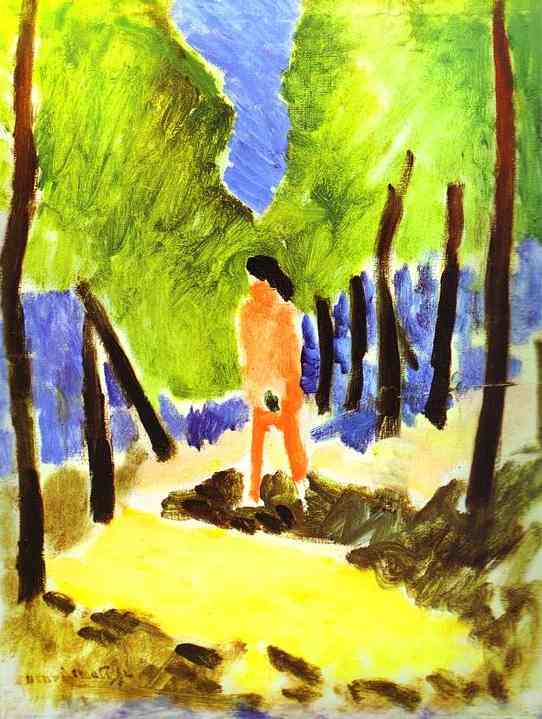
Henri Matisse’s “Nude in Sunlit Landscape” (1909) compresses figure, forest, and blazing noon into a few fearless color planes. A nude stands on a rocky path at the heart of a grove; black-brown tree trunks rise like vertical chords; leaves ignite into vibrating greens; violet-blue shadows pool on either side; and a wedge of open blue sky slices downward through the canopy. The picture is neither a descriptive vista nor a genre scene. It is a construction in which color makes light, contour makes structure, and a single standing body steadies the whole. What looks spontaneous at first glance reveals itself, on longer viewing, as a rigorous experiment in how the sensation of sunshine can be built from relationships rather than details.
A 1909 Turning Point
The year 1909 marks Matisse’s consolidation after the flame-thrower phase of Fauvism. He no longer needs to shock the eye with clashing hues; instead, he organizes heightened color into a stable architecture. Paintings from this period—bathers, dancers, still lifes, and interiors—share a disciplined simplicity: few elements, large planes, decisive contours, and intervals calibrated like musical rests. “Nude in Sunlit Landscape” sits squarely within that shift. It carries Fauvist warmth in the yellows and greens, yet the composition is controlled, the forms pared to essentials, and the palette limited to a handful of notes that ring together with clarity.
Composition as a Funnel of Light
The composition funnels the viewer’s attention from the forest’s wide shoulders to the central figure. The trees at left and right lean inward; their trunks splay like open fingers that guide the gaze down the path. The foliage masses form a high V that opens onto a triangular slice of sky, a device that both anchors the scene and intensifies the feel of looking upward into brightness. The nude stands not quite centered—nudged slightly to the left—so that the rhythm of trunks on the right can march forward without crowding the figure. This mild asymmetry gives the painting breath. The path moves diagonally from the lower right to the central rocks, where the figure plants a foot, completing a clean circuit for the eye.
Color Architecture and the Climate of Noon
Matisse organizes the scene through three color families: the hot yellow path and highlights, the saturated greens of canopy and sunstruck grass, and the cool violets and blues that define shadow and distance. Black-brown trunks and a small mass of dark hair provide the low register. The nude is painted in warm pinks and oranges, tuned so that the body belongs to the sunlit system rather than to the shadow. Nothing here is neutral. The yellow is not a pale tint but a high, buttery blaze that bleeds into warm cream. The greens are charged with lemon and sap; they read not as local leaf color but as light-struck air. The violets carry cooling relief, but they are clean and resonant enough to hold their own against the heat. Together these chords deliver the sensation of noon far more convincingly than any naturalistic modeling could.
Sunlight as the True Subject
Although the title names a nude, the protagonist is sunlight. It pours down the axis of the painting, erasing mid-tones and pushing forms toward silhouette and flare. Where it strikes the path, it turns ground to molten yellow; where it hits the upper leaves, it explodes into spangles of green that dissolve the canopy’s edges; where it touches the body, it simplifies anatomy into a few planes of warm flesh. Matisse refuses the conventional trick of dappling the figure with leaf shadows. Instead, he lets the body assert its own clarity, so that the human vertical becomes the measure of the forest’s light.
Drawing With the Brush
Contour does the structural work. Trunks are laid in with loaded, unbroken strokes that thicken where the brush slows and thin where it accelerates—marks that feel as alive as bark. The figure’s outline is a single, tense arabesque: a quick black curve for hair, a firm notch at the bent knee, a compact hook for heel and ankle. There is almost no interior modeling. The hands, face, and torso are built from adjacent patches that meet and lock, allowing the mind to complete the volumes. This drawing method—planes first, contours to seal them—keeps the surface frank and avoids anatomical fussiness that would break the painting’s larger rhythms.
Brushwork and the Living Surface
The surface bristles with speed. In the foliage, short, fibrous strokes drag semi-opaque greens over lighter underlayers, creating a shimmer that reads as heat without depicting any single leaf. In the violet zones, broader, wetter passes settle into soft pools that cool the flanking spaces. The yellow path is swept in with long, confident pulls whose direction changes slightly near the rocks, implying terrain without the crutch of perspective. On the body, creamy paint sits thicker, catching light; at the edges, it thins so that warm undertones glow through, lending the flesh a believable warmth. The cumulative effect is of air moving and time passing—an afternoon recorded as a sequence of choices.
Space, Depth, and the Shallow Stage
Depth is shallow, yet it convinces. Linear perspective is minimal: the path narrows, trunks diminish, sky wedges upward. The stronger cues are chromatic: hot colors advance, cool colors recede; dark trunks push forward against high-key greens; the blue-violet seam down the center pulls the eye back like a cool culvert of shadow. Overlap does serious work—trunk over foliage, figure over path, rock over ground—yet the scene remains close to the surface. This shallow stage is crucial to the picture’s intensity. It refuses the haze of distance and insists on the immediacy of standing in a clearing with light pressing from above.
The Nude as Axis and Meter
Matisse makes the figure the painting’s vertical axis and the meter by which other rhythms are measured. The body is neither coy nor posed; it is simply present, weight placed on the forward leg, the other leg stepping off a stone, the head turned slightly to listen or look. The small dark of hair and the compact mass of the trunk stabilize the surrounding flurry. The hand carries a green object—perhaps a fruit or a leaf—that quietly knots figure and landscape together. The reduced features and absence of facial detail protect the sitter from anecdote; she becomes an emblem of being-in-sunlight rather than an individual in a narrative.
Rhythm of Trunks and Intervals of Color
One of the painting’s pleasures is the repeating beat of tree trunks marching up the right side. Each vertical is slightly different—tilt, thickness, the degree to which it is swallowed by green—so that repetition becomes rhythm rather than rote pattern. The left side echoes this beat in a looser, more diagonal register, as if the grove were leaning into the path. These verticals set the tempo for the figure’s own verticality. Meanwhile, the picture’s intervals of color—yellow to violet, green to blue—create a counter-rhythm of temperature that keeps the eye moving between heat and relief.
Light Without Chiaroscuro
There is no theatrical spotlight and almost no cast shadow. Light is built from adjacency: yellow makes the figure’s warm pinks glow; the violet pushes the greens toward brightness; the black trunks sharpen the surrounding fields by contrast. Where a conventional landscape might model a tree roundly with shadow, Matisse lets the tree remain a dark plane that asserts edge and direction. The effect is more truthful to the experience of squinting in strong light, where forms flatten and color intensity replaces value gradation as the main carrier of information.
A Landscape Learned From the South
The Mediterranean changed Matisse’s sense of landscape. The sun is higher, the shadows denser, the colors more stable and saturated. “Nude in Sunlit Landscape” translates that climate into a distilled grammar: lemon in the path, sap in the canopy, amethyst in the shade. Gone are the cloud draperies and moist greens of the north; in their place, a clarity that feels almost architectural. The painting proposes that place can be made legible not by cataloguing local detail but by tuning a palette to the air.
Dialogue With Sister Works
The canvas speaks directly to other works from 1909. Its hot-cool pairing echoes the measured chords of “Flowers and Fruit.” Its shallow stage and simplified figure share method with “Naked by the Sea,” though the forest introduces a denser rhythm. The vertical force of the nude anticipates the standing figures that orbit the monumental circle in “Dance.” Across all of these works, Matisse is trying to learn how little is needed to deliver presence and how color can carry structure without the crutches of academic modeling.
Decorative Order Without Wallpaper
To call the painting “decorative” is to name its even distribution of interest. The foliage is not wallpaper; it is a system of repeating, varied marks that keep the eye alert everywhere. The trunks establish a beat; the path offers a broad rest; the figure provides a focal accent that does not cancel the whole. Ornament here is structural, a way of organizing vision so that the picture reads as a single, breathing fabric of light.
Material Evidence and the Trace of Process
Pentimenti—small halos and shifts—appear along several edges. The path’s yellow pools slightly into an earlier brown; a trunk has been nudged to widen the central wedge of sky; the violet pool at left overlaps a green that was laid first. Matisse leaves these edits visible, trusting that the record of adjustment strengthens rather than weakens the image. The surface tells the story of its making: not a diagram applied to canvas but an idea forged in successive relations that finally lock into inevitability.
Psychological Temperature and the Ethics of Presence
The mood is alert and restorative. There is no narrative beyond the facts of standing, seeing, and feeling sun on skin. The figure’s small turn of the head and easy stance suggest attention without anxiety. This restraint is ethical as much as aesthetic. By resisting melodrama and voyeurism, Matisse protects the dignity of the subject and invites the viewer to share the sensation rather than consume it. The painting becomes a proposal about happiness as clarity: fewer elements, stronger relations, more air.
Modern Classicism and the Bather Tradition
The standing nude in nature has a long lineage—from Renaissance Venuses to Cézanne’s bathers. Matisse honors the type while modernizing it. He abandons mythological alibis and rejects deep perspective. The body is neither idealized into marble nor individualized into portrait. It is simplified so that it can function as architecture within the landscape. The result is a modern classicism: timeless in theme, contemporary in method, and deeply human in tone.
Lessons for Seeing Today
The painting’s relevance endures because it teaches a way of looking. Start with a few strong colors that describe not things but conditions; define edges boldly and let planes meet cleanly; use repetition with variation to build rhythm; and trust that the sensation of place will arise from exact relations rather than from accumulated detail. This method can guide not only painters but photographers, designers, and anyone arranging color in space.
Conclusion
“Nude in Sunlit Landscape” is a small manifesto in the language Matisse forged in 1909. A clearing, a path, a handful of trees, a single body, and the calibrated triad of yellow, green, and violet-blue are enough to deliver the fact of noon. Contour conducts, brushwork keeps air moving, and the shallow stage holds the viewer close to the experience. The painting’s generosity lies in its economy: it gives only what the eye needs to feel both light and life, and in doing so it turns an ordinary grove into an emblem of clarity and joy.