Image source: wikiart.org
First Impressions: A Figure Found in Color and Air
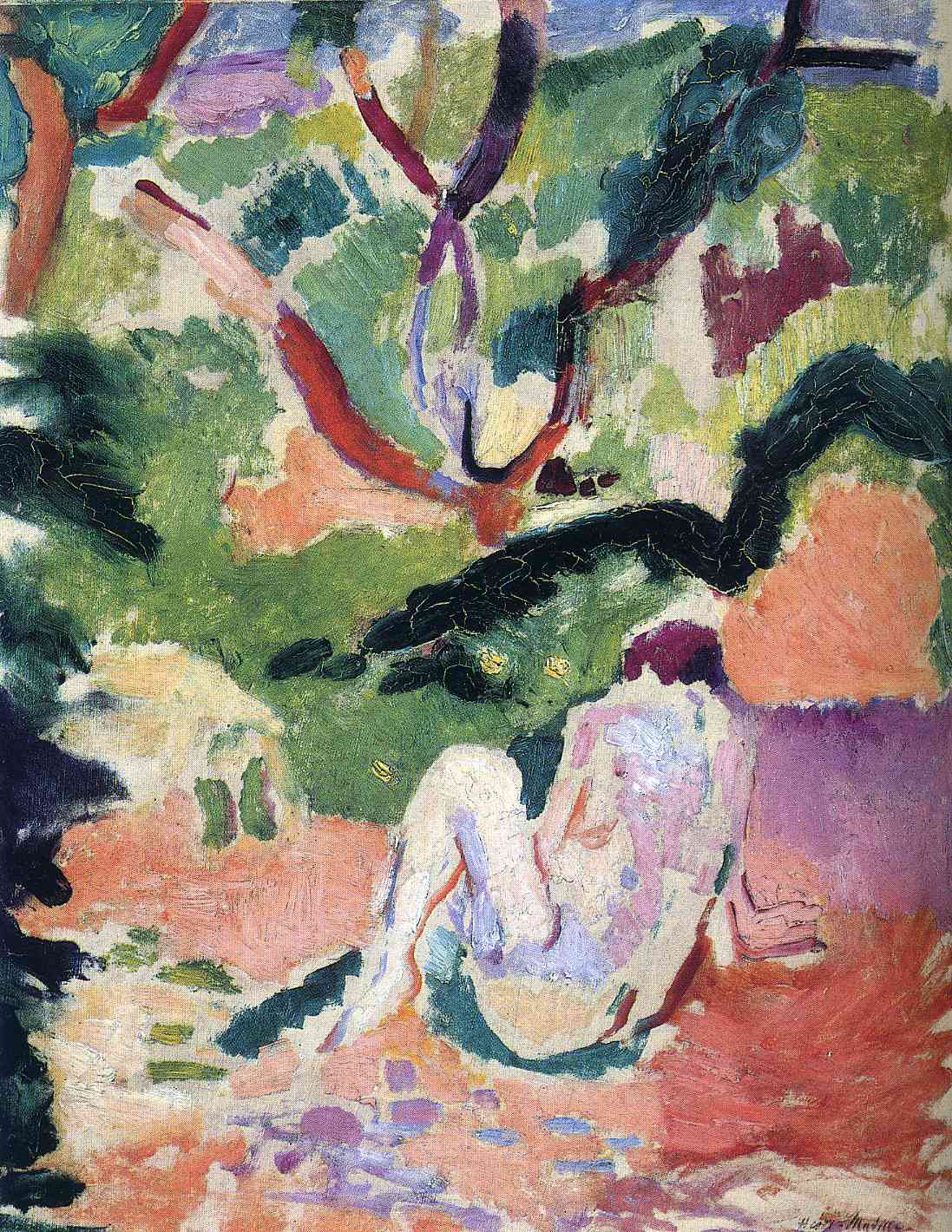
“Nude in a Wood” surrounds a seated figure with an orchestra of greens, violets, and coral pinks. The nude leans against a mauve plane at the right edge, legs angled forward and lit by cool lilac. Around her, tree limbs arc in calligraphic swerves—some the color of hot brick, others nearly black—while foliage dissolves into broken patches of mint, teal, and pale yellow. The picture feels as if it were discovered rather than constructed: broad fields of paint open like clearings and, within them, form coalesces. Instead of a narrative scene in a forest, we encounter an atmosphere in which body and grove share the same visual grammar.
1906 and the Consolidation of Fauvism
Painted the year after the explosive Salon d’Automne of 1905, this work belongs to Matisse’s period of consolidation. The shock of pure, unmodulated color had already been delivered; now he refines that language to carry subtler sensations. The canvas asks a pointed question: can the Fauvist method—clean color laid in decisive patches, drawing that is elastic rather than literal—sustain the ancient subject of the nude in nature without retreating to academic modeling? The answer here is a confident yes. The figure is persuasive not because shadow is carefully graded, but because temperatures and intervals are tuned until volume, light, and presence emerge on their own.
Composition: A Clear Stage and Counter-Stage
The composition is anchored by a large vertical at right—a mauve-violet block that reads as rock, wall, or sun-warmed screen—and by the pale body pitched diagonally against it. Two sweeping branches form a loose “V” above, their curves echoed by the nested arcs of leg and torso. The left half of the canvas opens like a clearing; the right half is more compressed, thickened by the violet plane and darker foliage. This asymmetry is crucial. It stabilizes the seated figure, gives the eye a place to rest, and keeps the atmosphere of the grove from dissolving into pure pattern. The ground at the lower edge—terra-cotta, rose, and lilac—tips forward in a shallow plane that brings the viewer close, as if we’ve stepped into the clearing and paused.
The Figure: Anatomy by Temperature, Not by Tone
The nude is built from cool lilacs, pale roses, and small notches of mint and teal. Where a classical painter would have drawn the contour and then filled it, Matisse models by adjacency. A lavender stripe along the shin sits next to a warmer note and the leg turns. A mint triangle under the knee meets a pale peach and the joint appears. The back is a sequence of soft steps from cool to warm; the shoulder is almost entirely a change in temperature. Very little brown or grey enters the flesh. This chromatic modeling is what makes the body feel bathed in outdoor light rather than staged in a studio.
The Wood: Calligraphy, Patchwork, and Weather
Surrounding the figure, the grove is written in two dialects. Limbs and boughs are calligraphic—long, confident swerves in brick red, violet, and near-black—while the foliage arrives as a patchwork of quick, rectangular or oval dabs. These two modes interlock: the calligraphy guides the eye, the patchwork creates air. Because many patches are thinly scumbled, the primed ground peeks through and becomes glare, the visual equivalent of bright noon leaking between leaves. That decision keeps the canvas breathable and prevents the darks from swallowing the figure.
Figure and Ground: A Deliberate Dissolve
One of the painting’s pleasures is the way the figure seems both separate from and continuous with her surround. The mauve plane at right sets her off clearly, yet her contour frequently softens into adjacent colors. The underside of the thigh blends with the cool green shadow beneath; shoulder and upper arm merge with pale foliage; the hand at right is barely suggested by a brick-pink accent that echoes the ground. This permeability is not indecision; it is the point. Matisse proposes that a body outdoors does not sit against nature but within it, sharing its light and its rhythms.
Color Architecture: Complements That Do the Building
The canvas is held together by a series of complementary chords. Warm corals and apricots—ground and some bark passages—are checked by greens from mint to bottle; mauve and lilac are balanced by small runs of yellow and green; the near-black branch swerves intensify nearby pale notes. Edges are almost always temperature edges. Where the cool body meets the warm earth, the figure sits. Where a red branch crosses a sea-green patch, the limb pops forward. Because the pigments remain clean, those seams stay legible, and the eye can read depth and form with very little drawing.
Brushwork and Facture: Matching Touch to Substance
Matisse adjusts his touch to match what he is describing. The violet plane is laid in broadly, a matte field that accepts and reflects other colors; the ground is a drag of rose and terra-cotta that feels like warm dust; foliage is a quilt of small, quick marks; limbs are long, slightly curved strokes that carry a sense of weight and direction. In the darkest boughs, paint is denser and sometimes cracked—a material thickness that doubles as the sensation of bark. Everywhere the facture remains visible, so that surface and subject strengthen one another: the paint behaves like the thing it stands for.
Light Without Chiaroscuro
There is no theatrical spotlight here. The world feels evenly lit, as if seen under high afternoon sun. Instead of deep cast shadows, Matisse gives us cool counterparts. A pale lilac next to a peach reads as a turning plane. A mint chip under the calf supplies the sense of shadow without lowering the value dramatically. The few truly dark passages—the black-green boughs—are structural rather than descriptive; they provide the bass that lets high-key notes sing. The effect is a luminous middle register in which form remains clear and atmosphere generous.
Rhythm and the Eye’s Path Through the Scene
The painting choreographs looking. Most viewers enter at the figure’s cool, pale thigh, follow the diagonal up to the torso and mauve plane, lift into the red branches that fork above, arc left along the ribbon of foliage, and descend through the lighter clearing back to the ground. Each handoff is managed by a rhyme: a color echo, a curve repeated at a new scale, a dark seam leading to another. Because every region participates, the eye loops continuously, the way one walks a small grove, circling trees and returning to the sunlit patch of earth.
The Nude as Landscape, the Landscape as Nude
Matisse often thought of bodies and landscapes as convertible. In this canvas, the torso is itself a clearing of pale paint, and the grove’s arabesques resemble the long lines a draftsman would use to describe a back or shoulder. Conversely, the ground’s rose patches and lilac stones look like the warm and cool notes that model flesh. The point is not to disguise one as the other but to propose a shared structure: both are realms of soft planes held by flowing contours, both are understood best through color relationships rather than illustrative detail.
The Role of the Mauve Plane
The right-hand mauve field is one of the picture’s most intelligent moves. Functionally, it acts as a reflector, bouncing cool light into the figure and separating her from the busiest foliage. Compositionally, it is a vertical that counterbalances the diagonals and curves elsewhere. Chromatically, it introduces a violet key that harmonizes with both the flesh and the sky-like patches at the top. And symbolically, its ambiguity—rock, wall, screen—keeps the scene from becoming storybook pastoral. It is a modern plane in a natural setting, a reminder that painting can be both place and surface at once.
Economy and Non-Finito
Large areas of the canvas remain thin or open, especially at the left where the ground shows through the foliage. The figure herself includes reserves—bare or lightly washed passages that become highlights. Rather than read as unfinished, this economy produces light. The viewer’s eye completes what is implied, which gives the scene a living, provisional freshness, as if the sun and air could still move through it.
Dialogues and Lineage
“Nude in a Wood” speaks to older traditions without quoting them. The outdoor nude belongs to a long arc from Renaissance pastoral to nineteenth-century bathers, yet Matisse replaces academic modeling with temperature steps and replaces narrative with rhythm. Cézanne’s sense of structure—planes meeting along color seams—hovers in the background, while Gauguin’s appetite for hot-cold harmonies is acknowledged but softened into a more breathable air. What is new is the decorative unity: every patch belongs to a surface rhythm even as it denotes leaves, skin, earth, or sky.
Psychological Temperature
Though the face is not specified, the picture carries mood. The coolness of the flesh against warm ground reads as ease rather than chill; the surrounding greens are gentle, more garden than forest; the arabesques of branch are protective instead of threatening. The body’s rest against the mauve plane suggests pause, not languor. These impressions arise from color climate, not facial expression. Matisse achieves feeling through equilibrium.
How to Look So the Scene Keeps Opening
Stand with the painting and pick a single seam—say, where thigh meets ground. Notice that the boundary is a change from lilac to coral rather than a graphite line. Follow that seam upward as it becomes the torso, and watch how it is echoed by the red bark curve overhead. Step to the left and let your eye count three or four small mint patches; see how a pale yellow next to them pushes them cooler, turning them into believable leaf-glint. Return to the mauve field and register the very small value differences inside it that keep it spacious. After a few such circuits the canvas stops being many small decisions and reads as one convincing climate.
Material Presence and the Sense of Weather
Because Matisse leaves the body of paint legible, the picture carries weather. The scumbled foliage feels dry and moving. The violet plane’s matte drag suggests warm stone. The dense black-green strokes of the boughs catch real light and return it as bark sheen. Material truth and optical truth reinforce each other, making a highly invented scene feel physically real.
Significance in Matisse’s Arc
This painting sits at a hinge-point. It draws together the discoveries of Collioure—clean color, visible touch, shallow but coherent space—and applies them to the perennial theme of the nude. The procedures stabilized here will shortly lead to more audacious orchestrations of figure in landscape and to interiors where bodies and rooms are bound by the same decorative logic. It also foreshadows the later belief, realized in the cut-outs, that a curve is both contour and color, both drawing and light.
Conclusion: A Grove of Relations
“Nude in a Wood” succeeds because it locates truth not in description but in relation. The figure is convincing because warm meets cool at the right places and in the right proportions; the grove breathes because reserves and scumbles admit glare; the whole coheres because arabesque, patch, and plane converse across the surface. What might have been an anecdote—person resting outdoors—becomes an argument for seeing: that color, given clarity and balance, can carry body, space, and weather with a kindness that feels as fresh now as it did in 1906.