Image source: wikiart.org
Introduction
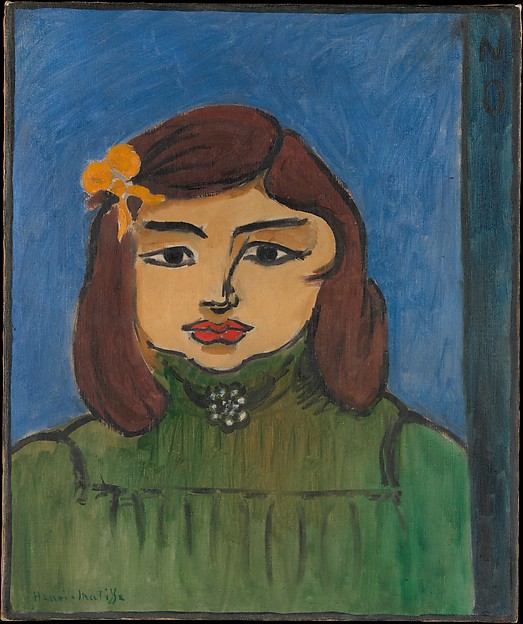
Henri Matisse’s Nono Lebasque (1908) is a compact, luminous portrait that turns a young sitter into a modern icon. Centered against a plane of saturated blue, the girl’s oval face, dark bob, and bright red mouth are drawn with firm black contours. She wears a high-necked green dress with a jeweled clasp; an orange flower slips into her hair like a small flame. The background is bare except for a narrow vertical band at the right, where the letters “NO” appear—an unmistakable wink at her nickname. With a few decisive marks and daring color chords, Matisse converts a friendly studio likeness into an image that reads from across the room and deepens at close range. The picture belongs to the moment just after Fauvism’s initial blaze, when Matisse sought poise between chromatic audacity and sculptural clarity.
Historical Context
Painted in 1908, the portrait emerges from the circle of artists who reimagined color in the first decade of the twentieth century. Matisse had exhibited sensational canvases at the 1905 Salon d’Automne and spent the next years consolidating those breakthroughs. He simplified forms, trusted bold contour, and treated the canvas as a constructed surface rather than a window onto deep space. Portraiture, more than any other genre, allowed him to test this language against the human face. Nono Lebasque reflects the camaraderie of that Paris art world: the sitter’s family name points to Matisse’s colleague Henri Lebasque, whose explorations of light and color dovetailed with Matisse’s own. The picture reads as a gift of friendship and a shared belief that modern color could coexist with humane presence.
Who Is Nono?
“Nono” is widely understood as a family nickname for one of Henri Lebasque’s daughters. Matisse’s choice to inscribe “NO” along the right-hand band is playful and tender, yet it also functions as a compositional device that stabilizes the blue field. By invoking the nickname directly on the surface, Matisse announces that this is not a generic type; it is a particular child seen through the lens of bold design. The resulting image balances affection with abstraction, capturing personality without relinquishing the clarity of signs.
Composition and Design
The composition is frontal and symmetrical, cropped just below the shoulders so the head fills the upper half of the rectangle. This close framing denies anecdote and draws the viewer into the encounter with the face. The background is divided into two zones: a large expanse of lapis blue and a narrower vertical bar at right in a cooler, darker tone. That bar is not a window or a wall; it behaves like a spine for the picture, countering the rounded forms of hair and collar and giving the canvas a left-right rhythm. The “NO” letters ride this stripe, and their upright orientation amplifies the portrait’s calm monumentalism. Nothing interrupts the silhouette. Like a medal, the portrait feels at once decorative and authoritative.
Color and Harmony
Color does the heavy lifting. The dress is a rich, grassy green; the background a saturated blue; the flower an emphatic orange; the lips a theatrical red. Matisse orchestrates these relationships with the precision of a composer. Orange is blue’s complement, so the tiny flower pops against the sky-like field. Red is green’s complement, so the mouth glows against the collar. The warm flesh, simplified to golden ocher and warm cream, floats between these chords, receiving their vibrations without being overwhelmed. The palette is high key but measured; there is no muddy middle. The eye moves from the orange flower to the red mouth, then out to the side band and back, a loop of warm accents inside a cool arena.
Line, Contour, and Calligraphy
Bold contour is the portrait’s grammar. With a loaded brush Matisse draws the arc of the hair, the almond eyes, the decisive bridge of the nose, and the small cupid’s-bow mouth. These lines thicken and thin, revealing the pressure and speed of the hand; they never harden into mechanical outlines. The effect is calligraphic—closer to writing than to shading. Features are not modeled; they are stated. Inside the face, a few succinct strokes suggest eyelids and brows, giving the expression a poised alertness. The result is legibility at distance and liveliness up close: the sitter’s look reads in a second, yet the varied edges keep the eye roaming.
Brushwork and Surface
Though the shapes are simple, the surface is anything but flat. The blue ground is woven from directional strokes, some short, some dragged, leaving small ridges that catch the light. The green dress is brushed with darker verticals that imply the ribs of fabric and the weight of the high collar. In the face, warmer and cooler notes mingle just enough to suggest cheeks and chin without dissolving into academic modeling. The hair, massed as a dark shape, carries a few lighter strokes that explain its body and soft sheen. Everywhere, the paint is frank and unlabored, asserting that a portrait can be both designed and palpably handmade.
Flatness, Space, and the Modern Plane
Matisse rejects deep illusion. There is no room beyond the blue, no shadow behind the head, no three-quarter twist to pull the figure into perspective. Instead, the painting claims the surface as a stage for color and sign. The right-hand bar functions like an architectural element reduced to hue; the jeweled clasp on the collar behaves like a star set on green velvet. Within this flatness, subtle cues still build space: the soft shift from darker to lighter blue across the field, the faint modeling around temple and cheek, the way the collar’s edge sits in front of the neck. The effect is neither photographic nor iconographic exclusively; it is a modern picture that holds both immediacy and depth in a single, economical syntax.
Expression and Psychology
The sitter meets the viewer with a sober, steady gaze. Her eyebrows arch gently; the mouth, though bright, is closed; the head tilts the slightest degree to one side, humanizing the symmetry. The black line that defines the eyes gives them weight without frown, and the ample cheeks soften the mask-like clarity of the features. This balance—between the emblematic and the intimate—is Matisse’s signature achievement in portraiture. He avoids sentiment yet refuses coldness. The girl is not a symbol of youth; she is this child, held still for a moment in the bright air of the studio.
Ornament, Costume, and Signs
Details are few but charged. The jeweled clasp at the throat is rendered as a cluster of small gray-white touches encircled by dark; it anchors the vertical sweep of the collar and introduces a sparkle that relieves the broad green. The pleats below are indicated by brisk, downward strokes, enough to propose texture and weight. The orange flower tucked near the part echoes the circular clasp in miniature; together they bracket the face with two points of emphasis. Matisse treats these ornaments as signs rather than things—the minimum notation required to conjure material—and in doing so he keeps the portrait buoyant.
The Typographic “NO”
The letters “NO” along the side are more than a playful nod to the sitter’s nickname. They stabilize the composition like a pilaster, setting up a crisp vertical that locks the central oval in place. Typographically, the letters are painted not as exact cutouts but as brush-drawn forms, participating in the picture’s handmade economy. They also fold text into image, title into composition—a modern move that collapses the boundary between naming and seeing. The viewer learns who she is at the same time the eye learns how the painting is built.
Parallels and Contrasts within Matisse’s Portraits
Seen beside Marguerite (1907), this portrait shares the reliance on contour and limited palette but shifts the mood from introspective to radiant. Compared with the more elaborate costumes and patterns of some later interiors, Nono Lebasque is stripped down—a lone figure against a field of color—yet the chromatic daring is the same. The simplified features anticipate the monumental calm of the 1910 panels Music and Dance, where faces become small, decisive masks and bodies are defined by line and flat hue. Here, Matisse proves the method on a smaller scale, marrying the discipline of drawing to the pleasure of color.
Light Without Chiaroscuro
There is no single light source casting shadows. Instead, light is created by the way colors press against each other. The warm face gleams because it sits inside a cool frame; the red lips glow because they are lodged in a green collar; the orange petals flare because they rest on blue. Where Matisse needs to turn a form—under the chin, along the cheek—he does so with a small cool note rather than a modeled shadow. The portrait therefore keeps its brightness even in dimmer light; it does not depend on a studio spotlight to make sense.
The Child and the Modern Gaze
Painting a child poses a particular challenge: how to respect youthful softness without sentimentality. Matisse solves it by avoiding sweetness in the features and letting color carry affection. The red mouth and orange flower are joyful, the green dress dignified, the blue field open and generous. The gaze is direct but not exposed; the face is simplified, protecting privacy and foregrounding structure. The result is a portrait that feels caring and contemporary rather than nostalgic or theatrical.
Mediterranean Air and the Language of Color
The choice of blue and green suggests coastal light without depicting landscape. The painting’s atmosphere belongs to the wider Mediterranean world that nourished Matisse’s imagination—clean air, sunlit color, and the pleasure of strong chroma set against simple forms. Even in a Paris studio, he could create that climate on canvas with a few decisive hues. Nono Lebasque breathes this air: open, relaxed, and bright.
Material Scale and Viewing Distance
From across the room, the portrait reads instantly: a head, a flower, a mouth, a name. The broad shapes and unambiguous contrast give it the authority of a sign. At intimate distance, the painter’s touch takes over—the scrub of blue, the dragged dark along a cheek, the small gray sparks in the clasp. This dual readability is central to Matisse’s project. He paints portraits to hold their own architecturally while rewarding close attention with the evidence of making.
Craft, Economy, and Decision
Everything in the picture demonstrates economy. There are no hesitant lines, no superfluous highlights, no fussy textures. Decisions are visible: where to place the eyes within the oval, how sharply to turn the hair at the cheek, how thick to draw the edge of the collar. The clarity of these choices creates calm; the sitter feels secure inside a structure that never wobbles. This craft is the quiet counterpoint to the bright palette. If color is the painting’s voice, drawing is its backbone.
Legacy and Afterlife
Works like Nono Lebasque taught later portraitists that likeness could be achieved with radical simplification, that a handful of colors and lines could carry personality without illusionistic depth. The typographic element foreshadows the confident integration of words and images that modern painting, posters, and graphic design would embrace. The portrait also anticipates Matisse’s late paper cut-outs, where figure and ground become pure shapes and contour alone defines form. The seed of that late flowering is here, in the way a face is distilled to a few essential strokes and set singing against a field of blue.
Conclusion
At once intimate and declarative, Nono Lebasque distills the ambitions of Matisse’s 1908 practice into a single, unforgettable image. A young sitter is honored not with academic finish but with clarity: bold contour, clean color, and a surface alive with the trace of the hand. The blue ground, green dress, orange flower, and red mouth create a chain of complements that keeps the image bright without noise. The typographic “NO” binds title to design, and the mask-like face maintains dignity while allowing the viewer to feel close. This is portraiture remade for modern life—swift, tender, legible, and enduring.