Image source: wikiart.org
Introduction
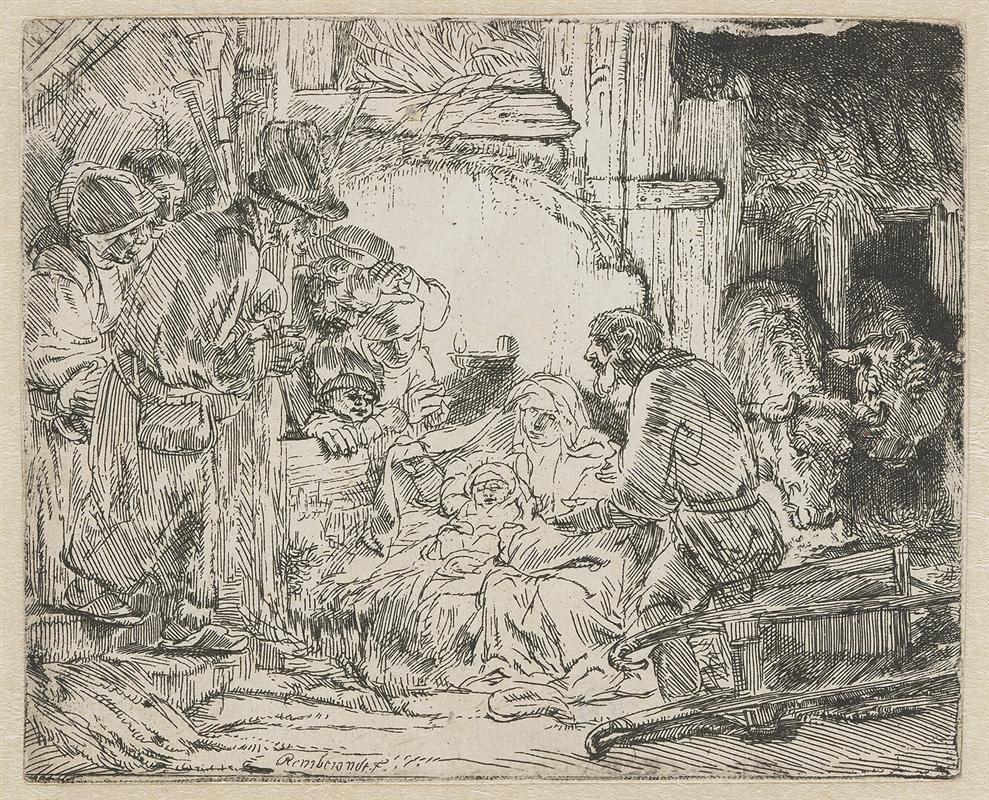
Rembrandt’s “Nativity” of 1654 compresses the most celebrated birth in Western art into the scale of a crowded barn, letting straw, boards, and the breath of animals share the foreground with the Holy Family. Instead of lavish angels or celestial architecture, he gives us a human geography of hands and faces leaning in around a newborn. The print’s intimacy turns the scene from a spectacle into a visitation, where recognition arrives neighbor to neighbor. With rapid etched lines and pockets of plate tone, Rembrandt conducts the viewer through a choreography of gazes—Mary toward the child, Joseph toward Mary, shepherds toward the manger, and cattle peering in from the dark. The result is a Nativity that feels local, audible, and warm, a devotional image built of attention rather than ornament.
Biblical Moment and Rembrandt’s Selection
The Gospel narrative places Mary and Joseph in Bethlehem, where the child is born and laid in a manger; shepherds, having heard tidings, come to witness. Rembrandt isolates the first, humble gathering: a rough shelter, a bed improvised from straw and boards, visitors crowding a doorway still half-open to the night. He omits angelic blaze and royal gifts. What matters for him is human proximity—how people change posture in the presence of a child who is also a promise. This choice aligns with Rembrandt’s late tendency to translate sacred events into domestic registers where empathy does the theological work.
Composition as Converging Attention
The composition forms a shallow stage boxed by timbers and walls. The left half of the plate is packed with shepherds and villagers who press forward in a diagonal wedge, all their weight leaning toward the center. At the right, a sled-like cart angles inward, and behind it two cattle push their large heads through shadow, their curiosity equal to the humans’. The central clearing—Mary reclining, the infant swaddled, Joseph kneeling—becomes the basin into which all lines flow. Even the roof rafters and the half-circle of the rough arch echo this inwardness, wrapping the scene like a cupped hand.
Light, Tone, and the Weather of the Barn
Rembrandt’s light is modest but articulate. The brightest paper is reserved for the infant’s swaddling and the folds of Mary’s bedding; the rest of the image is built from mid-tones and deep crosshatching. Patches of plate tone veil the upper right and back wall, making the cattle emerge from breathable dark. Shadows under the sled and along the threshold read as compacted straw and earth, proof that this is a working shelter. There is no theatrical beam descending from heaven; illumination seems to rise from the child outward, the classic Rembrandt move that transforms light into recognition rather than mere physics.
Materials and the Tactility of Poverty
The barn is not generic. It is constructed plank by plank in the language of line: vertical hatches for rough boards, soft loops for straw, stepped cross-strokes for packed thatch. The manger is a nailed-together trough; a gate swings open on a crude hinge; the sled’s runners curl forward, ready for work come morning. These details matter. They insist that incarnation happens amid real materials, that sanctity begins where hands already labor. The print persuades precisely because it refuses to beautify the setting into abstraction.
Mary as Shelter
Mary reclines in the center, her body forming a cradle within the cradle. Rembrandt avoids idealization; the face is tired and attentive, the head wrapped practically. Her arm bends toward the infant with the instinct of someone who has been holding a small weight for hours and will go on holding it. The bedding’s folds, mapped by quick, flowing lines, become visual equivalents of warmth. She is the still point in the surrounding bustle, a shelter whose strength is quiet endurance.
Joseph as Mediator
Joseph kneels forward at the bedside, shoulders rounded, hands open mid-gesture as he speaks to a visitor or to Mary. His posture, bridging the space between incoming shepherds and reclining mother, casts him as mediator and host. The hat on his back tilts like a halo of work rather than sanctity—the ring of a man who has carried tools and plans, now recalibrated to welcome strangers. Rembrandt often dignifies Joseph’s ordinary virtues: watchfulness, labor, and the instinct to make room.
The Child as Center Without Pageantry
The infant is small, wrapped, and hardly more than a cluster of light and ovals. Yet the geometry of the scene yields to him. The child’s presence is announced not by symbols but by the way every gaze, object, and beam bows toward the tiny face. Rembrandt knows that meaning can be borne by the simplest forms when the surrounding world has been tuned to receive them. The baby is visually the quietest element and thereby the most commanding.
Shepherds and Villagers: Crowd Psychology at Whisper Volume
At the left margin, figures layer in depth: an old man craning, a youth half-hidden by a broad hat, another pushing through the doorway with a staff turned walking-stick. Each face is individualized with a handful of strokes—skeptical, smiling, awed—but none steals the scene. Their bodies angle inward, weight on one foot, the other stepping over the threshold. One child peers over a ledge, chin hooked on wood, eyes large with permissionless wonder. Rembrandt’s gift is to let a crowd be many without becoming noise. The room fills, but the center continues to breathe.
Animals as Witnesses
The two cattle at right are not cartoon piety; they are curious large beings hauled into the holy by habit. Their blunt muzzles and blank eyes, etched with soft, dense hatching, register presence without comprehension. The warm breath of their bodies seems to touch the back of Joseph’s coat. In letting animals witness, Rembrandt underscores the universality of the event and the barn’s working reality. Birth belongs to the whole created order; recognition begins with looking.
The Sled, the Threshold, and the Language of Tools
The angled sled in the foreground is a brilliant insertion. Its runners hook inward like an underline to the cradle. It carries no cargo now, but it speaks of transport, provision, and tomorrow’s errands. The threshold plank, scuffed and dark, slows the incoming feet. These tools are neither symbolic props nor random clutter. They convert the loftiness of the subject into the grammar of a workday: the sacred will ride on whatever is at hand.
The Architecture of Line
Rembrandt draws with a musician’s sense of tempo. Long, parallel strokes mass shadow; short, skittering hatches describe wool and hair; wiry crosshatching densifies the nook where the cattle stand. The line weight changes as it moves across materials—heavier in the sled and doorposts, lighter in faces and cloth—so that the viewer can feel rather than merely see difference. He leaves pockets of paper bare, especially around the infant and the arch overhead, creating breathing spaces that keep the small room from collapsing into ink.
Plate Tone and Different Impressions
In many impressions, Rembrandt leaves a veil of plate tone in the upper right, which prints like a soft evening gloom. In cleaner pulls, the background opens and the cattle stand sharper. This variability is not incidental; it allows the sheet to shift mood—cozier with tone, crisper without—while preserving the central encounter. The technique mirrors the way memory works: we remember a night as warmer or clearer depending on the telling, yet the heart of it remains.
Comparisons Within Rembrandt’s Nativity Imagery
Earlier in his career, Rembrandt etched annunciations and Adorations with more theatrical contrasts and ornament. By 1654 the theatricality recedes. What remains is the discipline of noticing. This “Nativity” sits in conversation with his late Holy Family prints, where light seems to seep from the child into the room and where domestic gestures carry doctrine. It also dialogues with Dutch peasant interiors by contemporaries, borrowing their textures only to redirect them toward a sacred center.
Sound, Smell, and the Sensorium of the Scene
Rembrandt’s marks summon not only sight but sound and smell. One hears the shuffle at the threshold, the murmur of greetings, the wet nose of cattle pushing straw, the faint creak of the sled runner. One smells hay warmed by bodies, the sour-sweet stable air, the tang of sweat in winter garments. By activating the full sensorium, the print turns from illustration into presence; we do not stand outside a scene, we enter it.
Theology of Proximity
The print’s main theological claim arrives without emblems: holiness is hospitable. God comes as a child who must be held; shepherds must step over a threshold; animals keep a place warm. The room teaches that revelation travels along social lines—touch, welcome, shared looking. Joseph’s open hands, Mary’s cradling arm, the shepherds’ leaning bodies all propose a liturgy of nearness. It is not that doctrine is missing; it is embodied. The manger is less an altar than a table where attention becomes adoration.
Dutch Vernacular and Universal Story
Costume and carpentry are seventeenth-century Dutch, not first-century Judean. Rembrandt makes no apology for the anachronism. Vernacular translation is how a story lives. By letting the Nativity wear local woods and wool, he tells viewers that the birth belongs to their towns and seasons. The doorway looks like one you have brushed past; the sled like one you have tugged. The gospel becomes near not by erasing difference but by finding rhyme.
The Viewer’s Placement
We stand inside the room, a half-step above the sled, at the same level as Joseph’s shoulders. This vantage converts us from spectators into latecomers who must decide how to greet the child. The composition doesn’t push us toward a prescribed gesture; it simply leaves space to move in. Some will bow, some smile, some quietly look. The print trusts that the scene’s warmth will do the work of welcome.
Time, Pause, and the Next Hour
Although the image captures a single instant, it suggests the hours around it. The night has deepened; more neighbors will arrive; Mary will sleep; the cattle will shift; the sled will be used at dawn. Rembrandt’s etching addresses that flow of time by letting the arch overhead feel like a clock’s dome, its curve holding the moment while hinting at the day to come. The Nativity is not a static tableau; it is a beginning, and beginnings are busy.
Human Particularity Over Iconic Distance
Every face is somebody—no idealized types. The old man with a staff, the hat that hides a brow, the child on the ledge, the woman half-glimpsed behind another shoulder: each receives a few individualized strokes. This insistence on particularity dignifies the visitors without romanticizing poverty. They are neighbors with rough hands and good clothes for winter. If holiness is to be recognized, it must be recognized here, among these somebodies.
A Contemporary Reading
Seen today, the print argues for a spirituality of attention in crowded rooms. It invites communities to imagine how welcome looks at small scale: making space, leaning in, letting the least luminous thing—the wrapped child—govern the room’s arrangement. It blesses the world’s barns and buses, kitchens and back rooms, where good news still travels in whispers and where people reorganize themselves around a vulnerable center.
Conclusion
Rembrandt’s 1654 “Nativity” turns the great story into the small miracle of a warm room. With straw, boards, sled, cattle, and neighbors, he crafts a theater of hospitality in which a mother shelters, a father mediates, and a baby quietly commands. The etched lines breathe; the plate tone makes night; the faces learn to look. It is a vision of incarnation that persuades not by spectacle but by nearness. We leave the print with the sense that we have been present, that our own bodies were among those leaning at the threshold, and that the ordinary world—tools, animals, and winter coats—was enough to hold a glory that asked only to be received.