Image source: wikiart.org
A Chamber Filled With Sound And Symbols
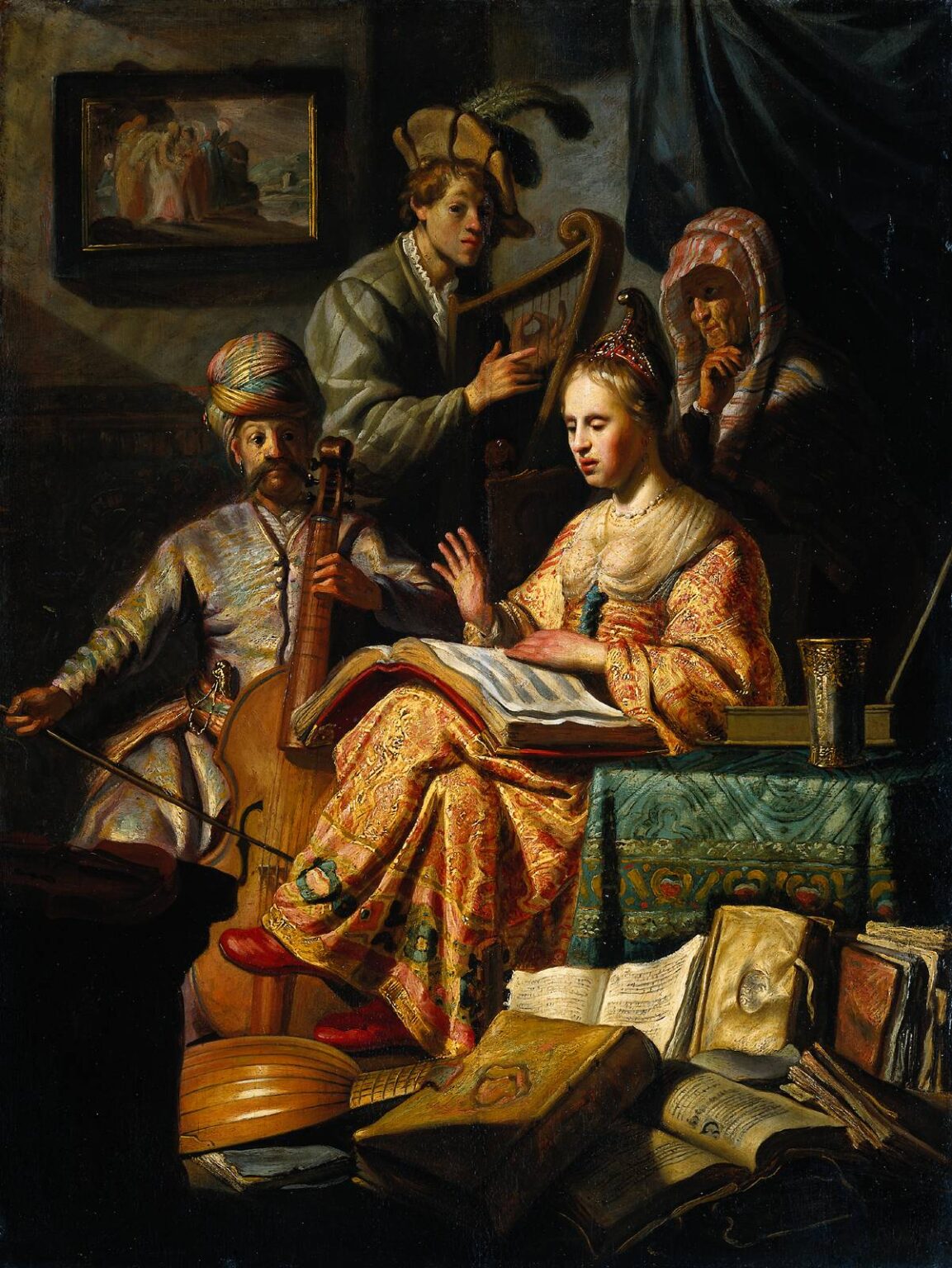
Rembrandt’s “Musical Allegory,” painted in 1626, is a luxuriant chamber scene where music becomes a metaphor for learning, harmony, and judgment. Four figures gather around a richly dressed young woman seated before a large book of notation. A turbaned viol player draws his bow, a page in a feathered cap touches the harp, and an older woman in striped headcloth watches with a knowing, even admonitory air. At the sitter’s feet and on the table spill books, instruments, papers, and a gilded cup. Light concentrates on the central figure’s face and hands, making her silent beat the conductor of the entire ensemble. The painting is intimate yet ceremonious, a miniature court where sound, study, and virtue perform together.
A Leiden Studio Determined To Impress
The year 1626 belongs to Rembrandt’s intensely ambitious Leiden period. Fresh from the workshop of Pieter Lastman, he was determined to prove mastery in the prestige genre of “history” while adapting it to smaller panels suited for learned homes. The city’s scholarly environment, with its university, printers, and collectors, provided patrons who appreciated allegory and pictorial wit. “Musical Allegory” answers that milieu with a picture both sumptuous and cerebral. It offers the glitter of exotic textiles and instruments but organizes them around a clear moral center: the training of the senses by discipline and understanding. In this sense the work is a sibling to his contemporary series on the five senses and to his early depictions of scholars in their studies.
The Central Figure As Measure And Mind
Seated in a high-backed chair embroidered with nailheads, the young woman becomes the heart of the composition. Light grazes her forehead and cheek, glints along a jeweled diadem, and rests on the palm of her outstretched hand as she silently counts the beat. Her other hand steadies the open book whose thick leaves and black staves model the “law” of music. She does not sing; she governs. The image resonates with the period’s humanist idea that music trains the soul by teaching proportion, memory, and harmony. Rembrandt gives this idea a human face—concentration without strain, authority without arrogance—and lets the rest of the room orbit her composure.
A Quartet Of Characters And The Drama Of Attention
Each attendant plays a distinct role in the chamber’s theater of sound. The turbaned viol player at left draws the bow with a grave, learned air, his head inclined toward the notation. Behind the chair, a youthful page in a feathered cap leans toward his harp, fingers hovering over strings in expectant poise. At the back right, an elderly chaperone, head wrapped in striped cloth, presses a finger to her lips in the universal sign for quiet and order. The four form a ring of attentions—playing, preparing, regulating, and counting—that personalize the allegory. None is generic. Each bears the idiosyncrasy of a portrait study folded into emblematic roles, a favorite early trick of Rembrandt that intensifies believability.
Composition That Conducts The Eye Like Music
The composition is built as a sequence of visual measures. The main diagonal runs from the viol’s fingerboard up through the woman’s hands to the boy’s harp and finally to the chaperone’s lifted finger. A counter-diagonal rises from the lutes and books in the foreground, passes across the patterned tablecloth, and meets the woman’s face. Rectangles of books, the lozenge of the chair back, and the square of the framed picture behind her set a rhythm of rests between these slanting lines. Nothing is crowded, yet the field is full. The eye reads the room as one would read a score, moving from part to part and returning to the strong beat of the illuminated face.
Light As Harmony And Judgment
Light functions as a conductor’s baton. It singles out what must be heard—the counting hand, the reading hand, the forehead of thought—then tours the ensemble to give everyone a cue. The viol player’s turban and cheek catch the beam in modest highlights; the harpist receives a gentler wash that describes his youthful softness; the chaperone retreats to a drier, more papery light befitting age and watchfulness. Objects in the foreground—open books with calligraphic staves, a lute, a gilded cup—flash in passing like ornaments within a larger harmony. This orchestrated illumination carries a quiet morality: light clarifies order, and order yields the beauty we call music.
Fabrics, Metals, And The Pleasure Of Surface
The painting is a feast for a painter’s hand. The seated figure’s robe is a brocade mapped in reds, oranges, and greens, edged with soft gold that catches on folds like sunlight in ripples. The turbaned player’s satin sleeves, broken by stitched bands, prove how woven surfaces can hold and release light. The green table covering with its repeating pattern adds a cool counterpoint to the warm costume, while the metal cup on top throws a sharp specular highlight that punctuates the right side like a cymbal tap. These textures are not mere opulence. They enact what music describes: variation, contrast, and resolution, performed by cloth and metal under light.
Instruments And Books As Emblems Of Learning
At the woman’s feet lie a lute and a binder thick with loose leaves; on the table rest tomes whose pages curl from use; on the floor sprawl volumes opened to show their staves and notes. They suggest a household that practices rather than merely displays culture. The instruments span registers—bowed bass, plucked treble, and harp—implying a complete harmony under her direction. The gilded vessel suggests reward or consecration, perhaps a prize cup or a ritual beaker in which learning is toasted. The bounteous still-life elements carry the weight of allegory but remain convincing objects, their edges scuffed by fingers and their pages buckled by air.
The Picture Within The Picture
On the wall behind the harpist hangs a small painting of a mythic or biblical scene with dancing or celebrating figures. Its tiny flare of movement adds a witty echo: music stirs bodies, but in this room music is mastered before it is released. The inset image deepens the space and provides an intellectual mirror. It says, in effect, that performance is the visible fruit of prior study. Rembrandt enjoyed these framed quotations at this stage of his career; they let a learned viewer read for references while the unlearned still enjoy the bustle of the main scene.
Costumes, Exotic Props, And Leiden’s Cosmopolitan Eye
The turban and Eastern fabrics connect the room to the global trade networks that made Dutch cities wealthy. Rembrandt collected such garments for the studio, not to document ethnography but to enrich the visual and symbolic register of his pictures. The turban here introduces a note of gravitas and learned otherness, aligning the violist with the long tradition of music theory reaching back through Arabic scholars to antiquity. The feathered cap of the page tips toward contemporary fashion and playful youth. The striped headcloth of the older woman recalls household order and modesty. Costume alone establishes a social and intellectual spectrum that the central figure quietly governs.
Gesture As A Dictionary Of Virtues
The outstretched counting hand embodies method. The harpist’s poised fingers signal readiness. The violist’s bowed stance enacts commitment. The chaperone’s finger to her lips represents restraint. Together they write a sentence about how beauty is made: through measured action, collaboration, preparation, and discipline. Rembrandt’s education under Lastman taught a vocabulary of expressive gesture; here he bends it to domestic pedagogy rather than public spectacle. The gestures are legible but not exaggerated, scaled to a room where the loudest noise is the turning of a page.
The Psychology Of Listening
Although instruments are present, the most dominant activity is listening. The woman reads silently; the men watch her hand and anticipate the beat; the chaperone listens for order itself. Listening is the moral center: attention rather than display, inwardness rather than flourish. Even the light seems to hush as it touches the books in the foreground. This inwardness will become a hallmark of the mature Rembrandt, whose greatest scenes arrest the split second when people attend to something larger than themselves.
The Space Of Learning And The Ethics Of Clutter
The foreground looks piled with knowledge, yet the room never feels messy. The open books jut at angles that guide the eye; the lute’s curve invites a slow return to the counting hand; the heavy tome on the floor forms a foothold for the gaze to step back into the scene. The controlled clutter declares that learning is lived-in. Perfection is not sterile; it is hospitable to the real instruments and papers that discipline requires. The viewer senses a home in which study and pleasure make one household.
Color And The Temperature Of Sound
Rembrandt builds a warm key around saffrons, reds, and coppery browns in the central costume, balanced by cooler greens and blue-grays in the table cover and the background drapery. The turban’s iridescent stripes echo the robe’s warmth while the harpist’s gray doublet calms the center. The chaperone’s muted pinks and whites carry the pallor of age. The coloristic balance resembles a chord with a glowing middle register and cooler fringes, a translation of harmony into pigment.
Technique, Touch, And The Young Painter’s Confidence
Up close, the brushwork shows a teenager’s bravura tempered by keen observation. Highlights on metal and jewel are small stand-alone dabs; the brocade is built by alternating glazes and impasto ridges along fold peaks; hair and fur are not fussed but suggested with broken strokes that vibrate under light. Flesh is modeled with thin warm layers over a cooler underpaint, producing a lifelike translucency on the woman’s cheek and the harpist’s fingers. Nothing looks labored. The confidence with which materials differentiate themselves is already unmistakably Rembrandt’s.
The Allegory’s Meanings Without a Single Moral
“Musical Allegory” can be read as an emblem of the prudent household where arts and virtues are taught; as a lesson in the harmony between the senses and reason; as a portrait of practice preceding performance; even as a coded praise of concord in civic life. The painting avoids a single fixed caption and instead supplies a matrix of signs that keep interpretation flexible. This openness is one reason the work remains fresh: viewers bring their own experience of learning and order to the scene and find it answered.
The Viewer’s Place In The Room
The vantage point puts us at the level of the piled books, almost within reach of the lute. We look up to the counting hand and then back to the instruments, as if about to join the practice. The arrangement invites participation rather than distant appraisal. We are not an audience; we are students admitted to the rehearsal, expected to quiet our own noise and attend to the beat. This complicity gives the picture its gentle authority. It does not preach; it draws us into good habits.
Echoes Of The Future Rembrandt
In later decades Rembrandt will pare away pageantry and let light and hands carry nearly all the narrative weight. Already here he trusts faces at rest, eyes that listen, and fingers that count to do the heavy lifting. He also displays the sympathy for ordinary objects that will culminate in his great late still-life passages. Most of all, the painting shows his lifelong conviction that meaning emerges where attention is concentrated. This chamber is not just about music; it is about the human ability to align desire with measure.
How To Look Slowly And Hear With Your Eyes
Begin with the woman’s upturned palm and feel the implied pulse. Let your gaze move to the black staves where the notes sit like tiny birds. Follow the bow to the viol’s bridge, then rise to the harpist’s suspended fingers and the chaperone’s admonishing hand. Return by way of the glittering cup, down the green tablecloth, across the splayed books with their curling pages, and back to the central face. On each circuit the room will sound differently in your imagination—warm with strings, bright with the metal cup’s gleam, steady with the soft count of a measured hand.
Why This Early Work Endures
The painting endures because it reconciles delight and discipline. It gives us the sweetness of fabric, the glimmer of metal, the tactile promise of instruments, and it binds them to a clear idea: beauty requires order freely embraced. The figures are specific enough to feel like people we might know and emblematic enough to carry the weight of a lesson without becoming pedantic. In a single small room, a very young painter makes us feel how knowledge, attention, and pleasure can live together without friction. That is a harmony worth hearing again.