Image source: wikiart.org
Introduction
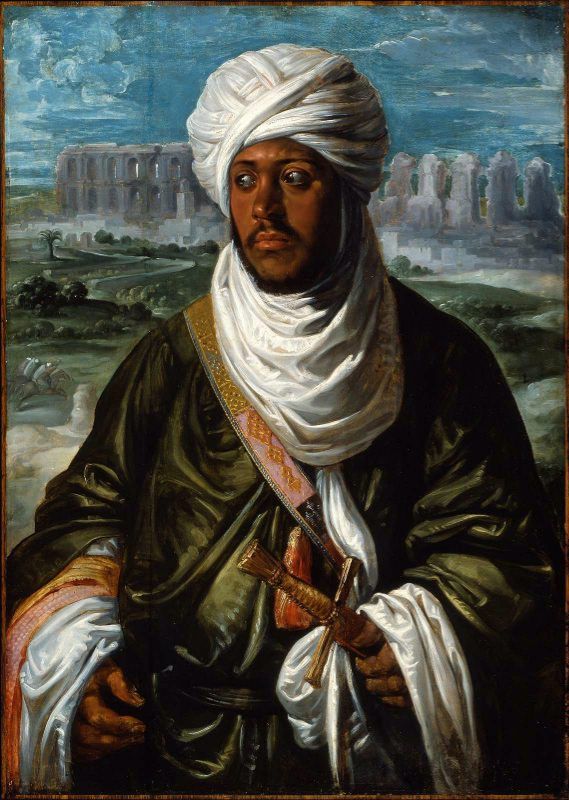
Peter Paul Rubens’s “Mulay Ahmad” (1609) is an arresting portrait that fuses courtly grandeur with the fascination for global encounter that animated early seventeenth-century Antwerp. The sitter—traditionally identified as Mulay Ahmad, a North African ruler of the Saadian line—stands before a luminous landscape of ruins and winding roads. He wears a brilliant white turban and scarf over a dark, glossy robe, a patterned sash crossing the chest, and his hands clasp the hilt of a dagger. Rubens sets this commanding figure against a blue, windswept sky, bathing the face in warm light that draws out a complex psychology: vigilant, self-possessed, and deeply present. Painted just after Rubens returned from Italy and at the dawn of the Twelve Years’ Truce, the picture reads as both a virtuoso study of light on fabric and a document of Europe’s expanding diplomatic and commercial horizons.
Historical Context and Cross-Cultural Curiosity
In 1609 Antwerp was re-opening to the world after decades of conflict. Merchants, envoys, and sailors moved through its docks carrying textiles, spices, diplomacy, and stories. Rubens had recently returned from a formative Italian decade rich with exposure to classical art, Venetian color, and the cosmopolitan life of courts. A portrait of a North African sovereign or ambassador could interest patrons eager to see the wider world reflected with dignity and immediacy. The title “Mulay Ahmad” points toward the Saadian dynasty of Morocco—names borne by sultans and princes who maintained vigorous relations with Iberia and the Low Countries. Whether Rubens painted from life, from sketches of a visiting dignitary, or from informed invention, he treats the subject not as an exotic curiosity but as a peer within the fraternity of rulers, granting him the same fullness of presence he gives to European sitters.
A New Kind of Court Portrait
Rubens adapts the language of court portraiture to a subject whose status and costume derive from another political sphere. The three-quarter figure fills the frame, shoulders squared, head turned slightly, gaze alert and unsentimental. There is no allegorical clutter, no parade of attributes. The dignity of the face, the monumentality of the turban, and the quiet assertion of the dagger suffice. In place of a palace interior he opens a generous prospect—the kind of world landscape learned from Venetian and Flemish traditions—so that the ruler appears anchored to a territory rather than to a chair. The result is a portrait that is both intimate and geopolitical: a person and a polity enter the European pictorial canon together.
Composition and the Architecture of Presence
The composition is built around a triangular armature whose apex is the luminous turban. From that summit a diagonal sweeps through the white scarf and patterned baldric down to the sheathed dagger, then back to the left hand. The broad, dark mass of the robe steadies the center while the white passages ricochet light like stepping stones across the canvas. The head is set against the sky rather than shadow so the profile of the turban reads clearly, its folds carved by light. The arms and hands bracket the torso, giving the figure an energizing sense of readiness. Nothing feels stiff. The clothing hangs with the soft logic of gravity; the sash pushes gently into the robe; the scarf knots with effortless plausibility. Rubens composes a body that occupies space with calm authority.
Light, Color, and the Choreography of Fabrics
The painting is a meditation on light moving across materials. The whites of turban and scarf are not uniform; they pulse from chalky brilliance to pearly gray, catching blue reflections from the sky and warm echoes from the face. The dark robe is a deep greenish black that gleams where pigment has been dragged wet-in-wet to mimic silk’s luster. A thin, patterned band—likely woven with gold—cuts diagonally under the right clavicle, its geometric motif picked out with tiny strokes that never become fussy. The dagger’s grip gathers ruddy browns and dull golds; its hilt throws a discreet highlight. This orchestration of whites, olives, umbers, and sky blues creates a chromatic world at once restrained and sumptuous, suitable to a sitter whose power is expressed through poise rather than ostentation.
The Face and the Psychology of Vigilance
Rubens’s modeling of the face communicates character without caricature. The skin is built with warm translucent layers over a darker ground, giving depth to cheeks and brow. The eyes look slightly off to the side, an angle that conveys both attention and self-containment. The mouth is firm and closed, the beard carefully described but not overdrawn. A faint index of fatigue shadows the lower eyelids, the kind of humanizing touch Rubens often grants rulers to keep their grandeur credible. The result is a presence that feels negotiated: the man meets our gaze as an equal, not as a curiosity on display.
The Dagger and the Ethics of Bearing
Weapons in portraits often serve as shorthand for rank. Here the dagger is compact and controlled, the opposite of theatrical display. The sitter’s hands fold around the hilt in a way that suggests habitual readiness rather than aggression. Rubens paints the fingers with attentive respect—nails, knuckles, and veins emerging from warm brown flesh that catches glints of light. This careful description resists stereotype. The weapon is not a symbol of menace; it is part of the grammar of sovereignty, like a European sword at a gentleman’s hip. The painter thereby aligns the codes of differing courts and invites the viewer to read them with parity.
Landscape, Ruins, and the Geography of Identity
Behind the figure a path winds through a pale, sandy terrain toward ruins that resemble a Roman amphitheater, their broken arcades catching sunlight beneath dense clouds. To the left, figures on camels or horses appear near a watercourse; to the right, low walls and groves thread toward the horizon. This landscape is both evocative and non-specific. It hints at North Africa’s ancient and Islamic layers without committing to topography. The ruins nod to a long history in which classical and later civilizations coexist; the road declares mobility, trade, and diplomatic travel. Rubens thus situates the sitter within a storied geography rather than isolating him in a studio void.
Brushwork, Surface, and the Pleasure of Paint
Rubens varies his handling to match matter. The turban’s highlights are laid with loaded strokes that break at the edges, simulating the crispness of folded cloth. The robe’s darker passages are scumbled and glazed, allowing an under-sheen to suggest silk’s depth. Skin receives short, elastic touches that preserve its living vibration; the mustache and beard are flicked with a small brush in tones close to the flesh so they integrate rather than sit on top. The sky is freely painted, clouds roaming with broad sweeps that keep the background alive. Everywhere one senses the joy of translating tactile fact into color and gesture.
Diplomacy, Curiosity, and Antwerp’s Global Imagination
Antwerp in 1609 was eager for images that captured the new texture of the world. This portrait belongs to a network of representations of North African envoys and rulers circulating in Europe—visual records that could be devotional to alliance or simply avid for difference. Rubens’s contribution is to refuse reduction. He avoids theatrical stereotypes and invests the sitter with the same moral gravitas he gives to archdukes and scholars. In doing so he shapes how a European audience might look: not down upon, not merely across to novelty, but toward a dignified counterpart whose clothing, weapons, and landscape are interpreted as signs of a shared political language.
Between Observation and Invention
Whether or not Rubens had a live model for this painting, he composes details with the authority of someone who has looked hard at textiles, metals, and faces drawn from many places. The folds of the turban, the layered scarf, and the tailored robe are constructed so persuasively that the picture reads as eye-witness, even if it synthesizes multiple sources. That fusion—sharp observation harnessed to imaginative completeness—marks much of Rubens’s best portraiture. He does not transcribe; he composes likeness plus meaning, turning an encounter into an emblem of rule and person.
A Dialogue with Venetian Color and Flemish Presence
Rubens’s decade in Italy left him with a devotion to Venetian colorism, the belief that light lives within pigment and that fabrics can be painted with a sensuality equal to flesh. “Mulay Ahmad” broadcasts that lesson in the prismatic whites and the glossy greens of the robe. At the same time the portrait bears a distinctly Flemish insistence on presence: the sitter fills the frame, the hands are emphatic, and the face confronts us with a realism that respects individual temperament. Italian atmosphere and Northern concreteness meet productively here.
The Viewer’s Encounter and the Ethics of Looking
The portrait stages an encounter between viewer and sitter at a distance intimate enough for conversation. The eyes do not petition; they measure. The hands do not point outward; they repose with readiness. The landscape opens like an invitation to think beyond borders. The painting therefore educates looking. It urges the viewer to suspend exoticizing curiosity and to adopt the decorum of diplomacy—attention, respect, and a willingness to be surprised by common ground.
Legacy and Continuing Resonance
“Mulay Ahmad” remains compelling because it shows how early modern portraiture could make space for global subjects without diminishing them to types. Contemporary audiences see in it an image that resists flattening difference into spectacle. The portrait’s glow comes from Rubens’s conviction that character, costume, and place can be painted with equal dignity, that faces from elsewhere belong within the same brilliant, breathing world of oil paint as Europe’s princes and scholars. It is an image of encounter that still feels fresh.
Conclusion
Rubens’s 1609 portrait “Mulay Ahmad” is a masterclass in respect—respect for light on cloth, for the weight of a hand on a dagger hilt, for a face that looks with alert intelligence, and for a world beyond Europe that enters European art at eye level. The painter composes a figure whose authority rests not on spectacle but on steadiness, and he surrounds him with a landscape that evokes history and movement. In the year Antwerp reopened to diplomacy and trade, Rubens offered an image equal to that moment: poised, generous, and eager to meet the world.