Image source: wikiart.org
Overview of Mucius Scaevola Before Porsenna
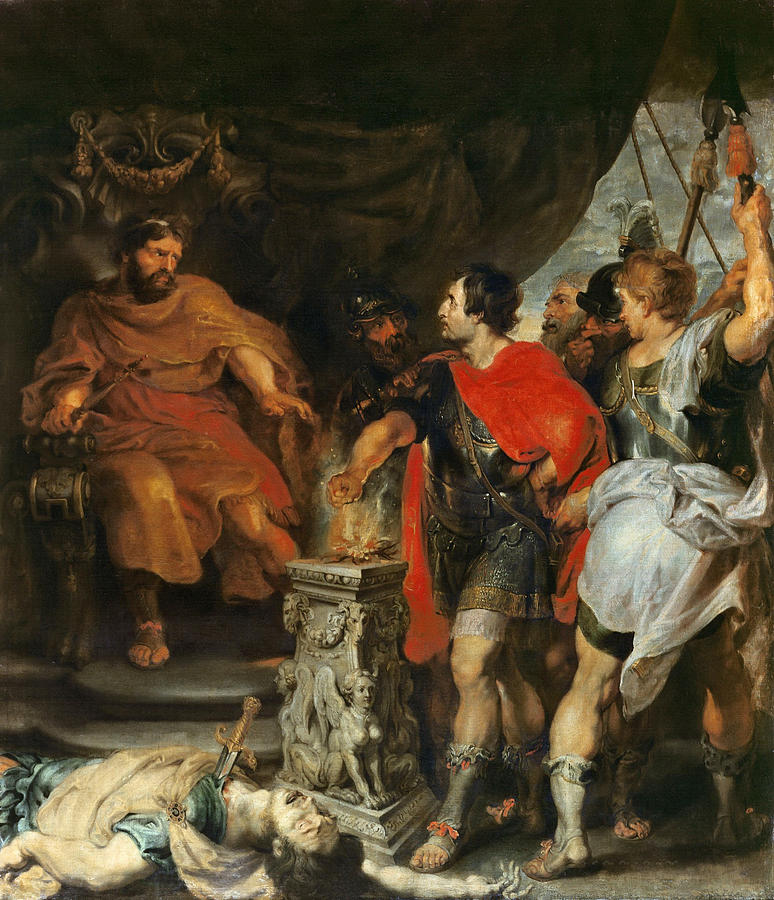
“Mucius Scaevola Before Porsenna” by Peter Paul Rubens is a powerful Baroque history painting that turns a Roman legend of courage into a vivid theatrical scene. The composition presents the young Roman hero Gaius Mucius standing defiantly before the Etruscan king Lars Porsenna after an assassination attempt has failed. At Mucius’s feet lies the corpse of the man he mistakenly killed, while a small altar with flames separates him from the enthroned ruler.
Rubens captures the exact moment that defines the entire story: Mucius, unshaken by failure and torture, declares his loyalty to Rome and thrusts his hand into the fire to prove his fearlessness. Porsenna, seated above him in heavy robes, watches in a mixture of anger, astonishment, and reluctant admiration. Around them a crowd of soldiers presses forward, their armor gleaming, their faces alive with shock and curiosity.
The painting is a model of Baroque storytelling. It fuses muscular bodies, rich color, and intense emotion to celebrate courage, patriotism, and the power of individual resolve against overwhelming authority.
Historical and Literary Background
The legend of Mucius Scaevola comes from ancient Roman historians such as Livy. During a war between Rome and the Etruscan king Porsenna, the young Roman Gaius Mucius secretly entered the enemy camp with the intention of killing the king. Unfamiliar with Etruscan customs, he mistakenly assassinated the royal secretary instead. Captured and brought before Porsenna, Mucius declared that hundreds of Romans were ready to sacrifice themselves in similar attempts.
To demonstrate his contempt for pain and death, Mucius placed his right hand into the sacrificial fire on an altar and held it there without flinching, letting it burn. Impressed by his bravery and by Rome’s resolve, Porsenna decided to make peace. Thereafter Mucius was known as “Scaevola,” meaning “left-handed,” because his right hand had been destroyed.
Rubens, steeped in classical literature, seizes on the moral core of this tale: the triumph of inner conviction over physical suffering and the way one man’s courage can alter the course of war.
Composition and Spatial Organization
The painting’s composition is dominated by a strong diagonal that runs from the lower left corner, where the dead secretary lies, up through the central figure of Mucius and toward the seated king on the upper left. This diagonal generates tension and leads the viewer’s eye from the consequences of Mucius’s mistake to the confrontation that will redeem it.
Porsenna occupies a throne enveloped in heavy drapery. The dark canopy above him creates a shadowy niche that sets him apart from the brightly lit soldiers. His elevated position and massive chair announce his status as ruler. Yet Rubens does not turn him into a distant icon; Porsenna leans forward, his right arm resting on the chair, his left hand gesturing with the scepter, his expression alive with reaction.
Mucius stands just to the right of the altar, thrusting his arm toward the flames. His body tilts slightly forward, one foot planted near the corpse, the other bent as if in mid-step. This pose conveys both physical motion and moral resolve. He is moving toward pain, not away from it.
Behind and beside Mucius, soldiers crowd in. Their presence creates a sense of claustrophobia and heightens the drama. We sense that the hero is surrounded by enemies, yet his stance and gesture command the center of the scene. The altar, placed between hero and king, acts as both physical separation and symbolic bridge—the place where sacrifice and judgment meet.
The Central Gesture: Hand in the Fire
At the thematic heart of the painting is the act of Mucius placing his hand in the flames. Rubens uses the small altar as a focal point. Its carved base, decorated with mythological figures, supports a shallow bowl of fire. Mucius’s arm and clenched fist are thrust directly into this blaze.
The artist suggests the heat and danger through bright touches of orange and white paint among darker embers. Yet he does not sensationalize the wound; instead of showing charred flesh, he focuses on the unflinching determination of the hero. Mucius’s muscles tense, but his face does not contort in pain. His gaze is fixed on Porsenna, not on his own suffering.
This gesture crystallizes the Roman ideal of virtus—courage, self-control, and devotion to the state. By deliberately burning his own hand, Mucius proves that he values Rome’s freedom more than his own body. Rubens turns this moral point into an unforgettable visual image, one that viewers can grasp immediately even without knowing the full story.
The Figure of Porsenna: Authority Challenged
Porsenna sits cloaked in voluminous reddish-brown drapery that covers his massive body and cascades over the arm of his throne. His posture conveys a complex mixture of reactions. On one hand, he leans back slightly, as if recoiling from the audacity of the Roman youth. On the other, his gaze is intent, and his hand grips the scepter—a sign that he is still very much in control.
Rubens avoids portraying Porsenna as a one-dimensional tyrant. His bearded face shows not only anger but also a dawning respect. He is confronted with something he did not expect: an enemy more fearless than any of his own soldiers. The king’s dark surroundings and heavy garments contrast with the more vibrant colors and active poses of the warriors, emphasizing his role as the weight of established power confronted by the spark of youthful heroism.
The throne itself, adorned with carved figures and animal-head armrests, underscores his authority and wealth. But the psychological center of the scene is shifting from this stationary seat of power to the standing figure of Mucius, who, though physically subordinate, exerts moral dominance.
Soldiers and Witnesses: The Crowd’s Reaction
The soldiers around Mucius form a living frame that guides the viewer’s emotions. Their reactions range from shock and fascination to admiration. The man directly behind Mucius leans forward, his helmeted head close to the hero’s shoulder, eyes locked on the burning hand. Another soldier grips a spear or standard, his arm raised high, adding vertical tension to the right side of the composition.
Across the scene, Rubens shows subtle variations in expression: open-mouthed surprise, narrowed eyes measuring the Roman’s resolve, and grim faces evaluating the implications for the war. The mix of armor types—breastplates, helmets with visors, leather straps—adds variety and emphasizes that this is not a staged ritual but a real moment in a bustling military camp.
By including these onlookers, Rubens heightens the sense that Mucius’s act is public and transformative. This is not a private test of will but a demonstration meant to impact the morale and decisions of an entire army. The crowd’s reaction mirrors the viewer’s own, making us feel part of the audience to this drama of courage.
The Dead Secretary: Consequence and Contrast
On the lower left, nearly at the edge of the canvas, lies the dead secretary, the unintended victim of Mucius’s failed assassination. His body sprawls across the steps, sword fallen nearby, robe disheveled. His pale face is turned toward the viewer, eyes closed, mouth slightly open in the stillness of death.
The diagonal of his body contrasts with the upright, energetic pose of Mucius. This contrast highlights the difference between failure and redemption. The corpse represents the error and violence that could have defined the episode; Mucius’s self-sacrifice transforms the narrative into one of heroism and honor.
Rubens also uses the corpse to anchor the composition. The weight of the dead body at the bottom left balances the psychological weight of Porsenna’s throne above, creating a visual triangle with Mucius at its apex. This geometric structure reinforces the idea that the hero’s decision connects death and power, shaping the outcome of both.
Color, Light, and Baroque Atmosphere
The palette of “Mucius Scaevola Before Porsenna” is typical of Rubens’s mature style: rich earth tones, vibrant reds, deep greens, and luminous flesh tones. Light pours into the scene from the right, illuminating the armor, the altar flames, and the faces of Mucius and the soldiers. Porsenna remains partly in shadow, his face and hands emerging from the darkness of the tent.
The heroic red of Mucius’s cloak immediately sets him apart as the central figure. It echoes in smaller accents—the ties on the soldiers’ footwear, the warm glow of the fire—creating a chromatic rhythm that leads the eye back to him. The reddish-brown of Porsenna’s robe provides a heavier, more muted counterpart, symbolizing stable but less vibrant authority.
Highlights on metal surfaces—the helmets, breastplates, sword hilts—add visual sparkle and underline the martial setting. Yet Rubens avoids making the scene purely decorative. The shimmering armor is subordinated to the emotional drama; it enhances, rather than distracts from, the narrative tension.
Atmospheric effects are also key. The dark canopy behind the throne creates a sense of enclosed, almost oppressive space, suggesting the heavy weight of political power. In contrast, a glimpse of bright sky and light to the far right hints at the world beyond this tent—Rome, freedom, the future shaped by the decision about to be made.
Anatomy and Gesture: Bodies as Moral Statements
Rubens’s mastery of anatomy is on full display. Mucius’s muscular arm and bare legs convey strength and youth, while the tension in his clenched fist and bent knees expresses moral determination. His chest twists slightly, and his head is turned toward the king, emphasizing his unbroken spirit even as he subjects his body to torment.
Porsenna, by contrast, is heavier, with rounded shoulders and a less defined physique. His seated posture signals age, established rule, and perhaps a degree of complacency. The soldiers occupy a middle ground—fit and strong but lacking the singular focus that defines the hero.
Gestures are essential to the painting’s storytelling. Mucius’s arm reaches forward into the flame; Porsenna’s hand with the scepter gestures in a mixture of command and disbelief; soldiers lean and point. These gestures create a network of lines that ties every figure into the central drama, making the entire scene feel like a choreographed stage play in which every actor responds to the decisive moment.
Moral and Political Themes
The legend of Mucius Scaevola was beloved in early modern Europe as an example of civic virtue and the willingness to sacrifice for the common good. Rubens’s painting underscores these themes. Mucius’s bravery impresses not only Porsenna but also the viewer, who is invited to admire such selflessness and steadfastness.
In Rubens’s time, such stories could carry political resonance. Courts and leaders commissioned scenes from Roman history to present ideals of courage, loyalty, and wise rule. A ruler like Porsenna, capable of recognizing and rewarding virtue even in an enemy, offered a model of magnanimity. Mucius’s readiness to die for Rome, meanwhile, exemplified the patriotic devotion expected of subjects or citizens.
The painting thus functions on two levels. It is a thrilling narrative about a specific ancient hero, and it is a broader meditation on how moral courage can influence political decisions. The burning hand becomes a metaphor for the kind of self-sacrificing integrity that can compel even hostile powers to reconsider their course.
Collaboration and Style
This work is often associated not only with Rubens but also with Anthony van Dyck, his gifted pupil and collaborator. Whether or not van Dyck contributed directly to particular passages, the painting exhibits traits of the Rubens studio: energetic composition, thick, luscious paint, and a fusion of Italian influence with Northern attention to texture and light.
The scene draws on lessons from Venetian painters like Tintoretto and Veronese, whose dramatic groupings and rich colors Rubens admired. At the same time, his interest in Roman sculpture informs the heroic poses and muscular forms. The result is a distinctly Baroque style that combines classical grandeur with immediate emotional engagement.
Emotional Impact and Viewer Experience
Standing before “Mucius Scaevola Before Porsenna,” the viewer experiences a range of emotions: shock at the dead body, apprehension at the impending torture, admiration for the hero’s steadiness, curiosity about the king’s reaction. Rubens orchestrates these feelings through careful control of composition, expression, and color.
The painting invites us to identify with Mucius’s courage, to feel the heat of the fire and the weight of the king’s gaze. At the same time, we may also sense the difficulty of Porsenna’s position—forced to reconsider his hostility in the face of such bravery. This emotional complexity gives the work a lasting power that goes beyond simple hero worship.
In the end, the image affirms a belief that moral conviction can reshape political reality. The young Roman’s willingness to endure pain becomes a force capable of changing a king’s mind and saving his city. Rubens’s painting makes that abstract idea tangible, transforming it into a scene of flesh, flame, and human faces that remains vivid centuries later.