Image source: wikiart.org
Introducing “Moses and the Water from the Rock of Horeb”
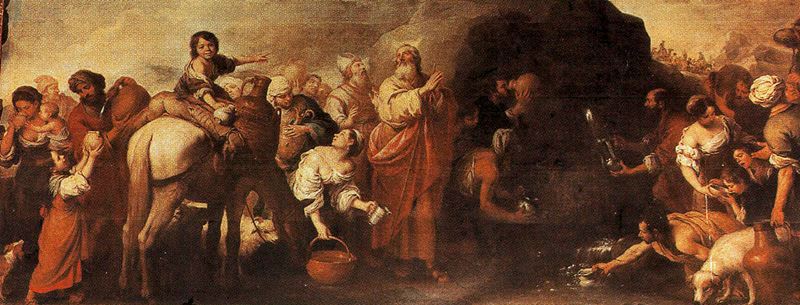
“Moses and the Water from the Rock of Horeb,” painted by Bartolome Esteban Murillo around 1670, captures one of the most dramatic moments in the Old Testament. The canvas stretches horizontally like a frieze, crowded with figures who surge across the scene in a wave of thirst, relief, and astonishment. In the center, Moses strikes the rock of Horeb, and water gushes forth to save the parched Israelites wandering in the desert.
Murillo is often remembered for tender depictions of the Virgin and Child or playful street children in Seville. Here, however, he turns to a large scale biblical narrative and shows that he can handle complex crowd scenes and powerful religious drama. The painting combines theatrical Baroque movement with a warm, human focus that is very typical of Murillo. It is both a miracle and a story about everyday desperation and hope.
The Old Testament story behind the painting
The subject of “Moses and the Water from the Rock of Horeb” comes from the Book of Exodus. After the Israelites flee Egypt, they wander in the desert, suffering from hunger and thirst. At Horeb, the people quarrel with Moses because there is no water. God commands Moses to strike a rock with his staff so that water will flow out and the people may drink.
Murillo compresses the entire episode into a single moment. At the center of the composition, Moses stands in his prophet’s robes, arm raised toward the sky as if he has just obeyed God’s command. The rock at his side has already been struck, and water pours out in a stream that divides the painting into two halves. To the left, the crowd presses in, still anxious and thirsty. To the right, figures kneel, scoop water, and fill vessels with new hope.
By depicting the moment when the miracle has begun but the crowd is still reacting, Murillo creates a powerful narrative tension. We feel the interval between despair and salvation. The people are still frightened and exhausted, yet the solution is already visible. That emotional overlap gives the painting its dramatic charge.
A panoramic composition filled with human drama
The format of “Moses and the Water from the Rock of Horeb” is unusually wide. Murillo uses this horizontal space to describe an entire community moving through crisis. The eye travels from left to right across the canvas, following the flow of bodies, animals, and vessels that organize the scene.
On the left edge, women hold infants, children ride on camels, and men push forward with outstretched hands. Their bodies lean toward the central rock, creating diagonal lines that drive our gaze inward. Many look directly toward Moses or toward the water, but some glance anxiously at each other, emphasizing the shared fear that binds them together.
At the center, Moses becomes the axis of the composition. He stands upright, draped in a reddish garment, his posture tall and commanding. The rock next to him is dark and vertical, echoing his figure and stabilizing the busy movement around him. From the base of the rock, water shoots forward in a bright stream, catching the light and acting as a visual link to the group on the right.
On the right side, Murillo shows the result of the miracle. A mother bends down with a child and a jug, a man kneels to drink directly from the water, and others pass vessels along an invisible chain. These figures are arranged in a more grounded, horizontal rhythm, suggesting that calm is beginning to replace chaos. The crowd is still full of energy, but the desperation that dominated the left side has started to give way to relief.
The composition is very carefully designed. Murillo balances heavy clusters of figures with areas of relative emptiness. The dark rock and the shadowy background help frame the bright stream of water and the lighter garments of some figures. The painting feels dense and busy, yet our eye never gets lost because the structure is so clear.
Light and color that guide emotion
Light is one of the key expressive tools in “Moses and the Water from the Rock of Horeb.” Murillo does not flood the entire scene with brightness. Instead, he uses controlled illumination to highlight the spiritual and emotional core of the story.
The sky above is hazy and somewhat muted, suggesting a dusty desert atmosphere. Against this subdued background, Moses’s robe glows with warm reddish tones, and the water from the rock sparkles with pale reflections. The faces of the central figures are gently lit, while the edges of the crowd fall into deeper shadow. This contrast concentrates our attention on the essential action and heightens the sense of mystery.
Murillo’s color palette mixes earthy browns and ochers with soft blues, greens, and warm flesh tones. The Israelites are not dressed in idealized robes of pure primary colors; their garments look worn and practical, yet still rich enough to please the eye. These hues reinforce the idea that the biblical story is also about real people who could have stepped out of seventeenth century Seville.
The water itself plays a special visual role. In a painting dominated by dusty tones, the bluish and white highlights of the stream stand out as a rare cool sparkle. It is as if the entire color scheme has been designed to make that liquid seem more precious. The water not only quenches physical thirst but also symbolizes grace and divine mercy.
The face and figure of Moses
Murillo’s Moses commands respect but is not distant or harsh. He appears as a dignified older man with a long beard, standing near the center of the scene, slightly separated from the pressing crowd. His gesture is both firm and prayerful: one hand holds the staff, the other may be raised toward heaven or pointing toward the rock and the miracle.
The expression on Moses’s face is not triumphant. Instead, he looks serious, perhaps even burdened. He seems aware that the miracle is not his own power but a gift granted through him. This nuance is typical of Murillo, who often portrays saints and biblical figures with inner humility rather than rigid authority.
His tall figure, draped in flowing robes, forms a vertical anchor in the scene. The folds of his garment, painted with broad, confident strokes, echo the swirling movement of the crowd while still setting him apart. Moses is firmly placed between God and the people, the mediator through whom the miracle is enacted.
The Israelites as ordinary people
One of the most characteristic features of Bartolome Esteban Murillo’s art is his sympathy for ordinary people. In “Moses and the Water from the Rock of Horeb,” the Israelites are not idealized heroes. They are men, women, and children of many ages, depicted with an almost genre painting sensibility.
On the left side, mothers cradle infants who cry with thirst. A boy clings to a camel, pointing excitedly toward the miracle. A woman lifts a jug or a basket in anticipation. Faces show fatigue, worry, and relief. Some figures are barefoot, their clothes slightly torn or dusty. Murillo’s training in painting street urchins and beggars in Seville is clearly visible: he understands how to convey poverty without cruelty, and how to depict tenderness among the disadvantaged.
On the right side, the gestures become softer. People kneel and bend to drink or to fill their vessels. One figure crouches low to the ground, shading his eyes from the brightness of the water as he leans close to it. The expressions here are more grateful than desperate, and the body language is more relaxed.
By giving so much attention to individual reactions, Murillo turns a large scriptural scene into a collection of personal stories. Every face seems to have its own narrative, and this variety helps viewers of any era identify with the scene. The miracle at Horeb becomes a metaphor for moments of crisis and relief in human life.
Symbolism of the water from the rock
For Christian viewers in seventeenth century Spain, the story of Moses bringing water from the rock was usually read as a foreshadowing of Christ. The water that saves the Israelites in the desert foretells the spiritual “living water” offered by Christ in the New Testament and also symbolizes the grace that flows from the sacraments, especially baptism.
Murillo quietly weaves these symbolic meanings into the painting. The water stream is shaped almost like a luminous path through the dusty landscape. It separates and yet connects the crowds, suggesting both physical and spiritual nourishment. Figures kneeling to drink resemble communicants approaching a sacred source.
The rock itself, massive and dark in the center of the painting, can be understood as a symbol of Christ as the firm foundation of faith. Moses’s staff, striking the rock at God’s command, becomes a tool of divine will that opens the hidden source of grace. At the same time, the surrounding desert reinforces the fragility of human life without such sustaining water.
This layered symbolism would have been especially resonant in Counter Reformation Spain, where religious painting often aimed to inspire devotion and reflection. “Moses and the Water from the Rock of Horeb” invites viewers not only to admire a spectacular biblical event but also to contemplate the generous mercy of God in their own lives.
Murillo’s Baroque style and artistic choices
Though gentler than some Italian or Flemish Baroque masters, Murillo still belongs fully to the Baroque era. In this painting, Baroque qualities appear in the dynamic composition, the contrast between light and shadow, and the focus on heightened emotion.
The crowd surges diagonally, creating a sense of movement and urgency. Figures twist and turn in different directions, yet their gestures are unified by the central theme of thirst and relief. The diagonals formed by raised arms, tilted vessels, and marching camels all contribute to a swirling rhythm that keeps the viewer’s eye in constant motion.
The lighting is dramatic. Murillo uses strong contrasts to model the bodies and to pull certain figures forward from the gloom. At the same time, he avoids extreme theatricality. The light feels natural rather than supernatural, as if the miracle manifests in a world that is still grounded in everyday reality.
Murillo’s brushwork is also worth noting. Up close, one can see broad, energetic strokes in the clothing and landscape, while the faces are handled with smoother transitions. This combination creates a lively surface that remains legible at a distance. The artist balances detail with general impression so that nothing feels stiff or static.
Relationship to Murillo’s other works
“Moses and the Water from the Rock of Horeb” belongs to a broader group of large religious canvases Murillo created for churches and religious institutions in Seville. While his genre scenes of street children might be more familiar today, works like this show his ambition as a major history painter.
Several features connect this painting to his other religious works. The warm golden light, soft color transitions, and gentle faces are trademarks of Murillo’s mature style. His Virgins and saints often have the same down to earth beauty seen in the women and children among the Israelites here. The same sympathy that infuses his images of charity and almsgiving appears in the way he treats this thirsty crowd.
At the same time, the scale and complexity of “Moses and the Water from the Rock of Horeb” demonstrate that Murillo could handle grand narratives just as confidently as smaller devotional subjects. The painting reveals an artist who understood how to satisfy patrons who wanted strong doctrinal messages, while still following his instinct for human warmth.
Devotional impact and legacy
For seventeenth century viewers, this painting would have functioned as both instruction and inspiration. Churchgoers who might not be able to read the Bible could learn the story visually and reflect on its meaning. The suffering of the Israelites would remind them of human frailty, while the abundant water would assure them of divine care.
The painting is also deeply emotional. Murillo’s ability to portray the vulnerability of children and the worries of parents encourages an empathetic response. The viewer is not a distant observer but almost another member of the crowd, standing in line for water. This emotional closeness makes the miracle feel real and present.
Over time, “Moses and the Water from the Rock of Horeb” has continued to attract interest for its combination of narrative clarity and painterly beauty. It offers art lovers a chance to see Murillo’s talents outside the more familiar Marian themes and playful street scenes. The work stands as an impressive example of Spanish Baroque narrative painting, full of life, faith, and humanity.
Conclusion
“Moses and the Water from the Rock of Horeb” by Bartolome Esteban Murillo, painted around 1670, is a richly layered exploration of a powerful biblical miracle. Through a wide, crowded composition, Murillo brings the story of Exodus to life with a host of individual characters, each responding in their own way to the sudden appearance of life giving water.
The painting unites strong Baroque drama with Murillo’s characteristic tenderness. Light and color emphasize the miraculous stream and the compassionate figure of Moses. The Israelites appear as real men, women, and children, whose thirst, anxiety, and gratitude are easy to understand. Symbolically, the water from the rock points forward to Christian ideas of grace and salvation, making the canvas an invitation to spiritual reflection as well as a feast for the eyes.
By blending narrative clarity, emotional depth, and sensitive craftsmanship, Murillo turns “Moses and the Water from the Rock of Horeb” into more than a simple illustration. It becomes a meditation on human need and divine generosity, a moment where heaven touches earth through the humble element of water.