Image source: wikiart.org
Introduction
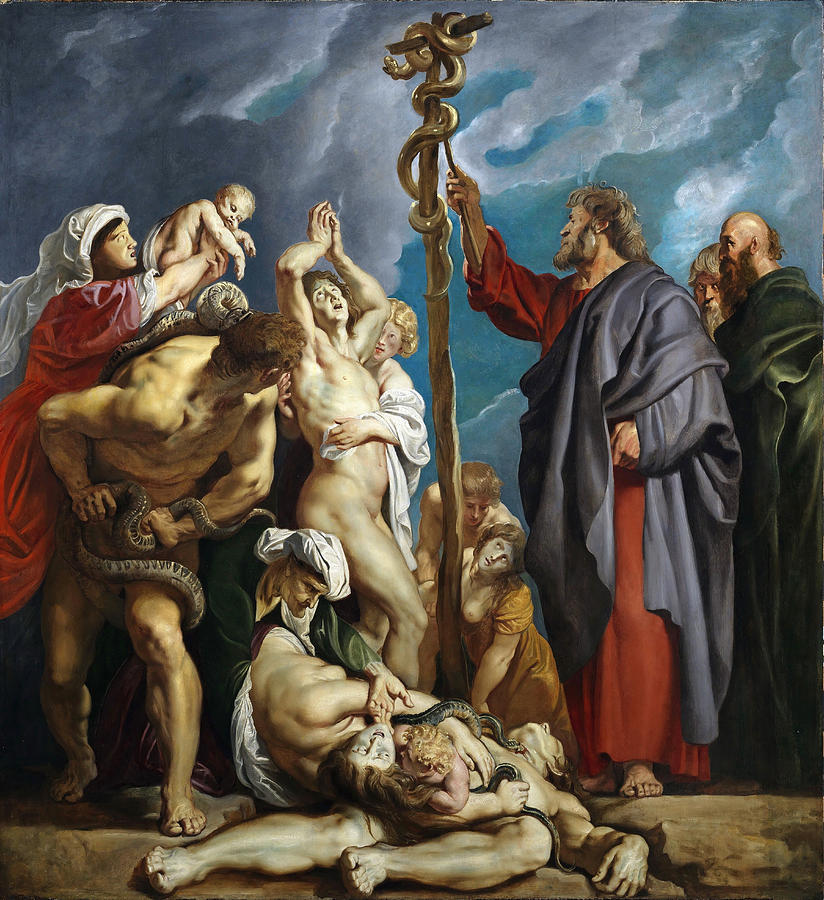
“Moses and the Brazen Serpent” presents Peter Paul Rubens at full Baroque voltage, fusing narrative urgency, theological depth, and virtuoso figure painting into a single whirling drama. The biblical episode from Numbers 21 bursts to life as a desperate multitude writhes under the assault of venomous snakes while Moses, robed like a prophet-king, lifts the bronze serpent on a tall staff. Salvation depends on sight: whoever looks upon the emblem lives. Rubens turns that command into a visual machine that pulls every gaze—and the viewer’s—toward the twisting metal form, converting doctrine into choreography.
The Scriptural Moment and Rubens’ Theological Optics
In the wilderness, the Israelites complain, and God sends “fiery” serpents among them. After repentance, God directs Moses to lift a bronze serpent; those who look upon it are healed. The paradox is not lost on Rubens. The very image of the weapon that wounds becomes the sign that cures, anticipating a Christian typology in which the instrument of death is transformed into mercy. In the painting the miracle resides in looking, and Rubens designs the picture so that sight operates like grace: once the eye finds the serpent, the composition’s torques and diagonals realign around that vertical sign.
A Composition Built on Two Interlocking Triangles
The canvas organizes itself around two vast triangles that share a single vertical axis. On the right, Moses and a cluster of elders form a stable, ascending wedge, anchored by the prophet’s planted feet and the tall staff that pierces the sky. On the left, a tumult of bodies forms a counter-triangle that tumbles toward the ground in convulsions of fear and pain. Between these masses rises the brazen serpent, the pivot on which the scene and its meanings turn. This architecture allows Rubens to deliver maximum kinetic contrast—the calm authority of Moses against the chaotic suffering of the people—without breaking pictorial unity.
The Vertical Sign and the Theater of Looking
Rubens makes the staff more than a prop: it is the picture’s spine. The serpent coils in a sequence of S-curves that capture light along their bronze highlights, creating a beacon visible from every corner. Faces tilt upward like compass needles spinning toward true north. A nude youth arches his neck to stare, an old man clasps his hands in prayer while raising his eyes, a woman lifting an infant strains to fix the child’s gaze upon the remedy. The painting thus acts out its own theology. The miracle is enacted as spectatorship; the picture asks the viewer to join the crowd and look where life is promised.
Moses as Prophet, Judge, and Physician
Moses stands barefoot and monumental, draped in a slate-blue mantle over deep red. Rubens gives him a physical presence that combines age and vigor: grey hair and beard, heavy forearms, a hand that grips the staff with firm economy. He is neither ecstatic nor passive; he is practical, authoritative, and focused. The profile is sculptural, recalling antique reliefs, yet the modeling of skin and hair is tenderly observed. By suppressing theatrical gesture and keeping Moses’ posture contained, Rubens makes him the eye of the storm, the still point around which panicked bodies whirl.
Anatomy Under Siege
On the left half of the canvas Rubens unleashes his unmatched knowledge of the human figure. Bodies twist, seize, and collapse in a chain of serpentine rhythms that double the writhing of the snakes themselves. A man with a coiled serpent around his thigh clenches his torso in a spiral of muscle and pain; a supine woman dimly echoes a pietà, her head thrown back, her arms slack, a long serpent slipping across her stomach; a child recoils as a snake loops around a limb, his flesh modeled with a heartbreaking softness. Rubens does not indulge in horror; he records the kinesthetic truth of a body under duress and the social truth of a community in crisis.
The Drama of Mothers and Children
One of the painting’s most poignant threads is the effort of caregivers to interpose faith between danger and the vulnerable. At the lower center a woman struggles to untangle a serpent from a child’s body; her hands are spread in determined helplessness, her face strained with pleading. Higher left, another woman thrusts her infant upward toward the staff, desperate for the child to “look and live.” The maternal actions make the miracle communal rather than individual and transform doctrine into an ethics of care. Deliverance is something done together.
Serpents as Visual Grammar
Rubens paints the snakes with a precise sense of their narrative and pictorial function. They read less as zoological specimens than as lines of force that knot and release the composition. Coils around limbs echo the scroll of the metal serpent overhead, tying cause and cure into a single graphic language. A snake’s curved body becomes a brushstroke that directs the eye toward the staff; another’s slick highlight becomes a shock of light that links the foreground to the miraculous object above. In this way, the plague itself becomes the vehicle of visual redemption.
Color, Light, and the Meteorology of Grace
The palette balances earthly warmth and transcendent cool. Flesh tones glow with the honeyed warmth familiar from Rubens’ mythologies, while Moses’ drapery conducts the chromatic drama: deep red suggests law and sacrifice, the blue mantle wraps him in sobriety and authority. The sky swirls with stormy greys and breakthroughs of turquoise blue. Light rakes across shoulders and torsos, seizing on key moments—prayerful hands, upturned faces, the bronze coils—and then dissolves into softer half-tones among the crowd. The weather seems to clear where the staff rises, as if the atmosphere itself responds to the act of lifting.
The Sky as Emotional Barometer
Rubens gives the sky an agency of its own. Dark clouds roll in from the left, pressing down upon the afflicted, while a paler band opens near Moses and the staff. The heavens are not simply backdrop; they perform the emotional climate. Where despair gathers, the sky is heavy; where hope breaks, the sky lightens. That meteorological choreography contributes to the sensation that the entire world—air, flesh, metal, and stone—participates in the turn from wrath to mercy.
Texture and the Touch of Reality
Despite the subject’s grand scale, Rubens cares for textures that anchor the miracle in tactile reality. The bronze serpent has the soft sheen and slight pitting of worked metal; Moses’ woolen mantle gathers in weighty folds; the serpents’ scales are indicated by quick, dry strokes rather than detailed pattern, allowing them to glint without stiffness. Even the ground at the bottom edge bears the scuffs and earth tones of a trampled camp. The mix of material truth and spiritual event gives the painting its peculiar authority: this miracle happens in a world you can touch.
Gesture, Rhetoric, and Baroque Persuasion
Baroque art relies on bodies to speak rhetoric, and Rubens writes a persuasive oration in arms and hands. One man opens his palms in confession, another points, a third clasps wrist to steady a venom-cramped forearm. Moses’ hand on the staff is a thesis statement; the multitude’s hands are arguments and responses, a debate enacted in muscle. The painting persuades not by a single grand gesture but by a chorus of gestures harmonized by the vertical staff.
The Moral Physics of the Crowd
Rubens understands that a miracle in a crowd must travel through social space. The people press toward the staff, but they also turn to one another, lifting, bracing, comforting, calling out. The good news that looking saves moves along the chain of bodies like voltage. That social conduction is a moral statement in paint: grace is not a private possession but a current shared, passed, and received. The painting invites viewers to imagine themselves as part of the circuit.
Echoes of Classical Relief and Christian Typology
Moses’ profile and robes would be at home on a Roman sarcophagus; the standing nudes recall Hellenistic prototypes. Yet the typological resonance is unmistakably Christian. The uplifted serpent prefigures the raised cross, and the act of saving sight anticipates the contemplative gaze of faith. Rubens integrates these registers seamlessly. Antiquity gives the bodies authority; Christian theology gives the scene teleology. The result is not eclecticism but synthesis.
Spatial Design and the Breath of Distance
Though most of the action presses forward, Rubens cracks the crowd open with pockets of space—a pale sky wedge beyond Moses’ head, a blue window between bodies at center, a cooler distance behind the prophet’s companions. These small breaths keep the picture from claustrophobia and, more importantly, stage the journey from nearness to transcendence. The eye moves from earthbound struggle to the vertical staff and then out into a more luminous air, retracing in optical terms the passage from peril to promise.
The Psychology of Pain and Relief
Rubens never treats suffering as spectacle. Expressions range from stunned disbelief to focused hope. A youth at center may already be recovering, his mouth slackening as his gaze fixes on the bronze serpent; an older figure near Moses looks relieved yet exhausted, proof that the cure does not erase the memory of fear. Such psychological gradations create an ethical tenor: the miracle is not a trick that flips despair to joy; it is a wave that moves through a human community, leaving tenderness and humility in its wake.
Rhythms of Curves and Counter-Curves
Visually the scene is a symphony of C-curves and S-curves. Serpents coil in S’s; torsos bend in contrapposto C’s; drapery ripples in semicircular arcs. These rhythms interlock and then break against the rigid line of the staff. The result is a poised agitation, a restless pattern that keeps the eye in motion until it encounters the immovable sign. Rubens thus inscribes the difference between human flux and divine constancy into the very lines that compose the picture.
The Weight of Feet and the Theology of Ground
Rubens rarely forgets the rhetoric of feet. Moses stands planted in bare humility, an Old Testament echo of holy ground. The afflicted stumble, kneel, and sprawl; some toes curl in cramps, others seek traction in their effort to rise and look. This attention to footing roots the miracle in the dust of life. Deliverance is not abstract; it happens to bodies with soles and heels.
Echoes Within Rubens’ Oeuvre
The painting converses with Rubens’ other crowd miracles and serpentine dramas. The sinuous bronze form recalls the serpents of Laocoön filtered through Baroque exuberance; the packed lower register of interlaced bodies echoes his “Descent from the Cross” in emotional pitch while reversing its iconography—the instrument lifted now saves rather than mourns the dead. Within Rubens’ career the work shows his capacity to drive doctrinal teaching through the channels of sensation without trivializing either.
Conclusion
“Moses and the Brazen Serpent” is a triumph of pictorial theology and human empathy. Rubens orchestrates anatomy, gesture, color, and light into a drama where seeing becomes healing. The painting captures the instant when a community learns, in terror and hope, to orient its gaze toward a sign that turns curse into cure. Moses’ steadiness, the mothers’ urgency, the youths’ straining necks, the serpents’ coils, the storm that yields to clearer sky—each element plays its part in a visual liturgy whose final imperative is simple: look and live. In the hands of Rubens, that imperative becomes not only a biblical command but an aesthetic experience that draws the viewer into a communion of sight, compassion, and awe.