Image source: wikiart.org
Introduction to The Circumcision at the Monastery of Nuestra Señora de la Defensión
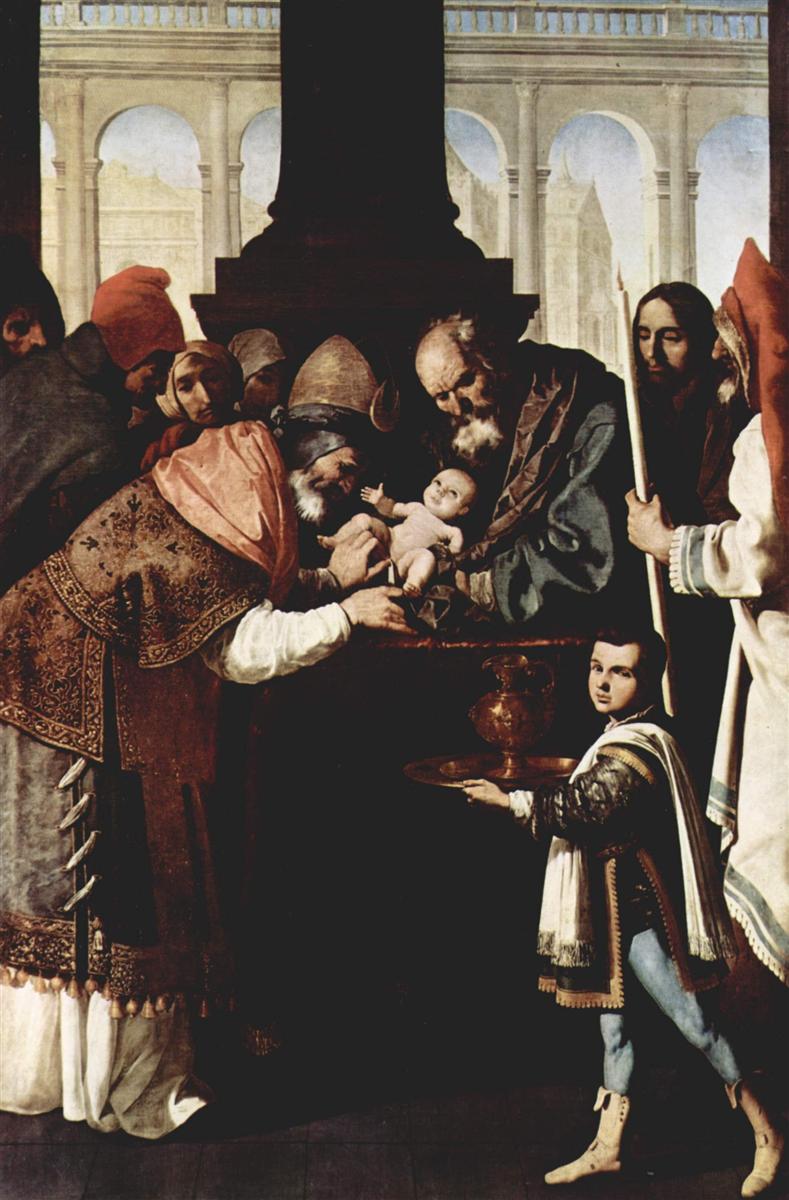
Francisco de Zurbaran’s painting “Monastery of Nuestra Señora de la Defensión at Jerez de la Frontera, Scene: The Circumcision,” created in 1639, brings one of the earliest moments of Christ’s earthly life into the solemn world of seventeenth century Spain. Instead of a distant biblical past, Zurbaran gives us a ceremony that feels immediate and tangible. The small body of the Christ Child is cradled at the center of a tightly packed group of figures. Priests, assistants, and curious onlookers form a living wall around the ritual table where the covenantal act of circumcision is about to take place.
This work belonged to a larger cycle painted for the Carthusian monastery of Nuestra Señora de la Defensión near Jerez de la Frontera, a community that prized silence, austerity, and contemplation. For such monks, images were not mere decoration. They functioned as visual meditations on the mysteries of salvation. In this scene Zurbaran unites narrative storytelling with the sober grandeur that characterizes his religious art, inviting viewers to reflect on the humility of the Incarnation and the first shedding of Christ’s blood.
Historical and Devotional Context
The subject comes from the Gospel of Luke, which recounts that on the eighth day after his birth, Jesus was circumcised and received the name given by the angel. In Jewish tradition circumcision was the sign of the covenant between God and Abraham’s descendants. For Christian theology, the circumcision of Christ marks his full insertion into the people of Israel and foreshadows the Passion, when his blood will be shed for the salvation of the world.
In early modern Spain, images of the Circumcision had strong liturgical connections. The feast of the Circumcision was celebrated on the first of January and often linked to reflections on the Holy Name of Jesus. Monks in a Carthusian monastery would contemplate this scene not only as a historical event, but as an invitation to imitate Christ’s obedience and humility at the very start of the year.
Zurbaran’s painting responds to this devotional need. It offers a detailed, almost theatrical account of the ceremony yet maintains a gravity appropriate to monastic contemplation. The viewer is drawn into the ritual circle, positioned as a quiet witness to an intimate yet theologically charged act.
Composition and Spatial Structure
The composition is dominated by a large architectural pillar rising at the center of the canvas. This pillar divides the distant background into two arcaded vistas, creating a rhythmic succession of arches and sky. Near the base of the pillar Zurbaran situates the main action. The priest in ornate vestments bends over the Christ Child, who lies on a shallow basin or cushion. To the right, an older man, likely St Joseph, supports the infant, while attendants and witnesses cluster around.
By grouping the figures in a semicircle around the baby, Zurbaran forms a visual focus that cannot be missed. Every gaze and gesture converges on the small body of Christ. Even the column, though massive, functions as a kind of visual arrow pointing downward toward the child.
The architecture in the background suggests a grand temple or basilica. Tall arches, classical columns, and open light recall Renaissance ideals but are treated with Baroque clarity. The space recedes convincingly, giving the sense that this ritual takes place in a sacred urban center, perhaps an imagined fusion of the Jerusalem Temple and a Spanish church. This fusion subtly links Old Testament context with contemporary liturgy.
The Christ Child at the Center of the Ritual
At the very heart of the composition lies the tiny figure of the Christ Child. Zurbaran paints him naked, his body luminous against the darker fabrics around him. His arms reach out in a natural infant gesture, suggesting both vulnerability and an almost unconscious offering of himself. His face is calm, without exaggerated suffering, which emphasizes the voluntary, salvific character of the event more than its physical pain.
By stripping the child of garments, Zurbaran emphasizes the humanity of Jesus. This is no ethereal symbol but a real baby subject to a very physical rite. Yet the light that seems to emanate from his skin hints at his divine identity. He is both ordinary and extraordinary, a child like any other and the Son of God entering into the covenant of his people.
The placement of the child on a shallow vessel or basin invites parallel with baptismal fonts and eucharistic vessels. For a seventeenth century viewer, the arrangement would recall the sacramental life of the Church. The infant who bleeds here will later give his body and blood in the Eucharist. Zurbaran compresses these layers of meaning into the small, central form of the baby.
The Priest and the Ritual Action
Leaning over the child is the priest, richly dressed in embroidered vestments that shimmer with gold and reddish tones. His head is covered with a cap, and his bearded face bears an expression of concentration and reverence. One hand steadies the infant while the other approaches the site of circumcision, which Zurbaran suggests without explicit detail.
The priest’s ornate chasuble anchors the left side of the composition with warm color and intricate pattern. The weight and grandeur of his vestments underscore the solemnity of the act. While historically the ritual would have been performed by a Jewish mohel, Zurbaran presents the officiant in garb that would be familiar to his Spanish audience. This anachronism translates the ancient rite into the visual language of Catholic liturgy, reinforcing the continuity between Israel’s covenant and the Church’s sacramental life.
His bent posture forms a diagonal that leads the eye from his head down to the Child. It suggests service more than domination. Though he is the official celebrant, he bows before the mystery he is handling.
Joseph, the Attendants, and the Crowd of Witnesses
To the right of the priest stands an elderly man in simple, dark clothing, likely St Joseph. His posture curves protectively over the infant as he supports the Child’s head and shoulders. His lined face, lit from the left, expresses tenderness and concern. Joseph’s clothing is markedly more modest than the priest’s, reminding viewers of his humble status as a carpenter and guardian. Yet his physical proximity to Jesus signals his singular role in the divine plan.
Behind and around these central figures crowd a variety of onlookers. Some are wrapped in dark cloaks, others in red caps or veils. Their faces display curiosity, piety, or quiet interest. One woman in the left middle ground peers out from under a hood, her gaze meeting the viewer’s with an almost questioning look. She acts as a mediating figure between the sacred action and the outside world, inviting the observer to join the circle of contemplation.
These witnesses transform the painting into a communal event. The Circumcision is not a private family moment but a public ritual of the covenant community. By populating the scene with varied types and ages, Zurbaran underscores that Christ’s entry into the covenant concerns all of Israel, and by extension, the entire Church.
The Young Acolyte and the Vessel of Blood
At the lower right, a boy steps into the foreground carrying a metal basin containing a gleaming vessel. His clothing is highly detailed, with a white cloth draped over his shoulders and elaborate trim along the borders. His right leg is advanced, suggesting motion, while his head turns back toward the infant with an expression of attentive service.
This young acolyte plays several roles. Practically, he is there to collect the blood of the circumcision or to assist with washing. Symbolically, he represents the next generation of believers who will carry forward the memory of Christ’s sacrifice. His youth and elegance contrast with the rougher, older faces behind him, suggesting continuity across time.
Because he occupies the front edge of the painting, the acolyte also connects the viewer to the ritual space. Standing almost at our level, he appears to move out of the picture plane toward us, carrying the vessel that will soon hold the covenantal blood. This subtle device invites viewers to understand themselves as recipients of the grace that flows from Christ’s first voluntary suffering.
Light, Color, and Texture
Zurbaran is celebrated for his mastery of light and fabric, and this painting offers a rich example of both. A cool, clear light enters from the left, striking the priest’s vestments, the faces of the central group, and the exposed skin of the Christ Child. The right side of the composition sinks into deeper shadow, where only select details like the acolyte’s face or the vertical candle catch the light.
The contrast of light and darkness emphasizes the sacramental center. The baby, the priest’s hands, and Joseph’s face are the brightest elements, reinforcing their importance. The massive column behind them is relatively dark, allowing the figures to stand out in relief.
Color is handled with subtle harmony. Warm reds, browns, and golds dominate the clothing, while the architecture is painted in cool grays and pale blues. The flesh tones are soft and natural. The overall effect is serious yet not gloomy. The painting suggests a sacred interior illuminated by daylight, a space where earthly ceremony meets divine significance.
Zurbaran’s attention to texture is evident in the embroidered patterns on the priest’s chasuble, the gleam of the metal basin, the coarse wool of cloaks, and the smooth skin of the child. These tactile details ground the scene in reality, making the theological mystery palpable through the senses.
Architectural Background and Theological Space
The grand architectural setting does more than provide perspective; it frames the event within a symbolic space. The open arches behind the figures suggest that the temple ceremony is open to the world. Through these arches we glimpse a distant cityscape flooded with light, perhaps an imagined Jerusalem, perhaps a Spanish city.
This openness implies that Christ’s covenant with Israel is not confined to the interior of the temple but destined to radiate outward. The repeated arches echo the rhythm of liturgical processions and the structure of monastic cloisters, tying the biblical event to the architecture of the Carthusian monastery where the painting originally hung.
The central column functions as a visual axis linking heaven and earth. Rising from the level of the circumcision table to the unseen heights above the frame, it suggests stability and permanence. One might read it as a symbol of Christ himself, the pillar of the Church, or as an allusion to the Temple’s architectural perfection, now fulfilled in the incarnate Son.
Emotional Tone and Spiritual Message
Despite the physical nature of the ritual, the emotional tone of the painting is remarkably restrained. There is no dramatic expression of pain or shock. Instead, the atmosphere is one of sober attentiveness. The faces around the child show concern and reverence rather than agitation.
This tone reflects the theological understanding that the circumcision, though involving suffering, is an act of obedience and integration into God’s plan. The painting does not dwell on the child’s discomfort but on the reverent care with which the community carries out the rite.
For monastic viewers, this would have provided a model of how to approach their own spiritual disciplines. Just as Christ submits in silence to the covenantal sign, so the monk is called to accept the demands of obedience, asceticism, and prayer. The scene becomes an invitation to renew one’s own covenant with God at the threshold of the new year.
Zurbaran’s Artistic Achievement
“Monastery of Nuestra Señora de la Defensión at Jerez de la Frontera, Scene: The Circumcision” demonstrates Zurbaran’s ability to handle complex narrative scenes with the same clarity and spiritual weight that characterize his single figure saints. He balances a large group of figures, detailed architecture, and symbolic objects while maintaining a strong central focus.
His integration of contemporary liturgical elements into a biblical subject shows how Spanish Baroque art bridged past and present, making the mysteries of Christ’s life feel close to the viewers’ own worship. The painting embodies the Carthusian ideal of contemplation informed by scripture and sacrament, inviting long, prayerful looking.
The blend of realism and symbolism, the careful orchestration of light, and the emotional restraint all mark this work as a mature achievement in Zurbaran’s career. It stands as a testament to his capacity to convey theological depth through the quiet intensity of human gestures and the glow of ordinary objects used in extraordinary ways.
Conclusion The First Shedding of Christ’s Blood
In this scene of the Circumcision, Francisco de Zurbaran presents more than a narrative from the infancy of Jesus. He offers a visual meditation on the beginning of Christ’s redemptive journey and on the intimate bond between Old Testament covenant and the sacramental life of the Church. At the center, the vulnerable yet radiant body of the Christ Child is surrounded by hands that serve, faces that contemplate, and architecture that situates the event within a grand, sacred order.
The painting invites viewers to stand alongside the young acolyte, witnessing the first drops of blood that anticipate the Passion. Its solemn beauty, rich textures, and layered symbolism encourage a slow, reflective engagement, making it a fitting image for a monastic setting and a powerful work for modern audiences seeking to understand Baroque spirituality. In Zurbaran’s hands, the Circumcision becomes a doorway into the mystery of a God who enters human history through humility, ritual, and community, so that a new covenant might extend to the ends of the earth.