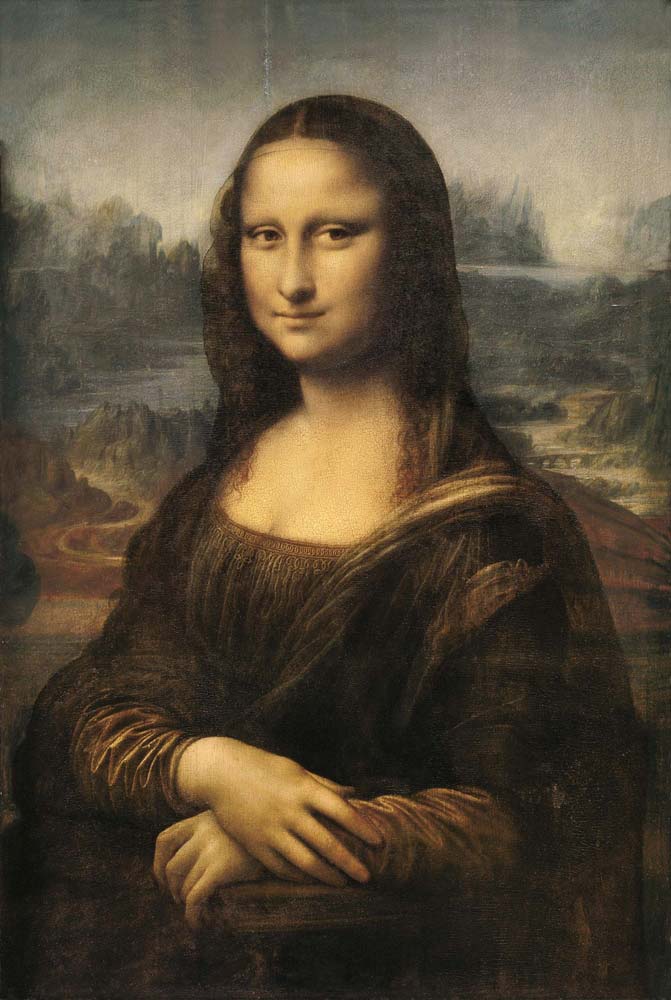
Image source: wikiart.org
Introduction
Leonardo da Vinci’s Mona Lisa is one of the most discussed paintings in the history of art, yet its power does not come from size, spectacle, or obvious drama. It comes from control. At first glance, the work seems calm, restrained, and even simple. A woman sits before a distant landscape, her hands folded, her body turned slightly toward the viewer. There are no crowns, no elaborate symbols announcing rank, and no crowded narrative scene. The painting does not depend on grand action. Instead, Leonardo creates an image that feels alive because every part of it seems to breathe, shift, and withhold a final answer.
This is one reason the Mona Lisa has remained so compelling for centuries. It does not reveal itself all at once. The portrait invites long looking. The famous smile, the softness of the face, the quiet intelligence in the eyes, and the dreamlike landscape all create an impression that feels both intimate and elusive. Viewers feel that they are close to the sitter, yet never fully certain they know her. That tension between familiarity and mystery is central to the painting’s lasting appeal.
Created by Leonardo da Vinci and associated with 1519, the final year of the artist’s life, the Mona Lisa stands as a summary of many of his greatest strengths. It shows his fascination with anatomy, optics, atmosphere, emotion, and the subtle mechanics of human expression. It is not simply a portrait of a woman. It is a painting about perception itself, about how the eye moves, how the mind interprets a face, and how art can create a presence that feels almost more vivid than life.
The painting also occupies a unique place within Renaissance art. Many portraits from the period are remarkable for their skill, elegance, and symbolic detail, but Leonardo’s achievement goes beyond representation. He transforms portraiture into a psychological and almost philosophical form. The sitter is not reduced to status or costume. She becomes a thinking, feeling presence suspended between the material world and the realm of imagination. This is why the Mona Lisa continues to inspire viewers, writers, historians, and artists across generations.
Historical Context and Renaissance Ideals
To understand the Mona Lisa, it is important to place it within the world of the High Renaissance. This was a period in which artists sought harmony, balance, naturalism, and intellectual depth. Leonardo was one of the defining figures of this era because he believed painting was not merely craft but a form of knowledge. He studied the body, the movement of water, the effects of light, and the structure of the natural world. These interests shaped the way he painted and allowed him to create works that feel intensely observed but never mechanical.
The Mona Lisa reflects Renaissance humanism in a profound way. Humanism encouraged attention to individual character, the dignity of the person, and the connection between the visible world and deeper truths. In this portrait, the sitter is presented not as a decorative object but as an individual with inward life. Her calm expression suggests intelligence and self-possession. She is not overwhelmed by jewels or theatrical attributes. Instead, Leonardo gives importance to her presence, making her mind and character feel more significant than external display.
This was a major development in portrait painting. Earlier portraits often stressed social status, family identity, or courtly refinement through costume, profile pose, and symbolic detail. Leonardo moves toward something more inward. He brings the sitter closer to the viewer and places her in a three-quarter pose that creates a more natural sense of encounter. She seems available to our gaze, but not fully accessible. The result is a portrait that feels personal without becoming ordinary.
The historical importance of the Mona Lisa also lies in its synthesis of observation and invention. Leonardo was deeply attentive to nature, but he was never content simply to copy appearances. He reshaped them into a more complete artistic truth. The portrait is realistic in its anatomy, light, and texture, yet it is also idealized. The face is specific enough to feel individual, but generalized enough to become universal. This balance helps explain why the painting has spoken to so many viewers across cultures and centuries.
Composition and the Quiet Power of Balance
One of the most remarkable features of the Mona Lisa is its compositional clarity. Leonardo organizes the portrait with extraordinary calm. The sitter is placed in a stable pyramidal arrangement, with her head at the apex and her folded hands forming the broad base. This structure gives the painting order and permanence. It also helps explain why the image feels so settled, even when its emotional meaning remains uncertain.
The composition guides the eye with subtle intelligence. We first notice the face, then the hands, then the movement of the body, and finally the receding landscape behind her. Nothing feels abrupt. Leonardo makes transitions seem natural, as though the painting unfolds at the pace of thought. This sense of measured harmony is essential to the portrait’s effect. The composition does not distract from the sitter. It serves as a framework that stabilizes her presence and allows expression to take center stage.
The three-quarter pose is especially important. It creates a stronger psychological connection than a strict profile view, because it makes the sitter appear present in our space. Her torso turns slightly, her head faces the viewer, and her gaze meets us with unusual directness. This combination of movement and stillness gives the portrait life. She is seated calmly, yet she does not appear frozen. She seems to have just turned toward us, as if a conversation might begin at any moment.
Leonardo also understands the emotional effect of restraint. There is no excess in the composition. The background is complex but distant. The costume is modest. The color relationships are subdued. This allows the smallest details, such as the curve of the mouth or the softness around the eyes, to become intensely meaningful. The painting proves that visual power does not depend on abundance. It can come from precision, control, and the careful placement of every form.
The Face and the Mystery of Expression
The face of the Mona Lisa is the center of the painting’s fascination. Many portraits show beauty, confidence, or status, but Leonardo’s portrait seems to register thought itself. The sitter’s expression is unstable in the most productive sense. It changes according to distance, lighting, and the viewer’s own attention. At times she appears serene, at times amused, at times distant, and at times almost melancholy. This shifting quality is one of the great achievements of the work.
The famous smile is not a simple expression of happiness. It is delicate, partial, and difficult to fix. Leonardo avoids sharp outlines around the mouth, allowing the corners to dissolve gently into shadow. Because of this, the smile feels alive rather than fixed. It seems to emerge and disappear. The viewer is drawn into a cycle of looking and reinterpreting, which creates the sense that the painting responds to us. This is part of its enduring psychological force.
Her eyes are equally important. They do not stare aggressively, nor do they retreat. Instead, they maintain a quiet engagement with the viewer. Leonardo creates the impression that she sees us, but also that she exists in her own inward world. This duality gives the portrait unusual depth. She is present and remote at once. The tension between outward contact and inner reserve is what makes the image feel inexhaustible.
The softness of the face also contributes to its effect. Leonardo avoids harsh contrasts and instead models the flesh through gradual transitions of light and shadow. This makes the face appear organic, almost atmospheric, as though it belongs to the same living continuum as the air around it. The expression is not painted as a mask placed on the features. It seems to grow naturally from the entire structure of the face. That integration is one reason the portrait feels more lifelike than many technically accurate images.
Hands, Posture, and the Language of Restraint
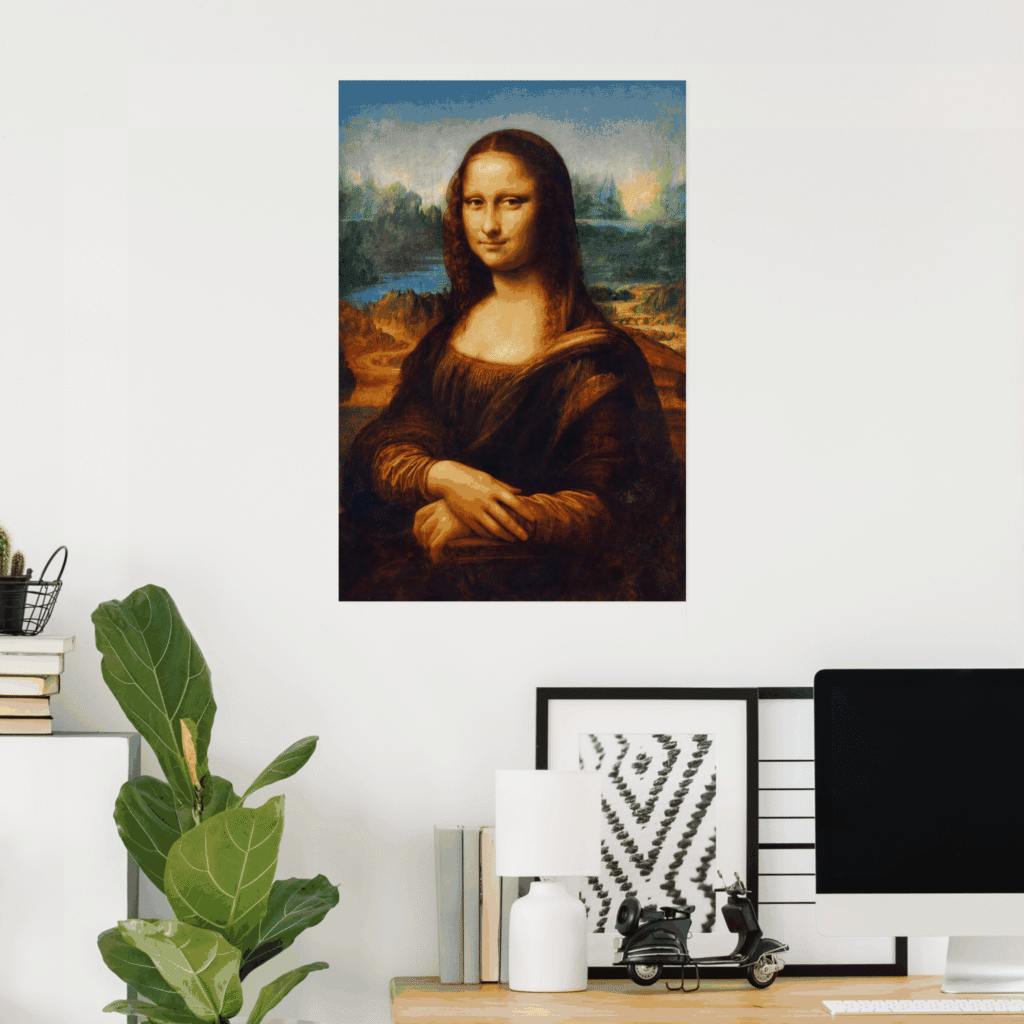
The hands of the Mona Lisa are often overshadowed by the face, but they are crucial to the painting’s success. Leonardo paints them with the same care and subtlety he gives to the sitter’s features. Resting one over the other, they communicate composure, grace, and self-control. There is no tension in the gesture. The hands are relaxed, poised, and dignified, reinforcing the calm authority of the sitter.
In Renaissance portraiture, hands could carry great expressive significance. They might hold symbolic objects, indicate virtue, or reveal social role. In the Mona Lisa, Leonardo chooses simplicity. The hands do not display wealth or activity. Instead, they echo the calm balance of the composition and deepen the sense of interior stillness. Their placement helps anchor the portrait physically while the face and atmosphere invite more psychological interpretation.
The posture is equally significant. The sitter sits upright but not rigidly. Her body turns gently, creating a rhythm that feels natural and fluid. Leonardo avoids stiffness, and this helps the figure feel alive. She does not pose like an emblem. She occupies space with ease. This naturalness is one of the painting’s quiet revolutions. It presents dignity without formality becoming oppressive.
Together, the hands and posture contribute to the portrait’s emotional tone. They suggest restraint, intelligence, and self-possession. Nothing in the figure is exaggerated. Leonardo trusts that small adjustments in gesture can communicate deep character. This is one reason the Mona Lisa feels so modern. It understands that personality is often expressed through subtleties rather than grand signs.
The Landscape and the World Beyond the Figure
Behind the sitter stretches one of the most extraordinary landscapes in Renaissance painting. It is not merely a backdrop. It expands the meaning of the portrait and gives the image a cosmic dimension. The winding paths, distant waters, rocky formations, and atmospheric haze create a world that feels ancient, mysterious, and almost primordial. This setting does not locate the sitter in a simple social environment. Instead, it places her before a vast and shifting vision of nature.
The contrast between figure and landscape is one of the painting’s deepest tensions. The sitter is calm, stable, and contained. The world behind her seems remote, changing, and difficult to measure. Yet Leonardo unites them through atmosphere and tonal harmony. The soft modeling of the face relates to the misty transitions in the distance. Human presence and natural world are linked through the same visual logic.
This connection reflects Leonardo’s broader interests. He saw the human being as part of nature rather than separate from it. The Mona Lisa expresses that idea visually. The sitter does not appear isolated from the landscape. She seems mysteriously in tune with it. Her calm expression and the flowing forms behind her suggest a shared order, as though inner life and outer world mirror one another in subtle ways.
The landscape also contributes to the painting’s aura of mystery. Its geography is not straightforward. The space feels believable, yet also dreamlike. Roads lead nowhere clearly defined. Water winds into distance. Horizons shift. This ambiguity heightens the sense that the portrait exists between reality and imagination. The background becomes a visual equivalent of the sitter’s expression: rich, suggestive, and never fully settled.
Leonardo’s Technique and the Art of Sfumato
A major reason the Mona Lisa feels so alive is Leonardo’s technical mastery. His use of sfumato is especially important. This technique involves soft, smoky transitions between tones, avoiding sharp edges and abrupt outlines. In the Mona Lisa, sfumato allows the forms to emerge gradually from shadow and light. The result is a surface that feels atmospheric, subtle, and deeply natural.
Sfumato is not merely a stylistic effect. It serves Leonardo’s larger artistic aims. Human perception does not usually encounter the world as a series of hard edges. Instead, forms shift gently into one another through changing light and air. By painting in this way, Leonardo creates a more convincing illusion of life. The flesh appears soft, the expression seems mobile, and the entire image takes on a sense of breathing continuity.
This method is particularly effective in the face. The areas around the eyes and mouth are modeled with such delicacy that expression appears unstable and living. Tiny transitions in shadow create emotional complexity. Rather than describing each feature with linear certainty, Leonardo lets vision do some of the work. The viewer completes what is suggested rather than fully stated. That active role in perception helps explain the painting’s unusual hold on the imagination.
Leonardo’s technique also reveals his patience and intellectual seriousness. The Mona Lisa does not look hurried or decorative. It looks studied, refined, and continuously adjusted. Every passage seems considered in relation to the whole. The painting is therefore not just a portrait but a demonstration of what painting can achieve when it becomes a science of seeing joined to poetic invention.
Identity, Symbolism, and the Question of Meaning
Part of the fascination of the Mona Lisa lies in the question of who the sitter is, but the painting’s deeper power comes from the fact that identity alone does not exhaust its meaning. Even if the sitter is understood historically, Leonardo presents her in a way that exceeds biography. She becomes both an individual and a type of ideal human presence. This is why the painting can feel intimate and universal at the same time.
The symbolism of the portrait is subtle rather than explicit. There are no oversized emblems, no obvious attributes demanding interpretation. Instead, meaning emerges from relationships between figure, gesture, expression, and landscape. The calm face, folded hands, and distant world behind her all contribute to the impression of harmony joined to mystery. The painting suggests inner life without translating it into a simple message.
Some of the portrait’s greatness comes from this refusal to become too easily legible. Leonardo allows ambiguity to remain. The sitter’s smile is not explained. The landscape is not fully identified. The emotional tone is not fixed. This openness keeps the painting alive for viewers because it makes interpretation an ongoing act. Each generation sees something slightly different in the work, yet the painting remains recognizably itself.
The Mona Lisa also symbolizes the power of painting to preserve more than likeness. It preserves presence. Leonardo does not merely show how the sitter looked. He creates the feeling that she continues to exist before us. That achievement touches on one of the oldest ambitions of portraiture, but here it is realized with unusual subtlety and depth.
Why the Mona Lisa Still Captivates the World
The Mona Lisa remains one of the most celebrated paintings in the world because it combines technical brilliance with emotional complexity in an almost perfect balance. It rewards quick recognition, but it also rewards patient study. A viewer can be struck immediately by its calm beauty, yet return repeatedly to its ambiguities and find something new each time. Few paintings sustain that level of repeated attention.
Its fame has, in some ways, become part of its meaning. The painting is no longer only a Renaissance portrait. It is also a cultural icon. Yet even when separated from the myths and reproductions that surround it, the work itself retains extraordinary force. Its reputation would not have lasted if the image were not genuinely powerful. The fame survives because the painting continues to justify it.
One reason for this endurance is that the Mona Lisa speaks to very fundamental human experiences. It explores how we read faces, how we respond to ambiguity, and how we search for inner life in another person. The portrait does not tell us what to think. It invites us into the act of looking. That invitation remains as compelling now as it was centuries ago.
Leonardo da Vinci created many works of immense importance, but the Mona Lisa occupies a special place because it brings together so many dimensions of his genius. It is scientifically observant, emotionally rich, technically refined, and philosophically suggestive. It turns a portrait into an encounter and a painted surface into a living presence.
Conclusion
The Mona Lisa endures because it is far more than a famous image. It is a profound meditation on humanity, perception, and artistic possibility. Leonardo da Vinci takes the familiar genre of portraiture and transforms it into something deeper and more searching. Through subtle composition, atmospheric technique, psychological complexity, and a haunting relationship between figure and landscape, he creates a work that seems permanently alive.
What makes the painting unforgettable is not one isolated feature, not only the smile, the eyes, or the landscape, but the harmony of all its parts. Everything contributes to the same effect of poised mystery. The sitter feels near, yet unreachable. The world behind her feels vast, yet intimately connected to her presence. The image is calm, but never static. It continues to move in the mind long after one has looked away.
That is the true achievement of the Mona Lisa. It does not simply present a woman from the Renaissance. It presents the act of seeing another human being as something complex, beautiful, and ultimately inexhaustible. This is why Leonardo’s masterpiece remains central to the history of art and why it continues to fascinate viewers around the world. The painting does not give up its meaning in a single glance. It asks us to return, to look again, and to recognize that great art often lives in what it suggests rather than what it fully explains.