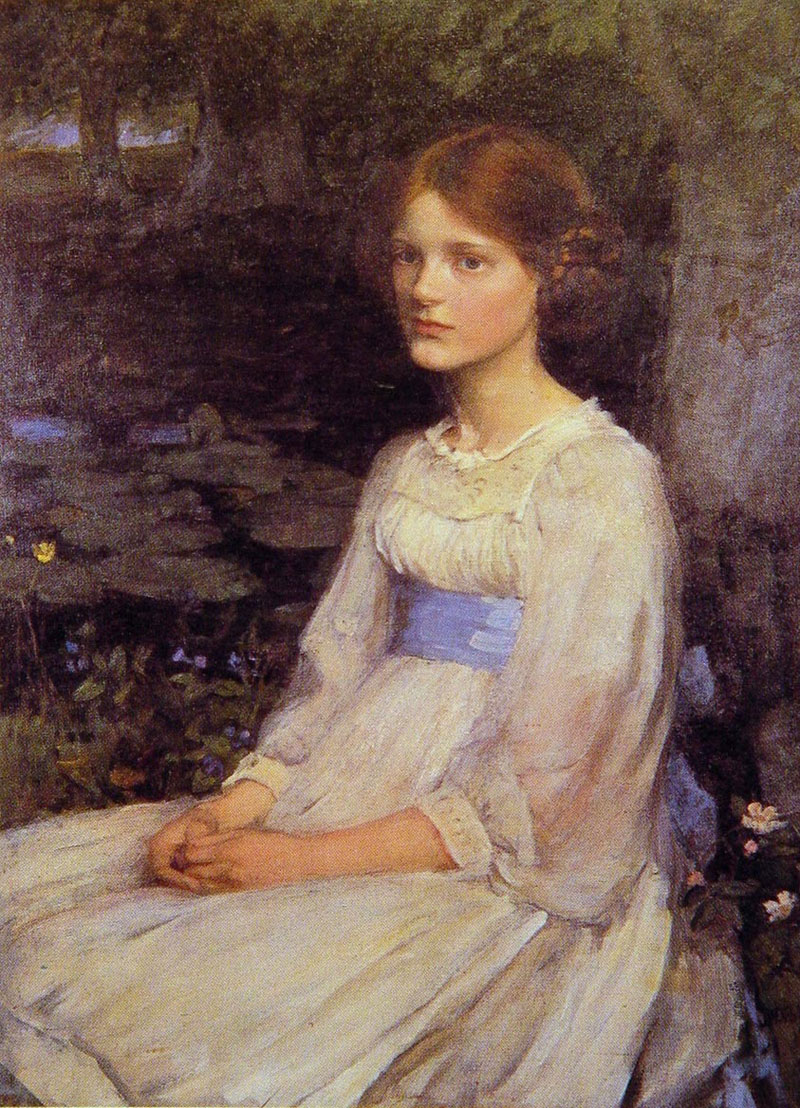
Image source: wikiart.org
An Intimate Portrait at the Edge of a Dream
John William Waterhouse’s Miss Betty Pollock (1911) belongs to the quieter, more intimate side of his late work, where narrative spectacle gives way to suspended feeling. Instead of myth, literature, or theatrical incident, Waterhouse offers a single figure and a modest outdoor setting. Yet the painting does not feel small. Its power comes from how carefully the artist calibrates mood, placing a young woman in a space that seems both real and gently removed from everyday life.
At first glance, the subject appears simply posed, seated near a stream beneath trees, her hands folded, her white dress catching the softest light. But as the eye adjusts, the image reveals a subtle drama of attention. The sitter’s gaze is directed outward, not fully meeting us, not fully lost in thought, occupying an in between state that invites interpretation. Waterhouse builds the portrait less around social identity than around inward presence. The title provides a name, but the painting’s true subject is a particular atmosphere of youth, stillness, and private consciousness.
Composition and the Language of Stillness
The composition is structured around a gentle diagonal that begins in the sitter’s face and descends through her torso to her folded hands, then out into the pale sweep of her skirt. This downward movement feels like a slow exhale. Waterhouse avoids sharp angles and assertive geometry. Instead, he creates a visual lull, a quiet rhythm that matches the sitter’s restrained pose.
The figure is placed slightly to the right, anchored by the vertical presence of a tree trunk. That trunk functions like a soft frame, holding her in place and preventing the scene from drifting into pure decorative blur. To the left, the stream opens a darker, cooler passage into space, drawing the viewer away from the sitter and then back again. This interplay between figure and setting creates the sensation that she belongs to the landscape without being swallowed by it.
Waterhouse also uses containment to heighten intimacy. The background does not expand into a wide vista; it stays close, almost enclosing her. The space feels sheltered, like a secluded bank where sound is muffled by foliage and water. In that quiet enclosure, the sitter’s calm becomes the painting’s central event.
Color Harmony and a Late Waterhouse Palette
The color scheme is restrained, weighted toward soft whites, earthy browns, mossy greens, and violet shadows. The most striking chromatic accent is the blue sash at the sitter’s waist, which interrupts the neutrality of the dress with a cool, clarifying note. That blue does not shout, but it organizes the image. It helps define the figure’s structure and keeps the whiteness from dissolving into the surrounding light.
The whites of the dress are not pure. They are stained with warm undertones and lilac grays, suggesting fabric that absorbs ambient color rather than reflecting a studio spotlight. This approach gives the clothing a lived, tactile quality. It also reinforces the sense that we are looking at a moment outdoors, where light is filtered through leaves and the world’s colors mingle on every surface.
Waterhouse’s greens are notably subdued. They are not bright spring greens but deeper, shadowed tones, with hints of olive and brown. This choice pushes the painting toward reverie. The landscape feels more like memory than immediate sensation. Even the water surface reads as dark and reflective, broken by pale lily pads and small, quiet blossoms that flicker like thoughts.
Light as Atmosphere Rather Than Spotlight
Light in Miss Betty Pollock is diffuse and atmospheric. It does not arrive as a single direction that casts crisp shadows; it seems to drift through the foliage and settle gently on the sitter’s face and sleeves. This type of light is crucial to the painting’s emotional effect. It makes the scene feel hushed, as if time has slowed.
The brightest area is the figure’s upper body and face, but Waterhouse keeps the highlights soft. There is no harsh glare on the forehead or cheekbones. Instead, the modeling of the face is smooth, with delicate transitions that preserve youthfulness without becoming sugary. The sitter appears illuminated from within as much as from outside, a common effect in Waterhouse’s portraits where emotional tone is carried by luminous skin and muted contours.
The dress functions as a reflector, catching and spreading that light into the lower half of the canvas. The skirt becomes a field of pale tones that balances the darker bank and stream behind her. This contrast makes the figure feel present and substantial while preserving the overall softness of the scene.
The Sitter’s Expression and the Psychology of Quiet
The most compelling feature of the painting is the sitter’s expression. Waterhouse paints her gaze with restraint: calm, slightly distant, and not easily categorized as happy or sad. The corners of the mouth are relaxed, neither smiling nor frowning. The eyes suggest alertness without urgency. This ambiguity is intentional. It creates a psychological openness that invites the viewer to project a story, while the painting itself refuses to confirm any single narrative.
Her posture reinforces this emotional ambiguity. She sits with composed dignity, hands folded in a gesture that reads as polite and self contained. Yet there is a softness to the pose that prevents it from feeling stiff. The hands rest naturally, with a gentle interlocking that suggests patience rather than tension. The body is turned slightly, giving the sense that she has paused mid walk or mid thought, as if she chose this spot for a brief retreat.
Waterhouse’s handling of the face is also key. He avoids excessive detail that would fix the sitter into a specific social role. Instead, he aims for a portrait of presence. The sitter feels like a person encountered in a moment of quiet, not a symbol parading as a person. That balance between individuality and poetic generality is part of what makes the painting linger in the mind.
Hair, Fabric, and the Craft of Surface
Waterhouse was a master of describing texture without overworking it, and this painting showcases that skill in a subdued register. The sitter’s auburn hair is gathered and braided, with a softness that contrasts the more uniform planes of the dress. The hair is not rendered strand by strand, but through tonal masses and subtle highlights that suggest sheen and volume. The warm color of the hair becomes an important counterpoint to the cool greens and grays behind it.
The dress is painted with a similar economy. The sleeves are sheer enough to imply lightness, yet solid enough to feel like fabric. Waterhouse conveys the dress’s structure through gentle shadow bands and faint crease patterns, letting the viewer sense the weight and drape without turning the painting into a catalog of folds.
The lace or delicate trim near the neckline is treated as a whisper of detail. It indicates refinement, but it does not become the point. This keeps attention where Waterhouse wants it: on the face, the gesture of the hands, and the overall mood of the scene.
The Landscape as Emotional Setting
The natural setting is not mere decoration. It acts as an emotional echo for the sitter’s interior state. The dark water behind her reads like a reflective mirror, an invitation to introspection. The lily pads and small flowers introduce a quiet liveliness, a sense of life continuing at a slower pace.
The trees and shadowed bank create a protective enclosure. The sitter appears sheltered, as if the world beyond the grove is kept at bay. This enclosure can be read as comfort or as separation. Waterhouse leaves that open. The scene offers solitude, but not isolation. Nature is close, active, and present, yet it does not demand anything from the figure.
There is also a sense of transition in the way the background recedes. The landscape becomes softer and more indistinct as it moves upward, dissolving into atmosphere. This dissolution suggests that the painting is less concerned with topographical accuracy than with the feeling of being outdoors at a particular hour, when edges blur and sound seems far away.
Symbolism Without Overt Allegory
Waterhouse is often associated with overt storytelling, especially in his paintings of mythological heroines and literary scenes. Here, symbolism is quieter. The stream and lilies can imply purity, fleeting time, or the flow of inner life, but the painting does not force such readings. Instead, it uses familiar natural motifs to create a poetic tone.
The white dress, with its soft volume and luminous presence, suggests innocence and youth, but it also acts as a painterly device, a light catching surface that makes the figure feel like the calm center of a darker world. The blue sash introduces a note of clarity, almost like a calm breath in the middle of muted tones. It can be read as a simple fashion detail, but it also helps the sitter feel gently distinguished from the earth around her.
The tree trunk at her side has its own quiet resonance. Trees often symbolize endurance or rootedness, but here it functions more like a companion form, steadying the scene. It gives the sitter a place within the environment, a vertical anchor beside her softer, horizontal pose.
Waterhouse in 1911 and the Late Style
By 1911, Waterhouse had moved into a late phase marked by increased softness, looser edges, and a preference for mood over intricate narrative. The brushwork in Miss Betty Pollock suggests this shift. Forms are present, but they often melt into their surroundings. The background foliage is suggested through tonal sweeps rather than tight leaf description. The water is dark and simplified, allowing the lily pads to register as shapes more than botanical study.
This painterly softness does not indicate carelessness. It reflects a deliberate emphasis on atmosphere and emotion. Waterhouse’s late works frequently create the impression of a remembered scene, the way memory compresses detail while preserving feeling. In that sense, Miss Betty Pollock functions like a portrait of a moment rather than a portrait of status.
The painting also shows Waterhouse’s ability to blend portraiture with the poetic sensibility of his figure subjects. Even without overt myth, the sitter retains a lyrical aura. She feels placed in a world that is slightly heightened, as if the ordinary has been gently refined into something closer to song.
Viewer Relationship and the Ethics of Looking
One of the most interesting aspects of this portrait is how it manages the relationship between viewer and sitter. The sitter is not posed as an object of spectacle. Her gaze is steady but reserved, granting the viewer access while maintaining personal distance. That distance is part of the painting’s dignity.
Waterhouse encourages a slower kind of looking. Because there is no dramatic action, the viewer begins to notice subtleties: the temperature shift between the warm skin tones and cool shadows, the soft contrast between hair and background, the slight turn of the shoulders, the way the dress gathers in quiet folds. The painting rewards patience, mirroring the sitter’s own composed stillness.
This dynamic also shapes interpretation. The sitter seems to exist independently of the viewer’s attention. She is not performing. She is simply present. That sense of independent presence is often what distinguishes a truly affecting portrait from a merely pretty one.
Themes of Youth, Pause, and Unspoken Narrative
Miss Betty Pollock can be understood as a painting about pause. It captures a moment that feels suspended between activities, perhaps between childhood and adulthood, perhaps between thought and speech. The sitter’s calm suggests a life not yet crowded by urgency. Yet her expression also hints at awareness, as if she is already beginning to sense complexity beyond the sheltered bank.
Waterhouse does not impose a moral lesson or a clear storyline. Instead, he paints the emotional texture of a quiet moment. That is why the setting matters so much. The stream suggests time moving on, while the sitter remains still. The flowers suggest life’s small continuities, while her gaze suggests a mind that has drifted elsewhere.
This balance between movement and stillness gives the painting its gentle tension. The viewer feels the world flowing around her, yet she holds her position, composed and self contained. The effect is tender, reflective, and faintly wistful.
Why the Painting Endures
The lasting appeal of Miss Betty Pollock lies in its combination of intimacy and mystery. It is immediately accessible as a portrait of a young woman in nature, but it resists complete explanation. Its softness is not vagueness; it is a carefully composed atmosphere that keeps the sitter’s inner life private.
Waterhouse’s technical choices serve this purpose. The restrained palette, diffuse light, softened edges, and balanced composition all contribute to a mood of quiet contemplation. The figure feels both close and slightly unreachable, as if we have stumbled upon a private pause and have been allowed to witness it only briefly.
In a career filled with dramatic heroines and richly staged scenes, this portrait stands out for its understatement. It suggests that Waterhouse’s imagination did not require myth to be poetic. Sometimes a shaded stream, a pale dress, and a steady gaze were enough to create a world.