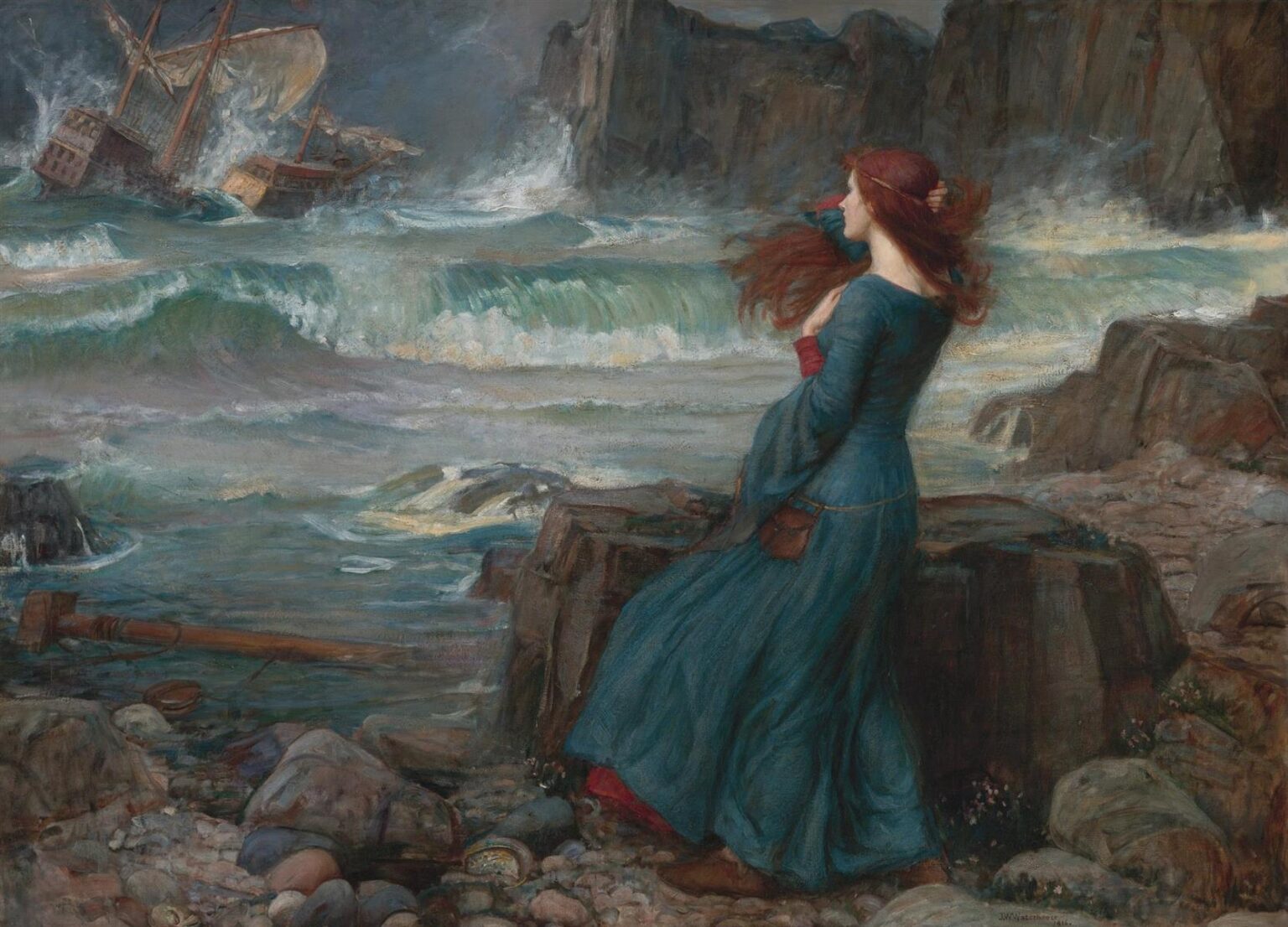
Image source: wikiart.org
First Impressions and the Scene’s Emotional Temperature
John William Waterhouse’s “Miranda” (1916) drops you into a coastline that feels alive with noise, spray, and dread. The painting is built around a single human figure, but it is the sea that sets the mood. Waves rise and fold with heavy force, throwing pale foam across a cold, green-grey surface. Farther back, a ship pitches at a dangerous angle, its masts and rigging skewed as if the whole structure is being twisted by wind and water. The cliffs behind it loom like a wall, dark and indifferent. This is not a decorative seascape. It is a moment of crisis held in suspension.
Miranda stands on the rocky shore as the storm plays out in front of her. Her pose is tense, protective, and intensely watchful. Waterhouse frames her as a witness rather than a participant, and that distance becomes part of the drama. She cannot reach the ship, cannot calm the sea, cannot alter what is happening, yet the painting insists that her feeling matters. The result is a work that turns spectacle into empathy, using the storm as a stage for the inner life of a character.
Miranda and Shakespeare’s “The Tempest”
The title points directly to Miranda from Shakespeare’s “The Tempest.” In the play, Miranda watches a shipwreck she believes is real, stirred by fear and compassion for those at sea. Waterhouse chooses a viewpoint that matches that emotional situation: the shore as a threshold, the sea as a violent barrier, and the heroine as the moral center. Even without any other characters present, the narrative is legible because it is anchored in her gaze.
Waterhouse emphasizes Miranda’s humanity through restraint. She is not theatrical in the sense of exaggerated gesture; instead, she appears braced against the wind, arms drawn inward, as if trying to steady herself. Her head turns toward the ship, and her attention seems fixed on the point where the vessel is failing. In Shakespeare, Miranda’s defining quality is her compassion, her instinctive response to suffering she cannot fully understand. The painting translates that compassion into posture and placement. She occupies the safest ground in the image, yet her expression and stance imply she is emotionally out at sea with the doomed crew.
The story behind the scene adds another layer. In “The Tempest,” the storm is conjured by Prospero, a controlled act with a purpose. Waterhouse, however, paints the storm as if it is nature at its most physical and frightening. That tension between the character’s innocence and the world’s violence is part of the painting’s charge. Miranda reads as sincere and vulnerable, and the sea reads as unstoppable.
Composition, Movement, and the Direction of the Wind
Waterhouse builds the composition on sweeping diagonals that mimic gusts and waves. The ship leans, the breakers roll in bands, and the cliffs cut across the horizon with blunt weight. Miranda is placed to the right, close to the foreground, which gives her presence and clarity. But she is not centered, and that matters. The space to her left is a broad arena of water and danger. By giving the storm more room than the figure, Waterhouse ensures that the environment dominates, making Miranda’s fragility and courage more visible.
Movement travels through the painting in a few linked pathways. One path runs from the ship down through the line of waves and into the shore, where the surf thins into shallow water. Another path is created by Miranda’s hair and dress, both pulled by wind. Those streaming strands and folds are not only decorative. They act like arrows pointing toward the ship, visually connecting Miranda to the disaster. Waterhouse uses the wind as an invisible force that touches everything, from rigging to fabric to foam.
Foreground detail supports the same logic. The beach is littered with rocks and what looks like debris, suggesting that the shore is not merely a viewpoint but a receiving place for wreckage. These objects keep the viewer low and close to the ground, which heightens the sensation of standing there with Miranda, close enough to feel spray, close enough to imagine the roar of water.
Color, Light, and the Storm Palette
The color scheme is controlled and atmospheric, dominated by marine greens, slate blues, smoky greys, and earth browns. Waterhouse avoids bright sunlight; instead, the light feels filtered, as if clouds are thick overhead. Foam and breaking water provide the strongest highlights, and those pale accents flicker across the surface like brief flashes. The ship, partially lit, appears caught between visibility and disappearance, its pale sail and hull emerging from the gloom only to be swallowed again by mist.
Miranda’s clothing becomes the painting’s most stable block of color. Her dress sits in the blue-green family, harmonizing with the sea but remaining distinct through deeper value and calmer texture. Waterhouse often uses rich garments to give his heroines a kind of visual dignity, and here the dress functions like a quiet anchor amid turbulence. The red tones in Miranda’s hair and hints of warmer color in accessories and underlayers introduce a restrained contrast. That warmth reads as life and feeling set against the cold impersonality of the storm.
The cliffs in the background are painted with heavy, muted browns and greys, forming a stern backdrop. They do not offer refuge; they are simply there, massive and unyielding. This choice keeps the scene from becoming romantically picturesque. The landscape is not a comforting sublime. It is a moral and physical weight pressing down on the moment.
Costume, Texture, and Waterhouse’s Late Style
Painted in 1916, “Miranda” belongs to Waterhouse’s late period, when his approach often balances detail with a softer, more atmospheric handling. Here, textures shift according to narrative importance. Miranda’s face, hairline, and upper body are handled with care so that her presence reads clearly. The cloth of her dress is described in flowing strokes that suggest movement more than they catalogue every fold. The sea and sky are rendered with layered, blended paint that creates a sense of moisture in the air.
Miranda’s costume is historically evocative rather than strictly period-accurate, which suits Waterhouse’s habit of creating a timeless poetic world. The dress feels medieval or early modern in spirit, an aesthetic aligned with Pre-Raphaelite and romantic revivals, yet it is painted with the fluidity of an artist interested in mood as much as line. Accessories like the small pouch at her waist ground her as a figure who belongs to a story-world, not a posed studio model.
The most striking textural contrast is between the softness of hair and fabric and the hardness of rocks. Miranda is framed by stone, and the shore looks rough, wet, and unforgiving. This contrast reinforces a key idea: her sensitivity is placed directly against a world that does not soften for anyone.
Symbolism of Shoreline, Wreckage, and Witnessing
The shoreline is more than a setting. It is a symbolic boundary between safety and catastrophe, knowledge and uncertainty, childhood innocence and adult awareness. Miranda stands at that boundary. She is not drowning, not being thrown by waves, yet she is psychologically immersed in what she sees. Waterhouse presents her as a figure of conscience, someone whose very helplessness becomes a form of moral clarity.
The shipwreck imagery carries layered meanings. On one level, it is literal narrative: a vessel in distress. On another, it becomes an emblem of human vulnerability. Ships often symbolize ambition, exploration, or fate. Here, the ship’s tilt and broken coherence suggest how quickly human plans collapse under forces beyond control. The debris-like elements on the shore echo that idea by implying aftermath and consequence. Even if the ship in the distance is still battling the sea, the foreground hints that wreckage is already part of the story.
Miranda’s gaze is crucial. She does not look at the viewer; she looks past us toward the disaster. That refusal of eye contact keeps the painting from becoming a mere portrait. It insists on a world beyond the frame, a drama unfolding independently of our attention. We are invited to share her witnessing, to feel what it means to watch and care without power.
Waterhouse, the Pre-Raphaelite Legacy, and the Power of the Heroine
John William Waterhouse is often associated with Pre-Raphaelite themes: literary subjects, luminous heroines, and emotionally charged narratives. “Miranda” fits that tradition through its source in Shakespeare and its focus on a single female figure as the emotional key. Yet Waterhouse is not simply illustrating a scene. He is interpreting a character. Miranda becomes an emblem of compassion, and the painting is designed to make that compassion readable.
Unlike some dramatic depictions of storms that center on sailors, heroism, or technical spectacle, Waterhouse centers the interior response. The sea can be terrifying, but the painting’s true subject is the experience of seeing terror and feeling for others. That focus aligns with Waterhouse’s broader interest in women as carriers of mood, moral tension, and narrative meaning, from mythic enchantresses to tragic lovers to contemplative figures at thresholds.
In 1916, this insistence on quiet feeling against chaos carries particular resonance. The painting does not need explicit contemporary reference to evoke a world where catastrophe feels near and uncontrollable. Waterhouse’s choice to return to Shakespeare, to a story about illusion, power, and mercy, feels like a turn toward enduring human questions.
Space, Distance, and the Sense of Time Stopped
One of the painting’s most effective strategies is its handling of distance. The ship is far enough away that details blur, yet close enough to be clearly endangered. That middle distance creates anxiety. If it were closer, the image could become too literal; if it were farther, the threat might feel abstract. Waterhouse keeps it in the zone where the mind can imagine cries, splintering wood, and sudden loss, even though none of that is shown.
Time also feels paused. The wave in the midground curls as if caught at the instant before it crashes. Miranda’s dress and hair are held in a wind-driven sweep that suggests constant motion, yet the painting freezes that motion into a single, readable shape. This is the visual equivalent of a gasp, a moment of suspended breath. The viewer is made to linger in the instant of apprehension, before outcomes are known.
That suspension intensifies the psychological dimension. Miranda is not reacting to a completed tragedy; she is reacting to unfolding danger. Her posture suggests the mind trying to process fear and empathy at once. Waterhouse turns the storm into a mirror of inner turbulence, making nature and feeling move in parallel.
Why “Miranda” Endures
“Miranda” remains compelling because it balances narrative clarity with emotional openness. Even if you do not know “The Tempest,” the painting communicates a universal situation: watching something terrible happen and wishing you could change it. Waterhouse makes the viewer feel the gap between seeing and acting, between safety and responsibility, between the calm ground underfoot and the chaos that can claim others.
The painting also shows Waterhouse’s gift for blending figure and setting into a single emotional climate. Miranda is not pasted onto a seascape; she belongs to the weather. The wind that lashes the sea also pulls her hair, the cold light that glints on foam also cools her skin, the cliffs that trap the ship also frame her solitude. Everything is unified by atmosphere and purpose.
In the end, Waterhouse’s “Miranda” is less about the mechanics of a storm and more about the ethics of attention. It asks what it means to look with compassion, to feel for strangers, to stand at the edge of an event you cannot control. That is the painting’s quiet force, and it is why the image keeps its hold long after the waves have settled in your mind.