Image source: wikiart.org
Introduction
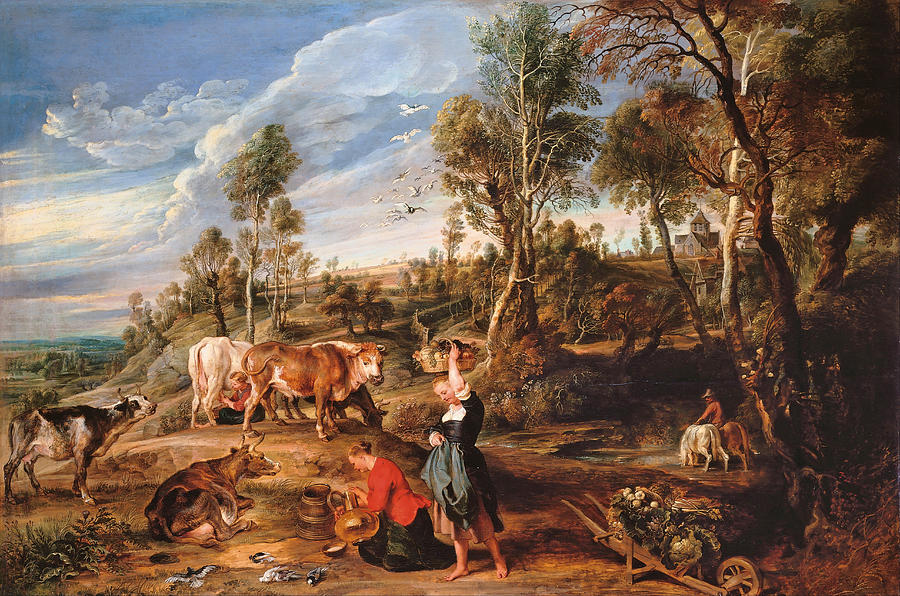
“Milkmaids with Cattle in a Landscape (The Farm at Laken)” presents Peter Paul Rubens in a more intimate and pastoral mood than his famous altarpieces and mythological dramas. The painting shows a Flemish farm on a bright, breezy day: cows graze and rest, women handle pails and churns, a rider waters his horse by a stream, and a cart piled with vegetables stands ready to be pushed toward the farmhouse. Nothing spectacular happens, yet the scene pulses with energy and contentment.
Rubens turns this quiet corner of the countryside into a grand visual poem about work, nature, and abundance. Every detail—from the swirl of clouds in the sky to the gleam on a cow’s flank—contributes to a sense of harmony between people and the land that sustains them. The painting is thought to reflect Rubens’ own estate near Laken, which makes the image not only an artistic invention but also a personal statement about the life he valued outside the city and court.
Composition and Spatial Rhythm
The canvas is organized around a powerful diagonal that runs from the lower left, where a cow lies ruminating, to the upper right, where trees and a distant farmhouse rise against the sky. Along this line Rubens arranges the main elements of the farm: grazing cattle, the path they follow, clusters of trees, and a meandering stream.
In the foreground, three cows and two milkmaids form a compact group. The reclining cow anchors the left corner with its massive body, while another cow stands in profile and a third is seen from behind, being nudged along by a farmhand. Slightly to the right, a woman in a red dress bends over a wooden tub, and another woman stands barefoot, twisting at the waist as she lifts a basket to her head. These figures create a circular movement that keeps the viewer’s eye revolving around the center of the action.
Beyond them, the land dips and rises in gentle undulations, leading toward an area of woodland where the stream appears. Here, a man on horseback pauses as his horse drinks, introducing another focal point at mid-distance. Above this, the silhouette of a house or farm building crowns a hill, framed by tall trees. This ascending arrangement suggests both physical depth and a progression from the intimate foreground to a broader, communal world beyond.
The vast sky occupies nearly half the painting, filled with layered clouds and a flight of birds. This generous allocation of space to the heavens balances the density of activity below and gives the landscape a feeling of openness and breath.
The Milkmaids as Central Figures
Although the painting is crowded with animals and landscape detail, the two milkmaids are clearly its human center. Rubens treats them with the same care and vitality he gives to queens and goddesses in other works, yet without idealizing away their rustic character.
The kneeling milkmaid, dressed in a bright red bodice and darker skirt, is deeply engaged in her task. She leans over a low tub, perhaps straining or skimming milk, her back curved in a natural working posture. The strong color of her dress draws immediate attention, and the way it catches the light turns her simple garment into a cascade of rich folds. Her bare forearms and absorbed expression convey both strength and focus.
The standing milkmaid, in a dark bodice and light apron, is shown at a moment of graceful exertion. One hand lifts the basket high, the other steadies it, and one leg steps forward, toes gripping the ground. Despite the effort, her movement has a dance-like elegance. Her bare feet remind us of her closeness to the earth, while her upright figure and composed face lend her a quiet dignity.
Together, the women embody the rhythm of rural labor. They are not background accessories but protagonists whose work generates the farm’s wealth. Rubens celebrates their physical vigor and the competence born of daily repetition, turning chores into a choreography of human bodies in balance with their environment.
The Cattle and Their Presence
The cows are painted with the affection and observational skill of someone who knew them well. The reclining cow in the foreground dominates the left half of the canvas; its body is foreshortened toward the viewer, emphasizing weight and volume. The relaxed position, with legs folded under and head slightly raised, conveys contentment. The texture of the hide, with variations of brown and white, is rendered with broad yet precise strokes that suggest both softness and mass.
Behind this animal stands another cow, its head turned toward the viewer, eyes calm, ears alert. A young farmhand crouches beside its flank, partially hidden as he tends to the animal. A third cow walks slowly up the path, while a fourth appears at the far left, nose lowered to the grass. This variety of postures—lying, standing, walking—animates the scene and suggests the continuous, cyclical nature of a working farm.
Rubens does not treat the cattle merely as economic units. They are individual creatures with their own temperaments. Their gentle movements, the way light glances off their backs, and the presence of small birds around them hint at a peaceful coexistence among all living things on the farm.
Landscape, Trees, and Sky
The landscape setting is as important as the figures. Rubens builds the terrain from rolling hills and gentle valleys, covered with patches of grass, shrubs, and clusters of trees. The trees in the middle ground are tall and slender, their trunks twisting slightly, their leaves caught by the wind. They provide vertical accents that break up the horizontals of the land and lead the eye upward.
To the right, the trees grow thicker and darker around the stream, creating a sense of cool shade and sheltered water. The horse and rider, partly enclosed by these trunks, seem to enter a more secluded space, in contrast with the open sunlit area where the cows and milkmaids work. This contrast between open and enclosed zones enriches the painting’s spatial variety.
The sky is a masterpiece in itself. Broad sweeps of blue alternate with bands of white and grey cloud, painted with energetic brushwork. The direction of the clouds suggests a breeze moving across the scene, and a flock of birds rides this current, their formation echoing the diagonal that structures the composition. The effect is a living, changing atmosphere rather than a static backdrop.
Light, Color, and Atmosphere
Light suffuses the painting with warmth and clarity. It appears to come from the left, illuminating the cows’ backs, the milkmaids’ faces and garments, and the tops of the trees. Shadows fall gently to the right, but they are never so dark as to feel threatening. The overall impression is of a mild, temperate day, perhaps in late summer or early autumn.
Rubens uses a palette dominated by earthy browns, greens, and golden tones for the land and animals, balanced by the vibrant red of the kneeling milkmaid’s dress and by the cool blues and whites of the sky. These colors harmonize without monotony; subtle variations in hue and saturation create depth and richness.
The brushwork is varied. In the sky and foliage, strokes are loose and fluid, suggesting movement and texture without minute detail. In the animals and human figures, the paint is more tightly controlled, modeling muscles and forms with nuanced gradations. This contrast draws the viewer’s focus to the living beings while still allowing the environment to feel alive and dynamic.
The atmosphere that results is both realistic and idealized. The air seems clear and fresh; the light has a golden transparency that flatters everything it touches. Rubens creates a mood of wellbeing that underlines the painting’s thematic emphasis on harmony and abundance.
Human and Animal Relationship
One of the painting’s most notable aspects is the ease with which humans and animals share the space. The milkmaids move confidently among the cows; the animals show no sign of fear or agitation. The boy in the middle ground is close enough to touch the cow he tends, yet there is no tension in his posture. The rider at the stream trusts his horse to find its footing in the water.
This familiarity speaks to a way of life in which people and animals coexist through daily contact and mutual dependence. The cows provide milk and strength; humans provide care, guidance, and shelter. Birds flutter around the hoofs of the reclining cow, unconcerned, as if they too feel secure in this environment.
By depicting these relationships with such naturalness, Rubens emphasizes that the farm is not merely a human enterprise imposed upon nature but a joint endeavor in which all creatures participate. It is a vision of rural life as an integrated ecosystem, long before such terms existed.
Symbolic and Social Meanings
While the painting is grounded in observation, it also carries symbolic overtones. The fullness of the milk pails, the lushness of the vegetables in the wheelbarrow, and the healthy appearance of the animals all express fertility and prosperity. This abundance can be read as a sign of divine blessing, a visual affirmation that honest labor on good land leads to plenty.
For Rubens himself, who owned and managed a country estate, such imagery was also a statement of identity. It linked him to the humanist ideal of the learned landowner who balances intellectual pursuits with direct involvement in agriculture. Depicting his farm or one very much like it was a way of celebrating a well-lived life rooted in both culture and nature.
Socially, the painting acknowledges the importance of rural workers whose efforts sustain the broader society. The milkmaids and farmhands are depicted with respect; their work is neither romanticized nor denigrated. In a world often dominated by images of nobles and saints, this focus on ordinary laborers is significant. It elevates their daily tasks to subjects worthy of painterly attention and admiration.
Rubens within the Landscape Tradition
This work also illustrates Rubens’ contribution to the development of landscape painting. Earlier northern landscapes often placed small figures against vast panoramas viewed from a high vantage point. Rubens situates the viewer closer to the action, at roughly eye level with the cows and milkmaids. This more immersive perspective invites a sense of participation rather than detached observation.
At the same time, Rubens brings to the landscape genre the coloristic richness and dynamic forms he developed in his figurative works. The twisting trees, muscular animals, and swirling clouds echo the energy of his mythological compositions. Yet he balances this dynamism with a calm, ordered structure appropriate to pastoral subject matter.
“Milkmaids with Cattle in a Landscape” thus stands at a crossroads: it is rooted in Flemish tradition but enriched by Italian influences and by Rubens’ own distinctive sense of grandeur. It helped pave the way for later landscape masters who would treat the countryside as a worthy theme in its own right.
Emotional Tone and Viewer Experience
The overall emotional tone is one of contentment. There is no looming storm, no impending danger, no sign of hardship beyond the natural exertion of work. Instead, the painting offers a moment of repose within activity: the cows chew cud or stroll lazily, the milkmaids are absorbed but not hurried, the rider gives his horse time to drink.
For the viewer, the painting can evoke nostalgia, even if one has never lived on a farm. It invites daydreams of simpler days when labor was physical and its results tangible, when the sky and weather mattered more than clocks. Yet this nostalgia is not sentimental; the depiction of work and animal management is too accurate and grounded for that.
The viewer’s eye wanders pleasantly from detail to detail: birds in flight, reflections in water, the texture of bark, the folds of skirts, the glint on a metal pail. This leisurely visual exploration mirrors the relaxed but purposeful pace of life in the scene. The painting becomes a visual rest, an opportunity to breathe more deeply simply by looking.
Conclusion
“Milkmaids with Cattle in a Landscape (The Farm at Laken)” is a rich and multifaceted work that reveals a quieter side of Peter Paul Rubens. Here, heroism is expressed not through battles or miracles but through steady labor, care for animals, and the cultivation of fertile land.
Through a masterfully balanced composition, luminous color, and sensitive observation of both people and nature, Rubens constructs a world in which humans and animals share a peaceful, productive existence. The painting celebrates the dignity of rural work, the beauty of the Flemish countryside, and the satisfaction of a life lived in harmony with the rhythms of nature.
Even centuries later, the scene retains its freshness. Standing before it, one can almost hear the lowing of the cattle, the clink of pails, the murmur of the stream, and the rustle of leaves in the wind. It is a testament to Rubens’ ability to transform his own everyday surroundings into timeless art that invites us to value the ordinary as something profoundly worthy of admiration.