Image source: wikiart.org
Introduction to “Mercury and Argus”
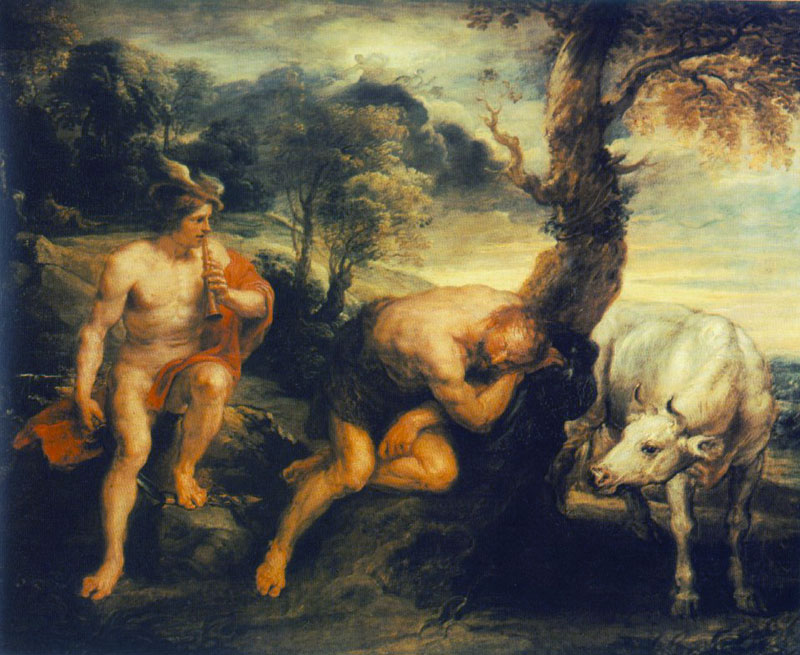
“Mercury and Argus,” painted by Peter Paul Rubens in 1638, revisits one of antiquity’s most poignant stories of deception and liberation. On the surface, the painting presents a tranquil rural scene: two male figures rest beneath a tree while a white cow grazes nearby, framed by a deep landscape and soft evening sky. Yet beneath this calm exterior lies a tense mythological drama. Mercury, the messenger of the gods, has been sent by Jupiter to kill the vigilant Argus and free Io, the nymph transformed into a cow by Jupiter’s jealous wife, Juno. Rubens chooses the moment just before the act of violence, when Mercury has lulled Argus into drowsiness with his music and the entire world seems to hold its breath.
This version belongs to Rubens’s late period, when his brushwork became freer and his color harmonies more atmospheric. It distills the story into a compact, emotionally charged triangle of figures, landscape, and sky, bringing together narrative clarity and a deeply felt sense of nature.
The Mythological Background
The story derives from Ovid’s “Metamorphoses.” Jupiter, king of the gods, seduced the nymph Io. To hide his infidelity from Juno, he transformed Io into a white heifer. Juno, suspicious, demanded the animal as a gift and set the many-eyed giant Argus to guard her. Jupiter then dispatched Mercury, god of travelers and cunning, to rescue Io. Mercury charmed Argus with stories and music until the watchman fell asleep, at which point Mercury killed him and led Io away.
Artists have long been fascinated with this narrative because it combines pastoral beauty with dramatic tension. Rubens, steeped in classical literature and visual traditions, interprets the episode as a meditation on vigilance, deception, and the fragile boundary between sleep and death.
Composition and Spatial Structure
Rubens organizes the painting around a loose triangle formed by Mercury at the left, Argus in the center, and the cow Io at the right. The tree that leans over Argus acts as the triangle’s vertical axis, both sheltering and imprisoning him. The figures are placed close to the picture plane, giving the scene intimacy, while a deep landscape opens behind them, leading the eye toward distant hills and a luminous sky.
Mercury sits on a low rock at the left edge, his nude body angled inward. One leg is bent and firmly planted, the other extended, suggesting readiness despite his relaxed pose. Argus slumps at the base of the tree, his massive torso folded over his knees, head resting on his forearm. Io, as a white cow, stands to the right, turned partly toward the viewer but glancing sideways at the sleeping guard, her body forming the final point of the compositional triangle.
The diagonals that connect these three figures create a visual dialogue. Mercury’s gaze and the direction of his flute lead toward Argus; Argus’s curved back and bowed head draw attention down and inward; Io’s angled body and turned head guide the eye back toward the center. This interplay of lines and directions makes the composition dynamic even though the figures themselves are largely still.
The Figure of Mercury: Charm and Calculation
Mercury’s role is central, and Rubens gives him a complex presence. He is depicted as a youthful, muscular man, mostly nude except for a red cloak draped loosely over his shoulders and arm. The cloak’s vibrant color immediately distinguishes him from the earthier tones of the landscape and the muted hues of Argus and Io. It hints at his divine nature and also anticipates the bloodshed that his mission will bring.
In this moment Mercury plays a simple reed flute. His fingers are delicately positioned, and his cheeks appear slightly inflated, suggesting sound in motion. His expression is attentive and slightly probing, as if he were watching Argus closely for signs that sleep has claimed him fully. This focused gaze betrays the calculation behind his gentle music. He is at once artist and assassin, using aesthetic means to achieve a deadly end.
Rubens imbues Mercury’s body with a subtle tension. The torso is relaxed, but the set of the shoulders and the angle of the supporting leg speak of latent energy, ready to spring into action when the time is right. The god’s physical beauty and poised elegance underline the paradox that the gentle figure of a musician will soon become a killer.
Argus: The Watchman Overcome by Sleep
Argus, traditionally described as having many eyes, appears here as a burly, almost rustic figure. Rubens does not literally multiply his eyes; instead, he suggests Argus’s role as vigilant guardian through his powerful physique and his central position beneath the tree. His body is large, his muscles pronounced, his skin tanned, emphasizing his earthbound strength.
Yet in this scene, that strength has been neutralized. Argus sits with one knee up, the other leg bent under him, his back hunched. His head is buried in his forearm, turned away from Mercury’s gaze. The posture conveys exhaustion and vulnerability. His staff lies neglected, and the tree against which he leans seems to absorb and pin him in place.
The darkness around Argus is significant. Shadows gather beneath the tree and across his back, suggesting the encroaching sleep that will soon become eternal. His massive form, once a symbol of vigilance, has caved inward, leaving him defenseless. Rubens’s treatment of Argus is sympathetic rather than villainous; the viewer senses a powerful being undone not by weakness of will but by the irresistible power of art and divine strategy.
Io as the White Cow: Innocence and Witness
At the right stands Io in her bovine form, a white cow with gentle eyes and softly modeled flanks. Rubens pours particular care into her depiction. Her coat catches the warm light, standing out against the darker tones of tree and hillside. The whiteness of her body suggests innocence and victimhood, a stark contrast to the morally ambiguous actions of the gods.
Io’s head is slightly turned, her gaze directed toward the collapsed Argus and the playing Mercury. She appears wary, as if sensing that something extraordinary is occurring. Although she cannot speak, her presence functions as a silent witness to the unfolding drama. In the broader myth, freeing Io is the purpose of Mercury’s mission; here, she already occupies a position of partial freedom, standing just beyond Argus’s slumped figure.
Her placement on the edge of the composition, close to the open landscape and distant horizon, hints at the liberation that is about to follow. Once Mercury has carried out Jupiter’s command, Io will no longer be tethered to this single spot under Argus’s watchful eyes. The open field behind her suggests both physical and existential escape.
Landscape and Atmosphere
The surrounding landscape is not mere backdrop; it plays an active role in establishing the painting’s mood. Behind Mercury, a path winds up a hillside dotted with trees, leading the viewer’s eye into the depth of the picture. Behind Argus and Io, the terrain slopes gently downward toward a distant horizon where land meets sky. The trees’ branches twist and curl, especially the one above Argus, whose gnarled trunk and exposed roots echo his knotty musculature.
The sky is richly varied: darker clouds loom above the central area, while a band of lighter, golden sky opens near the horizon on the right. This shifting light corresponds to the psychological tension of the scene. The darker zone above Argus seems to press down, mirroring his drowsiness and impending doom. The brighter region beyond Io hints at hope and divine intervention.
Rubens’s brushwork in the landscape is loose and atmospheric. Strokes of greens, browns, and blues blend into one another, creating a sense of humidity and depth. The earth appears tangible, yet the boundaries of objects are softened, as if viewed through the haze of evening. This atmospheric softness contrasts with the firmer modeling of the human bodies, drawing attention back to the central drama without isolating it from its environment.
Light, Color, and Symbolic Contrast
Light plays a crucial symbolic role. Mercury’s body glows with warm, pinkish highlights, catching sunlight that seems to filter from the left. Argus, by contrast, is partially submerged in shadow, with only parts of his shoulder and limbs illuminated. Io’s white coat reflects the brightest light in the painting, making her visually pure and prominent.
Color contrasts deepen these symbolic relationships. The red of Mercury’s cloak is the most intense hue on the canvas. It both announces his divine presence and foreshadows the blood that will soon be spilled. Argus’s wrap is dark and earth-colored, blending with the tree and ground, reinforcing his connection to the mortal world. Io’s white, tinged with subtle blues and creams, sets her apart from both, suggesting that she belongs to neither the realm of the gods nor the ordinary world of mortals but occupies a liminal, transformed state.
The overall palette is warm and subdued rather than high-keyed. Golden browns, muted greens, and deep blues create a harmonious tonal field in which the bright whites and reds stand out. This restrained color scheme suits the narrative moment: the tension is internal and psychological rather than explosive.
Narrative Moment and Psychological Drama
Rubens chooses a moment of quiet suspense rather than overt violence. We do not see Mercury drawing his sword or Argus falling dead. Instead, we witness the final stage of the seduction by music, just before the decisive act. This choice shifts the emphasis from physical action to psychological drama.
Mercury’s gaze, Argus’s slumped posture, and Io’s alert presence together create a triangle of emotional states: calculation, vulnerability, and anxious expectation. The viewer, aware of the myth, recognizes that what appears to be a peaceful pastoral scene is about to turn deadly. That knowledge infuses every detail with tension. The gentle music becomes ominous; the tree against which Argus rests becomes a potential instrument of his downfall; the open countryside behind Io becomes a promised escape route.
This psychological ambiguity is typical of Rubens’s late style, in which he often preferred moments of transition and inner turmoil to straightforward climaxes. The painting invites the viewer to imagine what comes next, extending the drama beyond the frame.
Classical Tradition and Rubens’s Interpretation
The theme of Mercury and Argus had been treated by earlier artists, especially in the Italian Renaissance. Many showed the decisive moment of the murder, with Mercury wielding a sword or scythe over a prostrate Argus. Rubens was familiar with these precedents but deliberately chooses a less explicit approach. By focusing on the lullaby and drowsiness, he emphasizes Mercury’s cunning and the power of art—music, storytelling—as instruments of change.
At the same time, Rubens remains faithful to classical iconography. Mercury’s red cloak, the flute, and the pastoral setting all conform to traditional depictions. Argus’s role as watchman is acknowledged, even if his many eyes are not literally depicted. Io’s transformation into a white cow is central, and the landscape evokes Arcadian ideals of the classical countryside.
Rubens’s innovation lies in the humanization of the figures. Mercury is not a distant, impersonal god but a young man whose concentration and moral ambiguity we can sense. Argus is more than a monster; he is a tired guardian with a tangible body and implied inner life. Io, though an animal, seems to retain traces of human awareness in her gaze. This humanization lends the ancient myth a fresh emotional relevance.
Moral Ambiguity and the Ethics of Rescue
The painting invites reflection on the ethics of Mercury’s mission. On one level, he is a liberator: he will free Io from unjust imprisonment. On another level, he is an agent of deception and murder, using charm and art to kill a sleeping foe. Rubens does not resolve this tension; instead, he visualizes it.
Mercury’s beauty and youth make him sympathetic, yet his calm demeanor in the face of an imminent killing can be unsettling. Argus, though aligned with Juno’s jealousy, appears more pitiable than villainous. Io, the real victim, stands somewhat apart, as if uncertain whether the forthcoming act will truly bring her safety.
In this sense, the painting reflects broader Baroque concerns with the complexities of power, loyalty, and justice. Divine commands do not automatically align with moral clarity. The viewer is left to ponder whether ends justify means, and the work’s pastoral calm becomes a vehicle for ethical unease.
Rubens’s Late Style and Personal Concerns
Created toward the end of Rubens’s life, “Mercury and Argus” showcases traits of his late style: looser brushwork, softer contours, and a more contemplative mood. Compared with earlier, more crowded compositions, this painting feels spacious and distilled. The narrative has been reduced to three main figures and a relatively uncluttered environment, allowing the viewer to focus on emotional nuance.
At this stage, Rubens was afflicted with gout and increasingly aware of his mortality. It is tempting to see in Argus’s slumped, weary body a reflection of the artist’s own sense of physical limitation, and in Mercury’s poised readiness a symbol of the inexorable approach of death. Whether or not such autobiographical readings are intended, the painting’s quiet intensity suggests deeper personal resonance beyond its mythological subject.
Lasting Appeal and Contemporary Relevance
“Mercury and Argus” continues to fascinate viewers because it fuses myth, landscape, and psychology into a unified whole. Its restrained drama, rich atmosphere, and subtle moral questions make it a work that rewards repeated looking. The painting speaks to modern concerns about manipulation, surveillance, and liberation. Argus, the watchman with many eyes, can be seen as a precursor of systems of control; Mercury, the charming assassin, as an embodiment of soft power and covert operations; Io, the innocent transformed, as a victim of forces beyond her control.
Yet beyond such analogies, the painting endures simply as a beautiful, haunting image. The glow of Mercury’s skin, the weight of Argus’s sleeping body, the quiet alertness of the white cow, and the rolling hills under a mutable sky combine to create a world that feels both distant and strangely familiar. Rubens, at the height of his powers, uses myth to explore what it means to be vulnerable, cunning, and hopeful in a world governed by complex, often conflicting forces.