Image source: wikiart.org
Introduction to Meditation of St. Francis
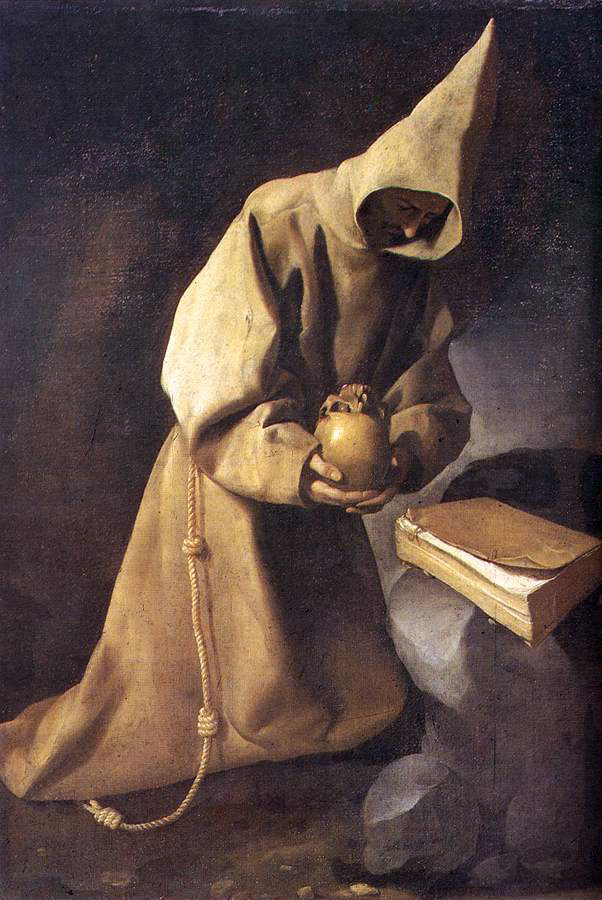
Francisco de Zurbaran’s “Meditation of St. Francis,” painted in 1632, is one of the most concentrated and haunting images of contemplative spirituality in the Spanish Baroque. A solitary friar kneels in silence, wrapped in a coarse habit, his head bowed beneath a pointed hood. In his hands he cradles a skull resting on a small pottery jar, while beside him a thick book lies on a rough stone ledge. The background is nearly black, the light sparse yet precise, falling across the drapery of the robe and the pale oval of the skull.
Nothing in the painting distracts from the act of contemplation. There is no landscape, no architectural setting, no narrative crowd. Instead Zurbaran offers a distilled vision of the Franciscan path of prayer, poverty and meditation on death. The painting encapsulates many of the artist’s strengths, among them his ability to make cloth and simple objects glow with meaning and his gift for transforming a quiet scene into an intense spiritual drama.
Historical Context and the Franciscan Ideal
The early seventeenth century in Spain was a period marked by strong religious fervor and the influence of the Counter Reformation. The Catholic Church encouraged images that would deepen devotion and convey doctrinal truths with clarity and emotional resonance. St. Francis of Assisi, founder of the Franciscan order, was one of the most beloved saints in Spain. His life of radical poverty, his love of Christ crucified and his closeness to nature made him an ideal model for both clergy and laypeople.
In Seville, where Zurbaran lived and worked, Franciscan convents and monasteries were important patrons of art. They commissioned paintings that celebrated their founder and the saints of their order, not only to adorn their churches but also to provide visual aids for meditation in private chapels and cloisters. “Meditation of St. Francis” was likely created for such a setting. Its intimate scale, sober palette and contemplative mood suggest it was destined for a quiet space where friars or devout visitors could pray in silence.
The painting reflects a specific aspect of Franciscan spirituality known as memento mori, the remembrance of death. Meditating on death was not meant to induce despair, but to encourage detachment from worldly attachments and to focus the soul on eternal life. St. Francis was often portrayed with a skull, especially in images that emphasize his retreats into solitude and his union with the suffering Christ. Zurbaran’s painting takes this motif and handles it with remarkable restraint and depth.
Composition and the Kneeling Figure
The composition of “Meditation of St. Francis” is simple yet carefully balanced. The saint occupies most of the vertical space, kneeling on the ground with his body turned slightly toward the right. The pointed hood of his habit creates a strong diagonal that leads the viewer’s eye downward to his lowered face and then to the skull he holds. His arms form a gentle curve that frames the skull and jar, intensifying the focus on this central object.
To the right, a stone ledge juts out, supporting a large book whose edges are uneven and worn. The book’s rectangular form and horizontal placement provide a counterweight to the vertical figure. The stones below it and the scattered pebbles on the ground echo the roughness of the Franciscan environment, natural and unadorned. The left side of the canvas remains mostly open, filled with shadow that gradually deepens as it reaches the top.
Zurbaran places St. Francis low enough in the picture that the viewer feels almost at eye level with him. This creates a sense of shared space and intimacy, as though we are kneeling nearby, just outside the pool of light. The lack of architectural framing or decorative elements emphasizes that this is not a scene staged for public view, but a private moment of prayer that we are allowed to witness.
The Habit and the Drama of Light
The Franciscan habit dominates the visual field. Rendered in earthy tones of brown and beige, the coarse fabric flows in heavy folds that convey both weight and modesty. Zurbaran was renowned for his ability to paint cloth with sculptural solidity, and here he turns the garment into a monument of humility. The large hood covers most of the saint’s face, leaving only his nose, lips and a hint of closed or lowered eyes visible. This concealment reinforces the idea that the subject is less the individuality of Francis than his interior union with God.
Light falls strongly on the upper part of the habit, creating sharp highlights on the shoulders and hood and casting deep shadows in the folds. The rope belt, with its simple knots and dangling end, catches the light just enough to be legible against the darker section of the garment. This interplay of light and shadow gives the figure a sculpted appearance, almost as if he were carved in stone or wood, yet the warm tones of the cloth keep him human and tangible.
The drama of the scene arises from this contrast. The illuminated habit and pale skull stand out against the dark background, suggesting that spiritual insight emerges from the obscurity of the world. The light does not appear to come from a visible source such as a window or candle. Instead it has a symbolic character, evoking divine illumination or the inner light of contemplation that reveals the truth of mortality.
The Skull, the Jar and the Book
The objects in the painting are few, but each carries rich symbolic meaning. The skull is the most obvious reminder of death. Held gently but firmly in St. Francis’s hands, it becomes an object of reverence rather than of horror. The saint does not push it away or stomp on it; he cradles it as one might hold a fragile vessel. This treatment suggests that facing mortality with honesty and acceptance is a path to wisdom.
The skull rests on a small, rounded jar. This ceramic vessel may recall containers used to hold oil or water, and it introduces a note of vulnerability. Clay jars can break, just as human bodies are subject to decay. In biblical tradition, jars of clay symbolize human fragility in contrast to the treasure of divine life within. By placing the skull upon such a jar, Zurbaran intensifies the memento mori theme while hinting at the hope of a treasure beyond death.
The book on the stone ledge represents learning, scripture and the spiritual writings of the Franciscan tradition. Its pages are thick and slightly curled, its binding simple. It lies closed, suggesting that the stage of reading has given way to the deeper stage of silent contemplation. The juxtaposition of book and skull echoes a long tradition in Christian art where scholars and saints meditate on death in the presence of their books, recognizing that all human knowledge is small compared to the mystery of God and eternity.
Together, these objects form a triad: skull and jar in the saint’s hands, book on the stone. They outline a path from intellectual understanding to interior appropriation of the truth of mortality. The stones beneath the book may recall the rocky places where hermits sought solitude. Knowledge, death and solitude come together here as instruments of spiritual transformation.
Space, Silence and the Desert Atmosphere
The background of the painting is almost featureless, a softly modulated field of dark tones. There is no window, no sky, no vegetation. Only the stone ledge and the rough ground indicate that St. Francis kneels in a natural environment, perhaps a cave or a rocky hillside. This sparseness creates a sense of desert atmosphere, a place stripped of distraction where the soul confronts God and its own mortality.
The emptiness around the figure functions like silence in music. It frames the saint’s gesture and allows the viewer to feel the stillness of the moment. The lack of narrative action, combined with the bent head and clasped hands, conveys an intense but quiet emotion. The viewer can almost imagine hearing only the sound of the friar’s breathing or whispered prayer.
Zurbaran’s choice to avoid any dramatic landscape sets his work apart from some Italian Baroque painters who placed saints in richly detailed settings. Here, the absence of scenery aligns with the Franciscan ideal of poverty and the desire to renounce worldly splendor. The true theater is interior, within the soul of the praying saint. The painting thus suggests that real transformation happens not in public spectacle but in hidden, solitary encounters with God.
Emotional and Spiritual Resonance
Although St. Francis’s face is largely obscured, the painting conveys a strong emotional charge. The tilt of his head, the curvature of his shoulders and the careful way he holds the skull reveal tenderness, humility and a certain sorrowful love. This is not fear of death in a crude sense, but a sober recognition of its inevitability and its role in drawing the soul away from trivial pursuits.
Viewers often respond to this painting with a sense of calm seriousness. The subdued colors and lack of decorative detail encourage the eye to slow down and trace the lines of cloth and stone. As one looks, the image begins to work like a visual meditation. It invites reflection on personal mortality, on the brevity of life and on the importance of ordering one’s priorities in light of eternity.
For the monks who first contemplated this painting, it would have served as both a mirror and a guide. Many members of religious orders spent time alone in their cells or in deserted chapels, meditating on their vocation and on the Last Things. Seeing their beloved Francis engaged in the same practice would reinforce their commitment. At the same time, his example might challenge viewers to deepen their own prayer life, to move from mere intellectual knowledge of faith to a more existential encounter.
Zurbaran’s Style and the Tradition of St. Francis Images
Zurbaran painted numerous images of St. Francis throughout his career, and “Meditation of St. Francis” belongs to this larger series. In many of them, the saint appears in similar Carthusian like habits, sometimes holding a skull, sometimes gazing at a crucifix or receiving the stigmata. What distinguishes this particular version is its radical simplicity. There is no cross visible, no wounds, no accompanying angels. The focus is entirely on the act of contemplating death.
The artist’s style here is austere and restrained. He uses a limited palette dominated by browns, grays and muted yellows, with only subtle variations in hue to model forms. His brushwork is controlled and precise rather than showy. The folds of the habit are clear yet not overly detailed. This restraint gives the painting a timeless quality and aligns it with the spiritual message. It feels as if nothing unnecessary has been allowed to remain on the canvas.
Within the broader history of art, images of St. Francis meditating with a skull were common from the late medieval period onward. Italian painters such as Caravaggio had treated similar subjects with intense drama and sharp contrasts. Zurbaran absorbs the lesson of strong chiaroscuro but strips away many narrative elements. His St. Francis is less theatrical and more introspective, closer to the meditative practices of Spanish mystics such as Teresa of Avila and John of the Cross.
Legacy and Modern Reception
Today “Meditation of St. Francis” is often cited as one of Zurbaran’s finest religious works. Modern viewers, accustomed to images crowded with information, may find its simplicity particularly striking. The painting resonates with contemporary concerns about meaning, mortality and the search for quiet spaces in a noisy world.
Art historians appreciate the painting as a prime example of Spanish Golden Age spirituality translated into visual form. It demonstrates how Baroque art could be dramatic without being noisy, how light and shadow could express inner states of soul rather than just outer theatricality. The work also shows Zurbaran’s remarkable ability to integrate still life elements, such as the skull, jar and book, into a coherent spiritual narrative.
For many people, religious or not, the painting functions as a meditation on human vulnerability. The figure of the hooded monk, absorbed in thought, can be seen as an emblem of anyone who confronts the reality of mortality and seeks to live more authentically as a result. This universal aspect explains why the painting continues to speak across cultures and centuries.
Conclusion
“Meditation of St. Francis,” painted by Francisco de Zurbaran in 1632, is a masterful exploration of contemplative spirituality and memento mori imagery. Through a sparse composition, a monumental habit, and a few carefully chosen objects, the artist creates a scene that draws viewers into the inner world of the saint. The skull and jar, the closed book, the rough stones and the enveloping darkness all serve to focus attention on the essential question of how to live in the light of death.
The painting reveals Zurbaran’s deep understanding of Franciscan ideals and his skill at translating them into visual form. It shows that genuine drama can occur in silence and stillness, that the most profound battles are often waged within the human heart as it turns toward God. Whether approached as a religious image or as a work of art, “Meditation of St. Francis” invites reflection on humility, mortality and the hope of a life that goes beyond what can be seen.