Image source: wikiart.org
A Vision of Heavenly Music: Introducing “Mary and Child with Angels Playing Music”
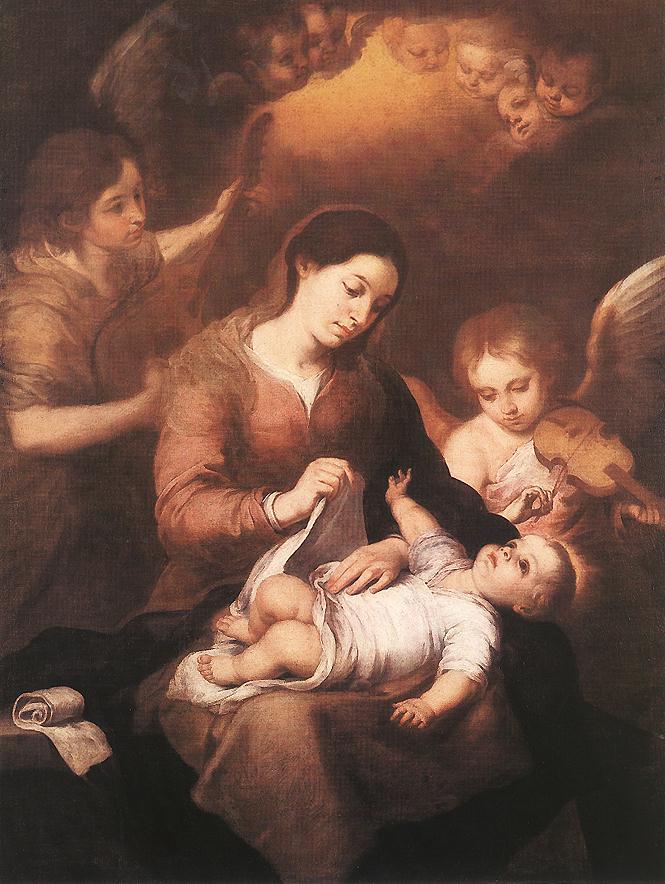
“Mary and Child with Angels Playing Music,” painted by Bartolomé Esteban Murillo around 1675, is an intimate and luminous vision of the Holy Family surrounded by celestial musicians. Murillo, the great Sevillian master of warmth and tenderness, combines domestic simplicity with heavenly splendor in a way that feels both familiar and transcendent. In this canvas the Virgin Mary quietly occupies herself with needlework while the Christ Child reclines on her lap and angels create a soft concert of praise around them. Above, a glowing cloud filled with cherubic faces completes the sense that this is a moment suspended between earth and heaven.
This painting belongs to a broader seventeenth century Spanish tradition that aimed to draw worshippers into a personal relationship with Christ and Mary. Instead of distant, enthroned figures, Murillo offers a scene that resembles a family moment glimpsed in a private room. Yet the presence of angels and the radiance of light remind the viewer that this is no ordinary domestic scene. The canvas invites contemplation of the mystery of the Incarnation, where the divine enters the everyday and transforms it with grace.
Composition and First Impressions
At first glance, the composition appears calm and circular. Mary sits at the center of the painting, her body slightly turned to the right, her head gently inclined toward the child on her lap. The Christ Child lies across her knees, his body stretching diagonally toward the lower right corner. To Mary’s right, an angel plays a small violin, while another angel on the left seems to hold a musical score or simply watch in reverent admiration. Above them, in a warm golden cloud, a cluster of cherub heads emerges from the mist, their faces glowing with delight.
Murillo uses these figures to create a visual rhythm. The curve of Mary’s shoulders, the arc of the child’s body, and the bend of the violin playing angel’s arm all echo one another, forming a gentle flow of movement around the central group. The angels at the top balance the composition and draw the eye upward, suggesting that the music being played is both heard in the room and echoed in heaven.
The lower part of the painting is darker and more grounded, while the upper area glows with a soft golden light. This vertical transition from earthlike tones to heavenly radiance reinforces the spiritual theme. The viewer’s gaze travels naturally from the Christ Child and Mary to the angels who attend them and finally to the cherubic faces that seem to peer down from the very threshold of heaven.
The Virgin Mary as Tender Mother
Murillo’s Virgin is deeply human and approachable. She is not adorned with an elaborate crown or surrounded by elaborate iconography. Instead she appears as a young mother, modestly dressed, absorbed in the simple act of sewing or mending a piece of cloth. Her garments are rendered in muted reds and warm browns, with a veil covering her hair. These colors invoke both earthly warmth and spiritual love without overwhelming the composition.
Her face is one of serene concentration mixed with quiet affection. Mary’s eyes are lowered, focused on her work, yet her entire posture communicates an awareness of the child resting on her lap. The slight tilt of her head and the soft line of her mouth convey both humility and contentment. Murillo avoids any dramatic expression, choosing instead a contemplative mood that invites viewers to enter into their own meditation.
The activity of sewing is not accidental. In Christian symbolism, Mary is often associated with weaving or stitching, acts that can suggest her role in “weaving” Christ’s human nature through pregnancy and care. The cloth she handles might also allude to the swaddling clothes of Bethlehem or even, in quiet anticipation, to the shroud that will one day wrap her son in the tomb. Through this simple domestic gesture, Murillo hints at the entire arc of salvation history, from birth to passion.
The Christ Child: Restful and Alert
The Christ Child is the luminous center of the composition. He lies across Mary’s lap, his body relaxed but not limp, one arm stretched outward and the other gently held by his mother. He wears a light garment that clings softly to his form, emphasizing the roundness of his limbs and the softness of childhood. His bare feet point toward the viewer, bringing him closer to us both physically and emotionally.
Unlike many depictions of sleeping infants, this child is awake. His head is slightly lifted, and his gaze seems directed outward, beyond the picture space. This outward glance invites a direct relationship with the viewer. While Mary is absorbed in her sewing, the child appears quietly aware, almost thoughtful, as if he listens to the music and contemplates the souls who will one day look upon this image.
Murillo’s handling of the child’s flesh is exceptionally tender. Subtle transitions of light and shade suggest the delicacy of skin and the warmth of life. Yet this naturalism is imbued with spiritual meaning. The artist wants us to feel both the reality of the baby and the presence of divinity within him. The pose over Mary’s lap recalls traditional depictions of the Pietà, where the dead Christ rests across his mother’s knees. Here, however, the body is alive and radiant, foreshadowing future sorrow while affirming present joy.
Musical Angels as Ministers of Joy
To the right of Mary and the child stands a youthful angel holding a small violin. The instrument is positioned in the angel’s left hand while the right hand draws the bow, producing an unheard melody that we can almost imagine. The angel’s face is soft and concentrated, eyes lowered toward the strings. A bare shoulder and simple garment underscore the purity and innocence of this celestial musician.
On the left, another angel leans in toward the central group. This figure may be accompanying the violin with voice or simply sharing in contemplation. The angel’s posture is attentive and slightly forward, indicating active participation in the scene. In these two angels Murillo offers a visual embodiment of heavenly worship. They act as intermediaries between the quiet domestic activity of Mary and the radiant host of cherubs above.
Music in religious art often symbolizes harmony between heaven and earth. In this painting the music being played seems to envelop mother and child, turning their simple interaction into a liturgical act. Murillo’s angels do not dominate the scene; rather, they enrich it, adding layers of beauty and devotion. Their presence suggests that every loving gesture in this holy family is accompanied by the praise of heaven.
Cherubs in the Golden Cloud
The upper portion of the painting is filled with a glowing cloud populated by cherubic faces. These small, plump visages appear to emerge from the mist rather than standing on solid ground. They cluster together like a choir, their expressions ranging from serene to quietly joyful. The golden light that enfolds them differs from the more neutral tones below, emphasising the heavenly origin of their presence.
This cloud functions as a visual halo for the entire composition. It frames the heads of Mary and the child, surrounding them with a soft aura of sanctity. The cherubs gaze downward, directing their attention to the scene below or perhaps joining in the angelic music. In doing so they also guide the viewer’s gaze back to the central figures, creating a circular visual movement.
Murillo often used such clusters of cherub heads in his religious paintings. They suggest a multitude of unseen witnesses, a heavenly audience that participates in the events unfolding on earth. In “Mary and Child with Angels Playing Music” they affirm that the simple, humble life of the Holy Family is of cosmic significance. The home of Mary is not just a private space but the stage of a divine drama that captivates the entire celestial court.
Light, Color, and the Atmosphere of Intimacy
Murillo’s mastery of light and color creates a particular atmosphere that is both intimate and transcendent. Warm, golden light filters from the upper portion of the canvas, bathing the figures in a gentle glow. This light is strongest around Mary’s face and the body of the child, subtly indicating their spiritual centrality. The surrounding angels and cherubs share in this radiance but with slightly softer intensity, creating depth and hierarchy.
The color palette is dominated by earthy reds, browns, and soft creams. Mary’s gown and mantle anchor the scene with warm tones, while the Christ Child’s clothing introduces pale highlights that attract attention without becoming harsh. The angels’ garments are painted in lighter hues that blend harmoniously with the surrounding clouds. Background shadows are deep yet never oppressive, providing contrast that brings the figures forward.
Murillo avoids sharp outlines, preferring instead to model his forms with delicate gradations of tone. This approach gives the painting a sense of softness and unity. Figures seem to emerge from the surrounding atmosphere rather than being sharply cut out against it. The effect is similar to the sensation of listening to gentle music, where individual notes blend into a larger harmony. This visual “music” complements the literal presence of instruments in the scene.
Domestic Details and Symbolic Meanings
Several small details contribute both realism and symbolism. The piece of fabric in Mary’s hands, for instance, may be part of the infant’s clothing or a swaddling cloth. It subtly calls to mind the practical tasks of motherhood: mending, washing, and caring for a child’s needs. Yet in a theological context it can also evoke the garments that will later be stripped from Christ on the cross and the linen that will wrap his body in the tomb. In this way, Murillo suggests that ordinary maternal duties participate in the larger story of salvation.
The scroll or small book at the lower left corner, partly unrolled, is another intriguing detail. It may represent Scripture or a prophetic text that prefigures the life of Christ. Placing it near Mary’s feet suggests her role as the one who “kept all these things and pondered them in her heart,” meditating on the mysteries foretold by the prophets. It also anchors the scene in the world of written revelation, connecting domestic life with theological reflection.
The angels’ instruments and gestures likewise carry symbolic weight. The violin is not only a source of pleasant sound but also a sign of harmony between heaven and earth. The attentive poses of the angels suggest that true worship involves careful listening as much as active expression. In this context, Mary’s quiet sewing appears as another form of worship, a prayer expressed through work.
Murillo’s Devotional Vision and Seventeenth Century Spirituality
In seventeenth century Seville, Catholic spirituality emphasized both intense devotion and accessible piety. Paintings were meant to draw believers into contemplation, stirring affection for Christ and the saints. Murillo excelled in this environment because he could combine doctrinal clarity with an emotional warmth that appealed to ordinary people.
“Mary and Child with Angels Playing Music” reflects this devotional culture. The painting is not a complex theological treatise but a visual invitation to love. By presenting Mary as a young mother and Jesus as a real child, Murillo makes the holy family feel close and approachable. At the same time, the presence of angels and heavenly light protects the scene from becoming overly familiar. Viewers are reminded that this ordinary looking family is in fact the center of divine history.
For religious communities and laypeople alike, such an image would have served as a focus of prayer. Gazing on it, one might imagine joining the angels in their silent concert, offering one’s own life as another melody of praise. The calm mood of the painting encourages prolonged contemplation rather than quick, passing admiration.
Emotional Impact and Lasting Appeal
Centuries after its creation, “Mary and Child with Angels Playing Music” continues to captivate audiences. Its emotional impact lies not in grand gestures or dramatic events, but in the quiet intensity of affection that binds the figures together. The viewer senses a deep peace in Mary’s posture, a trusting openness in the child’s gaze, and a reverent joy in the angels’ music.
Murillo shows that holiness can be found in simple acts performed with love. Sewing, holding a child, playing music, and listening attentively become vehicles of grace. This message resonates strongly in modern times, when many people seek spirituality in everyday life rather than only in grand rituals. The painting suggests that the household and family relationships can be places where divine beauty is revealed.
From an art historical perspective, the work also demonstrates Murillo’s mature style. The soft handling of paint, the warm palette, and the seamless blending of figures into atmosphere influenced later generations of artists and helped shape the popular image of Spanish Baroque art. For many viewers, Murillo’s depictions of the Virgin and Child define what tenderness in religious painting looks like.