Image source: wikiart.org
Introduction to Martyrdom of Saint James
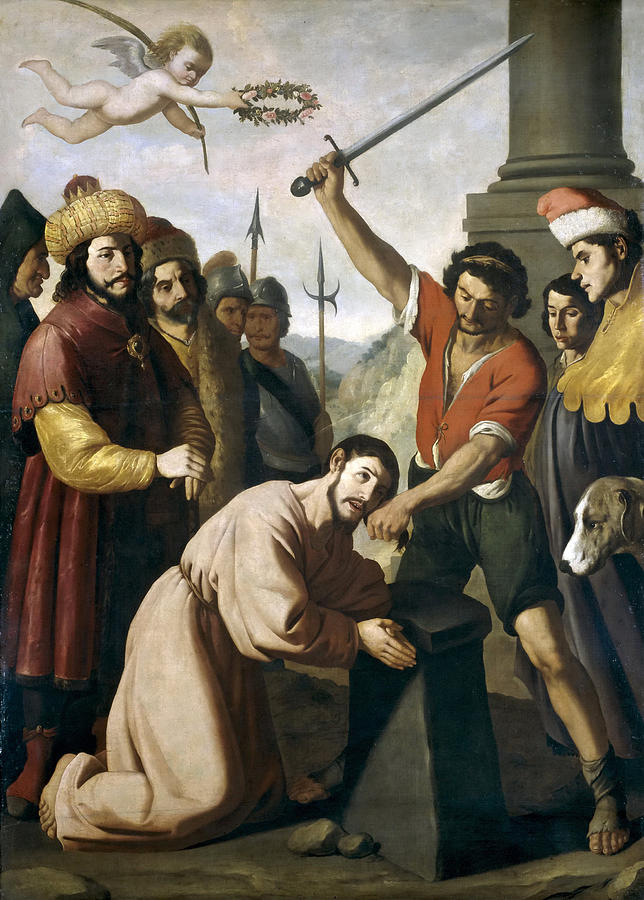
“Martyrdom of Saint James” by Francisco de Zurbaran is a vivid and dramatic exploration of faith carried to its ultimate consequence. The Spanish Baroque painter represents the apostle James at the moment just before his beheading, surrounded by soldiers, officials and curious onlookers. At the top left, a winged cherub swoops in with a wreath of flowers and a palm branch, signaling that what appears to be a brutal execution is also a glorious passage into heaven.
The painting fuses narrative action with intense spiritual symbolism. Saint James kneels in humble prayer, his neck resting on the execution block, while the executioner raises a sword for the final blow. Around them stand figures in rich costumes, spears rising in the background, and a monumental column that frames the scene. The combination of earthy detail and celestial intervention is quintessential Zurbaran, who had a special gift for turning stories of martyrdom into meditations on courage, justice and eternal hope.
Historical and Religious Context
Saint James the Greater, one of Christ’s twelve apostles, is traditionally believed to have preached the Gospel in the Iberian Peninsula before returning to Jerusalem, where he was executed under King Herod Agrippa. For Spanish viewers, James held special significance as the patron saint of Spain, often invoked as Santiago Matamoros, the miraculous warrior who aided Christian armies during the Reconquista.
By the time Zurbaran painted this work, seventeenth century Spain was a deeply Catholic nation where saints and martyrs played a central role in public devotion. The Counter Reformation encouraged painters to present religious stories in a clear, emotionally powerful manner that would inspire the faithful. “Martyrdom of Saint James” fits perfectly into this context. It offers not only a historical image of an apostle’s death but also a patriotic reflection on Spain’s heavenly protector and a model of steadfast faith.
Composition and Narrative Structure
Zurbaran organizes the composition in a powerful diagonal that runs from the angel at the upper left down through the raised sword and into the bowed figure of James. This diagonal creates a sense of movement, as if the viewer witnesses the final seconds before the blow falls. The eye travels from heaven to earth and then back upward, reinforcing the idea that martyrdom is a passage from temporal violence to eternal glory.
The scene is tightly staged in the foreground. On the left, a richly robed ruler and a group of attendants watch the execution. On the right, the muscular executioner stands beside a column, flanked by another figure and a dog whose lowered head echoes the impending fall of the martyr. Spears and halberds rise like a forest of metal behind the central figures, closing the space and heightening the sense of tension.
Despite the crowded cast, Zurbaran keeps the narrative legible and focused. Saint James occupies the lower center, kneeling in a simple brown habit that sets him apart from the colorful garments and metal armor around him. The executioner, caught mid gesture with sword lifted high, forms a visual and symbolic counterpart. These two figures embody sacrifice and force, humility and power, and the drama unfolds between them.
The Figure of Saint James
Saint James is represented not as a distant hero but as a very human, vulnerable man. He kneels on one knee, his body bent forward, hands resting on the stone block that will receive his head. His robe is plain and softly modeled, a muted earth tone that hints at poverty and simplicity. The cloth pools around his legs, emphasizing his kneeling posture and anchoring him visually to the ground.
His face turns slightly toward the viewer. The expression is one of calm sorrow rather than panic. His mouth is slightly open, as if he has just uttered a prayer or final word of forgiveness. The tilt of his head and the upward gaze of his eyes indicate that his attention is already fixed on the heavenly reward promised to him. Zurbaran captures the moment in which physical fear is overcome by spiritual conviction.
This depiction communicates James’s role as witness and apostle. Even at the point of death he continues to testify to his faith through his demeanor. The softness of his expression contrasts sharply with the coarse physicality of the executioner. In this contrast, Zurbaran expresses the Christian belief that inner peace can coexist with outward suffering when grounded in trust in God.
The Executioner and Instruments of Death
The executioner is a muscular figure dressed in a red shirt and greenish trousers, his sleeves rolled up to reveal strong forearms. His stance is wide and braced, one foot forward, as he prepares to swing the sword. The upward sweep of his right arm and the gleam of the blade create a dramatic arc across the sky. Zurbaran paints his body as a vehicle of action and force, with veins and muscles clearly defined.
Yet the executioner does not appear cruel. His face, slightly bent toward James, seems concentrated and almost reluctant. He performs a duty rather than indulging in bloodlust. This nuance prevents the scene from slipping into melodrama. Instead, it underscores the idea that the real conflict is not between good people and bad people but between worldly authority and divine calling.
The sword, a simple but long slightly curved blade, is more than a weapon. Positioned almost vertically, it points toward the angel and the heavens. It functions as a bridge between earth and sky, a reminder that death itself can be transformed into a path to glory. The execution block, solid and geometric, grounds the scene and contrasts with the ephemeral lightness of the angelic wreath above.
Spectators, Rulers and the Politics of the Scene
On the left side of the painting stands a richly dressed ruler wearing a turban and a red robe trimmed with gold. His posture is upright, his face composed and somewhat detached. Behind him cluster guards and officials, their expressions ranging from curiosity to mild concern. Their spears and helmets mark them as representatives of political and military power.
This group embodies the earthly authorities who condemn James. Their luxurious fabrics and elaborate headgear contrast with James’s humble robe, highlighting the familiar biblical theme of worldly power versus spiritual poverty. Yet Zurbaran does not demonize them. Some faces reflect a faint sympathy or unease, suggesting that even those who participate in injustice are still capable of moral awareness.
On the right, beside the executioner, another man in a feathered cap watches closely. He might be a lesser official or a witness ensuring that the sentence is carried out. A dog stands near his legs, its head lowered, adding a subtle note of pathos. Through these secondary figures, Zurbaran shows that martyrdom is a public act observed by many and judged in different ways. Viewers are invited to consider which group they would belong to, the spectators of power or the companion of the victim.
Heavenly Signs and Angelic Presence
The upper left portion of the painting introduces a radically different dimension. A small winged cherub flies through the sky, holding a laurel wreath and a palm branch. Both are traditional symbols of victory and martyrdom. The wreath, often associated with Roman triumphs, here signifies spiritual victory over death. The palm branch recalls the Book of Revelation, where martyrs stand before the throne of God holding palms as signs of their faithfulness.
The angel’s movement is swift and graceful. The arc of the branch and wreath echoes the curve of the executioner’s sword, visually connecting the instruments of earthly death and heavenly reward. This creates a powerful juxtaposition. At the very moment that earthly authorities believe they are silencing a troublesome preacher, heaven is crowning him as a victorious witness.
Light around the angel is slightly brighter and warmer than in the rest of the sky. The cherub’s pale skin and soft wings contrast with the darker, more grounded tones of the human figures below. Through this celestial visitor, Zurbaran reassures viewers that the martyrdom is not a tragic defeat but a mysterious collaboration between human history and divine providence.
Color, Light and Baroque Drama
As in many of his works, Zurbaran uses a relatively restrained palette enlivened by strategic bursts of intense color. The warm reds and golds of the ruler’s robe, the deep red shirt of the executioner and the muted but rich browns of the dog and column all play against the softer earth tones of James’s habit and the neutral background. The sky is a cool blue-gray, providing an atmospheric backdrop that does not distract from the main action.
Light falls from the upper left, illuminating James’s face, the executioner’s arm, and the rich fabrics of the onlookers. Strong highlights along the folds of garments and the edge of the sword give the scene a sculptural quality. Deep shadows carve out the figures, producing the dramatic contrasts typical of Baroque tenebrism, yet the overall effect is more measured than in Caravaggio. Zurbaran prefers a quiet intensity rather than extreme theatricality.
This interplay of light and dark reinforces the painting’s spiritual message. The brightest areas fall on the martyr, the approaching angel and the sword that will usher him into glory. The darker zones gather around the spectators and the base of the column, suggesting the moral shadow surrounding the unjust sentence. Viewers perceive at a glance where the true focus of the scene lies.
Landscape, Architecture and Setting
Behind the main group, a distant landscape opens up, with hills and rocky terrain leading toward the horizon. The muted colors and soft modeling create depth without pulling attention away from the figures. This landscape evokes the broader world in which the martyrdom takes place, a reminder that these events are part of human history, not mythical fantasy.
On the right side, a massive column rises out of the frame, its base occupying the edge of the scene. The column suggests imperial power and public authority, perhaps the palace or tribunal where judgment was pronounced. It anchors the composition vertically and visually allies the executioner with the ruling powers whose sentence he carries out.
The setting, with its mix of open landscape and monumental architecture, conveys a sense of public spectacle. This is not a hidden execution but a highly visible demonstration of authority. For early modern viewers, such a spectacle would resonate with their own experience of public punishments and processions, making the story of Saint James immediate and concrete.
Symbolism of Animals, Weapons and Clothing
Zurbaran enriches the narrative with subtle symbolic details. The dog near the executioner is particularly interesting. Dogs can symbolize loyalty, watchfulness or, at times, baser instincts. Here, the animal’s lowered head and subdued posture may reflect sorrow or instinctive awareness of the impending violence. It mirrors the martyr’s humility and perhaps hints that animals, untainted by human malice, respond with more compassion than some people.
Clothing also carries meaning. James’s plain tunic marks him as a preacher and traveler, closer to the poor than to the powerful. The rulers’ ornate garments suggest not only wealth but also the burden of worldly status that blinds them to truth. The executioner’s simple but vivid red shirt signals his role as an agent of bloodshed, while the feathered cap of the man beside him hints at vanity or proud service to authority.
Weapons and armor among the soldiers emphasize the worldly apparatus of control. Spears and halberds create a rhythmic pattern across the background, as if forming a cage around the martyr. Yet none of these metal instruments can touch the angelic realm above, where the gentle wreath and palm branch signify a different kind of power.
Zurbaran’s Artistic Language in Martyrdom Scenes
“Martyrdom of Saint James” belongs to a larger group of Zurbaran works that explore martyrdom and heroic sanctity. In paintings such as “Beato Serapio” and various scenes of Saint Francis, he often focuses on a solitary figure and minimal background. Here, however, he embraces a multi figure composition, closer to an altarpiece narrative. This demonstrates his versatility and his ability to handle complex storytelling while preserving spiritual focus.
His characteristic strengths are evident. The strong modeling of faces and hands, the careful rendering of fabrics and the ability to suggest inner states through small gestures all contribute to the painting’s impact. The work also shows his sensitivity to the dignity of humble people. Though Saint James is about to die, Zurbaran gives him a quiet nobility that surpasses that of the richly dressed onlookers.
By balancing human drama with theological symbolism, Zurbaran speaks both to the emotions and the intellect. The viewer can follow the story easily while also perceiving layers of meaning that reward longer contemplation.
Emotional Impact and Devotional Purpose
For seventeenth century viewers, this painting would function not only as a work of art but also as a devotional instrument. It invites believers to meditate on courage, fidelity and the cost of discipleship. Seeing Saint James accept death with serenity could strengthen their own resolve to remain faithful in times of trial, whether those trials were physical persecution or everyday temptations.
The emotional impact comes from the tension between the impending blow and the evident presence of grace. The viewer senses the weight of the sword and the vulnerability of the kneeling figure, yet also feels the nearness of the angel and the certainty of the heavenly crown. This dual awareness can stir both compassion and admiration, moving the heart toward gratitude for the martyrs and trust in divine justice.
Even for contemporary audiences, the painting speaks to questions of conscience and integrity. It poses a timeless challenge: what convictions are worth suffering for, and how does one stand firm in the face of overwhelming pressure to conform? Saint James becomes a symbol of anyone who must choose between comfort and truth.
Legacy and Contemporary Appreciation
Today “Martyrdom of Saint James” is appreciated as a masterwork of Spanish Baroque painting and an important part of Francisco de Zurbaran’s legacy. Art historians praise the work for its combination of narrative clarity and spiritual depth. The painting demonstrates how Baroque artists used visual drama not merely to entertain but to awaken moral and religious reflection.
Modern viewers, whether religious or not, can admire the technical brilliance of the composition. The expressive faces, controlled use of color and masterful handling of light reveal a painter at the height of his powers. The work also provides valuable insight into seventeenth century Spanish culture, where faith, politics and national identity were closely intertwined.
As interest in sacred art has grown among museum visitors and online audiences, images like “Martyrdom of Saint James” have found renewed relevance. They remind us that art has long been a medium for exploring themes of justice, sacrifice and transformation that remain pressing in every age.
Conclusion
Francisco de Zurbaran’s “Martyrdom of Saint James” is a rich and layered painting that captures the drama of an apostle’s final witness. Through a carefully structured composition, intense light and shadow, and a poignant interaction between earthly violence and heavenly consolation, Zurbaran transforms a scene of execution into a vision of victory.
Saint James kneels in humble trust, the sword hangs poised above him, and an angel races in with a wreath and palm. Around them stand rulers, soldiers and ordinary spectators, each responding differently to the unfolding event. The viewer is drawn into this complex moral theater, invited to contemplate the meaning of faith, power and ultimate loyalty.
Centuries after its creation, the painting still speaks powerfully. It invites reflection on what it means to stand firm in one’s convictions and offers a moving portrayal of a man who faced death not with despair but with hope grounded in a reality beyond the reach of any sword.