Image source: wikiart.org
Introduction
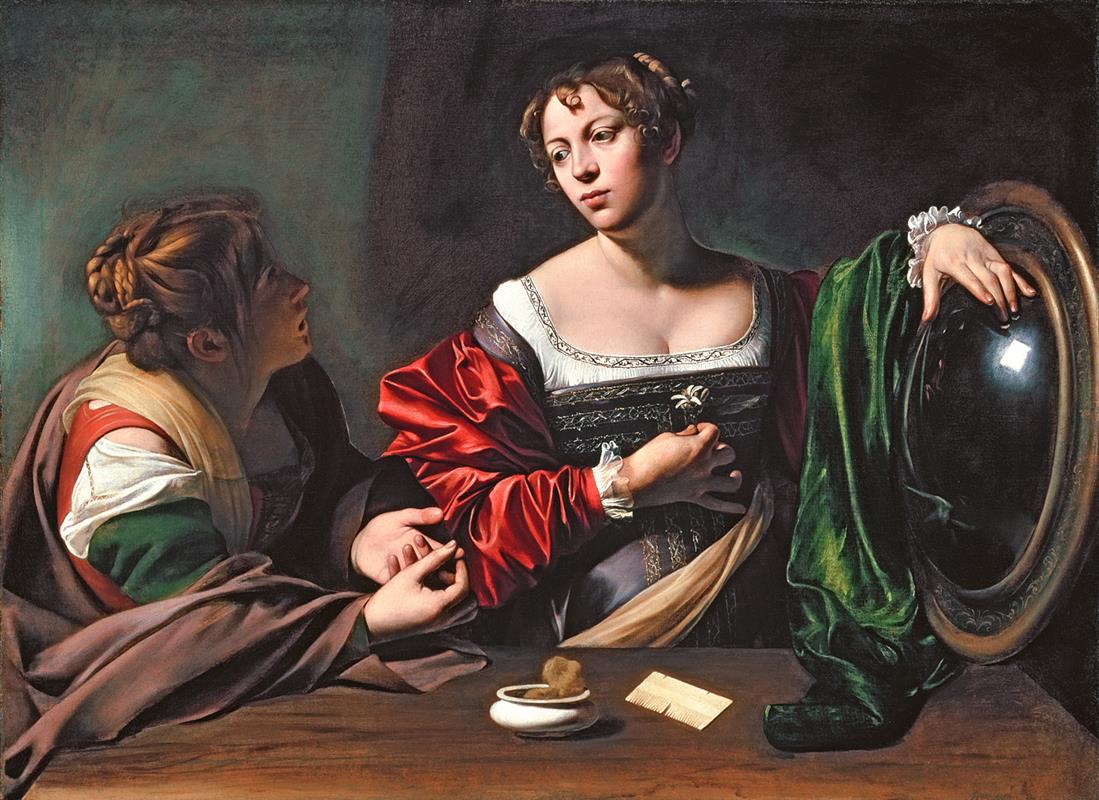
Caravaggio’s “Martha and Mary Magdalene” captures a moment of persuasion so immediate that it feels overheard. Two women sit at a table in a dim interior. On the left, Martha leans forward, counting off arguments on her fingers, her face lifted in earnest appeal. On the right, Mary Magdalene, lavishly dressed, turns away from a convex mirror and toward her sister, a slender flower caught between her fingers as if it were the last ornament she has not yet relinquished. The painting, made in 1598, transforms the biblical sisters into contemporaries—Roman women in fashionable dress—so that the scene’s drama is psychological rather than theatrical. Conversion happens not as a miracle of light from heaven but as a change of mind and heart measured in glance, posture, and touch.
Historical Context
By the late 1590s Caravaggio had found a receptive audience in Rome for his radical naturalism. The Counter-Reformation asked artists to make sacred subjects legible, moving, and morally clear; Caravaggio answered with scenes set in rooms that looked like his patrons’ rooms, peopled by figures who resembled their servants, friends, and models. “Martha and Mary Magdalene” fits this larger project: it is a small, intimate painting meant for private contemplation rather than a church altarpiece. The decision to treat the sisters as contemporary women was both practical—Caravaggio painted the life he saw—and strategic. It invited viewers to imagine that the conversion of a famous penitent could occur in any house where persuasion, patience, and grace are at work.
Subject and Iconography
The scene distills the familiar story of the two sisters into a single, decisive instant. Martha, emblem of active virtue, urges Mary to leave vanity and choose the better part. Mary, associated with worldly allure and later with penitence, turns from the circular surface of the mirror—a traditional symbol of self-regard and the fleeting pleasures of beauty. Caravaggio does not crowd the painting with emblems; he selects only a few. The mirror stands at the right margin, its convex glass a dark moon reflecting a single white highlight; a green cloth drapes over its rim with weight and splendor. On the table sit a small ceramic dish holding a sponge or pomade and a comb lying tooth-up: instruments of toilette now momentarily idle. The flower in Mary’s hand offers a restrained meditation on transience. These things speak, but softly. The painting’s real language is the exchange of looks and hands.
Composition and Dialogue
Caravaggio orchestrates the composition as a triangle of persuasion. The base is the table, close to the picture plane, its edge forming a stage lip. At left, Martha’s body and draped sleeve create a diagonal that points toward her sister’s face. At right, Mary’s torso forms the second diagonal, leaning slightly toward the mirror yet turning her head back toward Martha. Their gazes meet in a tight corridor of light that runs between them like a thread. The mirror and the green cloth act as a vertical counterweight, preventing the composition from sliding left and securing Mary’s body in place. A shallow background sustains intimacy; there is nowhere else to look but into the women’s minds.
Chiaroscuro and the Ethics of Light
Light enters from high left, striking Martha’s cheek and shoulder before falling across Mary’s chest, neck, and face. The effect is tender, not severe. Caravaggio’s chiaroscuro here clarifies moral priority without punishing the senses. The mirror’s dark eye absorbs light but returns a single star of reflection; the green drapery drinks illumination into its velvety folds; Mary’s scarlet sleeve flares as if catching the last warmth of day. Darkness gathers behind them and under their arms, cupping the figures so that every gesture reads with unusual clarity. Light informs the argument: it appears where attention should go—on the faces, the hands, the fragile flower—while vanity, represented by the mirror, recedes into a polished dusk.
Color and Textiles as Moral Temperature
Caravaggio’s palette stages the conversion as a shift in temperature. Martha wears brownish-violet and muted green—working colors that neither seduce nor proclaim—while Mary dazzles in crimson satin, black-gold bodice, and emerald drapery. Yet look at how the red sleeve folds inward, wrinkled where Martha’s reasoning has already tugged at it. The green cloth, though sumptuous, slips from the mirror like a curtain closing on a former scene. White accents—the lace at Mary’s neckline, the cuff ruffles at both wrists—cool the heat of the reds and signal the possibility of cleansing. The paint does not moralize; it registers how materials feel when priorities change: still beautiful, but suddenly heavy, less convincing as a source of joy.
Gesture and Psychological Realism
The painting’s psychological truth resides in the hands. Martha’s left hand is open, upturned, measuring out points; her right hand gathers Mary’s wrist with the gentlest insistence, not a grip so much as an anchoring. Mary’s left hand, resting at her bodice, presses the delicate flower against cloth, a tiny rite of farewell to ornament. Her right hand drapes casually over the mirror’s frame, but the relaxed posture reads now as lingering habit rather than conviction. The faces confirm this reading: Martha’s profile is bright with urgency; Mary’s three-quarter turn shows a softening mouth and eyes that look not at her sister but into thought. Caravaggio captures the minute internal shift when argument becomes self-persuasion.
The Mirror and the Vanishing Self
The convex mirror is one of the painting’s most eloquent inventions. It lies at the edge like an eclipsed sun, reflecting nothing we can read, only the white square of a window or candle far outside the frame. Traditionally, such mirrors signal pride or the fragility of appearance. Caravaggio intensifies that symbolism by denying the viewer a reflection of the women. We cannot see Mary as the mirror would show her; we see her as she is, lit and thinking. The bright highlight within the mirror becomes the last flicker of the old life—remote, already receding. Mary’s hand resting on the rim turns the object into a threshold she has not yet fully crossed, a last point of contact with habits she is willing to relinquish.
Objects on the Table
Few props in Baroque painting are so charged with meaning as Caravaggio’s humble trio: the dish, the sponge or pomade, and the comb. Their placement front and center transforms them into a low altar of everyday life. They are not demonized; they are merely paused. The sponge could cleanse as well as perfume; the comb could serve simplicity as easily as glamour. Caravaggio refrains from preaching through objects. Instead, he shows how small things enact large decisions. To push the dish away or to leave the comb untouched for a day is a moral experiment anyone can attempt. Asceticism begins in ordinary gestures.
The Language of Touch
Throughout the painting, touch mediates persuasion. Martha’s guiding fingers on Mary’s wrist enact sisterly love rather than dominance. Mary’s fingertips on the flower transmit hesitation and care. The green cloth’s palpable weight across Mary’s forearm reminds us how long she has carried the vocabulary of luxury and how new it feels to set it down. Caravaggio’s tactile emphasis—linen crispness, satin slickness, ceramic coolness—root the drama in sensation. Conversion here is not an abstract doctrine; it is a re-education of the senses so that pleasure can be received in different keys.
Spatial Stagecraft
The room is unadorned, an envelope of twilight that narrows attention to a shallow foreground stage. Caravaggio lowers the sightline so that the table commands the lower third of the canvas, making us fellow participants seated across from the sisters. The background is not a place; it is an atmosphere, a muted green-gray that tempers the strong local colors and deepens shadows. The spatial economy keeps the eye on the process of change rather than on scenic embellishment. If Caravaggio’s later altarpieces are grand theatres of revelation, this painting is a side-chapel where two voices exchange reasons until one heart turns.
Magdalene Typologies and Caravaggio’s Innovation
Painters before Caravaggio often presented Mary Magdalene as a solitary penitent with flowing hair, a skull, and a crucifix, or they staged her as a brilliant beauty luxuriously dressed before renouncing adornment. Caravaggio chooses neither stereotype. His Magdalene is neither melodramatic nor theatrically sensual. She is a thoughtful woman in fashionable clothing considering a better life at the prompting of someone who loves her. By domesticating the subject, Caravaggio brings sanctity within the reach of household experience. The locus of change is not a desert cave but a tabletop; not a weeping spectacle but a conversation.
Sisterhood and the Work of Persuasion
The painting honors the moral labor of Martha as much as the courage of Mary. Martha’s patience, familiarity, and trust in reason render the scene credible. She is not a scold; she is a sister who remembers who Mary can be. The proximity of their faces and the kindness in Martha’s hands suggest that conversion is rarely solitary. It is a social act supported by relationships, by the willingness of one person to hope generously for another. Caravaggio, who often depicts revelation as a sudden shaft of light, here shows it as slow speech punctuated by listening.
Theological Resonances Without Didacticism
Though domestic, the painting carries rich theological nuances. The turned mirror hints at renunciation of self-absorption; the flower, delicate and mortal, points to the choice of lasting goods; the crossing of hands near Mary’s heart anticipates the interiority of penitence. Yet Caravaggio refuses to emblazon these meanings in conspicuous symbols. The doctrines are embodied in ordinary behavior: an argument made kindly, a habit released, a preference altered. This restraint lets the painting function for viewers across belief systems; it reads as a profound human scene even when the doctrinal content is set aside.
Technique and Brushwork
Caravaggio’s paint handling shows confident economy. The scarlet sleeve is built from broad planes of body color loaded with lead white, then glazed to achieve satin’s paradoxical sheen—opaque in mass, luminous at the fold. Flesh is modeled with thin, translucent passages that preserve warmth under cool highlights. The green drapery descends in heavy, slow strokes whose directionality conveys velvet’s nap. The convex mirror’s perfect ellipse is a quiet feat of drawing; its glass surface is described with almost nothing—one luminous rectangle and a continuum of darkest values. Many edges are softened by penumbra, allowing forms to breathe into one another rather than sitting cut out against the ground. The result is a picture that feels both meticulously observed and spontaneously alive.
Comparisons within Caravaggio’s Oeuvre
Placed alongside “Penitent Magdalene” and “Rest on the Flight into Egypt,” both painted around the same time, this canvas reveals Caravaggio testing different registers of grace. In the solitary Magdalene, conversion is a silent interior event; in the “Flight,” rest becomes a sacrament sustained by music; here, persuasion proceeds through dialogue. The three together map Caravaggio’s conviction that sanctity can inhabit the ordinary: the tired parent, the thinking woman, the household argument. The variety of approaches underscores his broader revolution—sacred truth made visible through recognizably human behavior.
Reception and Afterlife
“Martha and Mary Magdalene” has long been admired for its psychological subtlety. Later Baroque painters learned from it how to stage moral conflict through faces and hands rather than through crowded emblematic displays. In modern times the painting has been read as a nuanced portrait of women’s agency: Martha exercises intellectual and spiritual leadership; Mary exercises the freedom to change. The canvas thus resonates across centuries not only as a religious image but as a study in how persuasion and affection can redirect a life.
How to Look
Begin at the corridor of light between the faces; let the angle of Martha’s gaze pull your eye into Mary’s. Travel down to Martha’s counting fingers and then across to the wrist she lightly steadies. Notice the flower resting at Mary’s bodice and the slight pressure of her thumb. Return to the mirror and feel how its velvety dark withdraws from significance, the bright reflection a distant square of elsewhere. Survey the table’s humble still life—the dish, the sponge, the comb—and imagine the gestures that will set them aside. Finally, step back to take in the color harmonies: the red sleeve answering the green drapery, white lace calming both, flesh tones unifying the drama with warmth. The painting will reward this looped looking; each circuit tightens the argument and clarifies Mary’s turning.
Conclusion
Caravaggio’s “Martha and Mary Magdalene” is a drama without theatrics, a conversion rendered as conversation. Everything matters—the slope of shoulders, the warmth of color, the resistant gleam of a mirror that no longer commands attention, the ordinary tools of grooming edged gently aside. In this room, persuasion is patient, and grace appears as a willingness to listen. Caravaggio gives the scene the dignity of paint so that viewers can recognize in it the texture of their own choices. The better part is chosen not by angels or thunder but by a woman thinking with her sister’s help. Few paintings honor human freedom with such tenderness.