Image source: wikiart.org
Introduction
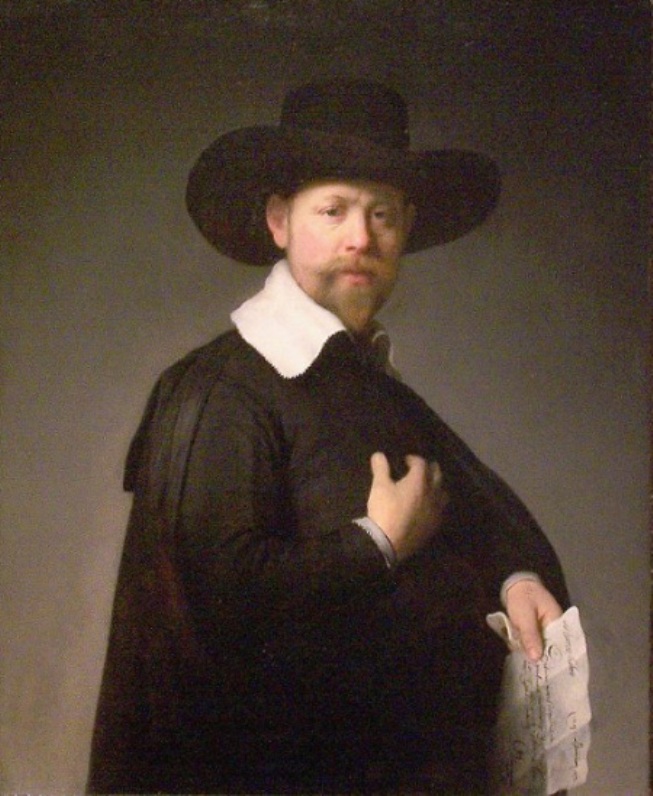
Rembrandt’s “Marten Looten” (1632) captures a prosperous Amsterdam burgher at the very moment the young painter was conquering the city’s portrait market. The sitter turns three-quarter to us in sober black, a broad-brimmed hat shadowing his brow, one hand pressed to his chest in a gesture of sincerity while the other holds a folded paper. Against a restrained gray ground and with light carefully concentrated on the face and hands, the painting reveals how status, character, and civic ideals could be distilled into a single, lucid image. It is both the likeness of a particular man and a manifesto for Rembrandt’s early Amsterdam style: polished yet intimate, decorous yet psychologically alert.
Historical Context
The portrait dates from 1632, the year Rembrandt definitively established himself in Amsterdam after leaving Leiden. The city’s merchant elites—flush with global trade and civic ambition—commissioned likenesses that balanced prosperity with Protestant reserve. Black clothing, immaculate white linen, and composed gestures were the visual language of probity. Rembrandt embraced these expectations while refining them. He softened the stark theatrical chiaroscuro of his Leiden years into a steadier, studio light and cultivated a finish that matched urban taste without sacrificing the searching observation that made his portraits distinctive. “Marten Looten” sits squarely in this moment: an urbane image that projects dignity, competence, and a quiet moral authority.
Composition and Pose
The composition is disarmingly simple. A half-length figure turns left while the head swivels back toward us, creating a subtle counter-twist that enlivens the stance. The body forms a dark, rounded mass that fills the lower right of the picture; the hat’s disc reinforces that geometry above, so that the brilliantly lit face becomes a pivot between two measured ovals of black. Rembrandt lets the background remain an unadorned gradient of warm gray, clearing a stage on which the sitter’s presence feels unforced and immediate. Nothing distracts from the human exchange of looking. The portrait is scaled to conversation, not spectacle.
The Language of the Hands
Few painters use hands as fluently as Rembrandt, and here they carry much of the meaning. The right hand—fingers relaxed, thumb curved—rests over the chest, a conventional sign of sincerity, oath-taking, or self-identification. It reads as an embodied signature: “I, Marten Looten.” The left hand holds a folded paper, its corners creased and edges slightly curled. Whether the document is a letter, an account, or a petition, its presence suggests literacy, commerce, and civic participation. The combination of hand-on-heart and paper-in-hand binds inward conviction to outward action, personal conscience to the written agreements that ordered Dutch society.
Costume and Social Signals
The sitter’s wardrobe is the grammar of Amsterdam respectability. The black doublet and cloak, likely of fine wool, signal sobriety and success without ostentation. The white collar—cut sharply and set crisply against the dark—announces cleanliness and moral discipline. The hat’s broad brim functions as a modest canopy that lowers the pictorial ceiling and frames the illuminated face. Rembrandt renders fabric with minimal rhetoric: enough sheen on a sleeve to show weave, enough depth in the cloak to create weight, but no needless ornament. The clothing reads as the uniform of a reliable citizen—precisely the image a merchant or civic official wished to project.
Light and Chiaroscuro
Light falls from the left, striking the forehead, cheek, and the slope of the nose before dissolving into half-tone along the far cheek and brim. The hands catch this same beam, creating a triangle of illumination—face and two hands—that carries the painting’s emotional temperature. Rembrandt refrains from hard Caravaggesque contrasts; instead, he orchestrates a calm, clear hierarchy of tones. The grays of the background brighten near the head, subtly pushing the figure forward, while the blacks of hat and cloak swallow light into velvety depths that make the skin feel warm and alive. The picture feels truthful to studio light—measured, dignified, and perfectly suited to the sitter’s character.
Color and Tonal Design
Though it reads as a picture of blacks and whites, the palette is quietly rich. Warm olives and brown-violets are suspended in the ground; the blacks carry blue and umber notes that keep them breathing; the skin contains peach, rose, and a hint of gray-green that anchors the flesh in the cool ambient light. The collar is not chalk white but prismatic grays that let the tiny highlights at its serrated edge sparkle. Color in this portrait is strictly in the service of tone. It creates coherence and lifelikeness without calling attention to itself.
Face, Hair, and the Tactility of Paint
Rembrandt’s handling is comparatively smooth in 1632, but even within polish the paint remains responsive. The mustache and goatee are articulated with crisp, wiry strokes that keep their edges lively. The modeling of cheek and brow proceeds by superimposed, translucent layers, yielding believable flesh without porcelain gloss. The eyes are managed with scrupulous restraint: the whites are a warm gray, the upper lid slightly heavier than the lower, and small darting highlights animate the pupils without glare. The face is not idealized; subtle asymmetries—the gentler lift of one brow, the slight set of the mouth—allow personality to register.
Psychology and the Gaze
Much of the portrait’s power lies in the sitter’s steadiness. Looten does not perform; he attends. The gaze is frank, focused, and receptive, as if the viewer had just spoken and he is about to reply. The hand on the chest heightens this dialogic quality—part pledge, part interruption, part readiness to speak for himself. Rembrandt refuses theatrical expressions; instead he captures a human equilibrium that feels native to the sitter. It is the poise of someone used to making decisions, reading documents, and being believed.
Gesture, Identity, and Moral Self-Presentation
Dutch portraiture often doubles as ethical self-portraiture. In a society that prized probity, the way one was pictured mattered as evidence of character. The compositional grammar here—black garment, white collar, steady gaze, modest background, eloquent hands—performs that ethical function. It tells the community who Marten Looten is: a man of business and conscience, attentive to his duties, neither flamboyant nor dull. That Rembrandt can project all this without props beyond a piece of paper is testament to his ability to extract meaning from the human body’s most ordinary signals.
Space and Background
The gray ground is not empty; it is an active atmosphere. It brightens gently around the head and fades toward the corners, creating a pressure that holds the figure at precisely the right pictorial distance. The absence of architectural or still-life elements was not laziness but strategy. The sitter brings his own architecture: hat brim, collar, shoulder line, and the arc of the cloak create a built environment of cloth and light. The purified setting ensures that the story we read is the one the sitter intends—about himself, not his possessions.
The Document as Narrative Device
That small, crumpled paper is a masterstroke. It anchors the lower right quadrant, contrasts rough texture with the smoothness of the cloak, and carries a cargo of associations. It could be a business letter, a legal instrument, a guild notice, a civic petition—any of which would fit an Amsterdam merchant’s life. The specificity of the folded corners and ragged edge makes it feel real, perhaps sketched from an actual document at hand. At the same time, the content remains unreadable, which frees the viewer to project. The painting thereby becomes a portrait of a man in the act of attending to society through paperwork—the modern form of power.
Brushwork and Finish
Early Amsterdam patrons expected polish, and Rembrandt delivers without sacrificing variety. The black cloak drinks the brush, leaving soft, swallowed passages; the collar’s serrations are cut with crisp strokes; the hands show a firmer touch that catches tendons and knuckle forms; the paper is dragged with drier paint to mimic its fibers. This hierarchy of handling directs the eye: we linger on face and hands, we acknowledge the garment’s weight, we register the paper’s tactility, and we pass over everything that might distract from the sitter’s presence.
Comparisons with Contemporary Portraits
Set beside contemporary works by Thomas de Keyser, Nicolaes Eliasz Pickenoy, or Govert Flinck, “Marten Looten” reads as both aligned with and distinct from the Amsterdam mode. Like them, Rembrandt respects social codes of dress and decorum; unlike many, he compresses the composition and enriches the tonal basin so the figure seems modeled by air as much as by line. Where others may elongate or prettify, he concentrates. The result is an image that feels more physically immediate and psychologically grounded than much of the competition—a reason patrons sought him despite his youth.
The Ethics of Restraint
Everything about the picture exemplifies restraint: the limited palette, the plain ground, the controlled gestures. Yet the painting does not feel cold. Restraint here is a moral style—an aesthetics of self-command that mirrors the sitter’s ethos. Rembrandt relies on the viewer’s sensitivity to small changes of light and minute shifts of expression. The work trusts the eye and meets it halfway. In that sense, it is the perfect portrait for a society that valued sober excellence over ostentation.
Conservation, Scale, and Viewing
The painting’s success depends on the depth of its blacks and the clarity of its half-tones. When well preserved and lit, one sees a soft aura along the hat brim, a breath around the collar’s edge, and the delicate transparency of glazes in the face. The work rewards mid-range viewing—close enough to feel the paint’s tactility, far enough to let the tonal architecture lock into place. Its size encourages intimacy; it was made for domestic rooms where viewers would stand within conversational distance, exactly as the composition invites.
Meaning and Legacy
“Marten Looten” shows how portraiture can fuse likeness with a vision of civic character. It preserves the face of one man while embodying a broader ideal of the Dutch Golden Age merchant: literate, disciplined, responsive to community. For Rembrandt, it is an early declaration that the most powerful theater is the theater of a human face and two articulate hands under honest light. The picture’s continuing appeal lies in that clarity. We feel we could step forward, name ourselves, take the paper, and continue the conversation.
Conclusion
In “Marten Looten,” Rembrandt refines Amsterdam’s codes of respectable portraiture into art that still moves the eye and mind. With calibrated light, impeccably judged tones, and gestures that balance inward conviction with outward engagement, he creates an image at once socially persuasive and deeply human. The painting stands as a testament to how much can be said with how little: a hat, a collar, a paper, two hands, and a face that looks back steadily across centuries.