Image source: wikiart.org
First Impressions and the Painting’s Unusual Ease
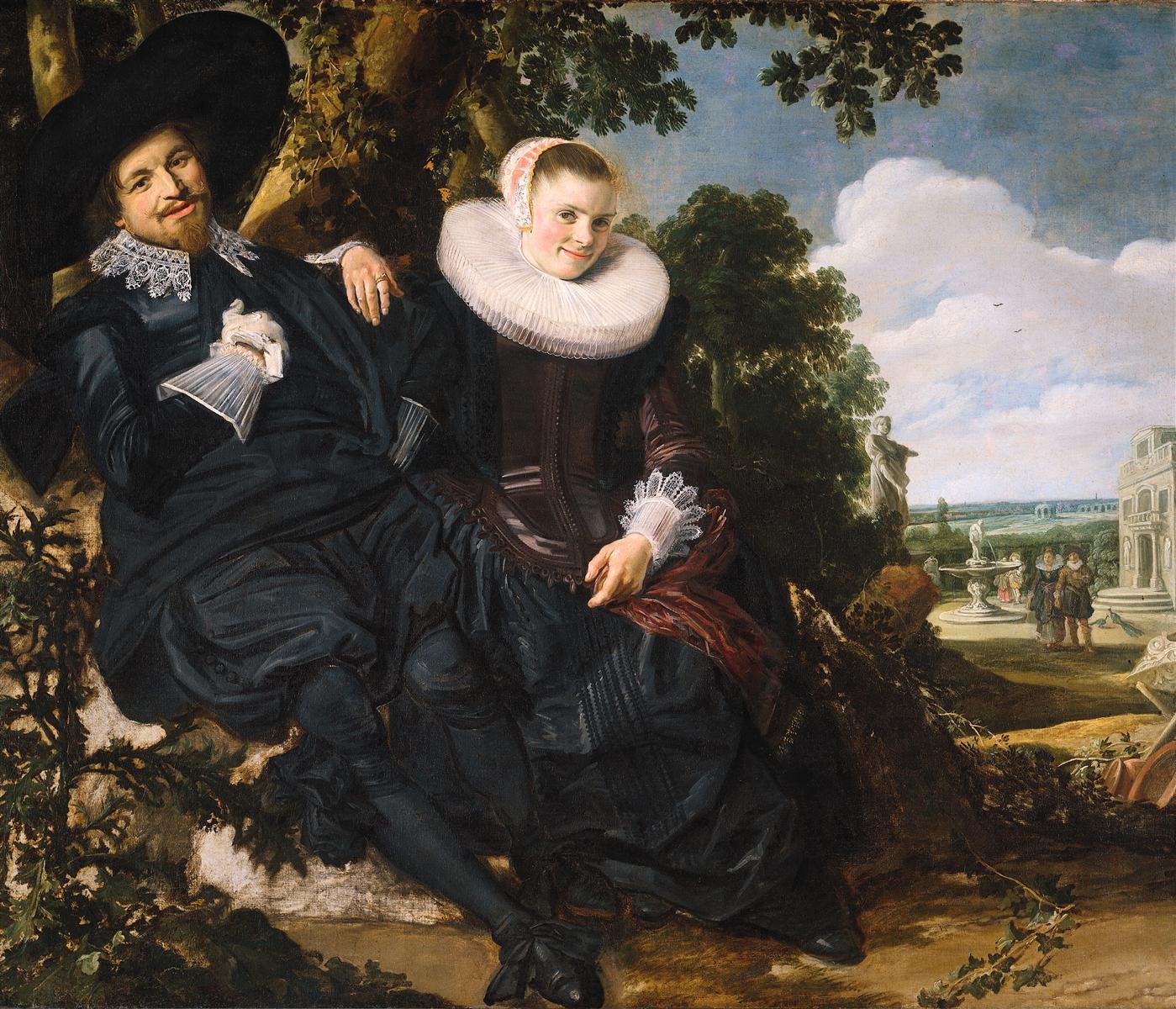
Frans Hals’s Marriage Portrait of Isaac Massa and Beatrix van der Laen (1622) immediately stands apart from many early seventeenth century double portraits because it feels relaxed, outdoors, and genuinely sociable. The couple sits beneath a tree in a lush landscape, framed by foliage and open sky. Isaac Massa reclines with a confident, almost playful ease, his broad hat and dark clothing giving him a striking silhouette. Beatrix sits close beside him, upright but not stiff, her large white ruff glowing against the darker tones of her dress. Both appear engaged with the viewer, yet their body language also suggests they are engaged with one another, sharing a private bond that the painting allows us to witness.
This is a marriage portrait, but it is not simply a statement of alliance. It is a portrait of companionship. Hals gives the couple a sense of shared presence, a believable comfort that feels modern. The scene suggests a world of prosperity and cultivated leisure, but also a world where affection and personality matter. The image becomes a celebration of social standing expressed through naturalness rather than rigid display. The couple appears as if they have stepped out of formal ceremony into a moment of ease, and Hals preserves that ease as their public face.
The Meaning of a Marriage Portrait in Dutch Culture
Marriage portraits served many purposes in the Dutch Republic. They recorded a union, displayed wealth and respectability, and affirmed the social networks that supported a household. They could also function as public declarations of stability, signaling that the couple belonged to the class of citizens whose prosperity was grounded in trade, property, and reputation. Yet even within those practical goals, portraiture offered room for nuance. A couple could present themselves as solemn and dignified, or as warm and approachable, depending on how they wished to be remembered.
Hals’s portrait leans toward warmth without sacrificing social authority. The landscape setting is significant. It places the couple in a cultivated natural world rather than an interior filled with objects. That choice can be read as a statement of taste and confidence. The couple does not need to prove wealth through a crowded display of possessions. They can present themselves through presence, clothing, and a setting that suggests access to leisure and refinement.
The portrait also aligns marriage with harmony and growth. Nature becomes an image of continuity: trees, sky, and distant gardens imply a world that extends beyond the couple, a world in which their union participates. The marriage is not isolated. It belongs to a social and moral environment that values order, prosperity, and the promise of the future.
Composition and the Choreography of Two Bodies
The composition is carefully designed to make the couple feel united while still allowing each individual to remain distinct. Isaac’s reclined posture creates a diagonal line that relaxes the scene and adds energy. Beatrix, sitting more upright, counters that diagonal with stability. This balance produces a visual metaphor for partnership. One figure introduces ease and outward confidence, the other introduces composure and poise. Together they form a complete structure.
Their closeness is crucial. Hals positions them so that the space between them feels minimal, almost like shared territory. Their bodies are separate but intimately aligned. The viewer senses that they belong together not only socially but physically, within the same orbit of comfort. Isaac’s arm drapes in a way that suggests casual possession of the space and, by extension, of the shared life they are presenting.
The tree and foliage above them frame their heads, creating a natural canopy that functions like a stage curtain. The couple becomes the central event, but the framing prevents the portrait from feeling isolated. Instead, it feels embedded, as if the environment itself participates in the image of marriage by enclosing and protecting the pair.
Isaac Massa’s Pose and the Performance of Confidence
Isaac’s posture is one of the portrait’s most distinctive features. He reclines with a confidence that borders on swagger, yet it never becomes vulgar. His broad hat amplifies his presence, and the angle of his body suggests that he is at ease in both the world and the painting. In many marriage portraits, the husband might stand formally, emphasizing authority. Here, Isaac’s authority is expressed through relaxation, as if he is so secure in his status that he does not need to pose rigidly to prove it.
His expression supports this reading. He looks outward with a faint smile, a friendly acknowledgment of the viewer. The face feels animated, sociable, and self aware. Hals gives him the charisma of someone who knows how to move through social spaces with comfort, a valuable trait in a world where reputation and networks mattered deeply.
The clothing adds to the effect. Isaac’s dark attire is rich but restrained. The dark fabric creates a strong mass, while the white collar and cuffs provide crisp accents. The restraint signals good taste and propriety, while the overall silhouette, especially the hat, gives him a theatrical presence. Hals makes him look both respectable and lively.
Beatrix van der Laen and the Elegance of Composure
Beatrix’s presence offers a different kind of strength. She sits with composure, her posture upright, her face calm, and her gaze attentive. The large white ruff around her neck is striking, almost sculptural, and it frames her face in a way that emphasizes clarity and refinement. Her expression is not exaggerated. It is poised and controlled, suggesting a woman trained in the social codes of respectability.
Yet she is not distant. There is warmth in her eyes and a subtle softness in her mouth. Hals allows her to appear approachable without undermining her dignity. This combination of restraint and warmth is a common ideal in elite portraiture of the period, but Hals makes it feel personal rather than purely conventional.
Beatrix’s clothing, darker and richly structured, supports the portrait’s theme of prosperity. Fine lace at the cuffs and carefully tailored fabric indicate wealth and attention to detail. Her figure, framed by the landscape and by Isaac’s reclining presence, becomes the stable center of the painting. She anchors the couple, not through dominance, but through calm certainty.
Landscape, Garden Imagery, and the Idea of Cultivated Life
The outdoor setting is not a generic backdrop. It feels like a carefully imagined environment that communicates cultivated leisure. Trees and foliage frame the foreground, while the distance opens into a brighter world with sky, architecture, and figures. This contrast between shaded foreground and sunlit distance creates depth, but it also creates meaning. The couple sits in a protected, intimate space, while beyond them lies a broader social world of gardens, fountains, statues, and human activity.
Such elements suggest a world shaped by taste and control. Gardens imply design, care, and cultivated order. Statues and architecture imply classical aspiration and cultural refinement. The landscape becomes an extension of the couple’s identity. They are not wild lovers hidden in nature. They are citizens who inhabit a world where nature is shaped into a scene of elegance.
The small figures in the distance contribute to the sense of scale and society. They imply that the couple belongs to a community, not an isolated idyll. The marriage is personal, but it is also public, embedded in a world of social ritual.
Clothing, Texture, and Hals’s Celebration of Material Reality
Hals was deeply attentive to the textures of clothing, and this portrait uses texture to communicate both wealth and vitality. The dark fabrics of Isaac and Beatrix absorb light, creating deep tones that convey richness. Against these dark fields, lace becomes luminous. The collars and cuffs catch light in fine, crisp patterns that suggest the intricate labor behind such garments.
The contrast between matte and sheen is subtle but important. Hals differentiates surfaces so that the clothing feels real, not symbolic. You can sense the weight of the fabric and the crispness of the lace. This realism is part of the portrait’s persuasive power. Wealth is not abstract here. It is material, embodied in textiles that require money, care, and social awareness.
Hals’s brushwork enhances this effect. He does not render every thread. He suggests texture through confident strokes, using highlights and edges to imply complex surfaces. The viewer’s eye completes the illusion. This painterly approach makes the portrait feel alive, as if the garments might shift if the couple moved.
Gesture and the Language of Relationship
The portrait’s emotional center lies in how the couple’s bodies relate. The closeness suggests intimacy, but the portrait does not rely on overt romantic symbolism. There is no dramatic embrace, no exaggerated tenderness. Instead, Hals gives us a believable companionship. Isaac’s relaxed posture and Beatrix’s composed proximity suggest that they share comfort and familiarity.
This subtlety matters. In a society where public decorum was important, especially for elite sitters, intimacy in portraiture often needed to remain coded and restrained. Hals achieves intimacy through spatial closeness, shared gaze toward the viewer, and the sense that they occupy the same protected foreground space beneath the tree. Their union is conveyed through the calm fact of being together.
Even Isaac’s relaxed lean can be read as a kind of compliment to the marriage. He appears comfortable because the world around him, including his wife, is secure. Beatrix’s steady posture suggests she participates in that security. The portrait makes marriage look like stability with warmth rather than authority with submission.
Light and the Balance Between Intimacy and Display
The lighting reinforces the painting’s dual character as both intimate scene and public portrait. The couple is in partial shade beneath the tree, which creates a sense of privacy and closeness. Yet their faces and white collars are bright enough to remain clear focal points. This balance allows Hals to suggest that we are seeing something slightly private, a relaxed moment, while still fulfilling the portrait’s requirement to present the sitters clearly and honorably.
The distant landscape is brighter, bathed in open air and light. This brightness creates contrast and depth, but it also creates a symbolic separation between the couple’s intimate world and the broader public world. The couple is presented as the foreground reality, the central identity, while the background world becomes context: society, culture, and the life that surrounds them.
The light also contributes to mood. It is not harsh or dramatic. It is warm and natural, supporting the portrait’s tone of ease. Hals avoids the severe lighting that might turn the scene into moral theater. Instead, he paints marriage as a confident, worldly partnership.
Hals’s Innovation and the Feeling of Modernity
What makes this portrait feel unusually modern is Hals’s willingness to break from rigid marital portrait conventions. The relaxed pose, the outdoor setting, and the lively expressions create an impression of authenticity. The couple looks like people rather than symbols. Hals gives them personality, and personality becomes part of their social identity.
This approach also reflects Hals’s larger artistic interest in immediacy. He often sought to capture the sense that a sitter is present in the moment, not frozen into a timeless mask. In this painting, that immediacy is expressed through Isaac’s casual posture, through the slight turn and attentiveness of Beatrix, and through the lively handling of faces and fabrics.
The portrait’s modernity is also emotional. It does not present marriage as a purely formal contract. It presents it as companionship. The couple looks like they enjoy each other’s company. That subtle joy, communicated through expression and closeness, gives the painting a warmth that transcends its historical setting.
Why the Painting Endures
Marriage Portrait of Isaac Massa and Beatrix van der Laen endures because it accomplishes something rare: it is both a public statement of status and a believable portrait of relationship. Hals offers an image of prosperity, refinement, and civic identity, but he delivers it through relaxed naturalism rather than stiff ceremony. The couple is dressed in the language of their class, yet they inhabit that language with ease, making it feel like an extension of their personalities rather than a costume.
The landscape setting deepens the portrait’s meaning by linking the couple to a world of cultivated nature and cultural aspiration. The tree’s shelter suggests intimacy, while the distant garden world suggests social breadth. The painting becomes a visual argument that marriage is both private and public, both personal bond and social foundation.
Most of all, the portrait remains unforgettable because it feels like an encounter with two living people. Isaac’s confident ease and Beatrix’s composed warmth create a dynamic that still reads clearly. Hals captures not only faces and clothing, but the subtle atmosphere of a partnership. That atmosphere is what lingers, making the painting feel less like a relic and more like a moment preserved.